The Smell of Molten Projects in the Morning

Ed Nisley's Blog: Shop notes, electronics, firmware, machinery, 3D printing, laser cuttery, and curiosities. Contents: 100% human thinking, 0% AI slop.

Author: Ed

  • Hall Effect Current Sensor: Doodles

    Hanging a Hall effect sensor on an Arduino brings up the notion of building a DC current sensor that doesn’t depend on measuring the voltage across a resistor. This would be important for a battery-powered gizmo, where not dropping voltage in a sense resistor makes more voltage available for the load as the batteries discharge.

    Pages 55-57 of that Honeywell booklet provides the outline: take a ferrite toroid with a cross-section larger than a linear Hall effect sensor’s package, cut a radial slit just barely big enough for the sensor’s thickness, wind N turns, and pass a current through the winding. Shazam! The sensor output varies linearly with the core flux, which varies linearly with the current, albeit subject to all the usual approximations.

    Some variables:

    • Ia = air gap (cm)
    • Ic = mean length of core (cm)
    • I = winding current (A)
    • Bc = flux density in core (G)
    • Ba = flux density in air gap (G)
    • μc = relative permeability of core (dimensionless)
    • N = wire turns around core (dimensionless)

    Yes, they use capital-eye for both length and current. They probably know what they’re doing. I don’t have to like it.

    Assuming a narrow gap with respect to the cross-section, Ba ≈ Bc. Assuming the core isn’t close to saturation, then Ba is proportional to current, thusly:

    Ba = (0.4 π · μc · NI)/(Ic + μc · Ia)

    I wondered how the numbers would work for a typical ferrite toroid…

    An FT50-43 toroid looks to be both the smallest ferrite core that will surround the sensor and the largest lump you’d want in a gadget. Some specs (that collection will be helpful):

    • 0.50 OD (inch) = 1.27 cm
    • 0.281 ID (inch) = 0.714 cm
    • 0.188 height (inch) = 0.478 cm
    • 0.0206 area (inch2) = 0.1232 cm2
    • 1.19 mean path length (inch) = 3.02 cm
    • μ = 850 (that’s “initial” permeability, with 2000 peak)
    • 2750 saturation flux (G) at 10 Oe
    • AL = 523 in weird units: N=√(nH/AL)

    More toroid info, including some background and inches-per-turn tables, lives there. A good guide to building the things, with more tables, is there.

    The sensors on hand seem to be 0.060 inch thick = 0.15 cm, although cutting an exact gap may be a challenge; a diamond slitting wheel in the Sherline may be needed for this operation. They claim a maximum flux density anywhere from 400 to 1000 G, depending on which datasheet extract you believe and whether the parts match their descriptions.

    Running the numbers for the higher flux density:

    1000 = (0.4 π · 850 · NI) / (3.02 + 850 · 0.15) = 8.2 · NI

    Note that the air gap dominates the denominator, which makes sense.

    Rearranging to solve for NI:

    NI = 1000 / [(0.4 π · 850) / (3.02 + 850 · 0.15)] = 1000 / 8.2 = 122

    Which means in order to have 1 A produce 1000 G at the sensor, I must cram 122 turns through that little toroid.

    The inner circumference of the toroid works out to 0.88 inch if you ignore the gap, which means a single layer requires 122/0.88 = 138 turn/inch. Consulting the enameled wire tables, that’s AWG 34 or 35. I doubt overlapping a few turns makes any difference and I’m certain I can’t wind that many perfect turns anyway, so that spool marked 32-33 AWG / 8.5 mil might actually get used.

    The Specialty Wire Box has a nearly full spool of AWG 44-½ wire (that grosses nearly half a pound and might reach NYC), but that’s just crazy talk; the stuff is 1.88 mil in diameter, almost exactly 1 RCH. There’s also a small solenoid coil wound with 4.5 mil wire (about AWG 37), still deep in the realm of craziness for winding that many turns by hand.

    Working backwards, NI varies linearly with flux density, so 400 G would require NI = 49 and only 60-ish turn/inch. That’s AWG 26 enameled wire and seems much more sensible.

    The gotcha is wire resistance: all this should offer less resistance than a sense resistor on the order of 100 mΩ. AWG 26 wire is 42 Ω/1000 ft = 42 mΩ/ft and FT-50 cores have about 0.6 inch/turn, so a 60 turn winding would be 3 ft long = 126 mΩ. The finer wires would be much much worse, so this is not a clear win despite its overwhelming geekiness.

    An op amp could boost the output by a factor of 10, reducing the winding to a dozen turns and the resistance to 13 mΩ, even if you didn’t use bigger wire. I like that a whole lot better, although the amp must remove the Hall sensor’s nominal Vcc/2 offset to get a sensible range & output for DC current, assuming unipolar current. We have control over the current, so we could turn it off, measure the op amp’s offset at 0 mA, then send the offset (as a filtered PWM output) to the op amp’s inverting input.

    A gain of 100 would give full-scale sensor output for 100 mA current, although I’d be suspicious of the overall accuracy and stability. For pretty-close measurements, like for LED current control, it might be Good Enough.

    Given the reduced number of turns, you could do a bifilar winding and then buck the main current with a sampling current. That has the benefit of reducing the core flux to zero during the measurement, so the sense amp can have huge gain and the sensor maintains a large dynamic range. At the cost of a calibrated current source, of course, but … maybe with more buck turns than sense turns?

  • Arduino Snippets: Vibrating Motor

    A small buzzer motor should come in handy for something. Perhaps alerting you to the presence of AC magnetic fields? Anyhow, driving a pager motor from one of the spare bits on the DL1414 display control shift register worked out well enough:

    Motor Driver with LED Character Display
    Motor Driver with LED Character Display

    These cute little surplus motors expect a 2.5 V supply and buzz overenthusiastically at 5 V; the 100 Ω resistor reduces the current to about 30 mA. That says the motor now runs on about 2 V and I admit picking the resistor became totally empirical, because starting even a little teeny motor requires more current than keeping it running and my first guess was far too high. The 1N4148 diode can handle a few tens of milliamps and will become inadequate for larger motors.

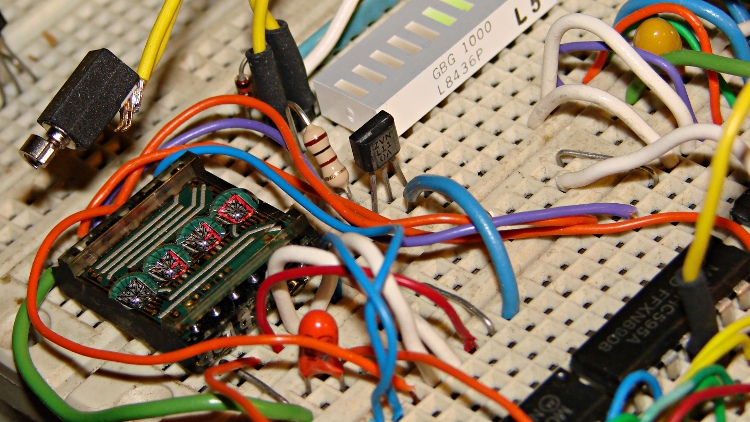
    The MOSFET driver resides between the LED displays, with the motor hanging in mid-air on a long wire and the diode hiding behind the motor terminals:

    Buzzer Motor Driver - breadboard
    Buzzer Motor Driver – breadboard

    Dropping the motor control bit into the DL1414 struct suggested that renaming the whole affair would be a Good Idea:

    union CONTROLBITS_ {
    	word ShiftWord;				// word overlay
    	struct {					// bitfield sent to the display
    		unsigned int Addr:2;
    		unsigned int NotWrite:1;
    		unsigned int Ctl3_6:4;			// unused bits
    		unsigned int Motor:1;			// buzzer motor drive
    		unsigned int Data:7;
    		unsigned int Data7:1;			// unused bit
    	} ShiftBits;
    };
    

    Controlling the motor requires changing only that single bit in the shift register:

    void MotorControl(byte State) {
    
    	ControlBits.ShiftBits.Motor = State ? 1 : 0;
    
    	shiftOut(PIN_MOSI,PIN_SCK,MSBFIRST,ControlBits.ShiftWord >> 8);
    	shiftOut(PIN_MOSI,PIN_SCK,MSBFIRST,ControlBits.ShiftWord & 0x00ff);
    	PulsePinHigh(PIN_RCKC);
    
    }
    

    We assume that the DL1414 control bits remain properly configured from the previous operation. The variable holding that struct (actually, the union wrapped around it), must have global scope so everybody uses the most recent bits. Global variables are obviously fraught with peril; hide it inside a method or other fancy construct, as you prefer.

    The demo code alternates the motor between on and off as you press Button 1 and shows the current status on the DL1414 display. I mashed up the button demo code with the LED character code, then sprinkled the motor on top:

    	Button = ReadButtons(PIN_BUTTONS);
    
    	if (PrevButton != Button) {
    		if (Button == N_BUTTONS) {
    			printf("Button %d released\n",PrevButton);
    		}
    		else {
    			printf("Button %d pressed\n",Button);
    			if (Button == B_1) {
    				ControlBits.ShiftBits.Motor = ~ControlBits.ShiftBits.Motor;
    				sprintf(LEDCharBuffer,"%";,
    					ControlBits.ShiftBits.Motor?"ON  ":"OFF ");
    				WriteLEDString(LEDCharBuffer);
    			}
    		}
    		PrevButton = Button;
    	}
    
    	if (PrevKnobCounter != KnobCounter) {
    		printf("Knob count: %d\n",KnobCounter);
    		sprintf(LEDCharBuffer,"%c%3d",
    			ControlBits.ShiftBits.Motor?'*':'_',
    			KnobCounter);
    		WriteLEDString(LEDCharBuffer);
    		PrevKnobCounter = KnobCounter;
    	}
    

    The picture shows the motor sitting idle and the DL1414 reporting OFF.

    When you turn the knob, that display shows the value of the knob click counter, with the first character indicating the motor state.

    If you ran the motor directly from an Arduino PWM output, you might get some speed control, but I think the dynamic range wouldn’t justify the effort. Buzzing in patterns of a few hundred milliseconds over the course of a second might be more distinctive; you could even do Morse code.

    The Arduino source code:

    // Quadrature knob with switch
    // Ed Nisley - KE4ANU - November 2012
    // Based on:
    // https://softsolder.com/2009/03/03/reading-a-quadrature-encoded-knob-in-double-quick-time/
    
    //----------
    // Pin assignments
    
    const byte PIN_KNOB_A = 2;			// knob A switch - must be on ext interrupt 2
    const byte PIN_KNOB_B = 4;			//  .. B switch
    const byte PIN_BUTTONS = A5;		//  .. push-close momentary switch
    
    const byte PIN_MOSI = 8;			// data to shift reg
    const byte PIN_SCK  = 6;			// shift clock to shift reg
    const byte PIN_RCKB  = 7;			// latch clock for LED Bargraph
    const byte PIN_RCKC  = 12;			// latch clock for LED character display
    
    const byte PIN_SYNC = 13;			// scope sync
    
    //----------
    // Constants
    
    const int UPDATEMS = 10;				// update LEDs only this many ms apart
    
    #define TCCRxB 0x02						// Timer prescaler
    
    enum KNOB_STATES {KNOB_CLICK_0,KNOB_CLICK_1};
    
    enum BUTTONS {SW_KNOB, B_1, B_2, B_3, B_4, N_BUTTONS};
    
    #define LED_SIZE		4				// chars per LED
    #define LED_DISPLAYS	1				// number of displays
    #define LED_CHARS		(LED_DISPLAYS * LED_SIZE)
    
    union CONTROLBITS_ {
    	word ShiftWord;				// word overlay
    	struct {					// bitfield sent to the display
    		unsigned int Addr:2;
    		unsigned int NotWrite:1;
    		unsigned int Ctl3_6:4;			// unused bits
    		unsigned int Motor:1;			// buzzer motor drive
    		unsigned int Data:7;
    		unsigned int Data7:1;			// unused bit
    	} ShiftBits;
    };
    
    
    //----------
    // Globals
    
    volatile char KnobCounter = 0;
    volatile char KnobState;
    
    char PrevKnobCounter = 0;
    
    byte Button, PrevButton;
    
    // ButtonThreshold must have N_BUTTONS elements, last = 1024
    
    word ButtonThreshold[] = {265/2, (475+265)/2, (658+475)/2, (834+658)/2, (1023+834)/2, 1024};
    
    union CONTROLBITS_ ControlBits;
    
    char LEDCharBuffer[LED_CHARS + 1] = "HELO";		// raw char buffer, can be used as a string
    
    unsigned long MillisNow;
    unsigned long MillisThen;
    
    //-- Helper routine for printf()
    
    int s_putc(char c, FILE *t) {
      Serial.write(c);
    }
    
    //-- Pulse selected pin high
    
    void PulsePinHigh(byte PinID) {
    	digitalWrite(PinID,HIGH);
    	digitalWrite(PinID,LOW);
    }
    
    //-- Write single char to DL1414, other control bits as defined
    
    void WriteLEDChar(char Char,char CharID) {
    
    	ControlBits.ShiftBits.Data = Char & 0x7F;
    	ControlBits.ShiftBits.Addr = ~CharID & 0x03;		// reverse order of chars
    
    	ControlBits.ShiftBits.NotWrite = 1;				// set up data and address
    
    	shiftOut(PIN_MOSI,PIN_SCK,MSBFIRST,ControlBits.ShiftWord >> 8);
    	shiftOut(PIN_MOSI,PIN_SCK,MSBFIRST,ControlBits.ShiftWord & 0x00ff);
    	PulsePinHigh(PIN_RCKC);
    
    	//	delay(1000);
    
    	ControlBits.ShiftBits.NotWrite = 0;				// write the character
    
    	shiftOut(PIN_MOSI,PIN_SCK,MSBFIRST,ControlBits.ShiftWord >> 8);
    	shiftOut(PIN_MOSI,PIN_SCK,MSBFIRST,ControlBits.ShiftWord & 0x00ff);
    	PulsePinHigh(PIN_RCKC);
    
    	//	delay(1000);
    
    	ControlBits.ShiftBits.NotWrite = 1;				// disable write
    
    	shiftOut(PIN_MOSI,PIN_SCK,MSBFIRST,ControlBits.ShiftWord >> 8);
    	shiftOut(PIN_MOSI,PIN_SCK,MSBFIRST,ControlBits.ShiftWord & 0x00ff);
    	PulsePinHigh(PIN_RCKC);
    
    	//	delay(1000);
    
    }
    
    void WriteLEDString(char *pString) {
    
    	for (byte i=0; (i < LED_CHARS) && *pString; ++i)
    		WriteLEDChar(*pString++,i);
    
    	return;
    }
    
    void MotorControl(byte State) {
    
    	ControlBits.ShiftBits.Motor = State ? 1 : 0;
    
    	shiftOut(PIN_MOSI,PIN_SCK,MSBFIRST,ControlBits.ShiftWord >> 8);
    	shiftOut(PIN_MOSI,PIN_SCK,MSBFIRST,ControlBits.ShiftWord & 0x00ff);
    	PulsePinHigh(PIN_RCKC);
    
    }
    
    //-- Knob interrupt handler
    
    void KnobHandler(void)
    {
    	byte Inputs;
    	Inputs = digitalRead(PIN_KNOB_B) << 1 | digitalRead(PIN_KNOB_A);  // align raw inputs
    //	Inputs ^= 0x02;                             // fix direction
    
    	switch (KnobState << 2 | Inputs) {
    	case 0x00 : 				// 0 00 - glitch
            break;
    	case 0x01 : 				 // 0 01 - UP to 1
            KnobCounter++;
    		KnobState = KNOB_CLICK_1;
    		break;
    	case 0x03 : 				 // 0 11 - DOWN to 1
            KnobCounter--;
    		KnobState = KNOB_CLICK_1;
    		break;
    	case 0x02 : 				 // 0 10 - glitch
            break;
    	case 0x04 : 				 // 1 00 - DOWN to 0
            KnobCounter--;
    		KnobState = KNOB_CLICK_0;
    		break;
    	case 0x05 : 				 // 1 01 - glitch
            break;
    	case 0x07 : 				 // 1 11 - glitch
            break;
    	case 0x06 : 				 // 1 10 - UP to 0
            KnobCounter++;
    		KnobState = KNOB_CLICK_0;
    		break;
    	default :  					// something is broken!
            KnobCounter = 0;
    		KnobState = KNOB_CLICK_0;
    	}
    }
    
    
    //-- Read and decipher analog switch inputs
    //		returns N_BUTTONS if no buttons pressed
    
    byte ReadButtons(int PinNumber) {
    
    word RawButton;
    byte ButtonNum;
    
    	RawButton = analogRead(PinNumber);
    
    //	printf("RawButton: %d ",RawButton);
    
    	for (ButtonNum = 0; ButtonNum <= N_BUTTONS; ButtonNum++){
    //		printf(" (%d:%d)",ButtonNum,ButtonThreshold[ButtonNum]);
    		if (RawButton < ButtonThreshold[ButtonNum])
    			break;
    	}
    
    //	printf(" ButtonNum %d\n",ButtonNum);
    
    	return ButtonNum;
    
    }
    
    //------------------
    // Set things up
    
    void setup() {
    	pinMode(PIN_SYNC,OUTPUT);
    	digitalWrite(PIN_SYNC,LOW);	// show we arrived
    
    //	TCCR1B = TCCRxB;					// set frequency for PWM 9 & 10
    //	TCCR2B = TCCRxB;					// set frequency for PWM 3 & 11
    
    	pinMode(PIN_KNOB_B,INPUT_PULLUP);
    	pinMode(PIN_KNOB_A,INPUT_PULLUP);
    
    	pinMode(PIN_MOSI,OUTPUT);
    	digitalWrite(PIN_MOSI,LOW);
    
    	pinMode(PIN_SCK,OUTPUT);
    	digitalWrite(PIN_SCK,LOW);
    
    	pinMode(PIN_RCKB,OUTPUT);
    	digitalWrite(PIN_RCKB,LOW);
    
    	pinMode(PIN_RCKC,OUTPUT);
    	digitalWrite(PIN_RCKB,LOW);
    
    	KnobState = digitalRead(PIN_KNOB_A);
    	Button = PrevButton = ReadButtons(PIN_BUTTONS);
    
    	attachInterrupt((PIN_KNOB_A - 2),KnobHandler,CHANGE);
    
    	Serial.begin(9600);
    	fdevopen(&s_putc,0);				// set up serial output for printf()
    
    	printf("Motor, knob, and buttons\r\nEd Nisley - KE4ZNU - December 2012\r\n");
    
    	ControlBits.ShiftWord = 0x0000;
    	WriteLEDString(LEDCharBuffer);
    
    	delay(1000);
    
    	MillisThen = millis();
    
    }
    
    //------------------
    // Run the test loop
    
    void loop() {
    
    	MillisNow = millis();
    
    	if ((MillisNow - MillisThen) > UPDATEMS) {
    
    		digitalWrite(PIN_SYNC,HIGH);
    
    		Button = ReadButtons(PIN_BUTTONS);
    
    		if (PrevButton != Button) {
    			if (Button == N_BUTTONS) {
    				printf("Button %d released\n",PrevButton);
    			}
    			else {
    				printf("Button %d pressed\n",Button);
    				if (Button == B_1) {
    					ControlBits.ShiftBits.Motor = ~ControlBits.ShiftBits.Motor;
    					sprintf(LEDCharBuffer,"%s",
    						ControlBits.ShiftBits.Motor?"ON  ":"OFF ");
    					WriteLEDString(LEDCharBuffer);
    				}
    			}
    			PrevButton = Button;
    		}
    
    		if (PrevKnobCounter != KnobCounter) {
    			printf("Knob count: %d\n",KnobCounter);
    			sprintf(LEDCharBuffer,"%c%3d",
    					ControlBits.ShiftBits.Motor?'*':'_',
    					KnobCounter);
    			WriteLEDString(LEDCharBuffer);
    			PrevKnobCounter = KnobCounter;
    		}
    
    		digitalWrite(PIN_SYNC,LOW);
    
    		MillisThen = MillisNow;
    	}
    }
    
  • Samsung VAC-9048R Vacuum Cleaner: Floor Brush Rollers

    The hard-floor brush for our old Samsung VAC-9048R vacuum cleaner began scratching the hardwood floor, which called for some investigation & repair. The Fine Manual doesn’t even mention the hard floor brush, so it’s obvious I’m on my own (as is usually the case). Believe it or not, we actually discussed buying a vacuum cleaner, but the new ones have poor reviews, bulky & awkward plastic widgets on the handle, or suffer from other glaringly obvious faults; although this one is aging poorly, it’s at least workable. Plus, I bought a lifetime supply of bags when it was new and it’s not dead yet.

    So, we begin…

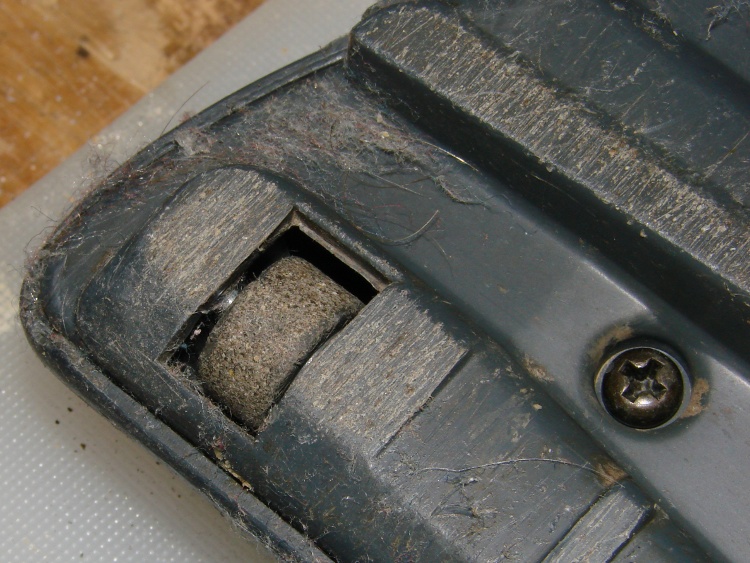
    The rollers that used to support the front of the brush have worn down, allowing the bottom cover to erode on the floor. The right side ran through something sticky in the recent past:

    Samsung 9048 - worn roller - right
    Samsung 9048 – worn roller – right

    The left side may not be sticky, but it’s in no better shape:

    Samsung 9048 - worn roller - left
    Samsung 9048 – worn roller – left

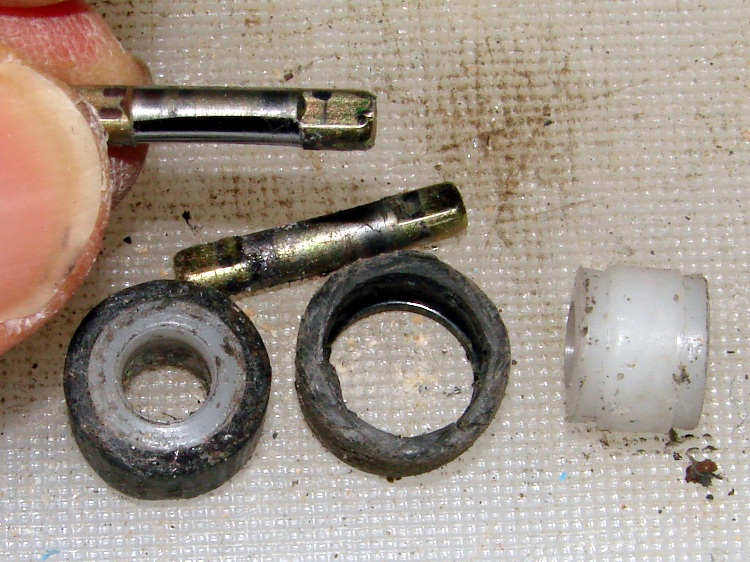
    Remove the two obvious screws, pry the front edge up, and the whole cover plate pops off to reveal the two rollers. They pull straight out of the shaft support brackets molded into the top frame. Even their metal shafts show grievous wear:

    Samsung 9048 - worn roller parts
    Samsung 9048 – worn roller parts

    The rollers consist of a hard plastic hub supporting a flexible rubbery tire, turning on a 3 mm steel shaft that’s worn on one side (which was downward, of course). The central holes in the rollers probably used to fit the shafts, but they’re now worn to 4 mm ID. The tires were probably a lot larger in diameter, too, back when they were new.

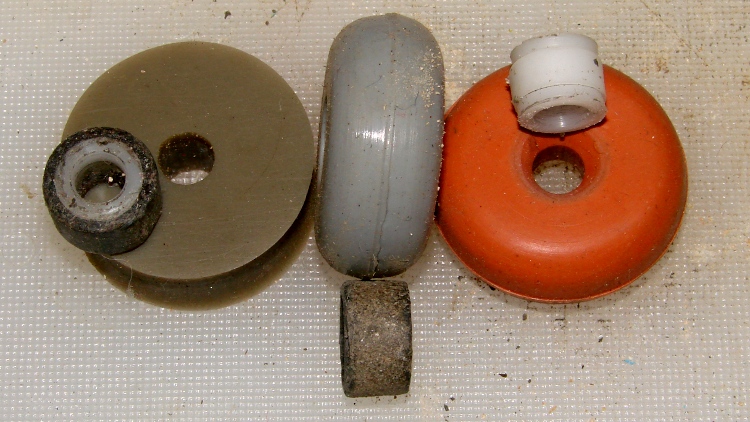
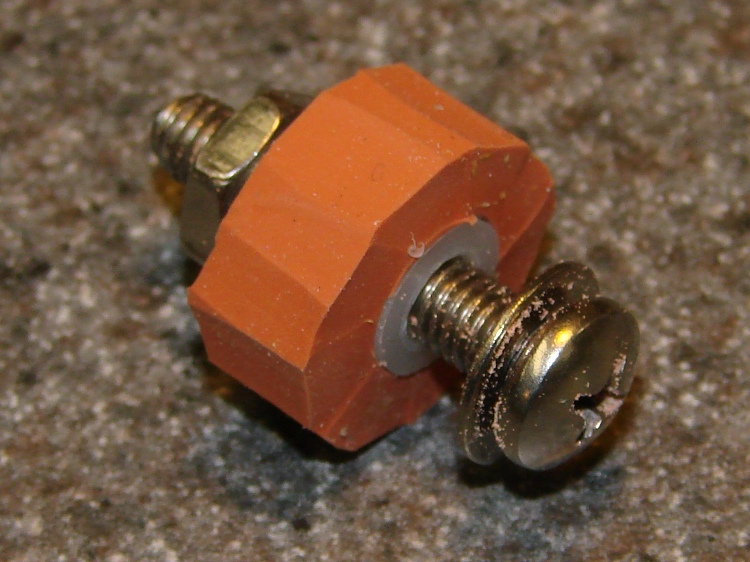
    A bit of rummaging in the Basement Laboratory Warehouse Wing produced a bag of vibration isolation bushings that had about the right consistency to become tires:

    Samsung 9048 - rollers and surplus vibration isolation bushings
    Samsung 9048 – rollers and surplus vibration isolation bushings

    They’re much larger than necessary, but are now, shall we say, fully depreciated and ready for a new, if somewhat downsized, lifestyle.

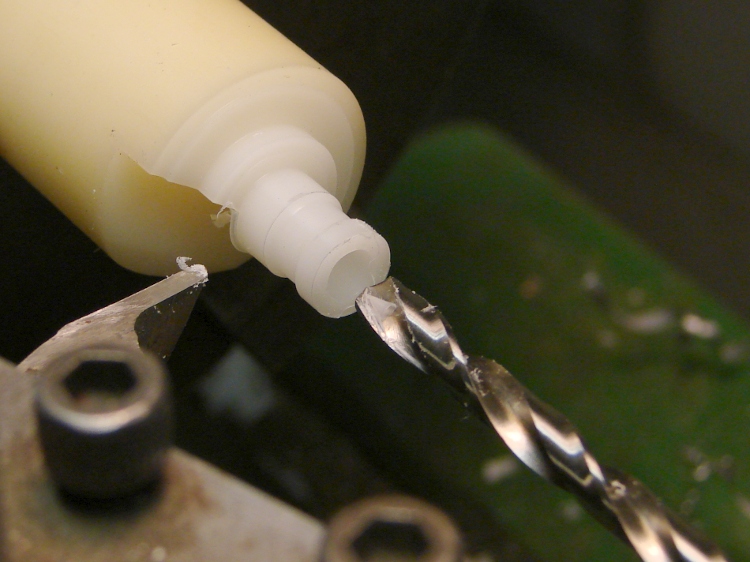
    Unfortunately, they don’t fit onto the existing hubs, so I can’t use the hubs as a template. Fortunately, I have a lathe and some random nylon stock (with crosswise notches that didn’t pose much of a problem):

    Samsun 9048 - turning roller hub
    Samsun 9048 – turning roller hub

    I came to my senses before converting this into a 3D printer project. If I had to make more than two hubs, it’d be a good idea to solid-model and print them, even if they’re just barely large enough to allow solid infill:

    Samsun 9048 - finished roller hub
    Samsun 9048 – finished roller hub

    I’d go for a 3 mm ID to increase the wall width; these have a 4 mm ID to fit the brass bushings described below. There’s no significant overhang and they’d print with no problems. Maybe next time?

    The isolation bushings cut easily with a sharp razor knife, so I pared them down to a bit over what I estimated to be the finished roller OD and width:

    Samsung 9048 - roller tire before grinding
    Samsung 9048 – roller tire before grinding

    The 10-32 screw in that shiny new hub serves as an arbor in the lathe, where I held a Dremel tool with a sanding drum down on the compound rest, ran the lathe at its slowest back-gear speed, and sanded the bushing down to what seemed to be the right OD for the tire:

    Samsung 9048 - grinding roller tire
    Samsung 9048 – grinding roller tire

    The white snout in front leads to a shopvac that caught most of the dust. The front of the lathe chuck shows it wasn’t perfectly effective and I should have worn a dust mask; my glasses didn’t collect much dust, so maybe my lungs didn’t, either.

    A trial fit in the floor brush body showed that this one was slightly too large and the sides needed tapering. The inside view:

    Samsung 9048 - ground roller before side trim
    Samsung 9048 – ground roller before side trim

    The outside view, with the cover just slightly unable to snap closed:

    Samsung 9048 - slightly oversize roller in place
    Samsung 9048 – slightly oversize roller in place

    Grinding a bit more off produced a pair of 15.5 mm OD tires which fit nicely. Some careful razor knife work smoothed and tapered the sides:

    Samsung 9048 - finished rollers
    Samsung 9048 – finished rollers

    Brass tubes (from the stash of cutoffs) compensate for the flat on the severely worn steel shafts; a fix that turned out to be much easier than building new shafts:

    Samsung 9048 - roller shaft bushing hub
    Samsung 9048 – roller shaft bushing hub

    Then reassemble in reverse order and it’s all good!

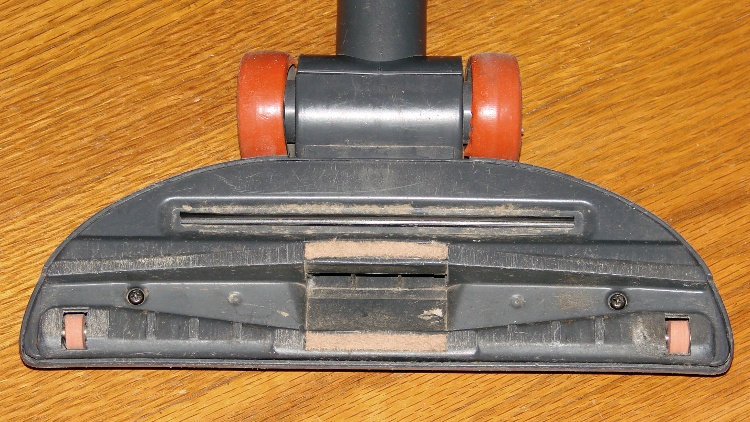
    I wrapped a layer of silicone tape around the large and slightly worn hard-plastic rear tires, even though I’m sure that won’t last very long at all:

    Samsung 9048 - repaired hard floor brush - bottom
    Samsung 9048 – repaired hard floor brush – bottom

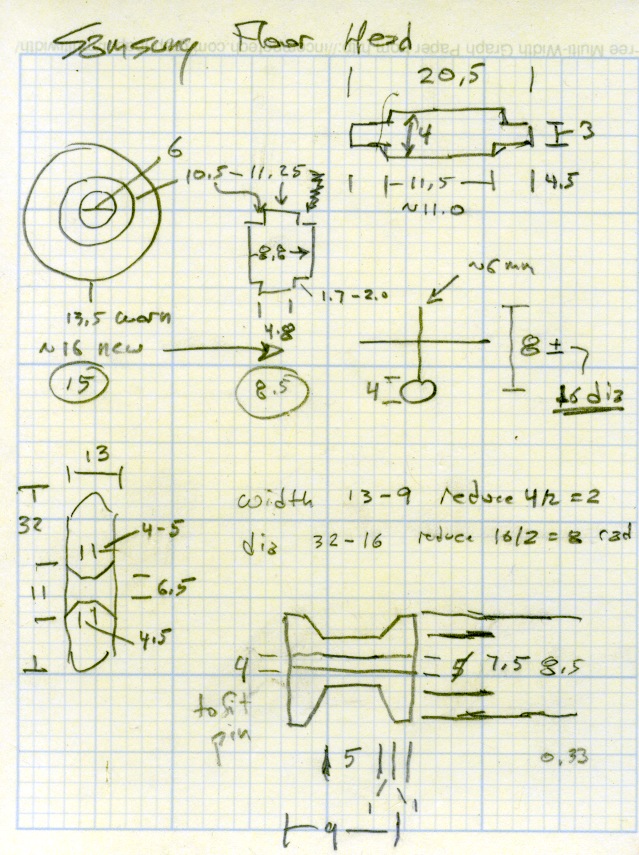
    The shop doodle giving all the sizes:

    Samsung 9048 - Roller dimension doodles
    Samsung 9048 – Roller dimension doodles

    Now, if that doesn’t count as a gonzo repair, I don’t know what would… [grin]

  • Monthly Picture: Laboratory Study of the Crayfish

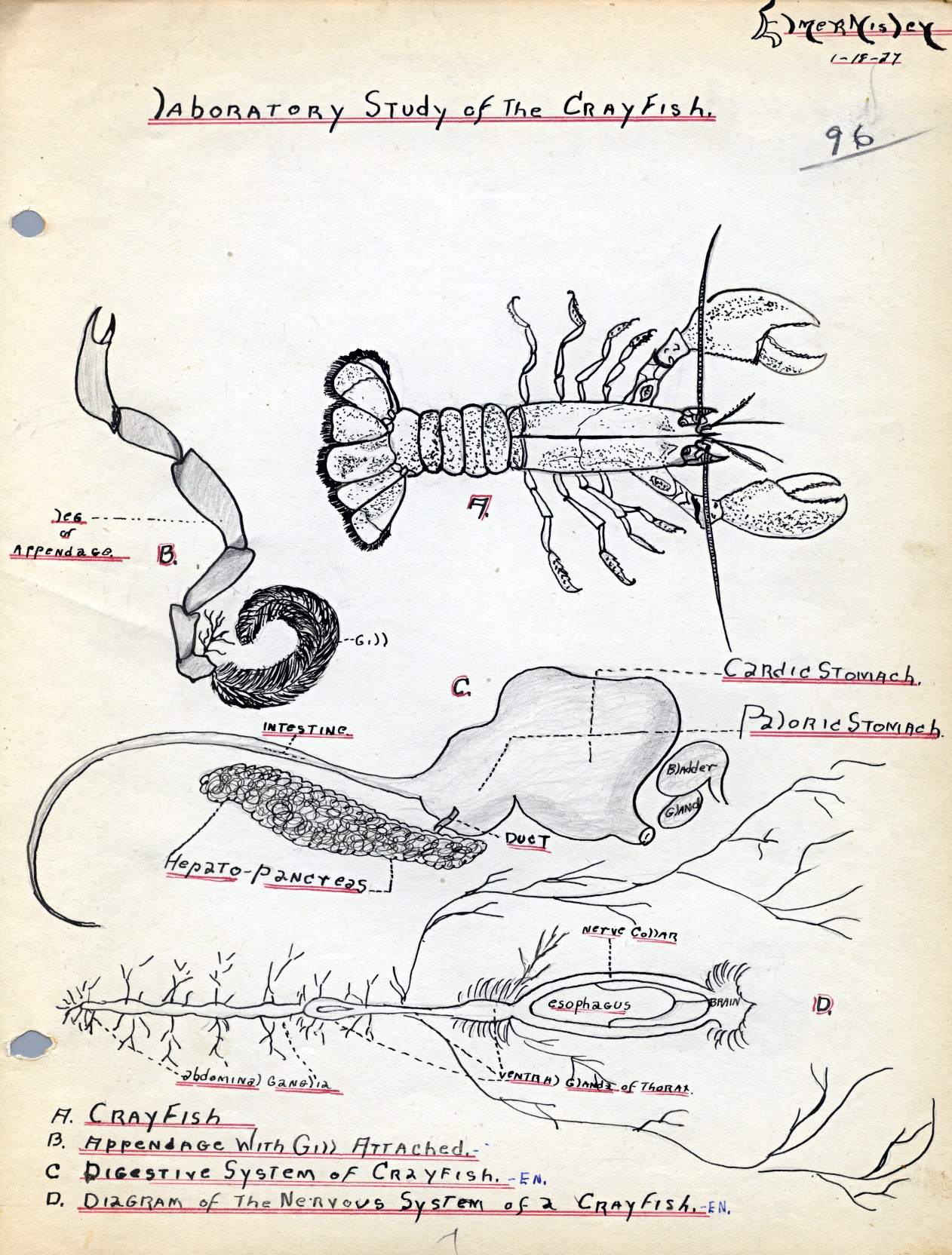
    My father obviously devoted considerable time to drawing the gills on this critter in his Sophomore Biology Notebook:

    Laboratory Study of the Crayfish
    Laboratory Study of the Crayfish

    The stomach and nervous system seem sufficiently stylized that they’re not drawn from a specimen; I’m pretty sure a real crayfish doesn’t come apart quite so neatly.

    Our Larval Engineer reports that the lab sessions for her second quarter of Anatomy and Physiology will involve dissecting sheep hearts and eyeballs (which arrive in plastic buckets festooned with hazmat stickers for the preservative). She regards this as more than making up for having to sit through A&P lectures and memorizing all those bones & muscles. Must be another generation-skipping trait, is all I can say…

  • Arduino Snippets: Analog Button Input

    Reading more than a few pushbuttons requires multiplexing, with a parallel-in shift register similar to the old 74LS166 being popular (and supported by the shiftIn() function). You can also use an Arduino analog input to multiplex the buttons, at the cost of a resistor string that probably draws more current and costs more than a logic IC:

    Knob and Buttons
    Knob and Buttons

    The switches produce voltages at the analog input which are not the evenly spaced 1 V increments you might expect: the 10 kΩ pullup appears in parallel with the sum of all the resistors above the closed switch, so the voltages come out a bit higher. The notation to the right of each switch indicates the voltage and equivalent ADC value, assuming a 5.0 V AVREF that won’t be quite right for your circuit. The analog input spec recommends less than 10 kΩ source resistance, but you could probably go much higher without any problem; the ADC output value need not be particularly accurate.

    If you happen to have a SIP resistor pack containing five separate resistors (not the usual nine resistors in a 10 lead SIP), then the circuitry doesn’t amount to much:

    Knob and Buttons - breadboard
    Knob and Buttons – breadboard

    It’s sitting in front of the ZNVL110A MOSFETs driving the RGB LED strip light. Those flat blue surplus buttons came in pairs pre-configured with wire leads and just begged to get out of the heap for this occasion. The encoder knob remains as before, with its shaft push-on momentary switch still going directly to analog input A5. The new button circuitry connects to that switch lead, ungainly though it may appear, with the gray wire bringing VCC from the cluster of sensor inputs.

    To simplify reading the buttons, build an array of threshold voltages about halfway between the calculated switch voltages:

    enum BUTTONS {SW_KNOB, B_1, B_2, B_3, B_4, N_BUTTONS};
    word ButtonThreshold[] = {265/2, (475+265)/2, (658+475)/2, (834+658)/2, (1023+834)/2, 1024};
    

    You could do the circuit calculation and VCC calibration in there, too, but those widely spaced increments don’t pose much of a problem. The table must include an end marker of 1024, greater than any possible analog input.

    Then you read the button input voltage and walk upward through the table until the value falls below a threshold, a process I find much cleaner and easier than a pile of conditionals sprinkled with fiddly constants.

    byte ReadButtons(byte PinNumber) {
    
    word RawButton;
    byte ButtonNum;
    
    	RawButton = analogRead(PinNumber);
    
    	for (ButtonNum = 0; ButtonNum <= N_BUTTONS; ButtonNum++){
    		if (RawButton < ButtonThreshold[ButtonNum])
    			break;
    	}
    
    	return ButtonNum;
    }
    

    As long as the button stays down, that function returns its ID number. You can detect both edges of a button press:

    	Button = ReadButtons(PIN_BUTTONS);
    	if (PrevButton != Button) {
    		if (Button == N_BUTTONS) {
    			printf("Button %d released\n",PrevButton);
    		}
    		else
    			printf("Button %d pressed\n",Button);
    		PrevButton = Button;
    	}
    

    The demo code produces results like this:

    Ed Nisley - KE4ZNU - December 2012
    Knob encoder and buttons
    Ed Nisley - KE4ZNU - December 2012
    Knob count: 2
    Knob count: 3
    Knob count: 4
    Knob count: 3
    Knob count: 2
    Knob count: 1
    Knob count: 0
    Knob count: 2
    Knob count: 4
    Knob count: 5
    Knob count: 6
    Knob count: 7
    Knob count: 8
    Knob count: 11
    Knob count: 15
    Knob count: 16
    Knob count: 17
    Button 0 pressed
    Button 0 released
    Button 1 pressed
    Button 1 released
    Button 2 pressed
    Button 2 released
    Button 3 pressed
    Button 3 released
    Button 4 pressed
    Button 4 released
    Button 2 pressed
    Button 2 released
    

    This scheme works for a single button pressed at a time, which is generally how you use discrete buttons. It’s not appropriate for keyboards or multi-axis joystick button arrays, which you could multiplex using resistors that produce accurate binary steps, but that’s fraught with peril and error.

    As with all non-interrupt-driven buttons, you must poll the button input at a reasonable rate to have a responsive UI. Non-blocking loop() code will be your friend.

    It made sense to exercise the new buttons in the encoder knob demo code, so this will look familiar…

    The Arduino source code:

    // Quadrature knob with switch
    // Ed Nisley - KE4ANU - November 2012
    // Based on:
    // https://softsolder.com/2009/03/03/reading-a-quadrature-encoded-knob-in-double-quick-time/
    
    //----------
    // Pin assignments
    
    const byte PIN_KNOB_A = 2;			// knob A switch - must be on ext interrupt 2
    const byte PIN_KNOB_B = 4;			//  .. B switch
    const byte PIN_BUTTONS = A5;		//  .. push-close momentary switch
    
    const byte PIN_SYNC = 13;			// scope sync
    
    //----------
    // Constants
    
    const int UPDATEMS = 10;				// update LEDs only this many ms apart
    
    #define TCCRxB 0x02						// Timer prescaler
    
    enum KNOB_STATES {KNOB_CLICK_0,KNOB_CLICK_1};
    
    enum BUTTONS {SW_KNOB, B_1, B_2, B_3, B_4, N_BUTTONS};
    
    //----------
    // Globals
    
    volatile char KnobCounter = 0;
    volatile char KnobState;
    
    char PrevKnobCounter = 0;
    
    byte Button, PrevButton;
    
    // ButtonThreshold must have N_BUTTONS elements, last = 1024
    
    word ButtonThreshold[] = {265/2, (475+265)/2, (658+475)/2, (834+658)/2, (1023+834)/2, 1024};
    
    unsigned long MillisNow;
    unsigned long MillisThen;
    
    //-- Helper routine for printf()
    
    int s_putc(char c, FILE *t) {
      Serial.write(c);
    }
    
    //-- Knob interrupt handler
    
    void KnobHandler(void)
    {
    	byte Inputs;
    	Inputs = digitalRead(PIN_KNOB_B) << 1 | digitalRead(PIN_KNOB_A);  // align raw inputs
    //	Inputs ^= 0x02;                             // fix direction
    
    	switch (KnobState << 2 | Inputs) {
    	case 0x00 : 				// 0 00 - glitch
            break;
    	case 0x01 : 				 // 0 01 - UP to 1
            KnobCounter++;
    		KnobState = KNOB_CLICK_1;
    		break;
    	case 0x03 : 				 // 0 11 - DOWN to 1
            KnobCounter--;
    		KnobState = KNOB_CLICK_1;
    		break;
    	case 0x02 : 				 // 0 10 - glitch
            break;
    	case 0x04 : 				 // 1 00 - DOWN to 0
            KnobCounter--;
    		KnobState = KNOB_CLICK_0;
    		break;
    	case 0x05 : 				 // 1 01 - glitch
            break;
    	case 0x07 : 				 // 1 11 - glitch
            break;
    	case 0x06 : 				 // 1 10 - UP to 0
            KnobCounter++;
    		KnobState = KNOB_CLICK_0;
    		break;
    	default :  					// something is broken!
            KnobCounter = 0;
    		KnobState = KNOB_CLICK_0;
    	}
    }
    
    //-- Read and decipher analog switch inputs
    //		returns N_BUTTONS if no buttons pressed
    
    byte ReadButtons(int PinNumber) {
    
    word RawButton;
    byte ButtonNum;
    
    	RawButton = analogRead(PinNumber);
    
    //	printf("RawButton: %d ",RawButton);
    
    	for (ButtonNum = 0; ButtonNum <= N_BUTTONS; ButtonNum++){
    //		printf(" (%d:%d)",ButtonNum,ButtonThreshold[ButtonNum]);
    		if (RawButton < ButtonThreshold[ButtonNum])
    			break;
    	}
    
    //	printf(" ButtonNum %d\n",ButtonNum);
    
    	return ButtonNum;
    
    }
    
    //------------------
    // Set things up
    
    void setup() {
    	pinMode(PIN_SYNC,OUTPUT);
    	digitalWrite(PIN_SYNC,LOW);	// show we arrived
    
    //	TCCR1B = TCCRxB;					// set frequency for PWM 9 & 10
    //	TCCR2B = TCCRxB;					// set frequency for PWM 3 & 11
    
    	pinMode(PIN_KNOB_B,INPUT_PULLUP);
    	pinMode(PIN_KNOB_A,INPUT_PULLUP);
    
    	KnobState = digitalRead(PIN_KNOB_A);
    	Button = PrevButton = ReadButtons(PIN_BUTTONS);
    
    	attachInterrupt((PIN_KNOB_A - 2),KnobHandler,CHANGE);
    
    	Serial.begin(9600);
    	fdevopen(&s_putc,0);				// set up serial output for printf()
    
    	printf("Knob encoder and buttons\r\nEd Nisley - KE4ZNU - December 2012\r\n");
    
    	MillisThen = millis();
    
    }
    
    //------------------
    // Run the test loop
    
    void loop() {
    
    	MillisNow = millis();
    
    	if ((MillisNow - MillisThen) < UPDATEMS) {
    
    		digitalWrite(PIN_SYNC,HIGH);
    
    		Button = ReadButtons(PIN_BUTTONS);
    		if (PrevButton != Button) {
    			if (Button == N_BUTTONS) {
    				printf("Button %d released\n",PrevButton);
    			}
    			else
    				printf("Button %d pressed\n",Button);
    			PrevButton = Button;
    		}
    
    		if (PrevKnobCounter != KnobCounter) {
    			printf("Knob count: %d\n",KnobCounter);
    			PrevKnobCounter = KnobCounter;
    		}
    
    		digitalWrite(PIN_SYNC,LOW);
    
    		MillisThen = MillisNow;
    	}
    
    }
    
  • Arduino Snippets: Bare-naked Passive IR Sensor

    The heap disgorged some bare passive IR / pyroelectric elements that, IIRC, came from Electronic Goldmine, described as SDA02-54 dual-element sensors. A bit of rummaging and a glance at Nicera’s Fine Datasheet says that can’t possibly be true: the SDA02-54 has a square window. The nearby SSAC10-11, however, has a round window and looks like a better match. Incidentally, that means the Fresnel IR lenses on the Electronic Goldmine site probably won’t work as intended, because the lenses typically produce multiple beams intended to focus on dual (or quad) elements. I suppose you could convert one Fresnel pattern into an IR telescope…

    For my present purpose, however, a bare single-element pyroelectric detector will work just fine: the general idea is to detect things out there in front, not make decisions about what’s going on.

    Under normal circumstances, where you want decisions, you’d use a module (from, say, Sparkfun) with a passive IR sensor in front of some circuitry that conditions the output and produces yes-no detections. LadyAda has a good description of the workings thereof & interfacings thereto, including a link to the BISS0001 analog chip that does most of the heavy lifting in low-end PIR modules.

    What’s the fun in that?

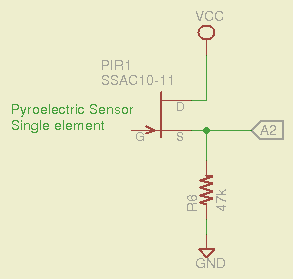
    A pyroelectric detector is basically a high-impedance element buffered by a JFET, with its drain and source terminals brought out. IR radiation produces a bias change on the gate, which connects to the (grounded) case through a very very very large-value resistor. That means we can build what amounts to a source follower around the JFET (with all the PIR stuff to the left of the gate not shown):

    Passive IR Sensor
    Passive IR Sensor

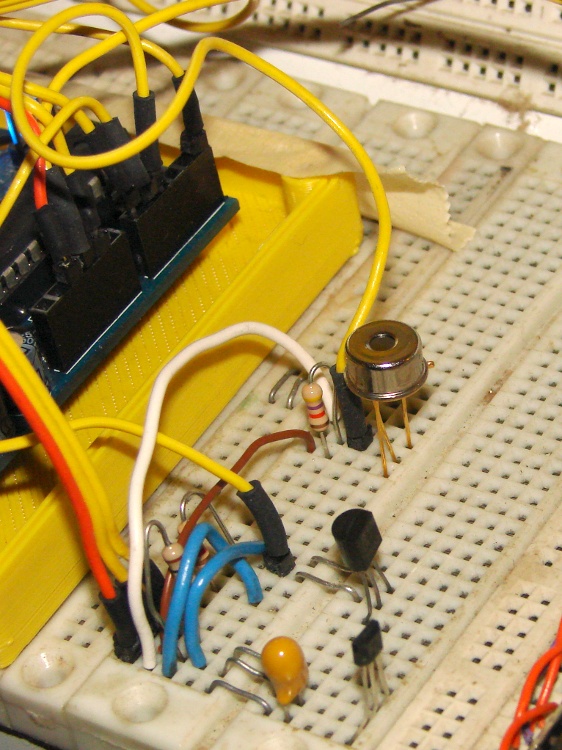
    The output runs around half a volt, which is a bit low. If you were serious, you’d pass it through an op-amp to boost it by a factor of four or five to around 2.5 V, which would have the additional benefit of lowering the impedance to work better with the Arduino’s ADC input circuitry. For now, I’ll pipe the voltage directly to an Arduino analog input:

    SSAC10-11 PIR Sensor - breadboard
    SSAC10-11 PIR Sensor – breadboard

    The linear Hall effect magnetic sensor and LM335 temperature sensor live just this side of the PIR can, sharing their VCC and ground connections in a most intimate manner. Remember, this is a breadboard, not a finished circuit… [grin]

    The SSAC10-11 (if, indeed, that’s what it is) reports the voltage difference between a reference element shielded within the can and an active element exposed to incoming IR. The DC bias for that lashup produces 650 mV on the 47 kΩ source resistor (about 14 μA) and the internal arrangement produces a lower voltage (and thus current) when the exposed element sees a warmer object, which isn’t quite what I expected. Warming the can by direct finger contact produces an increasing voltage, due to heating the reference element and leaving the sensing element (relatively) cool, at least until conduction equalizes the elements.

    I threw in a bit of averaging for each reading, not that it really matters:

    #define PAVG 3
    
    word ReadPIR(byte Pin) {
    word Sense;
    
    	Sense = analogRead(Pin);
    	for (byte i = 1; i < PAVG; i++)
    		Sense += analogRead(Pin);
    
    	return Sense / PAVG;
    }
    

    The LED bargraph shows the current input as a single bar scaled between the minimum and maximum values, so that the display automatically adjusts to changing conditions. The boolean shift direction sends the bar upward on the breadboard LEDs as the PIR element sees warmer objects, which makes much more sense than showing the actual decreasing sensor voltage. The input generally rests in the green zone and both extremes show nice red bars:

    	PIRSense = ReadPIR(PIN_PIR);
    	PIRDelta = PIRSense - PIRMin;
    
    	PIRMin = min(PIRMin,PIRSense);
    	PIRMax = max(PIRMax,PIRSense);
    	PIRRange = PIRMax - PIRMin;
    
    	PIRShift = (9 * PIRDelta)/PIRRange;
    	LEDBits = 0x00001 << PIRShift;
    	SetBarBits(LEDBits);
    

    In real life, you’d want a reset button, or some code that gradually drifts the extrema toward the running average of the input, so they’re not stuck forever.

    Dumping the raw ADC reading on the LED character display is easy:

    	sprintf(LEDCharBuffer,"%4d",PIRSense);
    	WriteLEDString(LEDCharBuffer);
    

    Updating the displays every 100 ms seems about right. It’s crazy sensitive to anything within its field of view; sitting down two feet away is good for a few counts and a palm at 30 cm gives you 15 counts. As expected, the increases and decreases fade away exponentially over the course of a few tens of seconds.

    If you wanted to do it right, you’d put a shutter or rotating aperture wheel in front, then track the AC signal difference between “scene” and “reference” views. A tiny Peltier module to stabilize the can temperature would make a lot of sense, too. Or, hey, that LM335 could report the actual can temperature, perhaps with everything embedded in a big thermal mass inside an insulating jacket with a peephole to the outside world. All that’s in the nature of fine tuning…

    The Arduino source code:

    // Nicera SSAC10-11 Single PIR Sensor
    // Ed Nisley - KE4ANU - November 2012
    
    //#include <stdio.h>
    //#include <math.h>
    
    //----------
    // Pin assignments
    
    const byte PIN_PIR = A2;			// Passive IR sensor
    
    const byte PIN_MOSI = 8;			// data to shift reg
    const byte PIN_SCK  = 6;			// shift clock to shift reg
    const byte PIN_RCKB  = 7;			// latch clock for LED Bargraph
    const byte PIN_RCKC  = 12;			// latch clock for LED character display
    
    const byte PIN_HEARTBEAT = 13;				// DO - Arduino LED
    
    //----------
    // Constants
    
    const int UPDATEMS = 100;					// update LEDs only this many ms apart
    
    #define TCCRxB 0x02							// Timer prescaler
    
    #define LED_SIZE		4				// chars per LED
    #define LED_DISPLAYS	1				// number of displays
    #define LED_CHARS		(LED_DISPLAYS * LED_SIZE)
    
    union DL1414_ {
    	word ShiftWord;				// word overlay
    	struct {					// bitfield sent to the display
    	unsigned int Addr:2;
    	unsigned int NotWrite:1;
    	unsigned int Ctl3_7:5;			// unused bits
    	unsigned int Data:7;
    	unsigned int Data7:1;			// unused bit
    	} ShiftBits;
    };
    
    //----------
    // Globals
    
    int PIRBase, PIRSense, PIRMin, PIRMax, PIRRange, PIRDelta;
    int PIRShift;
    
    word LEDBits = 0x5555;
    
    char LEDCharBuffer[LED_CHARS + 1] = "HELO";		// raw char buffer, can be used as a string
    
    unsigned long MillisNow;
    unsigned long MillisThen;
    
    //-- Helper routine for printf()
    
    int s_putc(char c, FILE *t) {
      Serial.write(c);
    }
    
    //-- Send bits to LED bar driver register
    
    void SetBarBits(word Pattern) {
    
    	shiftOut(PIN_MOSI,PIN_SCK,MSBFIRST,Pattern >> 8);
    	shiftOut(PIN_MOSI,PIN_SCK,MSBFIRST,Pattern & 0x00ff);
    
    	digitalWrite(PIN_RCKB,HIGH);
    	digitalWrite(PIN_RCKB,LOW);
    
    }
    
    void PulsePinHigh(byte PinID) {
    	digitalWrite(PinID,HIGH);
    	digitalWrite(PinID,LOW);
    }
    
    //-- Write single char to DL1414
    
    void WriteLEDChar(char Char,char CharID) {
    
    	union DL1414_ DL1414;
    
    	DL1414.ShiftBits.Data = Char & 0x7F;
    	DL1414.ShiftBits.Addr = ~CharID & 0x03;		// reverse order of chars
    
    	DL1414.ShiftBits.NotWrite = 1;				// set up data and address
    
    	shiftOut(PIN_MOSI,PIN_SCK,MSBFIRST,DL1414.ShiftWord >> 8);
    	shiftOut(PIN_MOSI,PIN_SCK,MSBFIRST,DL1414.ShiftWord & 0x00ff);
    	PulsePinHigh(PIN_RCKC);
    
    	//	delay(1000);
    
    	DL1414.ShiftBits.NotWrite = 0;				// write the character
    
    	shiftOut(PIN_MOSI,PIN_SCK,MSBFIRST,DL1414.ShiftWord >> 8);
    	shiftOut(PIN_MOSI,PIN_SCK,MSBFIRST,DL1414.ShiftWord & 0x00ff);
    	digitalWrite(PIN_RCKC,HIGH);
    	PulsePinHigh(PIN_RCKC);
    
    	//	delay(1000);
    
    	DL1414.ShiftBits.NotWrite = 1;				// disable write
    
    	shiftOut(PIN_MOSI,PIN_SCK,MSBFIRST,DL1414.ShiftWord >> 8);
    	shiftOut(PIN_MOSI,PIN_SCK,MSBFIRST,DL1414.ShiftWord & 0x00ff);
    	PulsePinHigh(PIN_RCKC);
    
    	//	delay(1000);
    
    }
    
    void WriteLEDString(char *pString) {
    
    	for (byte i=0; (i < LED_CHARS) && *pString; ++i)
    		WriteLEDChar(*pString++,i);
    
    	return;
    }
    
    //-- Sample PIR with a dab of averaging
    
    #define PAVG 3
    
    word ReadPIR(byte Pin) {
    word Sense;
    
    	Sense = analogRead(Pin);
    	for (byte i = 1; i < PAVG; i++)
    		Sense += analogRead(Pin);
    
    	return Sense / PAVG;
    }
    
    //------------------
    // Set things up
    
    void setup() {
    	pinMode(PIN_HEARTBEAT,OUTPUT);
    	digitalWrite(PIN_HEARTBEAT,LOW);	// show we arrived
    
    //  TCCR1B = TCCRxB;					// set frequency for PWM 9 & 10
    //  TCCR2B = TCCRxB;					// set frequency for PWM 3 & 11
    
    	pinMode(PIN_MOSI,OUTPUT);
    	digitalWrite(PIN_MOSI,LOW);
    
    	pinMode(PIN_SCK,OUTPUT);
    	digitalWrite(PIN_SCK,LOW);
    
    	pinMode(PIN_RCKB,OUTPUT);
    	digitalWrite(PIN_RCKB,LOW);
    
    	pinMode(PIN_RCKC,OUTPUT);
    	digitalWrite(PIN_RCKB,LOW);
    
    	Serial.begin(9600);
    	fdevopen(&s_putc,0);				// set up serial output for printf()
    
    	printf("Passive IR sensor - SSAC10-11\r\nEd Nisley - KE4ZNU - November 2012\r\n");
    
    	WriteLEDString(LEDCharBuffer);
    	SetBarBits(LEDBits);
    
    	PIRBase = ReadPIR(PIN_PIR);
    	PIRMin = PIRBase - 5;
    	PIRMax = PIRBase + 5;
    	PIRRange = PIRMax - PIRMin;
    	printf("Passive IR base: %d\n",PIRBase);
    
    	delay(1000);
    
    	MillisThen = millis();
    
    }
    
    //------------------
    // Run the test loop
    
    void loop() {
    
    	MillisNow = millis();
    
    	if ((MillisNow - MillisThen) > UPDATEMS) {
    		digitalWrite(PIN_HEARTBEAT,HIGH);
    
    		PIRSense = ReadPIR(PIN_PIR);
    		PIRDelta = PIRSense - PIRMin;
    
    		PIRMin = min(PIRMin,PIRSense);
    		PIRMax = max(PIRMax,PIRSense);
    		PIRRange = PIRMax - PIRMin;
    
    //		printf("PIR: %d Min: %d Max: %d Range: %d Delta: %d\n",
    //			PIRSense,PIRMin,PIRMax,PIRRange,PIRDelta);
    
    		PIRShift = (9 * PIRDelta)/PIRRange;
    		LEDBits = 0x00001 << PIRShift;
    		SetBarBits(LEDBits);
    
    		sprintf(LEDCharBuffer,"%4d",PIRSense);
    		WriteLEDString(LEDCharBuffer);
    
    		digitalWrite(PIN_HEARTBEAT,LOW);
    
    		MillisThen = MillisNow;
    	}
    
    }
    
  • Arduino Snippets: Temperature Measurement

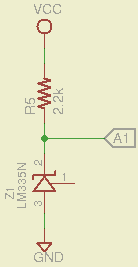
    Temperature seems an obvious thing to measure, so a bit of rummaging disgorged a classic LM335 temperature sensor that produce an output voltage directly calibrated in Kelvin at 10 mV/K: room temperature runs 296 K = 2.96 V. Nothing could be easier than this:

    LM335 Temperature Sensor

    The downside: a 1 °C temperature change corresponds to only 10 mV, which is barely two LSB of the Arduino ADC. In round numbers, a 1 °F change = 1 LSB, which doesn’t leave much room for measurement noise. I average five successive readings, which may be excessive, but the result seems stable enough:

    const float AVREF = 4.94;                    // Arduino analog reference
    
    #define TAVG 5
    
    float ReadLM335(byte Pin) {
    float Kelvin;
    
    	Kelvin = (float)analogRead(Pin);
    	for (byte i = 1; i < TAVG; i++)
    		Kelvin += (float)analogRead(Pin);
    
    	return Kelvin * (100.0 * AVREF) / (TAVG * 1024.0);
    }
    

    For better accuracy, you must measure VCC on the Arduino board and plug that into the AVREF constant, because the ADC reference voltage comes from the power supply. If you’re powering the Arduino from a USB port, then don’t bother worrying about analog conversion accuracy, because VCC depends on which PC you use, the USB cable length, what load current you draw from the regulator, and probably the phase of the moon.

    The magic number 100.0 converts 10 mV/K to K.

    The four character DL1414 LED display works well enough for the kind of temperatures you might find around a human being and, if you have an LED bargraph display, you may as well throw that into the mix, too.

    LM335 Temperature Sensor – 19 C

    The bargraph has RRYYGGYYRR LEDs, so I scaled the temperature at 5 °C/bar and put 0 °C on the bottom of the display, which means 15-19 and 20-24 °C occupy the green bars in the middle. Fingertip temperatures light up the two yellow bars and body heat gets you into the red, so it’s a reasonable display. Just to show it works, here’s a closer look (0 °C is on the right, but you can reverse that easily enough):

    LM335 Temperature Sensor – 25 C

    The Arduino source code:

    // LM335 Temperature sensor sensor
    // Ed Nisley - KE4ANU - November 2012
    
    //#include <stdio.h>
    //#include <math.h>
    
    //----------
    // Pin assignments
    
    const byte PIN_TEMPERATURE = A1;			// Temperature sensor - LM335 = 10 mV/K
    
    const byte PIN_MOSI = 8;			// data to shift reg
    const byte PIN_SCK  = 6;			// shift clock to shift reg
    const byte PIN_RCKB  = 7;			// latch clock for LED Bargraph
    const byte PIN_RCKC  = 12;			// latch clock for LED character display
    
    const byte PIN_HEARTBEAT = 13;				// DO - Arduino LED
    
    //----------
    // Constants
    
    const int UPDATEMS = 1000;					// update LEDs only this many ms apart
    
    const float AVREF = 4.94;					// Arduino analog reference
    const float KTOC = -273.2;					// Kelvin to Centigrade offset
    
    const float BARSCALE = 5.0;					// degrees per bar increment
    
    #define TCCRxB 0x02							// Timer prescaler
    
    #define LED_SIZE		4				// chars per LED
    #define LED_DISPLAYS	1				// number of displays
    #define LED_CHARS		(LED_DISPLAYS * LED_SIZE)
    
    union DL1414_ {
    	word ShiftWord;				// word overlay
    	struct {					// bitfield sent to the display
    	unsigned int Addr:2;
    	unsigned int NotWrite:1;
    	unsigned int Ctl3_7:5;			// unused bits
    	unsigned int Data:7;
    	unsigned int Data7:1;			// unused bit
    	} ShiftBits;
    };
    
    //----------
    // Globals
    
    int Temperature, BaseTemperature;
    
    word LEDBits;
    
    char LEDCharBuffer[LED_CHARS + 1] = "HELO";		// raw char buffer, can be used as a string
    
    unsigned long MillisNow;
    unsigned long MillisThen;
    
    //-- Helper routine for printf()
    
    int s_putc(char c, FILE *t) {
      Serial.write(c);
    }
    
    //-- Send bits to LED bar driver register
    
    void SetBarBits(word Pattern) {
    
    	shiftOut(PIN_MOSI,PIN_SCK,MSBFIRST,Pattern >> 8);
    	shiftOut(PIN_MOSI,PIN_SCK,MSBFIRST,Pattern & 0x00ff);
    
    	digitalWrite(PIN_RCKB,HIGH);
    	digitalWrite(PIN_RCKB,LOW);
    
    }
    
    void PulsePinHigh(byte PinID) {
    	digitalWrite(PinID,HIGH);
    	digitalWrite(PinID,LOW);
    }
    
    //-- Write single char to DL1414
    
    void WriteLEDChar(char Char,char CharID) {
    
    	union DL1414_ DL1414;
    
    	DL1414.ShiftBits.Data = Char & 0x7F;
    	DL1414.ShiftBits.Addr = ~CharID & 0x03;		// reverse order of chars
    
    	DL1414.ShiftBits.NotWrite = 1;				// set up data and address
    
    	shiftOut(PIN_MOSI,PIN_SCK,MSBFIRST,DL1414.ShiftWord >> 8);
    	shiftOut(PIN_MOSI,PIN_SCK,MSBFIRST,DL1414.ShiftWord & 0x00ff);
    	PulsePinHigh(PIN_RCKC);
    
    	//	delay(1000);
    
    	DL1414.ShiftBits.NotWrite = 0;				// write the character
    
    	shiftOut(PIN_MOSI,PIN_SCK,MSBFIRST,DL1414.ShiftWord >> 8);
    	shiftOut(PIN_MOSI,PIN_SCK,MSBFIRST,DL1414.ShiftWord & 0x00ff);
    	digitalWrite(PIN_RCKC,HIGH);
    	PulsePinHigh(PIN_RCKC);
    
    	//	delay(1000);
    
    	DL1414.ShiftBits.NotWrite = 1;				// disable write
    
    	shiftOut(PIN_MOSI,PIN_SCK,MSBFIRST,DL1414.ShiftWord >> 8);
    	shiftOut(PIN_MOSI,PIN_SCK,MSBFIRST,DL1414.ShiftWord & 0x00ff);
    	PulsePinHigh(PIN_RCKC);
    
    	//	delay(1000);
    
    }
    
    void WriteLEDString(char *pString) {
    
    	for (byte i=0; (i < LED_CHARS) && *pString; ++i)
    		WriteLEDChar(*pString++,i);
    
    	return;
    }
    
    //-- Sample temperature with a dab of averaging
    
    #define TAVG 5
    
    float ReadLM335(byte Pin) {
    float Kelvin;
    
    	Kelvin = (float)analogRead(Pin);
    	for (byte i = 1; i < TAVG; i++)
    		Kelvin += (float)analogRead(Pin);
    
    	return Kelvin * (100.0 * AVREF) / (TAVG * 1024.0);
    }
    
    //------------------
    // Set things up
    
    void setup() {
      pinMode(PIN_HEARTBEAT,OUTPUT);
      digitalWrite(PIN_HEARTBEAT,LOW);	// show we arrived
    
    //  TCCR1B = TCCRxB;					// set frequency for PWM 9 & 10
    //  TCCR2B = TCCRxB;					// set frequency for PWM 3 & 11
    
      pinMode(PIN_MOSI,OUTPUT);
      digitalWrite(PIN_MOSI,LOW);
    
      pinMode(PIN_SCK,OUTPUT);
      digitalWrite(PIN_SCK,LOW);
    
      pinMode(PIN_RCKB,OUTPUT);
      digitalWrite(PIN_RCKB,LOW);
    
      pinMode(PIN_RCKC,OUTPUT);
      digitalWrite(PIN_RCKB,LOW);
    
      Serial.begin(9600);
      fdevopen(&s_putc,0);				// set up serial output for printf()
    
      printf("Temperature sensor - LM335\r\nEd Nisley - KE4ZNU - November 2012\r\n");
    
      BaseTemperature = KTOC + ReadLM335(PIN_TEMPERATURE);
    
      WriteLEDString(LEDCharBuffer);
    
      LEDBits = 0x5555;
      SetBarBits(LEDBits);
    
      printf("Base Temperature: %d C\n",(int)BaseTemperature);
    
      delay(1000);
    
      MillisThen = millis();
    
    }
    
    //------------------
    // Run the test loop
    
    void loop() {
    
    	MillisNow = millis();
    
    	if ((MillisNow - MillisThen) > UPDATEMS) {
    		digitalWrite(PIN_HEARTBEAT,HIGH);
    
    		Temperature = KTOC + ReadLM335(PIN_TEMPERATURE);
    
    		printf("Temperature: %d C\n",(int)Temperature);
    
    		LEDBits = 0x0200 >> (1 + (int)(Temperature/BARSCALE));	// move upward on display!
    		SetBarBits(LEDBits);
    
    		sprintf(LEDCharBuffer,"%-3dC",(int)Temperature);
    		WriteLEDString(LEDCharBuffer);
    
    		digitalWrite(PIN_HEARTBEAT,LOW);
    
    		MillisThen = MillisNow;
    	}
    
    }