It’s generally accepted that laser cutter performance varies across the platform due to differences in path length, with (in my OMTech 60 W machine) the rear left corner having more power because it’s closest to the laser tube and the front right corner having less power because it’s farthest away.
Having measured the path lengths, set the laser pulse power to 25%, then plotted the power measurements against path length:
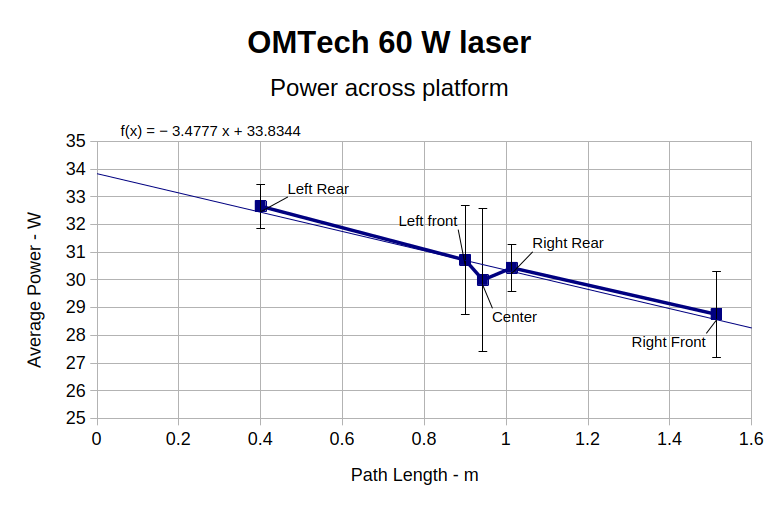
I was mildly surprised at the minimal path length difference between the two corners and the center, but it’s due to the meter case reducing the distance along the X axis without a similar change along Y. In real life, you’d snuggle the HLP-200B sensor against the boundaries of the platform and measure the corresponding distances.
Given the size of the standard deviation bars, you can surely draw different conclusions, but the linear fit suggests the beam loses 3.5 W per meter of path length: 3.9 W from left rear to right front. Using meters for the distance multiplies the coefficient by 1000 and brings the digits up out of the noise; don’t believe more than two digits.
Although the beam diverges, the HLP-200B sensor is much larger than the beam and captures all the energy even in the front right corner, so beam divergence doesn’t matter and any square-law effect doesn’t apply.
If I had measured the power at the tube exit, it would be around 34 W and the error bars would surely justify that expectation, too.
Assuming the path loss in watts is proportional to the tube exit beam power, calling it 10% would be about right. That would definitely reduce the cutting performance in the front right corner if the power setting was barely adequate elsewhere on the platform.
 The Smell of Molten Projects in the Morning
Comments
5 responses to “HLP-200B Laser Power Meter: Variation Across the Platform”
I don’t suppose the firmware is smart enough to compute the loss based on the head position and compensate by boosting the power as it moves away from the tube?
Not at all: what you set is what you get!
But how does that happen? Where is the power going? Are you heating up the air (how would that happen? beam interacting with ground-state CO2)? Wouldn’t you notice that?
I’ve not noticed many things that became blindingly obvious in retrospect, so …
Some casual searching produced rather old studies of atmospheric absorption at various wavelengths, all of which seem relevant at kilometer scales, so it’s probably not just heating air. The error bars seem tight enough to rule out a completely flat line, though. I must generate more numbers to puzzle over.
[…] will be especially valuable while I’m bypassing safety interlocks and poking around inside the […]