Flushed with success after building a Keychain Pill Tube with orange PETG, I tried dark gray carbon-fiber PETG with the same settings:

In real life, it’s a much darker gray.
It’s not only furry, it’s overstuffed: the threads didn’t engage at all.
Running a few single-thread calibration squares suggested an Extrusion Multiplier around 0.6 would produce the proper thread width. Making it so and trying again worked perfectly:

Not only did the cap screw on easily enough, the exterior finish improved and most of the stringing went away.
However, the Mighty Dragorn of Kismet (who nerd-sniped me into getting the MK4 in the first place) observed that he’d been running PETG-CF with stock PETG settings and getting good dimensional results without further tuning.
After a few more gyrations, I did what I should have done first:

The label on the spool suggests a 230 °C to 250 °C extrusion temperature and 235 °C seems like the sweet spot between overly stringy and terrible bridging, although I’d never expect PETG to cross that kind of gap without some support. The 35° overhangs on the left look surprisingly good at any temperature.
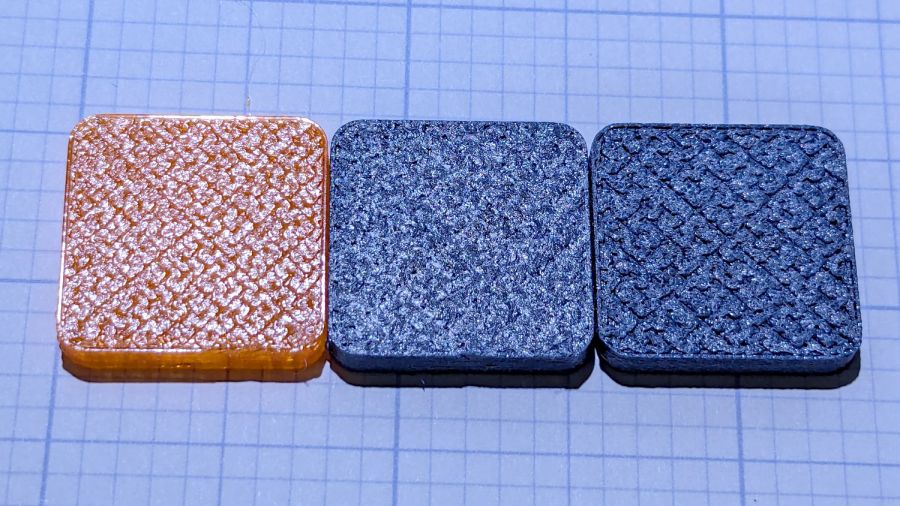
With that set up, running solid calibration squares showed Dragorn was right: 1.0 EM works the way you’d expect and 0.65 EM produces under-filled surfaces:

The hand-knitted surface is more visible at a more oblique angle:

The 0.2 mm layers look about the same on both squares.
Comparing plain PETG at 1.0 EM with those:
Set up a square with walls three threads thick:
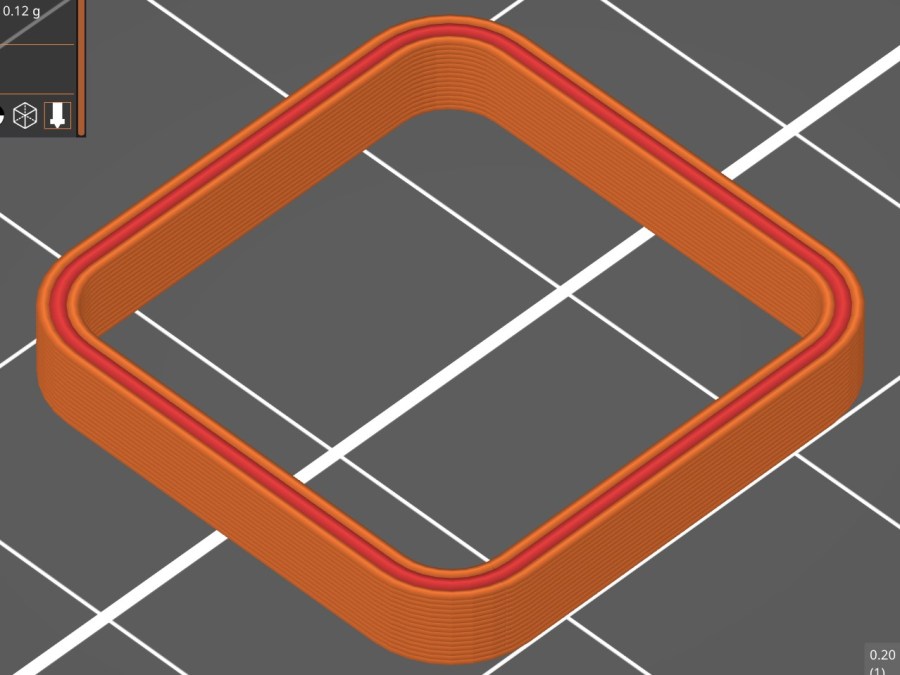
With PrusaSlicer set to produce 0.45 mm thread widths, the walls should measure exactly 1.35 mm = 3×0.45 mm thick:
- PETG = 1.30 mm (1.29 to 1.30)
- PETG-CF = 1.40 mm (1.37 to 1.40)
While I think you could tweak the EM for both materials, it’s unlikely to make any practical difference on typical objects.
So it looks like a slightly lower temperature with 1.0 EM will produce good outside dimensions for the carbon fiber filaments, while models with precise thin sections will require careful tuning.
 The Smell of Molten Projects in the Morning
Comments
4 responses to “Prusa MK4 vs. PETG-CF”
Keep in mind that CF is abrasive to a brass nozzle. You should use a steel nozzle for it.
Got the super-whoopie Obxidian hardened nozzle:
https://www.prusa3d.com/product/prusa-nozzle-obxidian-0-4-mm-2/
Which came in a separate package and added nearly a week onto the delivery because … customs?
Apparently carbon fiber cuts the lifetime of a brass nozzle to hours, which was enough to get my attention. I should probably stock up on spare steel nozzles, even though I have plenty of ordinary PETG to use up.
[…] gray bearing is PETG-CF and has maybe 1 mm of axial play, which agrees with my original observation that an Extrusion Multiplier of 1.0 results in slightly overstuffed carbon fiber parts. It’s […]
[…] in gray PETG-CF (carbon fiber) with Extrusion Multiplier = 1.0 based on the Pill Tube tests and and slightly lower temperatures based on the temperature tower. It definitely looks overstuffed […]