I put the camera in the front yard to monitor a new groundhog hole, then mowed the lawn. Although smoke drifting in from the Canadian fires has posed a problem, the air quality wasn’t this bad:

It turns out the camera’s case seal isn’t quite up to the task:
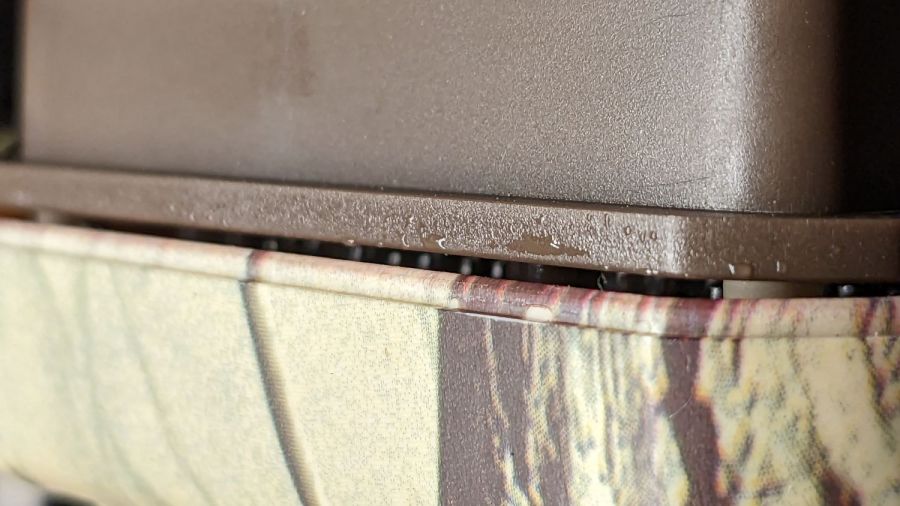
The lip around the front half of the case presses against a rubber gasket around the rear half, which means the water on the electronics chassis is inside the camera case:
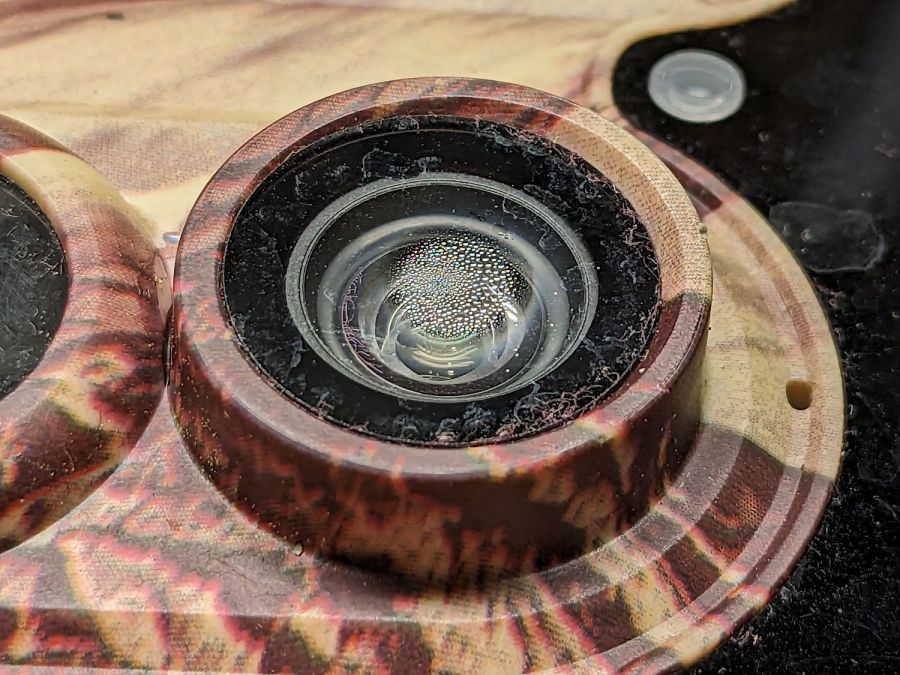
Fortunately, the water condensed on the inside of the glass lens protector, rather than on the camera itself:

I let the whole thing dry out on the bench for a few days and all seems right again.
The leak does make me think leaving it out in the rain is a Bad Idea™, which isn’t the sort of thought one should have about a trail camera.
Diurnal pumping can explain many electronic failures. For the record, the monitoring station on the Walkway Over the Hudson vanished a while ago, probably due to rampant electronic corrosion.
 The Smell of Molten Projects in the Morning
Comments
7 responses to “SJCam M50 Condensation”
As someone now professionally employed in building and deploying remote cameras who thought he’d seen everything that enclosures could do under weather, I still have so much to learn and always will be learning …
It does look as if some strategically-placed desiccant packs could fit in there, plus some thoughtfully-applied black Super 88 tape around the seam might help the camera on those dewy days
There’s a rectangular recess along the bottom edge custom-made for a sock of desiccant, which I must subcontract to our resident quilter … who is currently prepping for a pair of gardening presentations.
The rubberoid gasket isn’t particularly convincing, so, yeah, a tape seal seems like a good idea.
If the seal is perfect, then air-pressure and temperature changes will be constantly working to take it apart, no?
I’m interested because I’d like to put an ultrasonic proximity sensor in the well to monitor water level, and I haven’t figured out how to protect the electronics.
In the camera’s case, maybe a balloon inside the sealed enclosure leading outside — sealed to the case, of course.
Hermetic seals seem easier in theory than in practice, that’s for sure.
I have no idea how ultrasonic sensors remain clean enough to work in a dripping-wet environment, even ignoring the corrosion you’d expect on any metallic surface. I’d be tempted to pot the electronics behind the ultrasonic sensor in epoxy (or silicone or whatever) and hope for the best, but I’m pretty sure even that wouldn’t be good enough. Sealing the wire insulation well enough to withstand immersion seems difficult.
Make two so you can analyze the inevitable failure? :grin:
There’s a model of sensor that’s allegedly weatherproof,
( https://bc-robotics.com/shop/ultrasonic-distance-sensor-weatherproof/ ). It’s on a longish cable so I’d try to hang it down to maybe 2 meters above the level where we think the water should be.
One of those little ESP8266 boards would take the readings and send them via WiFi to the Raspberry Pi cloud server in the sunroom.
:) my usual purchasing policy is to buy one to destroy during construction[*], one to use, and one in case I think of follow-on or improvement. This price is up where I might stick to one at a time.
[*] I’m fundamentally a software guy; these things happen.
Mmmmm, IMO there’s considerable distance between “weatherproof” and “watertight”: the former probably assumes it lives in a dry-ish place with occasional soakings, the latter seems more suitable for down-hole use.
I’d also expect a “wider field of view” sensor to have trouble peering a couple of meters down a rough pipe, with echoes returning from the walls all the way.
However, I’ve been flat-out wrong about that sort of thing enough to recommend trying it out. You definitely want two of them, though! :grin:
[…] SJCAM M50 camera gasket seems unable to cope with The New Normal weather conditions around […]