The test pattern consists of 1 mm blocks:
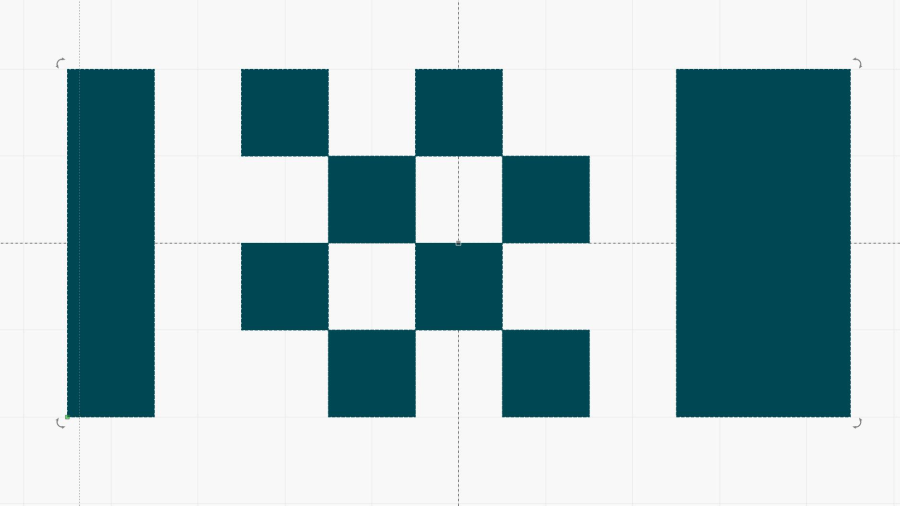
I set the layer speed at 250 mm/s = 4 ms / mm, then set PWM (a.k.a. “power”) for each test, and measured the results, which look like this for three power levels on corrugated cardboard:

The scan interval of 0.2 mm produces distinct lines at 10% PWM, the lower limit of the laser’s range. The lines remain separate at 30%, although their width is definitely increasing.
Yesterday’s post explains the test wiring setup and the signals in the scope screenshots.
The 10% PWM current waveform looks like nothing you’d expect:

The scope triggers at the start of a left-to-right scan line, with 50 ms devoted to ramping up the speed to 250 mm/s before the start of the vertical bar along the left edge and slowing down before reversing.
The green trace shows huge spikes in the laser current, not a well-defined DC current pulse, and they’re offscale beyond 30 mA at 5 mA/div. The baseline sits well above the 0 V line due to the AM502 amplifier’s breathtaking thermal drift; I occasionally touch it up, but the current really is zero between the pulses.
Similarly for 20% PWM:

Even through there’s little visible difference between the 10% and 20% current waveforms, there’s a distinct difference in the actual beam power delivered to the cardboard.
At 30% PWM the beam current looks a bit more reasonable:

The 2 mm = 8 ms bar on the right gives the current time to stabilize at 6 mA, but all of the pulses have at least 3 ms of spikes. The first pulse definitely looks worse, so it seems the power supply gets better as the scan line progresses.
At 40% PWM the beam current pulses look more like pulses:

They still have 3 ms or so of those startup spikes, as seen in this closer look at the first pulse in a line, scaled at 10 mA/div (along with the PWM drive signal):
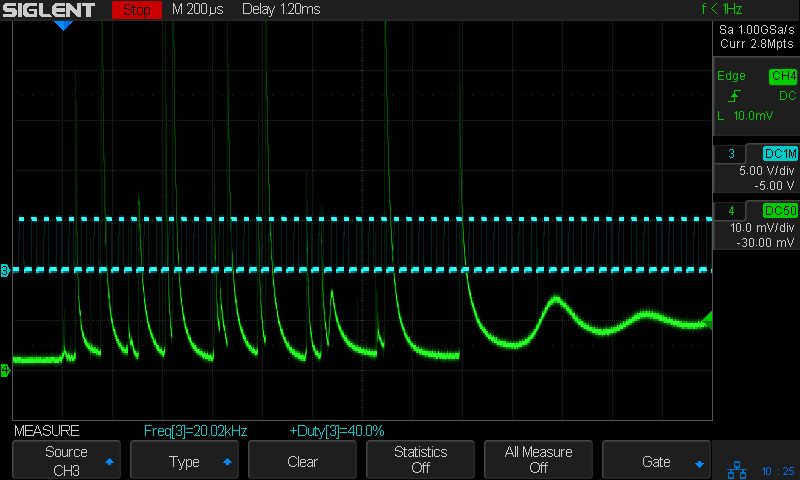
The top of those spikes exceed 70 mA!
At 80% PWM, the current waveform looks like a damped tank circuit:

The 20 mA at the end of that pulse suggests the maximum tube current would be 25 mA, which is undoubtedly why OMTech recommends running at no more than 70% PWM = 17-ish mA.
The pulses start immediately after the L-ON signal goes active and stop promptly when it goes inactive, so there’s no question about the responsiveness. What baffles me is why the current looks the way it does.
I must figure out how to have the scope compute the RMS value of those spikes, with a sufficiently large mA/div setting to keep the entire range of the pulses on the screen.
 The Smell of Molten Projects in the Morning
Comments
4 responses to “CO₂ Laser Tube Current: Constant Power”
[…] However, the scope traces for PWM values under about 25% all look pretty much like this: […]
[…] Having established that the RMS value of the huge current spikes at low PWM settings doesn’t amount to anything meaningful, I cranked the AM502 current amp gain to 10 mV/div, re-ran the tests for PWM values from 10% through 99%, and recorded the RMS value of a single line through a square of the same pattern: […]
[…] test patterns were engraved at various power levels, which was the whole point of the exercise: I was looking at the current waveforms, rather than the […]
[…] Start with the constant-power test pattern: […]