The defunct 18650 lithium cell I used for the DSO150 power supplyprompted me to crack open a battery from a long-gone Dell laptop to see if any of its cells were in better condition:

Yup, gently crushing it in a vise splits the case enough to work the Designated Prydriver around the joint, a process considerably simplified by the knowledge the case isn’t going back together again.
Prying the top off reveals the cells and their connections:

One of the cells had corroded, accounting for the pack’s failure:
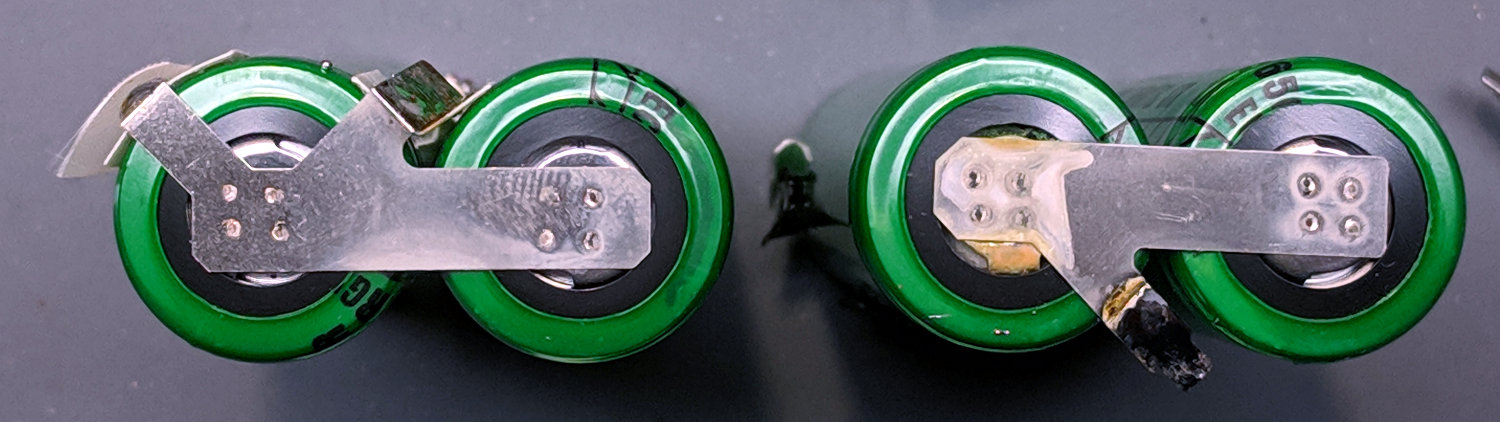
The others were undamaged, but had self-discharged down to about 1.5 V over the course of several years and refused to charge.
The moral may be to tear the pack apart as soon as it fails, a point always easier to recognize in retrospect.
So I taped the packs to prevent shorts and tossed them into the recycle box.
 The Smell of Molten Projects in the Morning
Comments
2 responses to “Dell Laptop Battery Teardown”
Most of the “dead” 1.5V or even lower cells will charge just fine if you jumpstart them with a bench power supply – the charger simply won’t even try when they are that low. Go slow, maybe 1/10C or less, limit the voltage to 4.2V and monitor temperature. When they get to 2.85V you can put them in a normal charger. You can dump any that jump straight to voltage limit as soon as you plug them in though.
I have many of these and they hold 1/2 to 2/3 of rated charge. “Healthy” ones that had over 3V when they were extracted usually hold something like 3/4 or 4/5 of the charge.
I won’t touch physically damaged cells or any with zero or negative voltage, and newer Chinese replacement packs – those are always crap. Rest are fair game, but they get monitored during charge cycle and I charge them in a middle of kitchen on a ceramic floor with nothing remotely flammable within 1m in any direction. Silicon fireproof pouches are also a good idea.
OK, I charged a pair of those cells (they were still welded together) from the bench supply set to 4.2 V and current-limited to 220 mA, with everything in the middle of the concrete basement floor. The voltage rose from 3 V, the current dropped to 40 mA, and the cells didn’t warm up at all.
However, when I clipped them into the battery tester and applied a 1 A load, the voltage immediately dropped to just about zero. Smaller loads had the same effect.
So, alas, they’re dead!