The Smell of Molten Projects in the Morning

Ed Nisley's Blog: Shop notes, electronics, firmware, machinery, 3D printing, laser cuttery, and curiosities. Contents: 100% human thinking, 0% AI slop.

Month: May 2018

  • Heavy Hauling

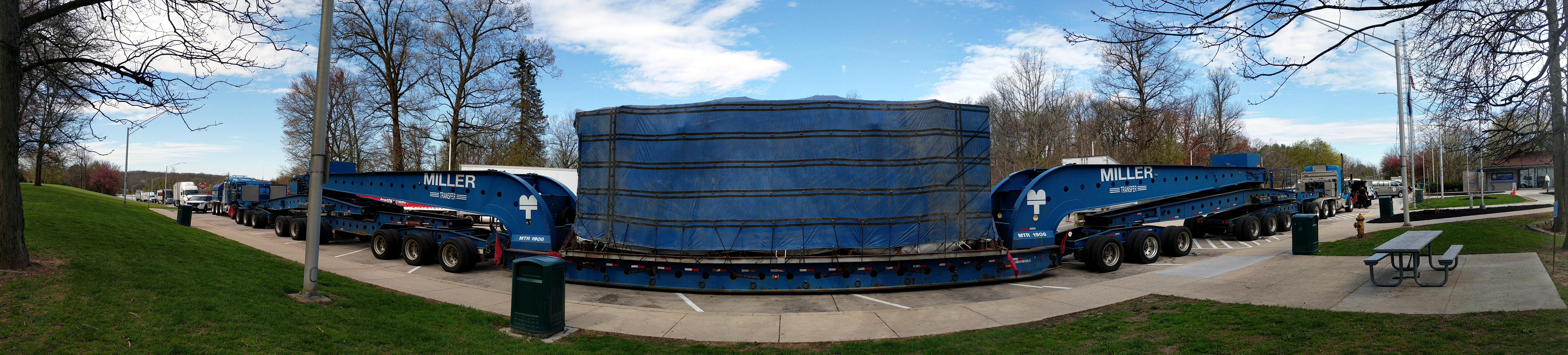
    A recent road trip presented this spectacle in the first Pennsylvania rest step on northbound I-83 (clicky for many more dots, then scroll to see it all):
    Heavy Hauling - panorama mid
    Heavy Hauling – panorama mid

    It’s a 150 Ton Flat and Depressed Well 19 Axle Trailer, including four axles on the front truck:
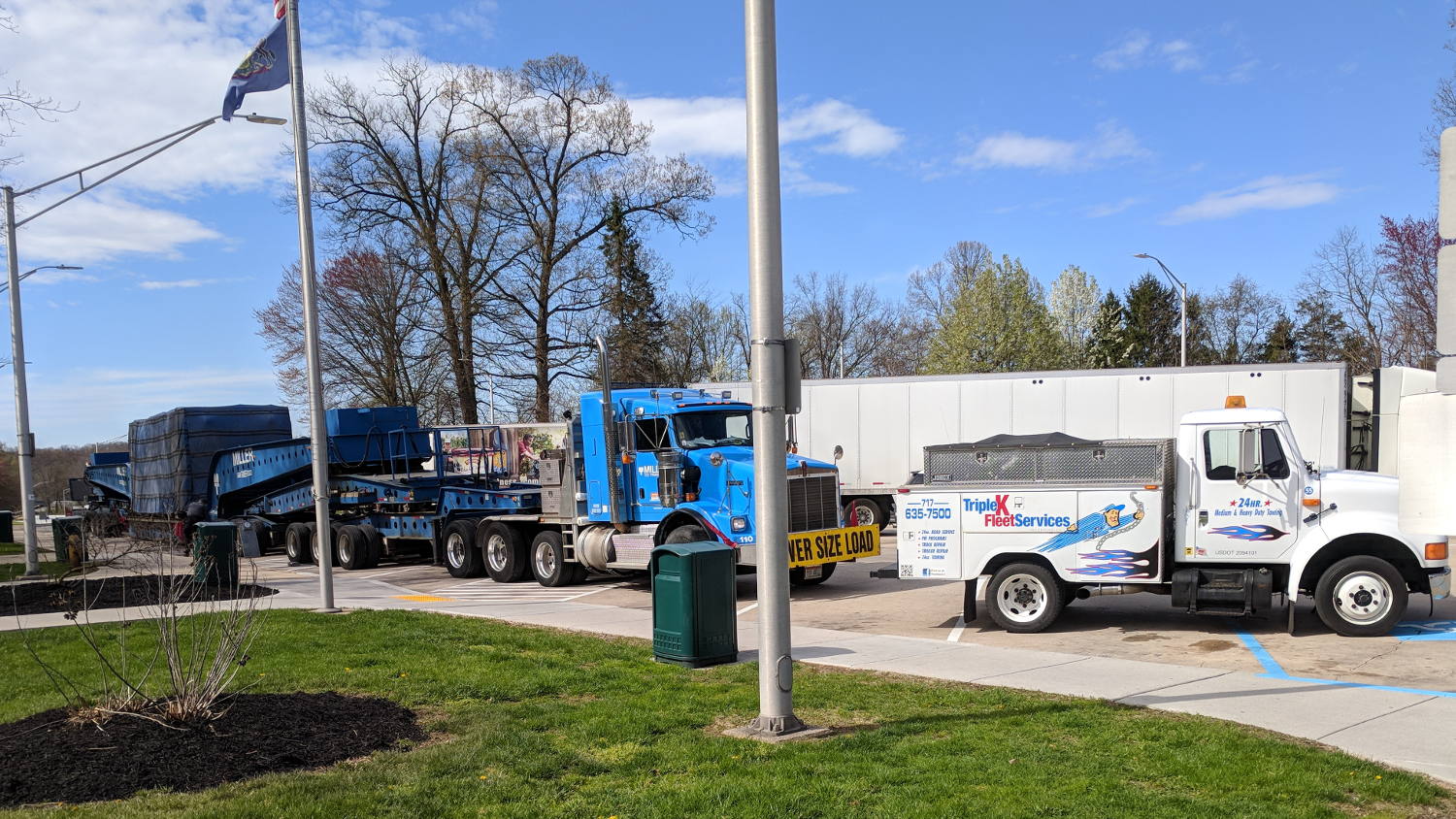
    Heavy Hauling - front
    Heavy Hauling – front

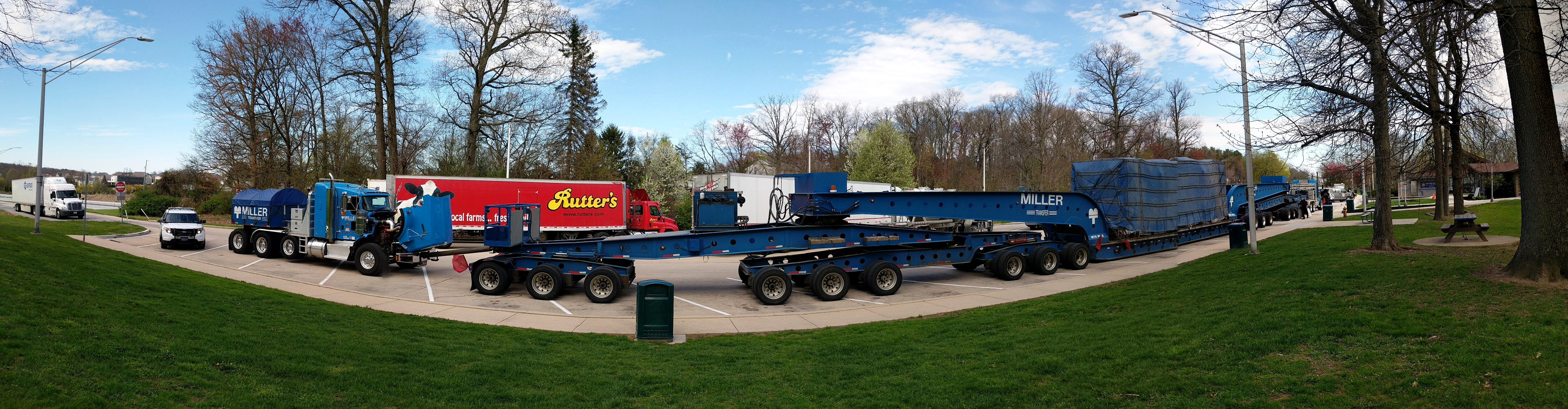
    Another truck on the rear pushes uphill and provides lateral control downhill:
    Heavy Hauling - panorama rear
    Heavy Hauling – panorama rear

    The weight block on the rear truck provides more traction, because friction depends on normal force.

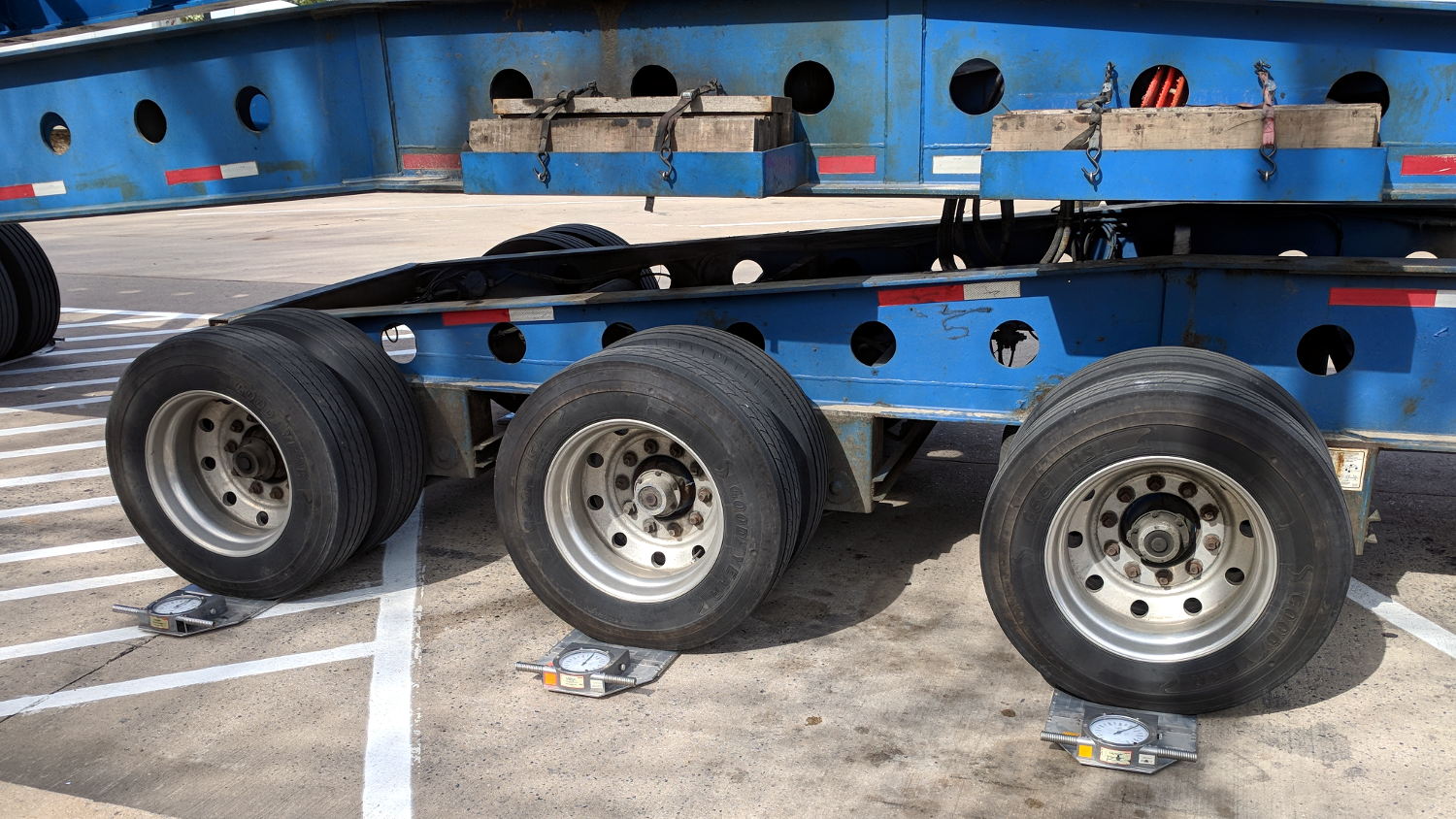
    The PA transportation folks were verifying the overall weight and per-axle distribution by weighing three axles at a time:
    Heavy Hauling - weight check
    Heavy Hauling – weight check

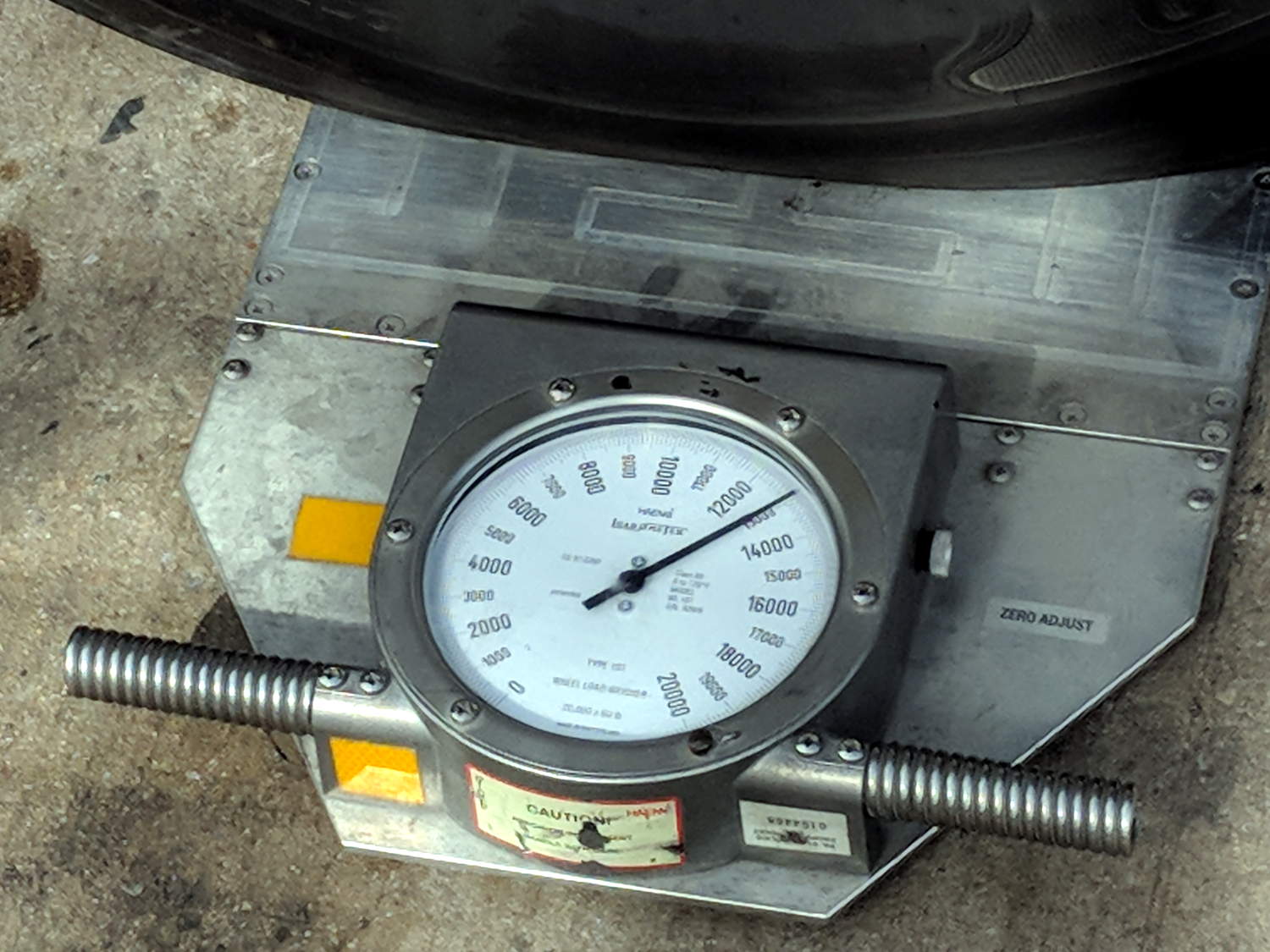
    Each scale has a 20 k pound range:

    Heavy Hauling - weight check - detail
    Heavy Hauling – weight check – detail

    The ones I saw reported 10-14 k pounds, so figure 24 k pounds per axle, then multiply by 19 to get 456 k pounds overall.

    The driver of the lead escort vehicle said the tarp covers a machined steel assembly weighing around 200 k pounds, with a total “vehicle” weight a bit under 500 k pounds. This is the second of four similar loads going from the Port of Baltimore to somewhere in Ohio where they’re assembling a huge press. It seems American manufacturing is still a thing.

    They’ll be driving for four or five days from Port o’ Baltimore to Ohio, following a route described in excruciating detail on four pages of notes, plus another 16 pages of permits for the series of bridges rated to carry however many axles will be on them simultaneously.

    Some searching produced a video of a similar load in transit, perhaps on the same trailer. Another video shows a different trailer jockeying into position beside a ferry (!).

    For the folks involved, it was just another day at the office.

  • FM DDS: SPI Mock 3

    Running some serial I/O in the background adds jitter to the timer interrupt pacing the ADC samples and as-yet-unwired DDS updates. For reference, an overview of the process showing the procession from the IRQ on the left to the SPI outputs near the middle and another IRQ on the far right:

    DDS Mock - 0 VAC - SPI
    DDS Mock – 0 VAC – SPI

    Now, speed up the sweep and delay the trace by 25 μs to put the triggering pulse off-screen to the left and the second pulse at the center division:

    ADC Sample IRQ jitter
    ADC Sample IRQ jitter

    The orange smear in the middle should be a tidy pulse, but it isn’t.

    The  25 μs timer interrupt now has the highest priority on the front burner:

    IntervalTimer AudioSampler;
    
    ... snippage ...
    
      AudioSampler.priority(0);
      if (!AudioSampler.begin(AudioSamplerIRQ, SamplePeriod)) {
        Serial.printf("Timer start failed\n");
        while (true) {
          FlipPin(BUILTIN_LED);
          delay(75);
        }
      }
    

    Although nothing can interrupt it, other code / handlers may disable interrupts around their own critical sections and delay the tick. If the triggering tick (the off-screen one starting the trace) is delayed, then the on-screen pulse will appear “too soon”, to the left of center. If the triggering tick is on time, but the on-screen pulse is delayed, it’ll appear “too late” on the right.

    The blur is (roughly) symmetric around the center graticule line, so the handwaving seems about right.

    In round numbers, the jitter moves the interrupt ±325 ns on either side of its nominal position, with most of the pulses within ±100 ns. I doubt the jitter distribution is Gaussian, but vigorous handwaving says the RMS jitter might amount to 75 ns.

    At the 4 kHz audio band limit, a 75 ns sampling error a phase error of 0.1°, so the maximum amplitude jitter would be sin(0.1°) = 0.002 = -55 dB, which might suffice for amateur-radio audio.

    I think, anyhow.

  • Monthly Science: As Seen On Radio

    This showed up when I looked at our APRS tracks after a recent ride:

    Balloon chase - KJ5HY-9
    Balloon chase – KJ5HY-9

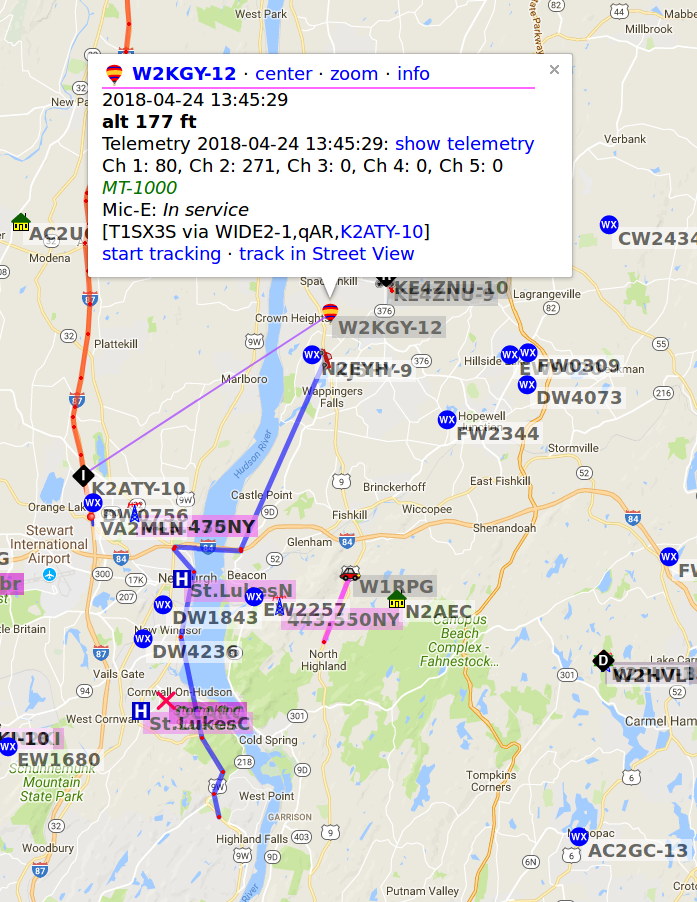
    Poking around a bit showed the target:

    Balloon chase - W2KGY-12
    Balloon chase – W2KGY-12

    Contrary to what I thought, it didn’t come up the Hudson River from West Point:

    Balloon chase - W2KGY-12 track - 2018-04-21 to 2018-04-24
    Balloon chase – W2KGY-12 track – 2018-04-21 to 2018-04-24

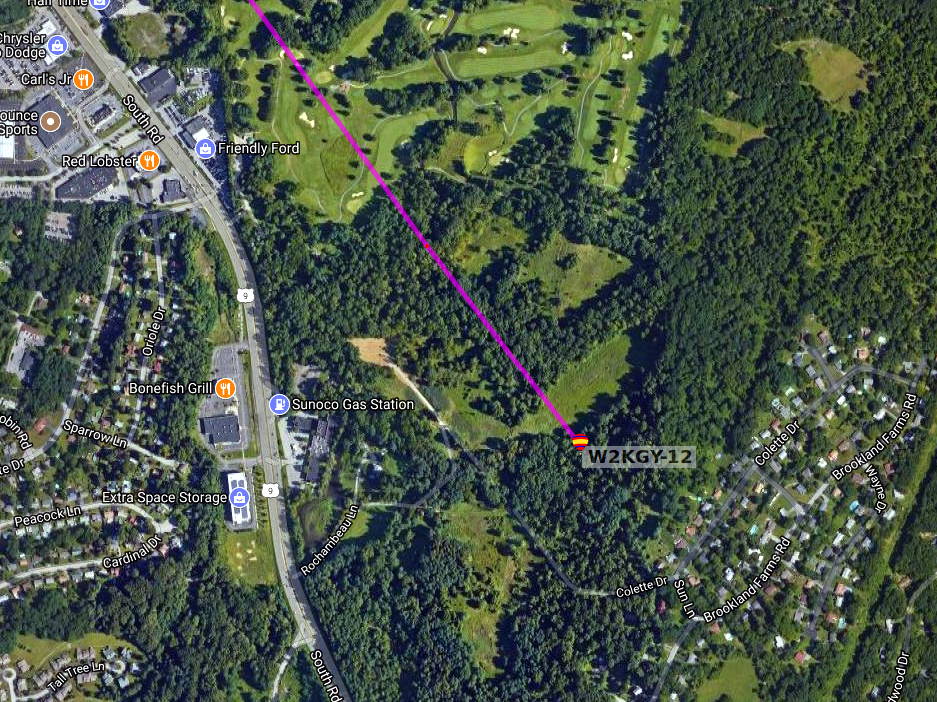
    Knowledge of the Universal Law of the Conservation of Perversity informs you a balloon will never land in the middle of a putting green:

    Balloon chase - W2KGY-12 landing site
    Balloon chase – W2KGY-12 landing site

    Apparently the launch is part of a regular class project at West Point. Good clean fun!