Those wearable LEDs spent the last five months sitting on the kitchen window sash, quietly discharging their CR2032 lithium cells:

Occasional voltage measurements produced an interesting graph:
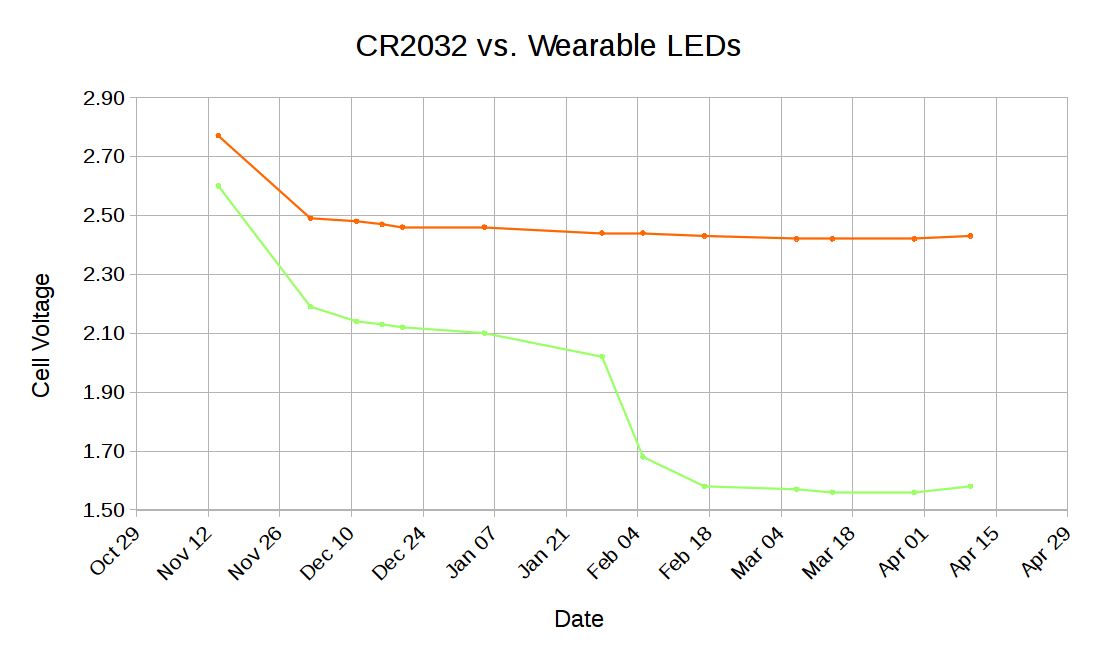
CR2023 primary lithium cells start out around 3.3 V, so these were pretty much dead (from their previous lives in dataloggers) when I slipped them into their holders. The LEDs seem to be blue LEDs, with threshold voltages around 3.6 V, with colored phosphors / filters, so they started out dim and got dimmer. The green(-ish) LED obviously fell over a cliff and went dark in late January; I have no way to measure long-term microamp currents, alas.
The reddish LED is still going, mmm, strong.
If you need a rather dim light for a surprisingly long time, these things will do the trick.
I should gimmick up another astable multivibrator to blink one LED.
The original data:

 The Smell of Molten Projects in the Morning
Comments
6 responses to “Monthly Science: CR2023 Lithium Cells vs. Wearable LEDs”
The security certificate on some of your ADs is expired.
As it says in the sidebar, any and all advertisements come from WordPress, not me: That’s Not My Problem in many different ways.
At the risk of my penny-per-hour revenue, I highly recommend using an ad blocker. [grin]
It used to be, you could flash a neon bulb with a “dead” photoflash or radio B battery for many months, even years. Then technology marched on, and the LM3909 chip came out, which let you flash an LED with a “dead” 1.5V cell for months. Then the LM3909 was discontinued (it was a somewhat clever chip, probably doing a charge pump style boost operation, like a “joule thief” without an inductor). Now I’m tempted to breadboard an LM3909 type circuit…
Somebody did a discrete version; http://home.cogeco.ca/~rpaisley4/LM3909.html. Cute little circuit, done by one of the nicer designers at National’s linear group, Pete Lefferts.
I am definitely soldering a discrete LM3909 atop a lithium cell holder!
[…] wearable LED from the completely dead CR2032 cell with a classic astable multivibrator circuit and a not-dead-yet CR123 cell produced a pure-analog […]