As Forrest Mims demonstrated back in the day, LEDs work perfectly well as narrow-band photodiodes with peak sensitivity to slightly shorter wavelengths than they emit. Aiming a red laser at an ordinary IR LED about a foot away generates 800 mV of photovoltage:
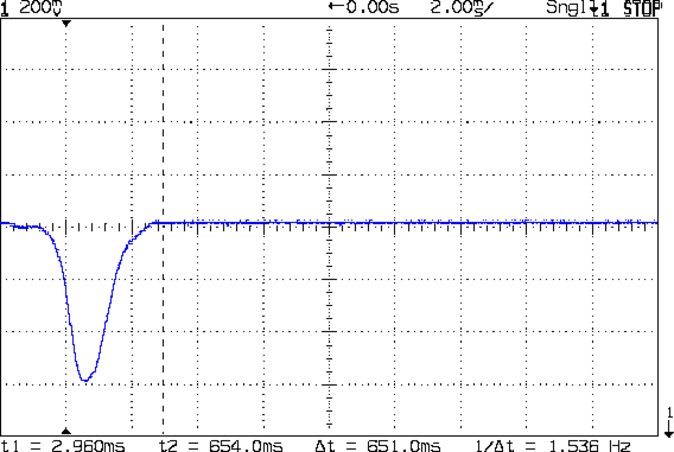
The blip comes from the shaft of a small screwdriver falling through the beam.
That’s in photovoltaic mode directly connected to the oscilloscope, but you’d want to run it through a low-gain transimpedance amplifier to get the zero bias photocurrent and a comparator for a clean digital edge. That’s obviously overkill for a simple optical interrupter, but the analog circuitry should come in handy for something else later on.
OK, now I can detect a moving object, trigger a camera, and fire a xenon flash, all under an Arduino’s control…
 The Smell of Molten Projects in the Morning
Comments
5 responses to “Red Laser vs. IR LED Photosensor”
I’ve used the same trick to measure the light curve from electronic flashes. Here’s one at full power http://www.vitriol.com/images/tech/equipment/microflash/minolta-full.png and the same one at minimum power: http://www.vitriol.com/images/tech/equipment/microflash/minolta-low.png You can see the leading edge (and the burst of noise from the trigger coil) are similar, but at low power, it cuts off abruptly before it really gets going.
Those traces are at least qualitatively similar to what the fancy 10AP photodiode saw with the 250 µF and 1 µF capacitors, which is comforting.
I’d like to measure the flash current, but the Tek Hall probe bears a prominent warning: “CAUTION CORE NOT INSULATED” and I’m loathe to clamp it around a flash tube lead at 300 V with a 4 kV trigger pulse nearby…
Shh! I used an “output” led for programming flash on an embedded sbc sytem, if you sent it the right message after a reset.
Sounds like one of those back doors I keep reading about… you must’a worked for
[fzzzt #$%^&* NO CARRIER][…] game plan: drop a small object through a laser beam that shines on a photodiode, thus causing an electrical signal that triggers various flashes and cameras and so forth and so […]