This simple cylinder connects two NEMA 17 stepper motors together:
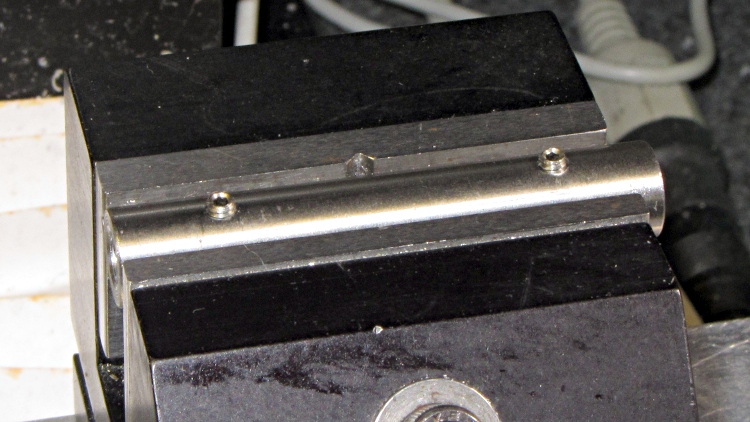
It’s quick-and-dirty:
- Cut 2+ inches of 0.375 drill rod, face both ends
- Drill #8 = 0.199 inch = 5.06 mm (because #9 = 0.196 inch = 4.98 mm is a bit too snug)
- Cross-drill #41 in the Sherline (because #43 makes for stiff tapping)
- Tap 4-40 for the setscrews
- File off rough edges, run #8 drill through the bore to clean out tapping chips &c
Now, you probably don’t want to do this in real life, because you want a coupler with a bit of compliance to soak up the inevitable misalignment and dampen the mechanical resonances.
 The Smell of Molten Projects in the Morning
Comments
7 responses to “Stepper Motor Shaft Coupler”
Why would you wan to connect two steppers directly together? Or is that bit saved for the next installment?
Stepper motor wrestling!
It’s a dynamometer: one will be a generator. Well, an alternator, but you get the idea: load the output, measure the power, divide by RPM, and get torque. I think it’s easier than a de Prony brake, but maybe less accurate.
If I worked all this stuff out in advance, it’d look a lot like, uh, work.
As it turns out, though, this will be part of a Circuit Cellar column, so you’re seeing the pieces as they happen… which is sort of the point of this whole bloggish thing.
I’d be interested in hearing your approximation of which drill to use for taps. I use the listed size for aluminum and one larger for steel.
I use pretty much whatever the chart says for aluminum and plastic: roughly 75% threads. For steel, we think alike: one size larger gives lower tapping force and fewer broken taps. I don’t need the ultimate possible strength, so pretty much anything will suffice.
There’s a table taped to my stainless steel screw box listing the tap and clearance drills… saves me a trip through the big chart for almost everything I make. For the 3D printer stuff, I’m slowly building a list of screw & nut sizes that should produce near-net holes; eventually I should turn it into an include file.
[…] The Smell of Molten Projects in the Morning « Stepper Motor Shaft Coupler […]
[…] wheel fits the shaft with a 4-40 setscrew to hold it in place. The post has 4-40 mounting holes for one of those optical […]