The air conditioning in our Toyota Sienna van emitted some barely cool air during the previous heat wave, which was definitely new news and not to be tolerated. The sight glass showed white foam when running and nothing when stopped, but the compressor hadn’t locked out on low pressure yet. My guess was that everything still worked and that the refrigerant had just slowly leaked away over the last 11.5 years; nothing lasts any more, eh?
I consulted with my cronies and devoted a few hours to discovering that many seemingly qualified people don’t understand the notion of vapor pressure, but that a DIY recharge wasn’t exactly rocket science. Picked up a Harbor Freight manifold gauge (on sale for 50 bucks, less one of the ubiquitous 20% coupons = $40) and two cans of R134a plus a can tapper from Autozone. Parked the car in the garage and popped the hood to let things cool off overnight.
The never-sufficiently-to-be-damned Toyota engineers put the low pressure port far back on the inside of the right-side wheel well, where I can barely reach it by standing next to the car facing forward, reaching backwards with my left arm, easing my outstretched hand through the gap between the well and the engine, then feeling around to find and unscrew and not drop the cap. No, I’m not left-handed, I just can’t contort my right hand sufficiently to do more than touch the cap.
Aligning and securing the low-pressure fitting on that port requires far more agility and strength than should reasonably be expected from one’s weak-side hand. A pox on their backsides!
Anyway.
The static pressure started out at 67 psi in the morning, which is roughly correct for R134a in the low 20 °C range: chart or table. That’s a good sign indicating that the sump still had liquid refrigerant, confirmed by the myriad bubbles in the sight glass. Eyeball the outer ring of the low-side gauge to find the R134a temperature corresponding to the pressure on the inner ring.

That gauge shows whatever pressure was left in the hose after finishing the job a few hours prior to the picture. It seems the manifold / hoses / valves hold pressure quite well, which is not a foregone conclusion given Harbor Freight’s QC.
The sticker under the hood reports the AC requires about 3 pounds of refrigerant. That’s far more than most cars because the van also has a rear-cabin AC evaporator with one honkin’ big compressor for both.
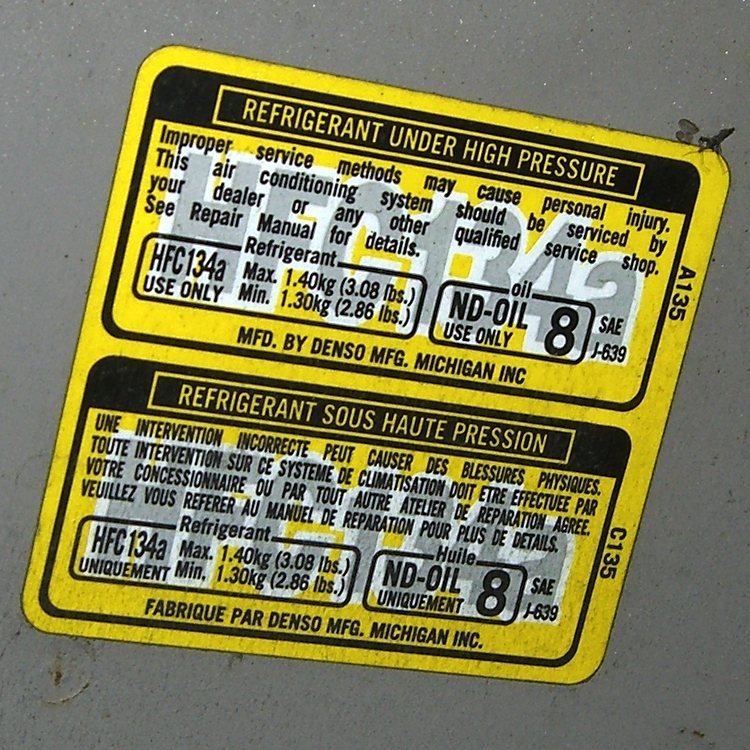
I made the working assumption that if the AC still had some liquid refrigerant, it also had pretty nearly all the OEM oil. Most of the year the AC stays off, so I figure we’ve got a slooowww gas leak past the (usually) non-rotating seals driven by vapor pressure, all of which left the oil down in the sump. In addition, I haven’t the slightest idea if Toyota’s ND-OIL 8 gets along with the current PAG oil and adding too much oil seemed worse than having slightly too little.
The running pressures were 7 and 75 psi: grossly low.
So I fired in both cans of R134a: one with UV leak detector and another with leak sealer. That brought the pressures up to 20 / 120 psi: still too low, but at least air from the center vent now came out at 9 °C. The sight glass showed mostly foam, although with bursts of bubbly fluorescein green liquid. No leaks in evidence anywhere I could find without a nose-to-tail under-the-car inspection back to that rear evaporator.
Another trip (this time by bike) to the Autozone fetched a third can of straight R134a, which gradually cleared up the sight glass and got the pressures up to 35 / 150 psi, roughly matching the actual evaporator and condenser temperatures. I figured a few excess ounces wouldn’t do the least bit of damage; the three cans add up to 35 ounces of refrigerant, so the system was about 3/4 empty.
Early reports from the current heat wave seem encouraging.
 The Smell of Molten Projects in the Morning
Comments
5 responses to “Auto AC Recharge”
NFP
“current heat wave”
Some of your erstwhile readers are half a globe away!
We just had our coldest June maximum in 96 years!
(As you don’t live in sub-tropical Brisbane you might not think that a low of 10.1 and a high of 14.4 degrees Celsius is real cold.
But temperatures usually go above 20 degrees on a winter’s day, and then you cast off the lightweight cotton cardigan or pullover.
So most of us shivered when we went outdoors.
It was a problem for schools. Home classrooms are air conditioned, but eating areas, playing areas, sports areas are not.
From what I read, you folks have been having quite a set of troubles involving too little rain and too much rain; makes a little overheating look downright inviting. Around here, Mark Twain’s old observations still ring true.
But I didn’t mind testing the AC this morning while out on an errand that couldn’t be done on the bike!
It would be nice if automotive engineers wouldn’t assume you can fully disassemble the vehicle for every minor repair. The replacement of an intake manifold gasket on a Saturn SL2 still gives me nightmares.
Indeed! The spark plugs in that Sienna will never be changed: the replacement process starts by removing the windshield bezel and continues down through the intake manifold. The shop quote was well over $300 some years ago. Oh, plus the whoop-dee-doo double-electrode iridium plugs, of course.
Then there’s replacing the serpentine belt, which involves removing the right-front wheel and splash shield, dismantling the engine mounts on that side, removing a bunch of doodads from the block through the wheel well, and then starting on the belt.
The only conclusion I can come to is that you’re not supposed to own a car much longer than the drivetrain warranty.
That vehicle design definitely has its quirks.
Why, for example, would anyone design the oil filter so that it is **impossible** to remove without dumping oil all over the block?
Or design the internal lubrication so that the engine sludges up even when the oil is changed at the specified interval? (http://philip.greenspun.com/materialism/cars/sienna)
Or design the rear hatch such that when the external plastic handle breaks — and it **will** break, eventually — there is no way to open the door with a key from the outside, nor is there a handle to release it from the inside. You have to climb into the rear, tear off the interior trim, and go to work with the socket wrench in order to get it open for repairs. Good luck if the rear is full of camping gear or something when this happens!
Still, we’ve been lucky with our ’99 Sienna. 192K miles and it is still rolling along.