An aluminum plate coated with ABS provides a very flat, very adhesive build platform, but that kludge atop the ABP didn’t provide enough stability or adjustability. I decided to scrap the ABP and modify the HBP to use the same removable plates.
The ABP kludge involved simply resting an aluminum plate atop the Heater PCB, which is ordinary PCB material with heat applied to only one surface and, on my ABP, has developed a pronounced warp. I decided to clamp the Heater to a thinner aluminum plate, ignoring the fact that PCB material has a much higher coefficient of thermal expansion than aluminum. Although the heater PCB may want to distort, I’m counting on the aluminum to maintain a flat upper surface.
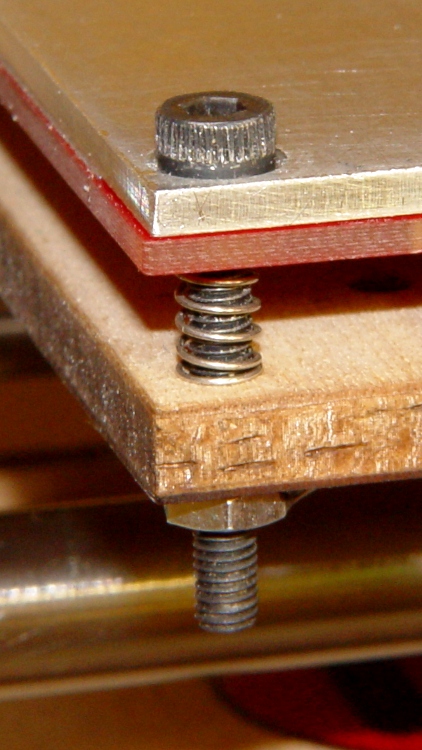
Those bolt heads sit in a 0.2 mm recess that lowers them just enough to be flush with the surface of the removable plate.
Then the removable plate sits atop the flat plate atop the heater: the two plates should snuggle together in Z and I think there’s no need to clamp them together. The holes have slight clearance around the bolt heads, making the plate a drop-in fit.
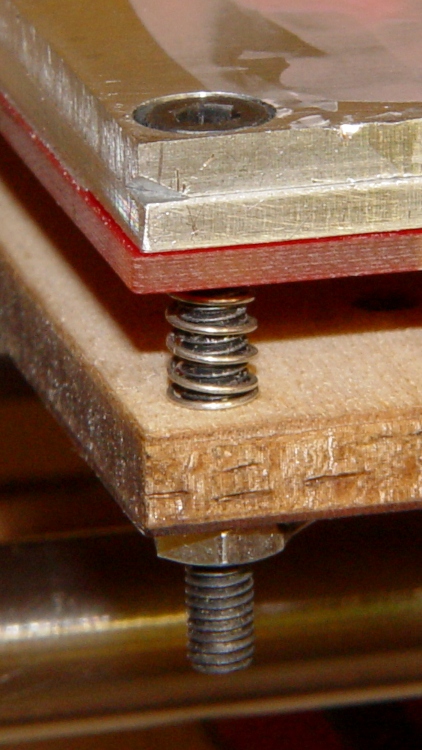
This view shows the small notch filed in the front left corner of the removable plate. I use a small scraper blade to pry the hot top plate loose after a build session, grab it with pliers, and carry it away for cooling. The Sherline mill’s tooling plate provides a wonderful cold surface and the ABS gives off a distinct snap when it cools enough to detach from the aluminum plate.
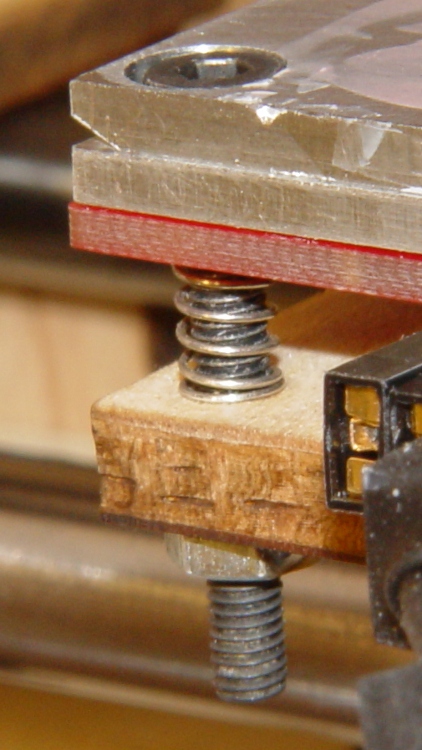
Although it’s not automated, swapping plates isn’t a tedious affair. The real delay comes from heating a cold plate to operating temperature again, which requires about five minutes.
The silicone wiper holds the removable plate against the bolt heads, providing some stability in the XY plane. There’s no need for precise indexing.
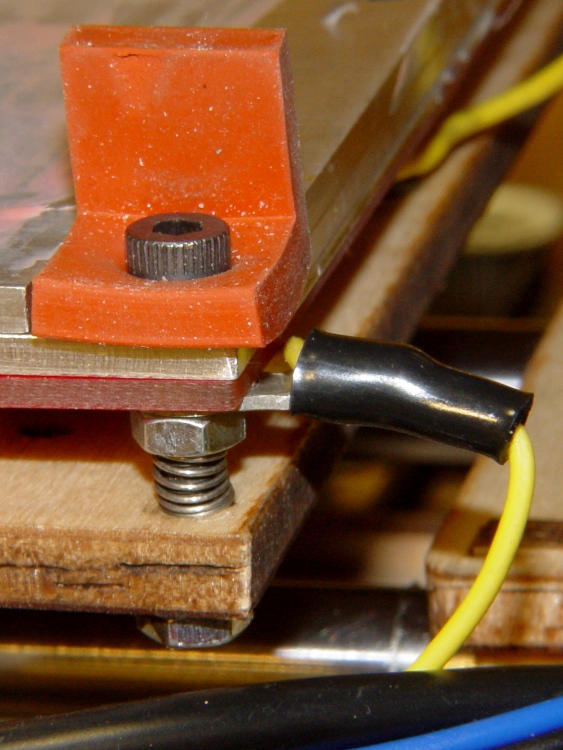
The Heater normally attaches to the HBP with six bolts, which severely overconstrains the surface. Here, three (center left, front+rear right) bolts clamp the heater to the sub-plate and three (front+rear left, center right) extend through the HBP plywood to nuts epoxied to the bottom surface.
Six matching springs from my Parts Heap support the whole affair, with the three on the clamping bolts being more compressed by the nuts below the Heater PCB. They come without pedigree and nearly anything that fits should work; it’s not like they must support an engine block.
The M3 bolts have a 0.5 mm thread pitch, so one turn changes the plate height by 0.5 mm and 1/6 turn (which is easy to make with a hexagonal wrench) changes it by 0.08 mm. The threads catch on the plate and Heater, so I may saw off some longer partially threaded bolts to get a smooth cylinder through the holes.
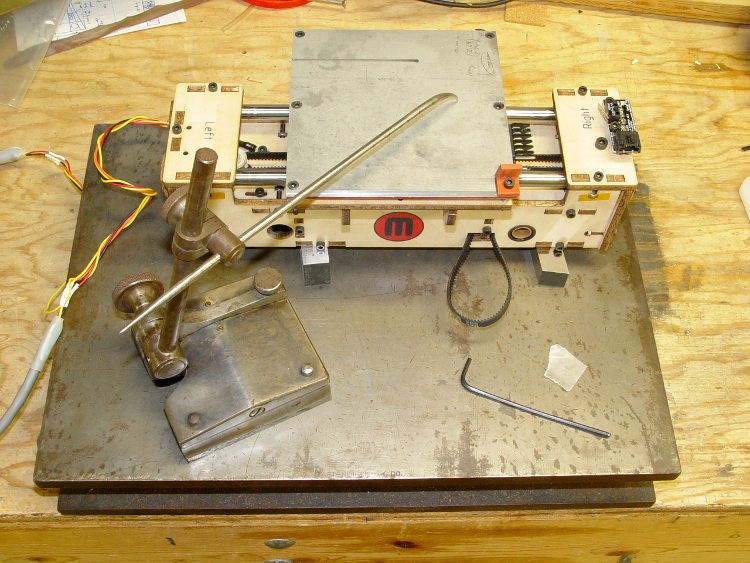
I did the initial adjustment on the surface plate with the entire XY stage assembly up on parallel blocks. Those blocks really should be under the Y guide rods inserted in the bearings, but this was enough to get a good first approximation to a level surface.
And then it went back into the Thing-O-Matic…
I thought of the X Rod Follower while I had this all apart, but after putting it together, I wasn’t going to build the follower just to tear the stage down right away.
 The Smell of Molten Projects in the Morning
Comments
10 responses to “Thing-O-Matic: HBP With Aluminum Build Plate”
[…] level build platform at a constant height from the nozzle. The platform leveling described there helps, but it’s a hassle to get everything set […]
[…] the X Rod Follower required realigning the aluminum sub-plate to get a level build platform. I got a crude initial setting by standing a 3 mm nut on edge under […]
[…] Build Plate Height and Level Stability The three removable build plates came from the same sheet of aluminum, albeit with different histories and somewhat different […]
[…] At 750 mA with just the aluminum sub-plate: […]
[…] build area seems like a Good Idea. The center line of the platform bolts sits 4 mm inward of the plate edge, to give you an idea of the […]
[…] start to see the effect of Z axis resolution and consistency on build quality. Putting the height adjustment on the build platform means you can set the initial nozzle height above the platform very precisely (no steps on the […]
[…] heaters to get the printer ready; heating from a cold start requires about 12 minutes due to the double aluminum build plates and hulking cartridge heater […]
[…] already found good values for those offsets as part of the aluminum build plate adventure, I jammed them into EEPROM using RepG’s Machine→Motherboard Onboard Preferences. […]
[…] The actual width depends on the actual thickness, of course: a too-low nozzle will create a too-wide pattern regardless of the extrusion settings. The thickness should be uniform across the entire pattern, so you can still adjust the platform leveling screws. […]
[…] this plate is firmly secured to the plywood build platform with three leveling screws over springs. Another aluminum plate, with Kapton tape as the build surface, sits on top, providing […]