A comment on yesterday’s post about quartz crystal measurements prompted me to destroy a crystal in the name of science…
The question is, what effect does exposing a crystal to the air have on its performance? I would have sworn it would never work right again, because it’s normally running in an inert atmosphere and maybe a partial vacuum. One measurement being worth a kilo-opinion, here’s what happened.
I picked random crystal from the bottom of the crystal box, based on it having a solder seal that I could dismantle without deploying an abrasive cutoff wheel or writing some G-Code to slice the can off with a slitting saw. The crystal was labeled HCI-1800 18.000 MHz and probably older than most of the folks who will eventually read this… younger than some of us, though.
The overall response, measured in the same fixture as shown yesterday (click the pix for more detail):
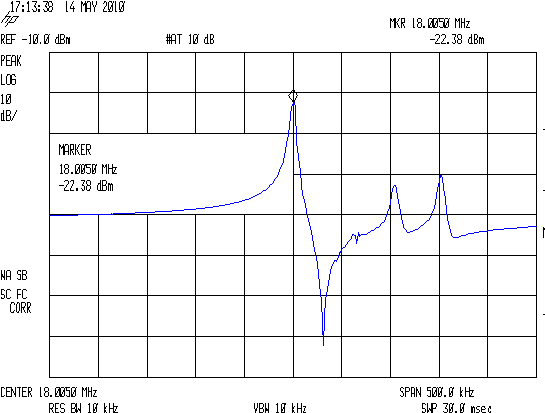
The center frequency is 18.0050 MHz (at this rather broad span) and it has some ugly spurs out there to the right.
A closeup of the series-resonant peak:
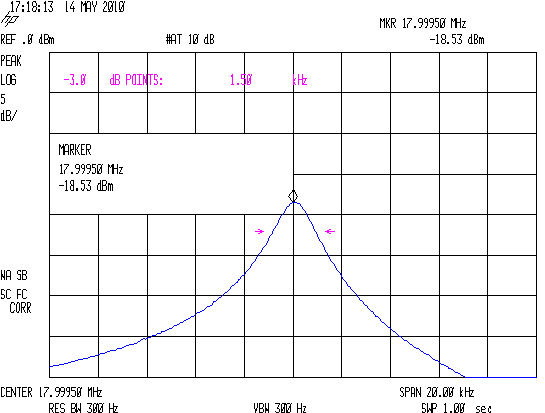
The bandwidth is 1.50 kHz at 17.99950 MHz at this span.

Then I applied a soldering iron around the seal and yanked the case off. I think that didn’t involve whacking the crystal with the case en passant, but I can’t be sure. In any event, it looks undamaged and seems to operate properly.
A pair of spring clips attach to the electrodes and hold the quartz disk in position. They’re just the cutest little things and quite unlike the other holders I’ve seen. I think the solder blobs fasten the spring ends together and don’t bond to the electrodes, but what do I know?

The quartz disk has a few small chips near the edge:
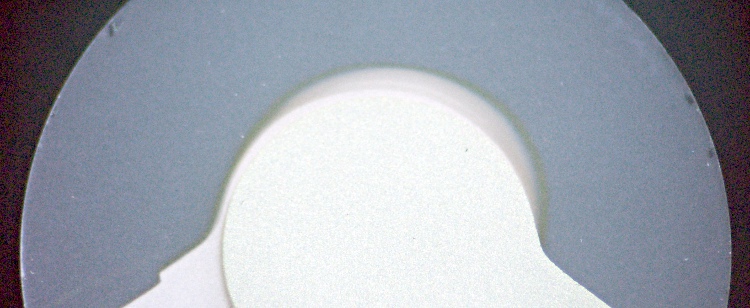
I think those are Inherent Vice… simply because:
- They’re not in a position where I could have whacked the disk and
- I doubt I could whack it that delicately
Anyhow, with the can off, here’s what the series resonant peak looks like:
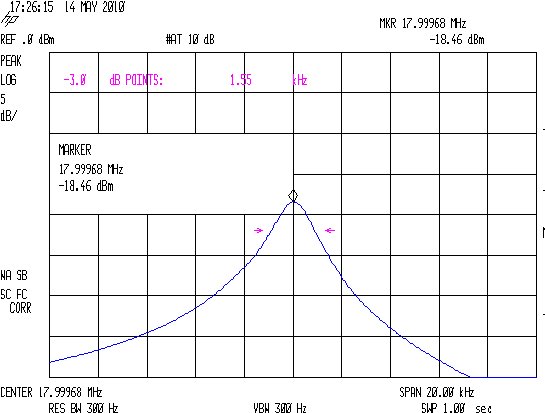
The resonant frequency is now 17.99968, 180 Hz higher, which may be due to instability in the HP8591 spectrum analyzer’s not-stabilized-for-ten-hours ovenized oscillator. The bandwidth is 1.55 kHz, 50 Hz wider, although I think that’s one resolution quantum of difference.
Here are the two bandwidth traces overlaid.
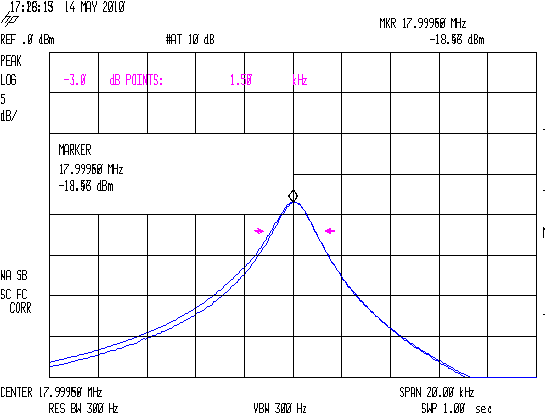
The peak has been centered in both, so you can’t tell they’re slightly different. The interesting point is the difference in the slope to the low-frequency side of the peak, which is slightly higher for the open-case condition. Seeing as how the missing case completely changes the usual stray capacitance situation, I’m not surprised.
Anyhow, I admit to being surprised: there’s not that much difference after opening the case. I’ll put the naked crystal in a small container in a nominally safe place for a while, then retest it to see what’s happening.
Memo to Self: A “safe place” is nowhere near the Electronics Workbench!
Here are some other naked crystals:

Notice the tarnished (presumably) silver electrodes on the crystal in the lower left. That one’s been sitting on my monitor and in other hazardous locations for a few years. I can’t find these anywhere right now, but if they turn up I’ll test them, too.
 The Smell of Molten Projects in the Morning
Comments
6 responses to “Opening a Quartz Crystal Can: Effects Thereof”
Can you please help me out i am trying to remove the seal of an HC-49U crystal for a project.
What exactly do i need to do this without damaging the contents inside. And it does have a disc shaped crystal unit right i dont wanna open up to find its some other shape as shape is of importance as well. Thank you!
For crystal cases sealed with solder, you can just apply a soldering iron and pull the top off. For welded cases, a Dremel abrasive wheel seems to not bother the crystal very much at all.
If you use an abrasive wheel, clamp the top of the case and be delicate!
There’s no way to tell: that depends on what the crystal manufacturer decided to use. I think they generally use round quartz slices because of the symmetry, but there’s really no way to tell. The smaller crystal in the picture has a rectangular slice because it operates in different mode, which was obvious before I cut the can open: no room for a disk!
Thank you for the info been really helpful ill try it out.
Let us know how it works out!
Wouldn’t part of the change in resonant frequency with the case removed be due the stray capacitance between the crystal proper and the case?
That gets modeled as capacitors to the case from each side of the RLC equivalent circuit, plus another cap across the whole RLC. The resonant frequency depends mostly on the RLC, with a very weak dependence on the stray caps.
So it doesn’t change much at all. I think the tempco will have more of an effect in real life, not to mention the deterioration of the electrodes in what passes for room air around here.