
With the epoxy cured overnight, I fired up the Sherline CNC mill to poke screw holes in the brass hinge splice.
The first step was to mill a flat-bottomed hole in the lower surface of the thin brass to expose the threaded hole in the remaining hinge plate. I crunched the end of the frame in a machinist’s clamp, then grabbed that in the Sherline milling machine vise; the frame is upside-down in the picture.
The brass stock was 0.015 inches, so I milled downward 0.020 inches to get through the epoxy. I’d love to say that worked perfectly, but I had to fiddle around a bit and eventually put a slight divot in the hinge plate.
That alignment was by pure eyeballometric guesstimation, but poking a small epoxy disk out of the threaded hole revealed that the 2 mm milled hole was centered on the hinge hole. Pretty close. Kinda-sorta. Good enough for my purposes, anyway.

I aligned the spindle to the actual hinge hole with my laser aligner, a process that turned out to be surprisingly easy: note where the red dot vanishes on each side of the hole, split the difference, repeat for the Y axis, and you’re done.
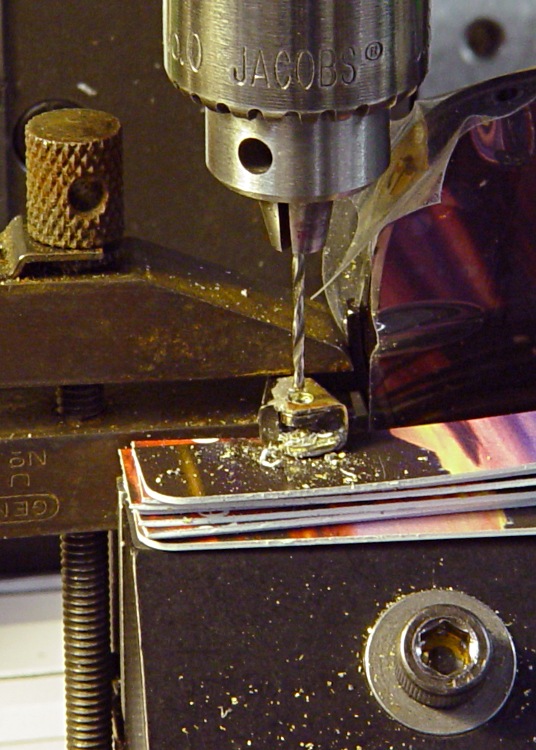
With the spindle centered, I ran a #60 drill through the threaded hole (which it just barely cleared) and poked a hole in the thicker top plate (which is on the bottom here, remember). The packing under the hinge is a cut-up credit card; a handy source of thin sheets of stiff plastic.
Then I flipped the frame over and drilled out the top hole with a #54 drill to clear the threads on a 00-90 machine screw. I’d like to say I did a precision alignment job, but what I actually did was chuck that little bitty drill up in my big drill press, run it on the slowest spindle speed (maybe 400 rpm), brace my arms on the table, and feed the frame onto the drill by hand. Works perfectly… if only because I’m enlarging the hole by, what, 7 thou on each side.
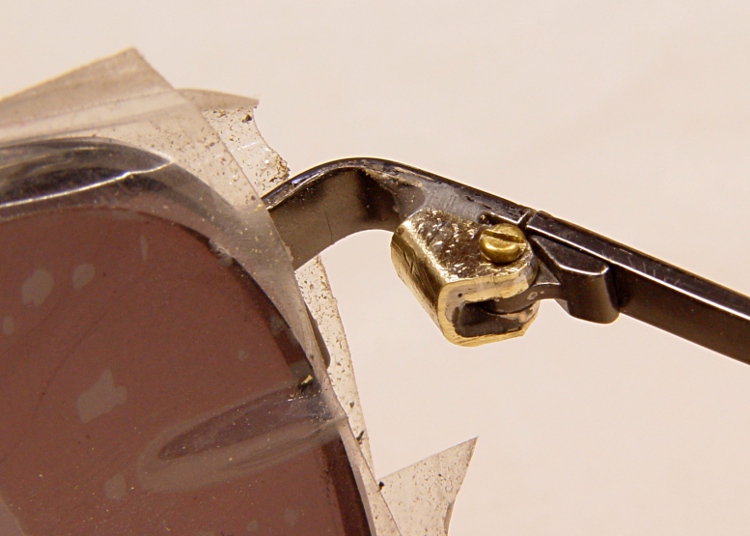
A bit of filing cleaned up the drill chaff inside the hinge so I could mount the earpiece on the frame and screw it in place. I don’t have a 00-90 tap and wouldn’t use it in a titanium frame anyway, so you can tell this isn’t going to have a happy outcome, but, by and large, the undoubtedly metric threads in the frame did a pretty good job of re-forming the 00-90 brass threads. Ugly, but serviceable.
Some Dremel-tool work with an itsy grinding wheel on the flexy shaft eroded the back side of the U-shaped brass and new hinge plate to clear the earpiece; I think it only took half a dozen trial fittings & tiny grindings before the earpiece folded properly.
A dab of low-strength purple Loctite in the threads and I’d say that screw is in there for life!

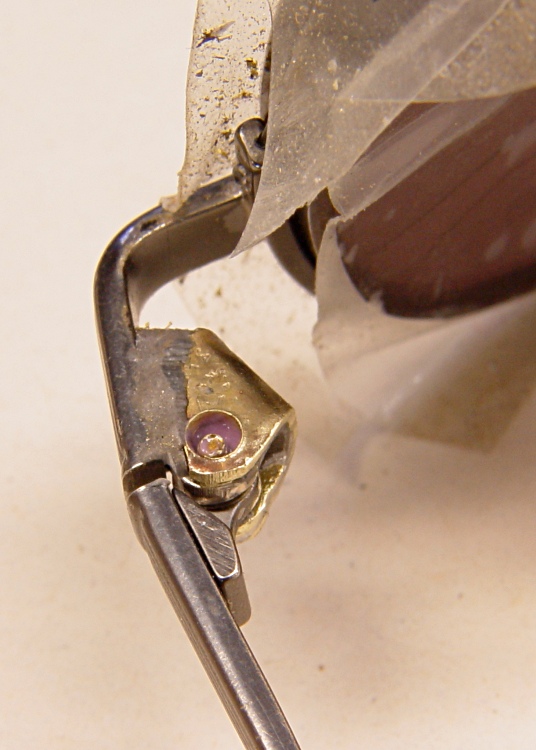
Then I cleaned it up with a miniature wire wheel and, hey, it’s got a certain geeky charm, doesn’t it?
I have my doubts about how well the epoxy affixes itself to the brass, so I suspect I’ll be drilling a hole or two to mechanically lock it in place with some urethane adhesive when it falls off.
If the remaining hinge plate fractures, however, then the frame is toast.
Until I get around to having the optical shop dye up another pair, these should suffice for my simple needs.
Trivia:
The plastic film on the lenses comes from a big roll of the stuff they use to protect CRT monitors in shipping. Works great for shop projects and, back in the day, I used it when I was hauling monitors around. I think it’d suck the front right off an LCD panel, so I haven’t used much of it lately.
If you’re following the pictures, you’ll notice that the dsc* numbering series resets right in the middle of the story. That’s where my Sony camera gagged while writing an image and explains why I don’t have pix of the first drilling steps.
The color balance is weird on the milling machine pix because the shop lights are much cooler than the warm compact fluorescent bulb hovering over the table.
 The Smell of Molten Projects in the Morning
Comments
2 responses to “Sunglasses Repair: New Hinge Holes”
[…] I let the epoxy cure overnight… when the story continues. Comments […]
[…] or Y axis, which means you generally resort to successive approximation. I did something like that there with good […]