The Smell of Molten Projects in the Morning

Ed Nisley's Blog: Shop notes, electronics, firmware, machinery, 3D printing, laser cuttery, and curiosities. Contents: 100% human thinking, 0% AI slop.

Tag: Wildlife

Other creatures in our world

  • Tree Frog: The Video

    Frog walking on tent
    Frog walking on tent

    Watching the tree frogs crawl up the tent from inside let us see how they move: hand-over-hand up the fabric. A dozen of them crawling along was spooky…

    I took a movie with my pocket camera that turned into an 8 MB AVI, which I can’t upload here. Most of it isn’t all that interesting, anyway, an observation which hasn’t stopped YouTube dead in its tracks yet, but we can do better than that.

    A pair of Free Software programs extracts the interesting part and produces a (somewhat) smaller animated GIF that works with WordPress.

    First, shatter the AVI into separate JPG images:

    mkdir frames
    ffmpeg -i cimg3781.avi -sameq frames/frame-%03d.jpg

    A bit of browsing showed that I wanted frames 227 through 265 and that the frog was pretty much in the upper-middle of the image. So, crop a 320×240 image around the frog from those 640×480 frames:

    cd frames
    mkdir stills
    for f in `seq 227 265` ; do convert frame-$f.jpg -crop 320x240+160+60 stills/still-$f.jpg ; done

    Then convert them into an animated GIF with a 500-ms frame rate (the -delay ticker is 10 ms):

    cd stills
    convert -delay 50 still-2* frogwalk.gif

    It’s a 1.6 MB wad, but gets the message across: frogs keep three paws stuck to the floor.

    Remember, that little guy is moving at glacial speed in the GIF: those 40 frames of video last just over a second in real time.

    Memo to self: MPEG-1 and MPEG-2 only support video-style frame rates around 30 fps.

    Update: Regular reader Przemek Klosowski showed me how to generate those numeric sequences on the fly, without using a for loop:

    There's this neat Bash construct {1..10} that you can use directly after ffmpeg:
    convert -delay 50 still-{227..430}* result.gif
    
    You can even skip every nth frame:
    convert -delay 50 still-{227..430..5}* result.gif
    

    Thanks!

  • Tree Frogs!

    Tree Frog - View Through Tent
    Tree Frog – View Through Tent

    We bicycled along the Pine Creek Gorge rail-trail in north-central Pennsylvania on a Rails-to-Trails Conservancy group ride, camping at schools and campgrounds along the trail. Quick summary: for four days we rode in the sun and slept in the rain.

    Tree Frog - Natural Light
    Tree Frog – Natural Light

    As we set up camp at Pettecote Junction, the wet ground was hopping with tiny tree frogs. It was impossible to avoid stepping on the critters. When we got the tent set up, they swarmed up the sides between the tent and the rain fly; perhaps they had an imperative to get above the flood?

    The lines in the tent fabric are about 3.7 mm apart, so the frogs are perhaps 10 mm from snout to butt. That size rules out everything in our RTP Eastern Reptiles & Amphibians book except the Little Grass Frog, which used to live only south of Virginia. The spot pattern doesn’t match, either, although they’re said to be highly variable. Who knows what’s going on in these degenerate days?

    cimg3787 - Tree Frog - Flash
    Tree Frog – Flash Illumination

    They didn’t like the mesh vent screens, favored the rougher tent fabric over the smoother seam binding, and didn’t seem to mind falling off the tent.

    Things are different when you’re small.

    Tomorrow: the video

  • Dragonfly

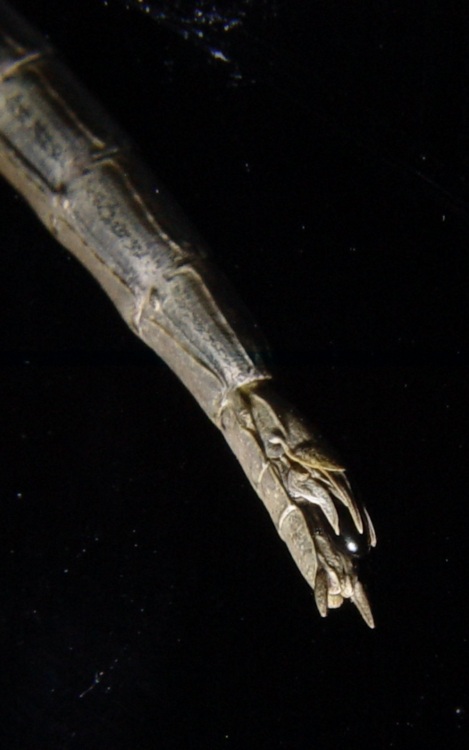
    I found this fine specimen parked on the underside of a second-floor patio.

    Dragonflies date back to the Age of Dinosaurs, so they’re about as well-tested and proven as an insect can be.

    We enjoy watching them dart overhead in the evening, catching mosquitoes on the wing. We’ll even overlook their grabbing the occasional honeybee

    The body patterns are just beautiful.

    Photo with Sony DSC-H5 from about 5 feet with flash.

  • Staghorn Beetle

    This scary-but-innocuous fellow landed on our doorstep last night.

    Staghorn Beetle
    Staghorn Beetle

    He’s a staghorn beetle and, as nearly as we can tell, uses the mandibles to demonstrate his superiority over the rest of the staghorn beetles in the neighborhood.

    Staghorn Beetle - top
    Staghorn Beetle – top

    Go, beetle, go!

  • Bees!

    Swarm cluster
    Swarm cluster

    We hived a giant swarm!

    They’re doing well in their new home, building out comb on the foundation. The queen is in good shape, laying eggs as soon as the workers finish the cells. The workers seem to be feeding pollen directly to the larvae rather than storing it, which makes perfect sense. They’re taking two quarts of 1:1 sugar water every day!

    Either you already know what this is all about or you really don’t want to know.

    ‘Nuff said…

  • Cellular Toad

    Toad in planter cell
    Toad in planter cell

    Mary left a plant starter pot on the patio overnight and found an unexpected resident when she picked it up: a toad tucked neatly into a vacant cell.

    It’s difficult to tell with toads, but we think that’s a smug expression. The cell was just exactly body-sized, so maybe it’s a snug expression.

    Toad in garden
    Toad in garden

    Put back in more natural surroundings, in the garden with abundant flies & bugs, the critter faded right out of sight.

    The plant is celeriac, which sounds like it should be a computer built around 1946…

  • Bird Box Entrance Reducer

    Wren-sized entrance reducer in place
    Wren-sized entrance reducer in place

    We put out bird boxes to encourage more House Wrens, but House Sparrows often take over the boxes. This year we kept the boxes down until the sparrows had already started their nests in the bushes, hoping that the wrens would get a head start on their nests. Two days after we put the boxes up, we had a nesting pair of wrens… and two days later a pair of sparrows had evicted them and were installing their own nest.

    Rechecking the box specs, it seems wrens prefer a hole somewhere between 7/8″ and 1-1/8″, but I’d drilled 1-1/2″ holes for bluebirds (a long time ago, before we knew bluebirds vastly preferred the edges of open fields). Making a hole larger is easy, making one smaller is more difficult.

    Cutting off the barb
    Cutting off the barb

    I thought of making a wood bushing, then came to my senses: a 3/4″ thick wood ring with 1/4″ walls just wasn’t going to work. Given that the wrens (or their ancestors or relatives) have already tried nesting in our gardening boots, bicycle helmets, and tool trays, I figured they wouldn’t be too fussy about the material around their entrance hole.

    To the Basement Laboratory Machine Shop Wing!

    The parts heap disgorged a box of huge hose barb fittings, one of which had a 1.1″ ID and a 1.4″ OD: close enough. I parted off 3/4″ from the end of the barb, using a bit not really suited for the purpose that gave a nearly perfect edge in the soft plastic. One swipe with a deburring tool and it’s done.

    Bushing ready to install
    Bushing ready to install

    A few wraps of duct tape provided a nice press fit and a springy retaining force without gluing the barb in place. This is pretty, mmmm, barbaric, but if it survives one nesting cycle I’ll do something much nicer.

    Time is definitely of the essence here, as we fear the wrens have been driven away: we haven’t heard them since their eviction. I did three boxes in about half an hour; we’ll see what transpires.

    The bottom pic shows the box from the front yard, where Downy Woodpeckers nested for a few years. They thought the hole needed a bit of renovation… and they have the tools for the job!