The Smell of Molten Projects in the Morning

Ed Nisley's Blog: Shop notes, electronics, firmware, machinery, 3D printing, laser cuttery, and curiosities. Contents: 100% human thinking, 0% AI slop.

Tag: Wildlife

Other creatures in our world

  • Bed Bugs: Infestation and Breeding

    The first thing to understand about our infestation is that we never actually saw an adult bed bug. In fact, of the hundred-odd photos I took during the experience, it’s not clear that any show a bed bug.

    That’s a crucial difference between our infestation and the horror stories you’ll read about elsewhere. Our infestation consisted of a relatively few bed bugs and, because we (generally) acted quickly, decisively, and consistently, they didn’t multiply beyond control.

    There is no mistaking a bed bug bite, however, and that will probably be the first indication that you have an infestation. The references in the first post in this series should give you a general idea of what a bite looks and feels like, but here’s a quick summary:

    • You’ve never felt a bite itch like that in your life
    • Two or three such bites, a few cm apart, are diagnostic

    Some people have a long-delayed reaction or no reaction at all. If you’re one of those folks, then our techniques probably won’t work for you, unless the rest of your family has more “normal” reactions.

    Bed bugs are obligate hematophages: they must have at least one blood meal at each stage of their life cycle. That’s where you come in. While they prefer humans, it seems any mammal will serve in a pinch, and if you’re the sort with indoor dogs or cats, you have a real problem.

    Because they’re only a few millimeters long, bed bugs tend to stay relatively close to their food supply (i.e., you), rather than commute long distances. The bed bugs you brought home will, most likely, quickly take up lodging in your bed, a favorite chair, or the desk where you sit for a few hours. Eliminating all of those lodgings, known as harborages, is essentially impossible, despite what you read in the references.

    Each of the five instars from egg to adult requires at least one blood meal to provide enough energy to grow and molt. An adult female bed bug requires one meal after mating, after which she can produce a few hundred eggs without another meal. Although the references aren’t forthcoming, we think bed bugs have no qualms about introducing loops in their family trees: any male may inseminate any female.

    (Digression: So you think you’re comfortable with weird sexual practices? This will turn your stomach: bed bugs practice traumatic insemination.)

    Our overall plan of battle, then, was quite simple:

    • Eliminate as many harborages as practical
    • Prevent every instar from progressing to the next stage
    • Prevent breeding

    The plan may be simple, but the implementation posed some, ah, difficulties…

  • Bed Bugs: Overview

    Back in July, we returned from our bicycling vacation with a few bed bugs in our luggage. We have our suspicions about where they came from, but that’s not really relevant: bed bugs can come from nearly anywhere. You can bring a bed bug home from a classy hotel just as easily as from a sleazy dive… and you will!

    After three months, we think we’ve eliminated the last bed bug: no bites for the last three weeks. One can never be absolutely certain, but that’s definitely a good sign, particularly in combination with the monitoring measures we’re using.

    We accomplished this on our own, without the use of a licensed PCO (Pest Control Operator) and without the use of toxic chemicals. It was, however, extremely expensive in terms of time, materials, and furnishings, as well as completely disrupting our family life.

    While our methods definitely do not scale to the level required for a major infestation, most likely you’ll be in our situation: you return from a vacation with one or two, um, guests. If you understand what we’ve done and why we’ve done it, you’ll have a better basis for your own decisions and actions.

    So.

    Most of what you’ll find in the usual Internet forums comes from (possibly) well-meaning folks who haven’t done any reading or experimentation: it’s raw anecdotal experience. Not to slander them, but it’s better to start with the basics, which you get from the primary sources.

    To that end, here are the better sources we’ve found and used:

    With those references in hand, I can describe what we did and how it worked. If you’re the sort who can’t drive past a nasty accident without gawking (and we are all that sort, really), then the next week or so should be good for at least that level of amusement…

    A note to the potential purchasers of our house, when you read this in what’s currently our future: yeah, bed bugs. The only difference between this house and the next one on your list is that you know what happened here, what we did, and how it worked out. Trust me on this: no other homeowner will tell you anything about their bed bug experiences, to the extent of lying to your face.

    Believe it.

    Update: Here’s a quick index to the rest of (this chapter of) the Bed Bug Story:

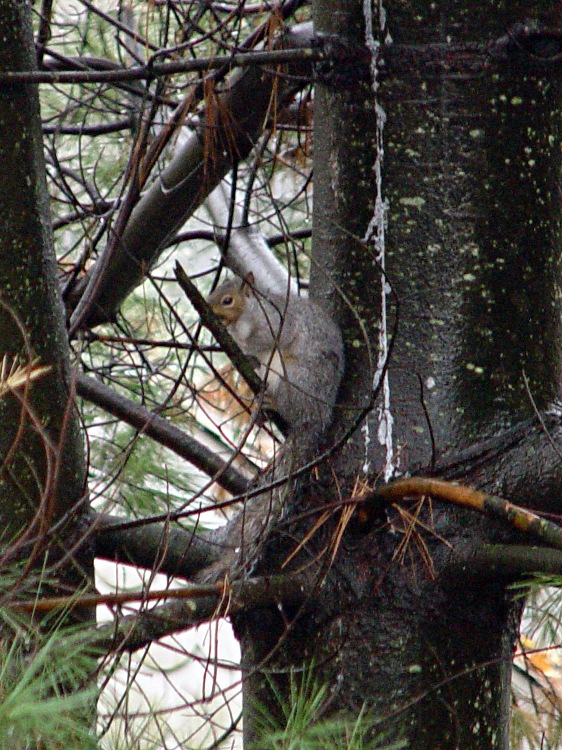
  • What Do Squirrels Do When It Rains?

    Rain-soaked squirrel
    Rain-soaked squirrel

    Although I’m not a big fan of tree rats squirrels, I’ll admit this one was having a tough time of it during a recent rainstorm. He (she?) sat motionless on that stub of a branch for well over half an hour, no doubt thinking gloomy thoughts.

    Taken through two layers of mid-1950s window glass, so it’s not the sharpest image in my collection, but I’m not going out in the rain just to take a picture of a squirrel!

  • Turtles on a Log

    If there’s anything to reincarnation, next time around I’m going to put in a request to be a Staff Turtle at the Vassar Farm Environmental Station.

    Vassar Farm Turtles
    Vassar Farm Turtles

    Taken with my Casio EX-Z850 pocket camera, underexposed 2/3 stop to avoid blowing out the highlights even more. This is a dot-for-dot crop from the middle of a much larger 8 MP image, crisped up just slightly. Terrible results, but it’s better than the big camera I didn’t drag along on a guided geology tour (which ended with a generous handful of fine clay from the stream a bit further along).

    And, yeah, I know the whole reincarnation thing says you get what you deserve, not what you want. On the other flipper, nobody really knows how it all works, so I’m not losing hope.

  • Experimental Determination of Squirrel Sprint Speed

    So there we were, biking along the northern segment of the Dutchess Rail Trail, when a squirrel scampered up a fencepost a few hundred feet ahead of us and struck a classic tree-rat pose: standing up atop the post, tail arched behind, front paws together.

    As we rolled closer, the squirrel noticed us and, as squirrels are wont to do, panicked.

    *Must* *run* *away*

    Squirrels tend to escape up the nearest tree, which works perfectly with most predators. In this case, though, the squirrel was already as high as it could get on the post and there were no trees within jumping distance.

    Decision time: can’t run up, can’t escape to the side, must not run toward the threat.

    *Must* *run* *away*

    So the critter lit off along the top rail, hurdling over the protruding fenceposts in a dead run, as fast as its little legs could carry it.

    Which, as it turned out, was just over 15 mph. We stopped pedaling and coasted, but this section is slightly down-grade and we didn’t slow very much.

    The thing was running at my eye level, about five feet to my left, and kept pace with us for maybe a dozen fenceposts. Finally it decided this tactic wasn’t working and dove off the fence into the bushes beside the trail.

    Squirrels must produce adrenaline like I produce saliva.

    And I really, really need a helmet camera…

  • Dry Ice Sublimation Rate

    For reasons I’m not at liberty to discuss, we had a cooler of dry ice pellets in the freezer for a few days. I used about a pound of it a time to mumble.

    I started with “10 pounds” of dry ice in a half-pound Styrofoam container with 1.5-inch thick walls; the total weights include the container. For what it’s worth, dry ice costs $3.50/pound under 10 pounds, then $2.75/pound over that. It used to be plenty cheaper in the old days, evidently, but everything else was, too.

    In between withdrawals, the cooler sat in the freezer and and the dry ice quietly sublimated; here’s how the weight varied between uses.

    Starting weight: 9.2 lb gross, so I lost quite a bit in transit. Which, as it happened, was about half an hour in a bike trailer during a rather hot afternoon.

    A) 7.2 to 6.7 lb -> 0.5 lb / 15 hr = 0.033 lb/hr

    B) 3.8 to 3.0 lb -> 0.8 lb / 11 hr = 0.072 lb/hr

    C) 2.7 lb to 2.0 lb -> 0.7 lb / 11 hr = 0.064 lb/hr

    I’m suspicious of that low number for the first stay, too. Maybe a side effect of having the cooler’s cavity nearly full of dry ice? Or the freezer ran defrost cycles for the other two?

    Anyhow, to a back-of-the-envelope resolution the cooler loses a bit over 0.05 lb/hour of dry ice. Call it 15 hr/lb.

    The temperature of sublimation is, according to Wikipedia, -109°F. The freezer is around 0°F: a differential of 109°F across 1.5 inches of Styrofoam. Assuming the cooler foam has R=4 with units of (ft^2·hr·°F) / (BTU·in ) and an internal surface area of 304 in^2, the cooler leaks heat at 38 BTU/hr. Call it 11 W.

    Cross check: Wikipedia says the enthalpy of sublimation at STP is 571 kJ/kg. Sublimating 0.07 lb = 0.031 kg requires 18 kJ (18 kW·s) and doing that over the course of an hour requires 5 W.

    Well, considering the rough-and-ready measurements and the fact that the freezer isn’t at STP and that I’m ignoring gas leakage and a bunch of other stuff, a factor of two error is spot on.

    If I were you, though, I’d double-check those calculations before leaping to any particular conclusions. Fair enough?

    When all was said and done, I found this thing in the bottom of the cooler. It wasn’t there when we started, soooo

    Dry Ice Thing
    Dry Ice Thing
  • Chipmunks Discover Agriculture

    Chipmunk atop sunflower
    Chipmunk atop sunflower

    One of the sunflowers in the garden started swaying wildly, despite having no breeze at all. I though it was a goldfinch plucking seeds, but a quick look through the binoculars showed a brown furry tail hanging below the topmost seed head, about five feet off the ground.

    Mary reports that this is one of five sunflower plants growing in a tight group near the garden fence; she thinks a chipmunk’s seed stash sprouted. This could be the start of something big: next thing you know, they’ll be planting seeds and harvesting crops!

    As we watched, the critter’s cheeks became more and more distended.

    Chipmunk stuffing cheek pouches
    Chipmunk stuffing cheek pouches

    Eventually, however, gluttony overcame common sense.

    Getting the last seed
    Getting the last seed

    Seconds after the shutter clicked, the sunflower head disintegrated, depositing the chipmunk on the ground with a rustle and a soft plop.

    No damage done, we’re sure, and that critter’s pantry should be stuffed full in short order. Next year Mary will probably do some extensive sunflower culling to get room for the rest of her crops!

    And, yes, the title is a riff on Bears Discover Fire