Ed Nisley's Blog: Shop notes, electronics, firmware, machinery, 3D printing, laser cuttery, and curiosities. Contents: 100% human thinking, 0% AI slop.
Even half an inch of masking tape forms an impenetrable barrier for small creatures; you could splurge on 2-inch tape to get more surface area if you’re squeamish. I did see a spider stepping daintily along a barrier, but, for the most part, all these specimens became mired within a few millimeters of an edge. That made it easy to decide which direction they were traveling: incoming insects stuck near the floor and a (very few) outbound insects stuck at the top, just after leaving the non-sticky surface.
This is, we think, a well-fed first- or second-instar bed bug caught on a tape barrier; it’s not quite the right shape for the book louse seen below. A powder trap caught the only other bed bug in our collection.
Bed bug on tape
In addition to that sole bed bug, the tape barriers captured a steady stream of critters that were not bed bugs. The trick is sorting through all the false positives…
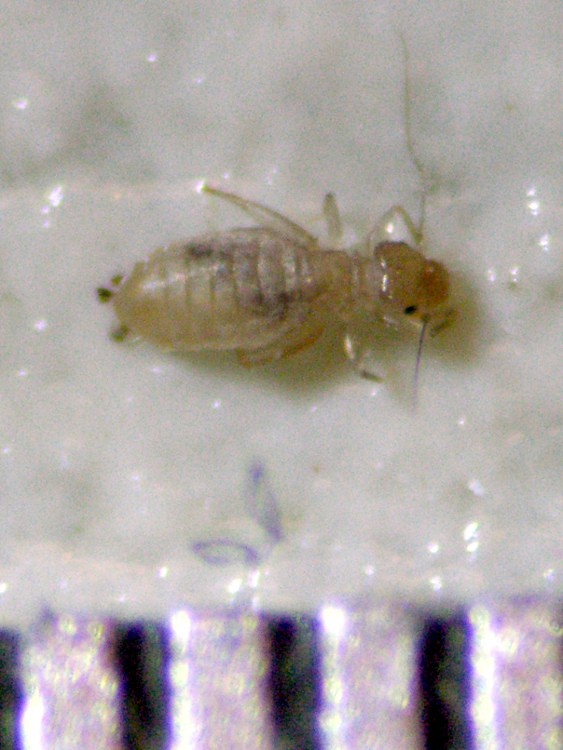
Given the number of books in the house, we caught many book lice. These have a disturbing resemblance to bed bugs, but are basically harmless to humans. You don’t really need books to have book lice, although we captured most of them adjacent to our bookshelves.
Book louse with 0.5 mm scale
This scary critter is a carpet beetle larva. They survive on any fabric surface and can infest upholstery as well as carpets.
Carpet beetle larva with 0.5 mm scale
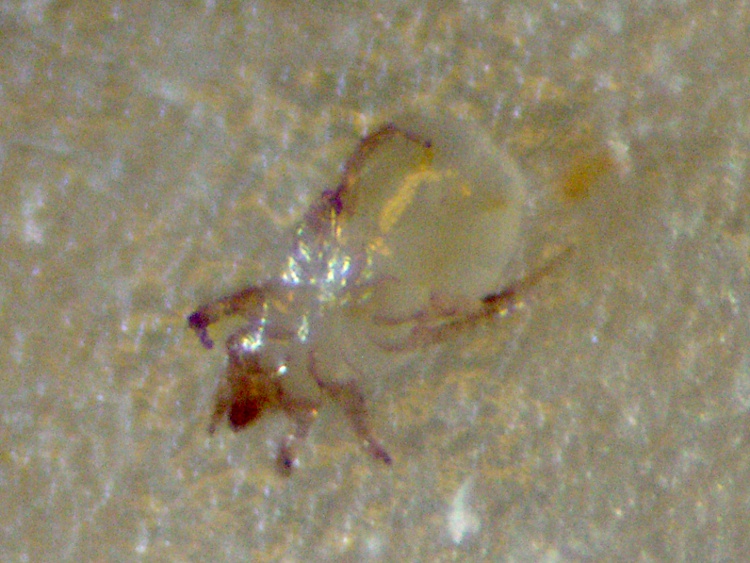
Dust mites, at least for their first few instars, are transparent little bags of bug stuff. The first instar may have six legs, just like a first instar bed bug, but successive instars have eight.
Dust mite first instar
Here’s a close up view, showing it has eight legs:
Dust mite
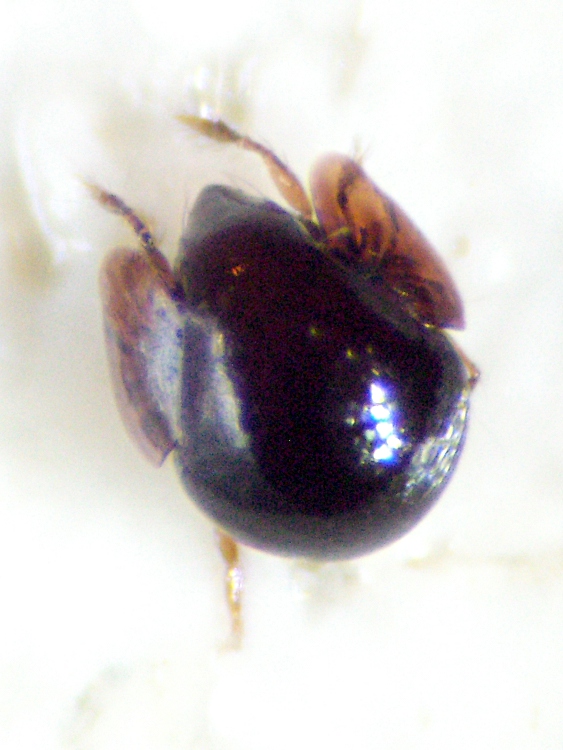
We have no idea what this cute little thing might be. It’s about 0.5 mm in diameter and, to the naked eye, looks like nothing so much as bed bug crap. But it’s alive!
Spherical insect – dorsal
This terrifying apparition sprinted across the (non-isolated) kitchen table, whereupon I mashed it with a magazine. It’s most likely not a bed bug; we’re guessing a spider of some sort. That stylet in its proboscis doesn’t look spider-ish, though.
Red insect with stylet
It might be related to this eight-legged critter; the lancet on the front end is similarly scary. The legs aren’t the same, though.
Mystery bug
All in all, we found a bewildering variety of insects, bugs, and spiders wandering around in our house. None of them are particularly harmful, although I now have a (most likely pyschosomatic) allergy to dust mites.
We’re not entomologists: if you know what the mystery critters are, I’d like to hear from you!
Up next: a Hot Box that might forestall all this excitement.
During the course of our adventure, we disinsected four rooms with varying degrees of attention to detail.
Our bedroom: everything except bookshelves
Guest bedroom: killed bed, but not much else
Living room: killed desks and chairs, isolated couch
Downstairs office: killed desk and chairs, spread DE
In each case, we wondered how could we demonstrate that there are no bugs left to kill? Yeast reactor lures don’t produce human-scale amounts of carbon dioxide, although we did deploy them to see what happens. Simply moving everything back into the room didn’t seem like a Good Idea: repeating the whole process if we got another bite wasn’t attractive.
Given the low level of infestation, we decided that the most effective bed bug lure was an actual human: me. Ideally, we could intercept the approaching bed bugs before they bit me and, if no bed bugs were attracted to me, then we simply didn’t have any.
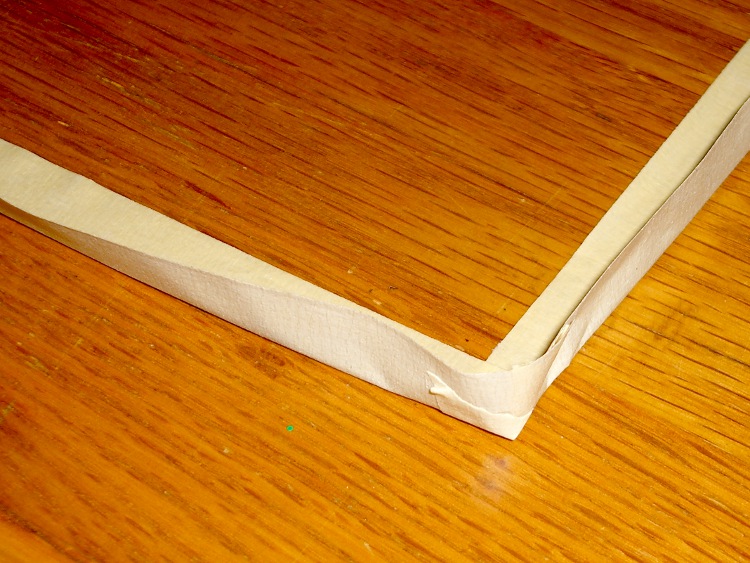
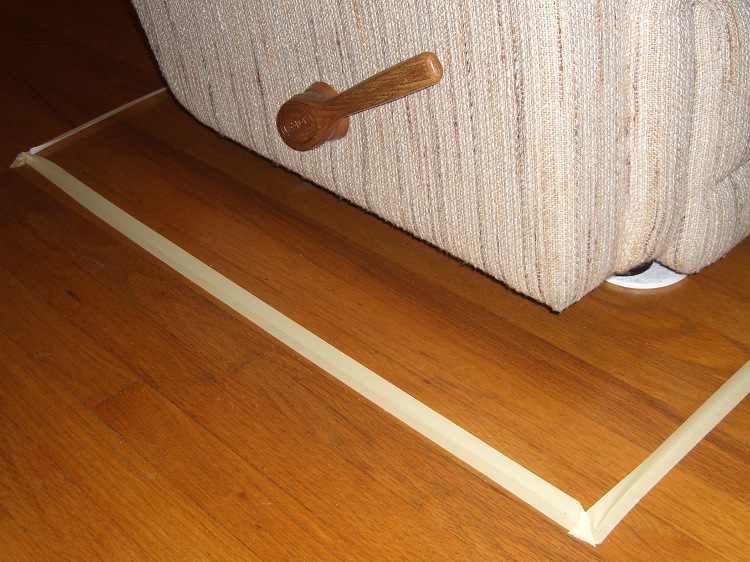
Now, I’m not sufficiently brave (or stupid) to simply spend the night (“sleeping” may be too strong a term) on the floor, waiting for a bed bug to stroll over and puncture me. I laid out a barrier around an air mattress and sleeping bag: a ring of masking tape folded so half stuck to the floor and half presented a sticky surface to incoming bugs.
Tape barrier on floor
To date, we’ve gone through four rolls of masking tape and I just bought two more three-packs. Buy in bulk and save!
The best tape is ordinary, albeit good-quality (we’ve been using 3M), painter’s masking tape; the three-day kind works fine. Fancy long-duration blue tape isn’t sticky enough. You should pull the tape up, examine it for stuck bugs, and lay down fresh tape about twice a week.
This works well on our hardwood floors, but wall-to-wall carpets probably won’t provide enough flat surface for the tape. If you’re serious about this project, those carpets might just have to go…
I’ll leave to your imagination the picture of an air mattress, sleeping bag, and suchlike in the middle of a large rectangle of tape inside a stripped room. I’ve been sleeping that way, in various rooms, for the last three months. I didn’t spend any nights in the basement: it’s just too cold down there, even in summertime.
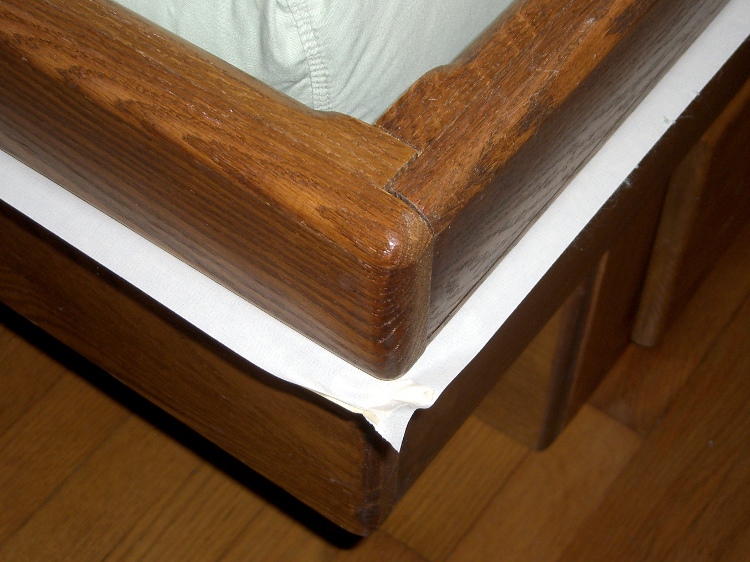
We only recently reassembled our platform bed, with a layer of diatomaceous earth underneath. I taped the cracks and gaps around the platform and applied a ring of tape to the outside: any intruders will encounter a sticky surface. So far, no bugs, although I just renewed the tape once again.
Isolated platform bed
You can also lay tape down with the adhesive facing inward. Here’s the living-room couch we’ve abandoned in place, up on powder traps and isolated with a ring of masking tape:
Isolated couch
After you’ve deployed a variety of lures, traps, and tapes, you’ll start collecting a wide variety of insects and bugs. Some of them might even be bed bugs…
[Update: If you’re arriving from that link in bedbugger.com, this adventure has many parts. Start there to see them all.]
After we dismantled our bedroom, Mary got bitten while sleeping in the guest bed. That bed, a much smaller, more-or-less standard double bed mattress and box spring on a metal frame, was much easier to disinsect:
Wash and dry all the bed linens
Toast the pillow in the clothes dryer
Vacuum the mattress and box spring
Encase the mattress and box spring
Heat the frame to killing temperature
Reassemble everything
Encased mattress and isolated foot
However, there’s not much point in doing that if a bed bug can simply crawl from the floor up a bed frame leg. We put powder traps under each bed foot, using tall containers to prevent access.
Although the traps collected a fair amount of dust, we didn’t find any insects of any kind in the powder.
Yes, that’s a length of Kapton tape on the mattress encasement. Mary discovered that heating the encasement with a hair dryer isn’t a good idea: the fabric is actually a non-woven plastic film that melts at a surprisingly low temperature. Kapton sticks to the fabric and the adhesive doesn’t promptly turn into goo.
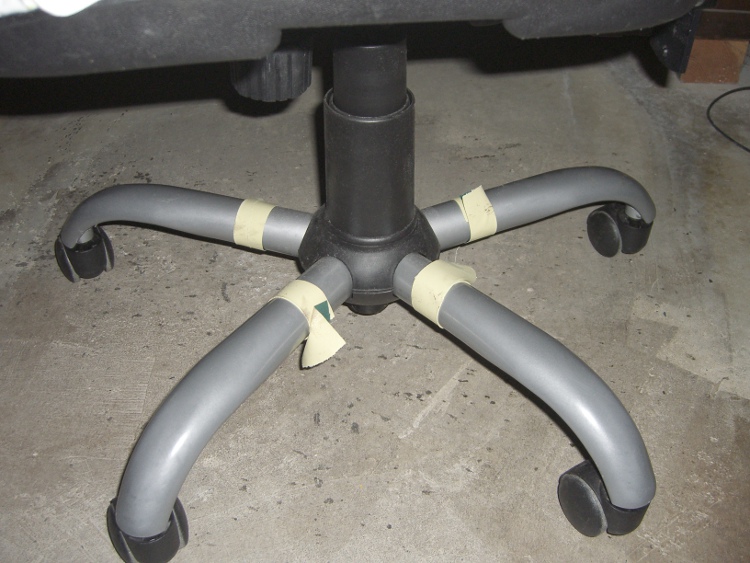
Powder traps work well for stationary furniture like beds and tables and desks, but they aren’t useful for chairs. I applied a ring of tape (masking or duct, as you prefer) around chair legs, folded lengthwise so the sticky side is outward. The tubular steel legs on this office chair terminate in fishmouth welds on the central pillar, so the bugs can’t crawl up through the inside:
Isolated desk chair
That’s the chair I pulled out of storage after scrapping out my homebrew car-seat chair. Turns out I installed the replacement seat about a week before sustaining a bite while sitting at my desk. Calling down the angelfire on that comfy chair was more annoying than expensive, but … no more bug bites in the basement!
For historic reasons, I use an ancient Balans chair at the Electronics Workbench. Four strips of masking tape isolated it from the floor:
Isolation tape on Balans chair leg
Isolating the chair from the floor obviously doesn’t prevent a bed bug from crawling up your leg, but we never had a problem with that. They’re not really hunters and vastly prefer to lurk in furniture than track and pounce on a moving shoe…
As it turned out, we never trapped any bed bugs on chair legs, which is most likely a testament to how few bugs we actually had. However, larger tape barriers were quite effective in another context: isolating entire regions of a room.
The research paper on bed bug lures (see the references in the first post) described pitfall traps made from small dishes coated with “fluoropolymer resin” (which is, I think, just some Teflon spray lube) and cat feeding dishes with a layer of talcum powder inside. The general notion is that the bugs can crawl in, but then can’t crawl back out.
You can buy ClimbUp Insect Interceptors for roughly $5 each that fit under furniture legs. They have two concentric moats filled with talcum powder, so that you can tell whether the bed bugs were coming or going. That’s helpful if you don’t know whether the infestation is in the bed or in the room.
You can build much the same thing from common household items for basically zero dollars. Your choice.
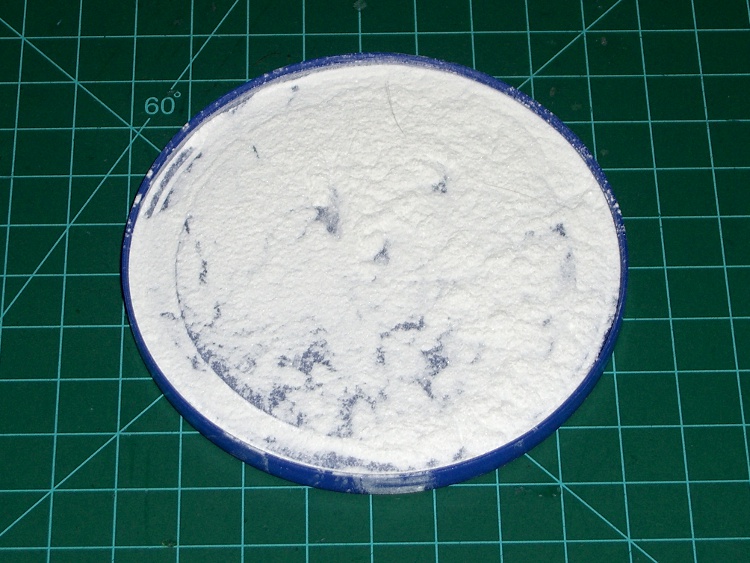
I made several different types of powder traps from various food containers. The simplest is just a lid from a raisin canister with a layer of powder:
Powder trap
Scuff up the outside edge with sandpaper, although I think the bugs are pretty good about climbing up obstacles on their own.
You can use these under gas lures or furniture legs:
Powder trap as furniture isolator
Be careful the coaster doesn’t snuggle up to the rim, as shown there, thus allowing the bugs to travel between furniture and floor without visiting Planet Powder. In this case, there’s a tape barrier a foot further out: this is our abandoned-in-place couch.
Here’s what happens when a book louse heaves itself over the outer edge:
Book louse in powder
Not only do they lose traction, they get entirely fouled up in the powder.
This, we think, is one of the few bed bugs from our infestation, caught in a powder trap using a carbon dioxide lure:
Bedbug nymph in powder
This is what the critter looked like after rinsing it off in a generous dollop of denatured alcohol:
Bedbug nymph
In my experience, when you find a bug near the perimeter, it just crawled in over the edge: they do not travel very far after landing on Planet Powder. A bug near the center probably came from the furniture, although we didn’t have that happen.
A stereo zoom microscope makes scanning Planet Powder for intruders much easier. Compared to what you didn’t spend on commercial CO2 lures and powder traps, you can buy a really nice microscope and have change left over. You should gimmick up a camera adapter so you can show off your findings.
I also used a headband magnifier. After a while, you don’t even feel like a dork when you walk around the house wearing one. Trust me on that.
If you arrived here by a search engine while looking for something completely different, note that “Planet Powder” has nothing to do with detergents or music.
In general, you cannot solve a bed bug problem by attracting and trapping bugs: there are simply too many bugs that are breeding ahead of their losses. We had (presumably) brought very few bugs home in our luggage, so every one we trapped was one less bug in the room. In any event, the number of bugs caught in the traps would give some idea of how much trouble we were in.
The bottom line: we trapped one or two bed bug instars and no adults.
Anything labeled for use against bed bugs carries a staggering markup and considerable smoke-and-mirrors marketing, but if you go back to the original sources (see the references in the first post), you’ll find out what actually works, which is quite different from what’s advertised.
The study by Wang, et. al., tested carbon dioxide, heat, and chemical lures. Tested singly: CO2 is pretty good, heat is OK, chemical lures definitely come in last. Basically, I think there are way too many significant figures in their results, but under idealized test conditions in a small arena, they collected about 80% of the bugs after six hours.
One key number: the CO2 flow rate was about 170 ml/min, roughly that produced by an adult human.
Another interesting number:
The visual inspections found ≤23 bed bugs in each apartment and they were considered as low levels of infestations.
CO2 mug and powder trap
Based on that, we decided to build some CO2 traps, which led to those observations. Our version of a dry-ice trap used a huge insulated mug filled with dry ice, perched atop an inverted dog food dish. We deployed two traps like that.
The dog dish has a cloth skirt (so the bed bugs can get traction on the way in) and a layer of talcum powder inside (so they can’t get any traction on the way out). The gas flow rate was in the right ballpark.
After several days, we had collected exactly zero bed bugs.
That wasn’t surprising, of course, because we knew we didn’t have all that many bugs, but we were still getting bitten in other parts of the house. Like, alas, the guest-room bed where we’d moved after gutting our bedroom.
Using dry ice as a CO2 source is relatively expensive and exceedingly inconvenient. We went through two iterations and decided that this was far too expensive, given the expected results.
It turns out that baker’s yeast metabolizes sugar into ethanol and carbon dioxide as the yeast gradually dies in a sea of dilute ethanol; if you have a distillation rig handy, you can probably get a decent yield of vodka from this project. Normally I use the carbon dioxide to stretch bread dough, but in this case it came in handy all by itself.
You can buy, for $50, a Bed Bug Beacon or you can build your own carbon dioxide lure and trap from ordinary household items for pretty close to zero dollars. Your choice.
I built and deployed four yeast reactor lures, built from gallon milk jugs and Tygon tubing from the parts heap. This picture tells you pretty nearly everything you need to know.
Yeast CO2 generator
I used a hollow punch to poke those the neat holes in the lids, but a razor knife will suffice. Seal the opening on the bottle cap with something sticky; nothing adheres well to polyethlyene and Tygon, although the contact cement I got with the dryer rear seal worked well.
Cap detail
Put three quarts / liters of warm water in the jug, add a cup of sugar (lots of sugar = longer production = more gas) and a teaspoon of yeast (lots of yeast = more production = live hard, die young), put on a solid cap, and shake vigorously to mix. Swap in the cap with the tubing and deploy. The recipe is totally non-critical and would make a great science fair project…
The dingus on the other end of the hose is the bottom of a cottage cheese container, artfully sculpted into a shallow dish with four small feet between low arched openings. Basically, it’s a little cover to trap the CO2 in a confined area and let it leak out in relatively concentrated streams. I have no idea if that’s how it works, but it was easy to do and keeps the hose from wandering away.
What they don’t tell you is that the gas production from a small yeast reactor is maybe 5%, tops, of the 150-200 ml/min required to mimic a human: I bubbled the gas into an inverted 60 ml syringe and used a stopwatch. The gas production varies strongly with time; after a week it’s down to essentially zero, so I’d say the “11 day” claims for the BBB’s lifetime are, mmmm, fanciful, at best.
Gas production is proportional to the total number of active yeast. Methinks a cup of sugar in three quarts of water will yield more yeast than a packet of sugar in, what, a pint jar? If you drop fifty bucks on a BBB, make some measurements and let me know, OK?
Maybe they use brewer’s yeast, which is an ethanol-tolerant strain of ordinary baker’s yeast. The end product, after a week, smells strongly of ethanol, so I’m not sure how much difference that would make.
In any event, my opinion is that such a minimal gas flow can attract bugs from only a very limited radius, so the results are far less conclusive than dry ice or pressurized-gas lures. Of course, if you have floors crowded with bed bugs, a few of them will stumble across the lure simply by accident.
Of course, there is one lure that’s absolutely guaranteed to attract bed bugs from across the room: you. I’ll discuss that after covering traps and barriers…
We discovered our first bed bug bites one morning, shortly after we returned from our vacation, which meant at least one bed bug had taken up residence in our bed. That should come as no surprise: why do you think they’re called bed bugs?
For historic reasons, we have an oak California King platform bed with a Select Comfort air-bag mattress in the middle of the room. An oak dresser stands at the head of the bed, with various cords from the power strip screwed underneath the bed. An oak wardrobe stands a few feet away, with closets on either side of the room. Floor-to-ceiling bookshelves line one wall.
A bed bug can find an essentially infinite number of harborages within easy walking distance.
We dismantled the bed:
Everything washable into bags, then to the washer & dryer
Pillows directly to the dryer
Mattress & air bags to the attic
Compressor & wiring to the attic
Wood parts to the driveway, baking in the sun
Foam padding to the driveway, plus an alcohol spray
The woodwork reached a surface temperature of 150°F and, after a few rotations to let the interior parts heat up, got stacked on sawhorses in the garage. Some smaller wooden parts of the bed didn’t collect enough energy to get hot enough, so we sprayed those with alcohol.
We sorted clothing in the dresser & wardrobe & closets into bags, tagged the bags, and moved to the attic. When it’s needed, we first wash and dry it; we’ve been activating the “winter clothing” bags in the last few weeks.
Hint: you must tag the bags as you seal them. The attic is a sea of black plastic trash bags, piled two and three high after their initial heating, and there is no way you can remember what’s inside a particular bag without a label.
The dresser and wardrobe got hauled to the driveway, heated, and stacked in the garage. You must keep rotating the pieces so the desired surface gets sufficiently hot; the driveway resembled a tag sale for several days.
We took bags and suchlike to the attic during the hottest part of the day, to ensure that any bugs couldn’t just walk away without being toasted.
If the weather had been cool and wet, this whole process would not have worked. As it was, we had reasonable confidence that any bugs were either dead or isolated in a bag.
Mary decided this was a good time to give the room a thorough cleaning, so she vacuumed the books and washed the shelves. She also washed the floors and walls, leaving the place immaculate… after which, I poofed diatomaceous earth around the edges of the floor.
Now, how would you go about demonstrating that there were no bed bugs left in that room? Obviously, you’d set out a baited trap and see what it collected.
Although pesticides generally don’t work against bed bugs, the critters seem surprisingly susceptible to overheating, with the Australian CoP (references in the first post) noting:
Bed bugs are very sensitive to heat and are rapidly killed when exposed to temperatures over 45°C.
In the US, the equivalent 113°F seems to be regarded as a three-significant-figure Golden Number; I’ve even seen similar temperatures with a few digits trailing a decimal point.
In round numbers, you want to heat objects to an interior temperature of at least 120°F and hold them there for perhaps an hour to ensure the bed bugs get the message. The CoP observes:
It is often claimed that bed bugs can be killed via heat by placing infested materials into black plastic bags and then into the sun. However, a scientific investigation has shown that this can be ineffective with large items such as mattresses, which have a high thermal inertia
Our infestation began during late July and early August, with clear skies and high temperatures. Our house has an easily accessible attic that becomes unbearably hot on sunny summer days. We have also learned to park the van so the huge windshield isn’t aimed at the afternoon sun.
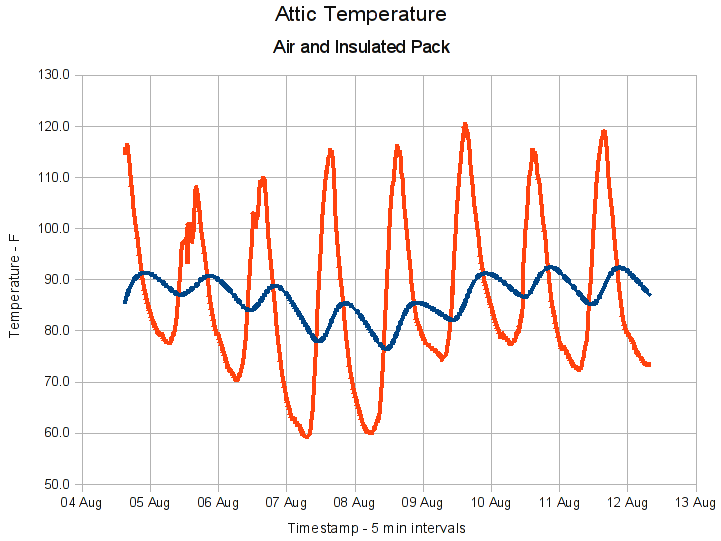
The attic air temperatures in August were, at best, marginal, according to a data logger tucked into gel packs inside a foam box, with an external sensor dangling in mid-air:
Attic temperatures
While the air temperatures got over 120°F, that didn’t necessarily mean the contents of the canonical black plastic trash bags would heat up. We did put most of our clothing (in bags) and small items in the attic, moving them there at the peak of the temperature curve, simply to get them out of the house. The peak inside-the-bag temperatures, according to the IR thermometer, generally exceeded 120°F, so we felt comfortable leaving the bags up there.
The van became our main killing machine. The same logger produced this record; obviously, location and weather dramatically affect the interior air temperature.
Van Temperatures
Although the air temperature rarely got above 120, the temperature in the inner layers of clothing inside black plastic bags laid on the dashboard & seats under the sun routinely exceeded 130°F, as measured by the IR thermometer.
Our electric clothes dryer reaches 150°F on the High setting, so we began toasting all our clothing in there. The hot water supply simply isn’t hot enough to matter, so we continued to use the washer’s Warm/Cold setting.
We had been considering getting a chest-style freezer to preserve Mary’s garden harvest and this note in the CoP pushed us over the edge:
If the freezer is operating at or around -20°C, then two hours at this temperature will kill all stages.
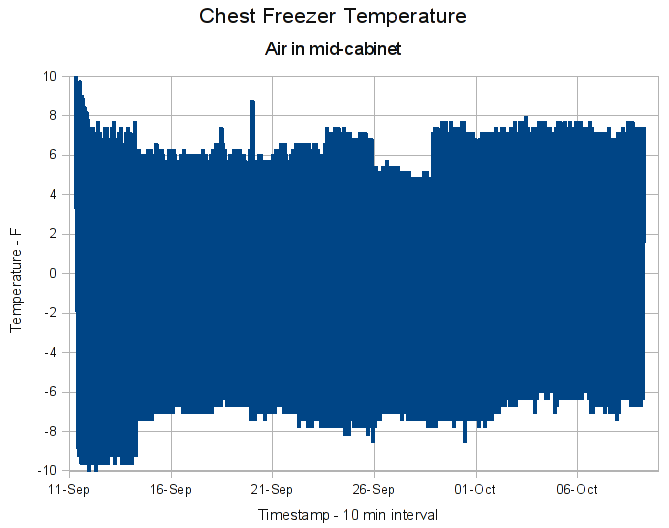
The American translation is -4°F, which rounds off to zero. A logger tucked into the freezer confirms that the default thermostat setting of 4 should suffice:
Freezer temperatures
A closer look shows a classic bang-bang thermostat in action, with pretty nearly a 50% duty cycle. The period got longer as we filled the freezer with veggies and similar dense materials.
Freezer temperatures – detail
The freezer disinsected items we didn’t want to (or couldn’t) toast: keyboards, mice, trackballs, notebooks, purses-with-contents, and so forth.
Between the attic, the van, and the freezer, we had sufficient weaponry to make some headway. Remember that we had a small infestation, just a few bugs, and were not trying to disinsect the whole house and all our belongings.











 The Smell of Molten Projects in the Morning