Ed Nisley's Blog: Shop notes, electronics, firmware, machinery, 3D printing, laser cuttery, and curiosities. Contents: 100% human thinking, 0% AI slop.
This orb weaving spider set up anchors on the patio, the railing, and the gutter, as have many before her, but managed to get a slight twist in her web:
Orb weaving spider – warped web
It seemed to work well, although she packed up and moved on after just one night.
We haven’t seen many orb spiders this year, for unknown reasons.
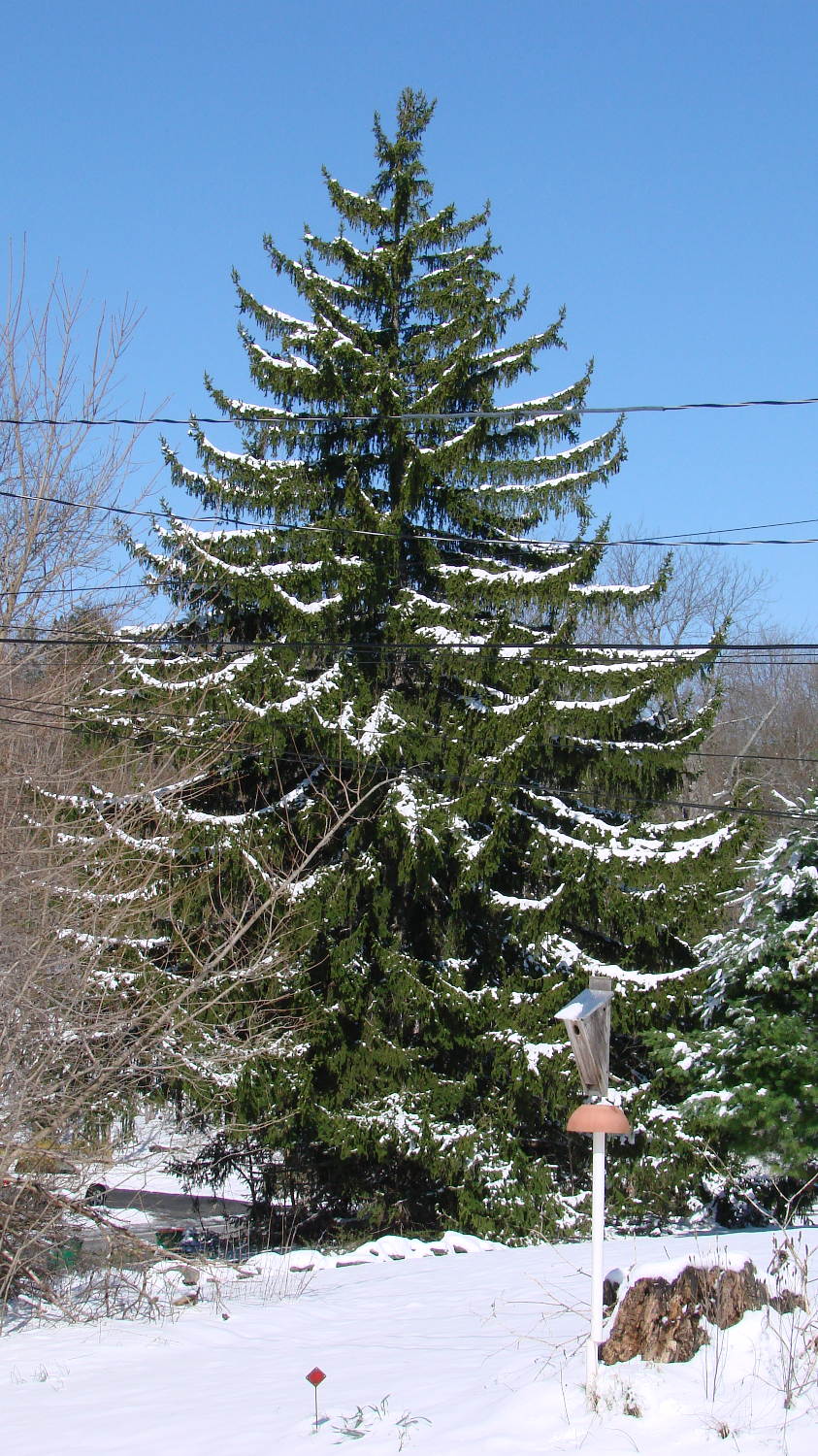
The bird box in the front lawn serves as a favorite perch for surveying the landscape:
Hawk on bird box
The chipmunks seemed fewer and farther between this summer. It’s hard to tell with chipmunks, but they seem to spend more time looking around and less time paused in the middle of the driveway.
Taken with the DSC-H5 and 1.7 teleadapter, diagonally through two layers of cruddy 1955-era window glass.
A stray sunflower seed decided that the spot just outside the garden gate was perfect and gave Mary’s garden an attractive marker. It will eventually have a dozen blossoms, each one serving as a buffet for the local bumblebees:
Sunflower with bumblebee
Each bee makes several complete circuits of the florets, draining the nectar and collecting pollen as she goes:
Sunflower with bumblebee – detail
Mary tucks the open gate inside the garden to avoid disturbing the pollinators, as wasps tend to have short fuses and multiple-strike stingers:
Sunflower with wasp
The bumblebee traveled clockwise and the wasp went counterclockwise, but I don’t know if that’s the general rule. I certainly won’t dispute their choices!
In a few weeks, long after the petals fall away, a myriad small birds will harvest the dried seeds…
At this instant, neither of us realized the other was present:
Starling-0145
Despite what it looks like, the blackbird (maybe a starling) passed just beyond arm’s reach directly ahead of the bike at eye level:
Starling-0167
And away!
Starling-0173
At 60 frames per second, that’s 466 ms of elapsed time.
Stepping through the video, frame by frame, the bird’s wings flap at a consistent three frames per stroke = 50 ms/stroke = 20 stroke/s = 1200 stroke/min. A bit of rummaging produces a study suggesting a starling’s normal rate is 10 stroke/s, so the critter had the throttles firewalled at war emergency power.
It makes my pedal pushing seem downright inconsequential…
A few minutes after we started riding, an insect collided with my helmet. About 3/60 second before impact:
HDR-AS30V 1280×720-60 – Insect – crop
We paused in a park at the far end of the ride, rolled out, and another insect buzzed past:
HDR-AS30V 1280×720-60 – Insect 2 – crop
Both of those flew within a few inches of the lens, far inside the camera’s fixed-focus near point, and it’s a wonder they look as good as they do. Looking at successive frames reveals wingbeats, although they’re surely flapping much faster than frame rate and therefore heavily aliased.
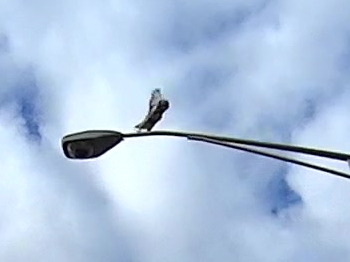
Fortunately, a Gas Hawk didn’t come that close:
Rt 376 – Dutchess Airport – landing
All from the Sony HDR-AS30V in 1280×720 at 60 frame/s. The bug images were ruthlessly cropped to show the full-size dot-for-dot camera image, then stored with minimal compression.
This isn’t the first time I’ve been buzzed on the bike, but it’s a record for one ride.