Ed Nisley's Blog: Shop notes, electronics, firmware, machinery, 3D printing, laser cuttery, and curiosities. Contents: 100% human thinking, 0% AI slop.
Tag: Thing-O-Matic
Using and tweaking a Makerbot Thing-O-Matic 3D printer
It’s actually a snub-nosed version of that, cut down by 15 mm to fit the TOM’s vertical space; the nozzle homed 3 mm above the last of the 345 layers.
I wanted to discover three things:
Are there any axis skips in a 4 hour print?
Can ABS film + aluminum plate anchor a tall object?
Can I use up all the pink filament?
Answers: no, just fine, not quite.
I did not re-check the platform alignment after installing the new Y axis motor and fiddling a bit with the Y axis rods. Quite to my dismay, the platform was about 0.5 mm too high (crunch!), so I gave the Z axis leadscrew a mighty twist and salvaged the first layer during the Outline extrusion. Despite that, the first layer seemed to be flat within the usual 0.2 mm (eyeballometrically measuring the first infill, as the Outline was trashed) and adhesion was fine.
The grip delaminated a bit and the butt pulled the film up, which isn’t entirely unexpected for huge objects.
I enclosed the build chamber before starting this print, but the temperature still isn’t all that high in the Basement Laboratory and the plastic was barely warm when I took it out. I’m not convinced any reasonable chamber temperature will solve the problem; it may work out better to assemble large objects from thinner parts.
This was the first full-up test of the X Rod Follower and the new Y axis stepper motor. Prior to printing this thing, I did a quick torture test (about which, more later) and dialed the motor currents back:
X REF = 0.63 V → 315 mA
Y REF = 1.76 V → 880 mA (in a 2 Ω winding)
Z REF = 0.54 V → 270 mA
A REF = 0.99 V → 450 mA (in a 2 Ω winding)
After four hours the Y, Z, and A steppers were barely warm to the touch and a thermocouple stuck into one of the X stepper’s bolt holes reported it was 38 °C, just above barely warm. I’m adducing evidence that the MBI steppers aren’t appropriate for the TOM’s requirements and that the default current settings are much too high.
The NEMA standards for stepper motors don’t specify the shaft dimensions, alas. While most NEMA 17 steppers have 5 mm shafts, the X and Y axis motors in a Thing-O-Matic have 3/16 inch shafts: MBI belt pulleys with 4.76-ish mm ID won’t fit on 5 mm OD shafts.
(Note: the “17” in NEMA 17 means the mounting holes are on a more-or-less 1.7 inch circle. The side of the motor frame will be close, but that’s not the controlled dimension. Some relevant diagrams live there.)
I plan to replace the Y axis stepper with a better motor (I got a set of three, one of which is now driving the stepper extruder), which means either buying a new pulley or having some Quality Shop Time. Plus, a bit more length on the Y axis shaft than what comes standard would be a Good Thing, too.
[Update: From the motor label, not that you’ll ever find one like it…
38 mm case
Minebea-Matsushita 17PM-K150-P1V
No T6824-02
]
So I built an adapter from 5/16 and 3/16 rod with a setscrew to grab a flat on the stepper shaft and a pin for the torque. The larger rod turned out to be La Salle Fatigue-Proof steel, not that it matters, and the smaller rod is plain old W-1 Water Hardening Drill Rod, both from Brownell’s, a long time ago in a universe far away. You could turn and drill the adapter from a single length of 5/16 rod if you prefer, but take some care to maintain the alignment.
A bit of lathe & Sherline CNC work:
Face one end of the 5/16 rod
Drill half an inch with a #9 drill (0.196 + runout = 5 mm)
Drill another quarter inch with a #12 drill (0.189 = 4.8 mm)
Saw off 3/4 inch, face the raw end
Saw & face an inch of 3/16 rod
Epoxy little rod in big rod, set upright, wait overnight
Cross drill #43 and tap 4-40 near big end
Cross drill #56 for 0.045 music wire pin
Chamfer pin hole, clean, epoxy pin in place, wait overnight
File two flats on 3/16 shaft for MBI pulley setscrews
Tapping shaft adapter
I grabbed the small rod in the vise with the large rod resting on the top of the jaws while the epoxy cured, figuring that it’d be pretty much self-aligning. Not that a few mils one way or the other will matter, as it’s driving a timing belt in a flexy machine anyway.
Cross-drilling the pin hole required eyeballing the center of the length of 3/16 rod within the 5/16 rod. It’s not critical, but avoid missing the poor thing entirely. You want to minimize the nested length, so as to keep the adapter as short as possible, but keep at least one diameter (3/16 inch) so as to maintain alignment.
Tapping should involve a bottoming tap, but I used what I had and it worked out OK.
Now, one reason I was willing to do this is that the stock Y axis motor shaft was already too short. As nearly as I can tell, the TOM dimensions were set before MBI started shipping those cork sound-deadening plates, because the shaft is recessed into the pulley by about the thickness of that plate.
The MBI pulleys are an extremely tight fit on a 3/16 inch rod, so, rather than forcing the pulley, I enlarged the hub with a #12 drill (same as in the adapter) to get another 1.5 mil of clearance; it’s now an easy slip fit on the rod.
Drilling MBI motor pulley
Anyhow, the bottom flange of the pulley is 17 mm above the ridge on the motor and this one worked out to a bit over 20. No problem, I can just lower the motor a little bit, flip the pulley over to get the setscrew end of the hub on the top, and it’ll have plenty of room. A bit more shaft is much better than not enough, sez I.
Y axis motor shaft extension
The motors came from the usual eBay seller complete with a squishy silicone sound deadening panel that turned out to be exactly the right thickness, when stacked atop a cork sheet, to put the pulley where it needed to be. I cut a second cork sheet, so as to isolate the bolt heads from that acrylic body panel, and it’s all good.
The digital caliper on my desk has been getting a lot of use lately and, as expected, that delicate glued repair failed.
Well, I can fix that…
Thumbwheel holder – installed
That’s a somewhat chopped-up Version 1; as always, I must build one prototype to see how everything fits, then make a real part incorporating all the changes. The models and code below have those changes and should print fine.
This picture from the previous repair shows what broke and why:
Broken caliper thumb roller mount
I removed the remainder of the arch, filed the stub square, made a bunch of tedious measurements, and wrote a chunk of OpenSCAD code to create a repair part that looks like this:
Thumbwheel holder – build model
There’s also a layout arrangement to confirm that it’ll fit the stub:
Thumbwheel holder – fit model
And then I printed four so I could pick the best one. The horizontal hole and notch come out surprisingly well, although this thing is right down around the minimum size you’d want to print:
Thumbwheel holders – as built
The 1-72 screw threads itself into the hole without a nut; I simply match-drilled a hole in the stub under the hole in the part. Of course, that means I must fit the next part to that hole…
I really wish I was printing with, say, black filament. Even dark green would be better. Heck, I’d go with yellow, but if I don’t get rid of this pink stuff I’ll have it forever.
The OpenSCAD source code:
// Digital Caliper thumbwheel holder
// Ed Nisley - KE4ZNU - Apr 2011

Build = true;						// set true to generate buildable layout

$fn = 8;							// default for holes

// Extrusion values
// Use 0 extra shells behind the perimeter
//     2 solid shells on the top & bottom

ThreadThickness = 0.33;
ThreadWT = 1.75;
ThreadWidth = ThreadThickness * ThreadWT;

HoleWindage = ThreadWidth;			// enlarge hole dia by extrusion width

Protrusion = 0.1;					// extend holes beyond surfaces for visibility

// Caliper dimensions

WheelDia = 10.0;					// thumbwheel OD
WheelRadius = WheelDia/2;
WheelMargin = 1.0;					// space around wheel
WheelRimThick = 2.5;				// subtract from repair block

ShaftDia = 2.90;					// axle between knurled wheels
ShaftRadius = ShaftDia/2;
ShaftLength = 2.7;
ShaftRetainer = 3.0;				// thickness around shaft

StubThick = 2.45;					// stub of holder on caliper head
StubLength = 5.0;					// toward caliper head
StubHeight = 6.0;					// perpendicular to caliper head
StubClearance = 0.5;				// distance to caliper frame

FrameLength = 50;					// for display only
FrameHeight = 16.0;
FrameThick = 3.0;

// Repart part dimensions

ForkLength = StubLength - StubClearance;	// toward caliper head around stub
ForkHeight = StubHeight;			// perpendicular to caliper head
ForkGap = 0.2;						// clearance to stub on all sides
ForkBladeThick = 2.0;				// on each side of stub

ShaftClearance = 0.0;				// Additional clearance around shaft
ShaftOffset = 8.5;					// Shaft center to stub

BoltHoleDia = 1.8;					// 1-72 machine screw, more or less
BoltHoleRadius = BoltHoleDia/2;

// Convenient sizes and shapes

FrameBlock = [FrameLength,FrameThick,FrameHeight];

StubBlock = [StubLength,StubThick,StubHeight];
StubMargin = [ForkGap,2*ForkGap,ForkGap];

RepairBlockLength = ForkLength + ShaftOffset;
RepairBlockThick = 2*ForkBladeThick + StubThick;
RepairBlockHeight = WheelRadius + ShaftRadius + ShaftRetainer;

RepairBlock = [RepairBlockLength,RepairBlockThick,RepairBlockHeight];

// Caliper parts to show how repair fits in

module CaliperParts() {
  union() {
	translate([0,0,-(StubClearance + FrameHeight/2)])
	  cube(FrameBlock,center=true);
	translate([-(StubLength/2 + ShaftOffset),0,(StubHeight/2)])
	  cube(StubBlock,center=true);
  }
}

// Repair block with origin below wheel shaft

module RepairPart() {

  difference() {

// Body of repair part
	union() {
	  translate([-RepairBlockLength/2,0,RepairBlockHeight/2])
		cube(RepairBlock,center=true);
	  translate([0,0,WheelRadius])
		rotate([90,0,0])
		  cylinder(r=ShaftRadius+ShaftRetainer,h=ShaftLength,center=true,$fn=12);
	}

// wheels
	translate([0,(ShaftLength + WheelRimThick)/2,WheelRadius])
	  rotate([90,0,0])
		cylinder(r=(WheelRadius + WheelMargin),h=WheelRimThick,center=true,$fn=16);
	translate([-(WheelRadius + WheelMargin)/2,
			  (ShaftLength + WheelRimThick)/2,
			  (WheelRadius - Protrusion)/2])
	  cube([(WheelRadius + WheelMargin),WheelRimThick,(WheelRadius + Protrusion)],
			center=true);
	translate([0,-(ShaftLength + WheelRimThick)/2,WheelRadius])
	  rotate([90,0,0])
		cylinder(r=(WheelRadius + WheelMargin),h=WheelRimThick,center=true,$fn=16);
	translate([-(WheelRadius + WheelMargin)/2,
			  -(ShaftLength + WheelRimThick)/2,
			  (WheelRadius - Protrusion)/2])
	  cube([(WheelRadius + WheelMargin),WheelRimThick,(WheelRadius + Protrusion)],
			center=true);

// axle clearance
	translate([0,0,WheelRadius])
	  rotate([90,0,0])
		cylinder(r=ShaftRadius,h=(ShaftLength + 2*Protrusion),center=true);
	translate([0,0,(WheelRadius - Protrusion)/2])
	  cube([ShaftDia,(ShaftLength + 2*Protrusion),(WheelRadius + Protrusion)],
		   center=true);

// stub of previous wheel holder
	translate([-(ShaftOffset + (ForkLength - ForkGap)/2 + Protrusion),
			  0,
			  (StubHeight + ForkGap - Protrusion)/2])
	  cube([(ForkLength + ForkGap + Protrusion),
		   (StubThick + 2*ForkGap),
		   (StubHeight + ForkGap + Protrusion)],
		   center=true);

// mounting screw hole
	translate([-(ShaftOffset + ForkLength/2),0,StubHeight/2])
	  rotate([90,0,0])
		cylinder(r=(BoltHoleDia + HoleWindage)/2,
				 h=(RepairBlockThick + 2*Protrusion),
				 center=true,$fn=6);
  }
}

// Build it!

if (!Build) {
  CaliperParts();
  RepairPart();
}

if (Build) {
  translate([-RepairBlockLength/2,0,RepairBlockHeight])
	rotate([0,180,0])
	  RepairPart();
}
I built a quartet of very small knots to see how they’d stick to the ABS film and whether Reversal could cope with tiny things.
Multiple knots on platform
The left rear knot lost its footings and I removed the rubble while the nozzle was busy with another knot. The top grew surprisingly well out of a tangle deposited in mid-air.
The ABS film peeled neatly off the aluminum plate and shows what the adhesion looks like from below. The tangle is now in the right front.
Bottom view of ABS coating with knots
Reversal at 20 rpm, 75 ms, no early start. Still some blobbing during travel, so the reverse parameter isn’t quite large enough.
My Shop Assistant prettied one up by cleaning off the snots, dunking it in the jar of pink goo, and applying several layers of bronze acrylic paint. Next time, we’ll use thinner goo and scuff the knot a bit before painting.
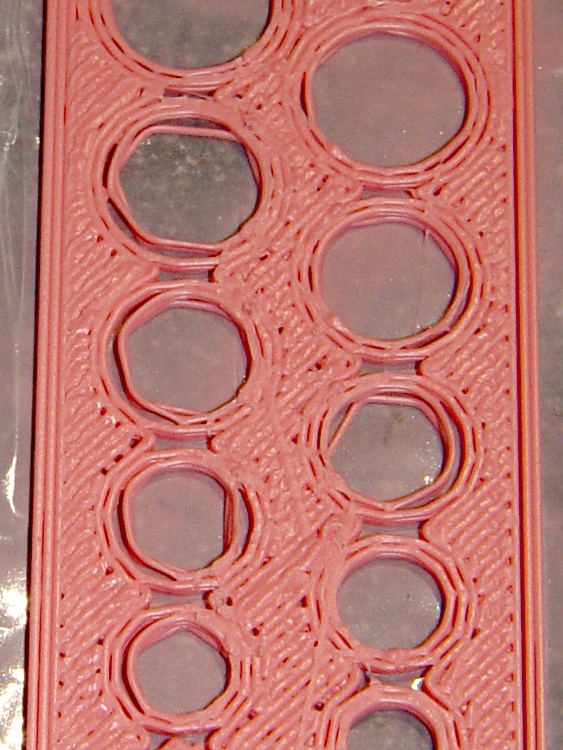
This polyholes test piece started with the nozzle 0.45 to 0.50 mm above the build plate. The threads around the holes didn’t bond well to the plate, dragged slightly inward of their intended position, and didn’t join to their neighbors or the infill.
Polyholes 0.33 mm layer – 0.5 mm starting height
Adjusting the nozzle downward to start at 0.28 to 0.39 above the plate produced this result:
Polyholes 0.33 mm layer – 0.3 mm starting height
So, in round numbers, changing the nozzle’s height by 0.2 mm makes all the difference for an object printed with 0.33 mm layer thickness. That’s why I’ve been so focused on getting a flat, level build platform: a mere 0.2 mm is 60% of the layer thickness!
The perimeter and additional threads around the holes are now where they should be, plus they’re all bonded to each other and the infill.
I think Skeinforge positions the center of the perimeter thread at the very outside edge of the object, which means objects are one thread width larger than they should be and holes are one thread width smaller. The HoleWindage parameter I added to nophead’s code compensates for that, although you must manually add it to / subtract it from the critical dimensions.
[Update: SF does the right thing. See the comments.]
The larger holes in the second test piece (printed with the correct starting height) came out just about spot on, the mid-size holes are 0.25 mm too large, and the smaller holes are pretty close in absolute terms (and awful in relative terms). There’s no way to get perfect holes, but these are certainly good enough for most purposes and repeatable enough to not require much in the way of tweakage.
The polyholes sheet is three layers thick. It presents quite an infill challenge, because there’s not much room around the holes (witness the open areas where the available space drops below one thread width) and the Fill plugin doesn’t lay the infill down from one end to the other. The myriad stops, starts, and movements presents many opportunities for blobs, of which you’ll see quite a few.
Feed 40 mm/s, flow 2 rpm, 210 °C / 120 °C. First layer at 25% feed & flow. Reversal set for 20 rpm, 90 ms in & out, and no early action.
I measured the thickness of the Outline thread around the actual objects, as described there, to get the first layer thickness. The starting heights for the first piece are the middle array there. These are the heights for the second piece, in units of 0.01 mm:
33
28
29
31
28
31
31
32
39
28
32
37
The OpenSCAD source, which is pretty much directly from nophead:
// nophead polyholes
// Modified to use parameters and add diameter Finagle Constant

HoleWindage = 0.6;

NumHoles = 9;

PlateZ = 1.0;
Protrusion = 0.1;
HoleZ = PlateZ + 2*Protrusion;

module polyhole(h, d) {
    n = max(round(2 * d),3);
    rotate([0,0,180])
        cylinder(h = h, r = (d / 2) / cos (180 / n), $fn = n);
}

difference() {
	cube(size = [NumHoles*10,27,PlateZ]);
    union() {
    	for(i = [1:NumHoles]) {
            translate([(i * i + i)/2 + 3 * i , 8,-Protrusion])
                polyhole(h = HoleZ, d = (i + HoleWindage));

            assign(d = i + 0.5)
                translate([(d * d + d)/2 + 3 * d, 19,-Protrusion])
                    polyhole(h = HoleZ, d = (d + HoleWindage));
    	}
    }
}
The three removable build plates came from the same sheet of aluminum, albeit with different histories and somewhat different construction details, so they’re pretty much the same thickness. After leveling the sub-platform, I built three objects in one session with a single maximum Z height setting in start.gcode to see how things changed.
These measurements are from the Outline extrusion around the objects, with the number of data points (units of 0.01 mm) depending on the actual length of the side. Of course, I should have built three identical objects, but there’s only so much I’m willing to do for Science…
A 45 mm Companion Cube on Plate 1:
30
26
31
27
32
29
27
30
A pair of slightly tweaked nophead Polyhole test plates on Plate 2:
45
38
47
38
47
45
48
48
49
51
A completely failed 3D Knot (too large = too much overhang) with a very small Outline on Plate 3:
46
48
49
50
Things went quite literally downhill after the first object, but only by 0.2 mm. Unfortunately, a 0.50 mm first-layer height (when you expect 0.33 mm) is entirely enough to prevent adhesion to the ABS build surface and ruin at least the first few layers.
On the good side, the platform remains level within 0.05 mm, which is down around my measurement resolution.
Installing the X Rod Follower required realigning the aluminum sub-plate to get a level build platform. I got a crude initial setting by standing a 3 mm nut on edge under each adjusting bolt, then lowering the platform until it just touched each nut. Doing that procedure again with the height set to 119.5 mm produced these values:
1.6
1.3
1
1.3
1.1
0.9
0.9
0.8
0.7
I removed the silicone wiper to keep the Thermal Core insulation from landing atop it during the probing. A single wipe at the beginning is a Good Thing, but the wiper is just too tall.
The rear left corner seems to be too low by about 0.7 mm, which is a bit more than one turn of the M3×0.5 bolt. Remember: larger numbers = lower platform, so you loosen the bolt to raise the platform. I almost got that right the first time. After doing that:
1.1
0.9
0.8
1
1
0.9
0.9
0.9
0.8
A final quarter-turn got the platform to this happy state:
0.9
0.8
0.9
0.9
0.9
0.9
0.9
0.9
0.9
That’s just the sub-platform at room temperature, but it looks pretty good. The platform returns to the same position after pushing it down against the springs, so that seem stable enough.
The next step is to run up the temperature and build something.



 The Smell of Molten Projects in the Morning