Ed Nisley's Blog: Shop notes, electronics, firmware, machinery, 3D printing, laser cuttery, and curiosities. Contents: 100% human thinking, 0% AI slop.
Tag: Thing-O-Matic
Using and tweaking a Makerbot Thing-O-Matic 3D printer
Flushed with success on the small-hole front, I conjured up a large hole testpiece using the same HoleAdjust function that proved unnecessary with the little ones:
Circle Calibration – solid model
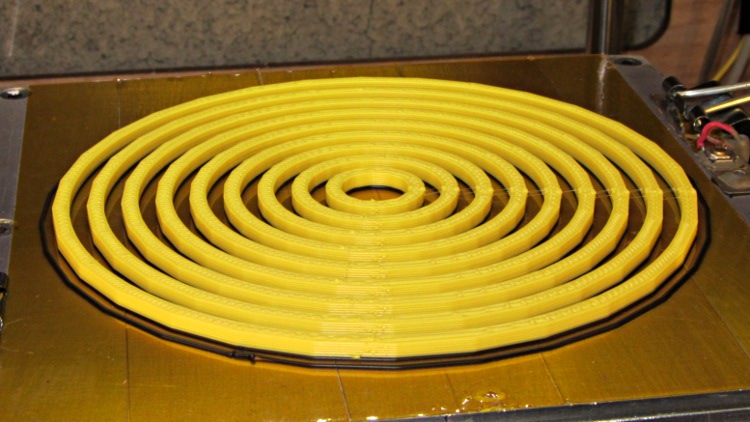
The first version didn’t have the cross bars, which turned out to be a mistake, because the individual rings distorted even under minimal pressure from the calipers:
Large circle cal – unlinked rings
However, measuring as delicately as I could, the holes seemed a scant 0.20 mm too small, more or less, kinda-sorta:
Nominal
Nom+0.0
10
9.83
20
19.75
30
29.85
40
39.84
50
49.84
60
59.72
70
64.76
80
79.28
90
89.77
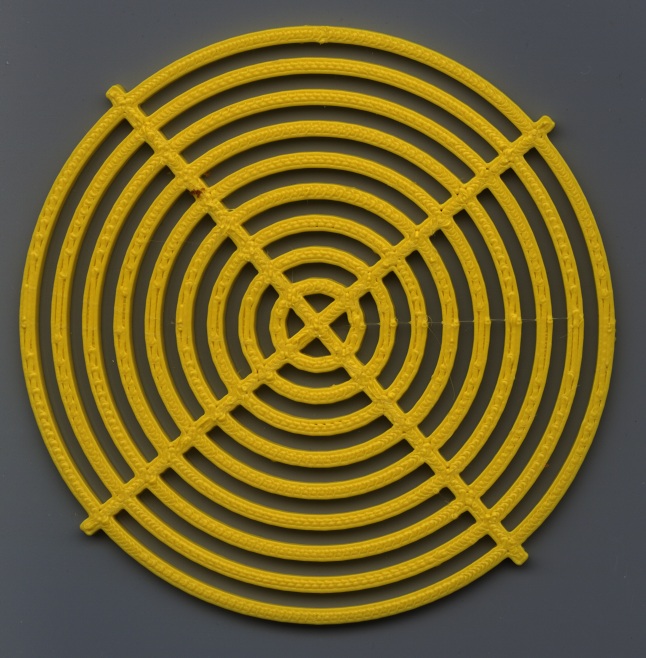
So I fed in HoleFinagle = 0.20 and the second iteration looks like it’d make a great, albeit leaky, coaster:
Large Circle Calibration object – HoleFinagle 0.20
Measuring those holes across the center with the calipers on facets (rather than vertices), produced somewhat more stable results:
Nominal
Nom+0.20
10
10.08
20
20.17
30
30.08
40
40.08
50
50.00
60
60.02
70
70.05
80
79.98
90
90.07
Frankly, I don’t believe those two least-significant digits, either, because a different set of measurements across different facets looked like this:
Nominal
Nom+0.20
10
10.13
20
20.11
30
29.84
40
39.90
50
49.88
60
59.90
70
69.84
80
79.82
90
89.66
I also printed a testpiece with HoleFinagle = 0.25 that averaged, by in-the-head computation, about 0.05 larger than that, so the hole diameter compensation does exactly what it should.
Applying the calipers to the 10.0 mm hole in the small-hole testpiece gives about the same result as in this one. The fact that HoleFinagle is different poses a bit of a mystery…
The only thing I can conclude is that the measurement variation and the printing variation match up pretty closely: the actual diameter depends more on where it’s measured than anything else. The holes are pretty nearly the intended size and, should the exact size matter, you (well, I) must print at least one to throw away.
All in all, a tenth of a millimeter is Good Enough. Selah.
Oh. The ODs are marginally too small, even using PolyCyl.
The OpenSCAD source, with both adjustments set to neutral:
// Large circle diameter calibration
// Ed Nisley KE4ZNU - Nov 2011

//-------
//- Extrusion parameters must match reality!
//  Print with +1 shells, 3 solid layers, 0.2 infill

ThreadThick = 0.33;
ThreadWidth = 2.0 * ThreadThick;

HoleFinagle = 0.00;
HoleFudge = 1.00;

function HoleAdjust(Diameter) = HoleFudge*Diameter + HoleFinagle;

Protrusion = 0.1;			// make holes end cleanly

function IntegerMultiple(Size,Unit) = Unit * ceil(Size / Unit);

//-------
// Dimensions

Width = 2.5;
Thickness = IntegerMultiple(2.0,ThreadThick);

DiaStep = 10.0;

NumCircles = 9;

echo(str("Width: ",Width));
echo(str("Thickness: ",Thickness));

BarLength = (NumCircles + 1)*DiaStep;

//-------

module PolyCyl(Dia,Height,ForceSides=0) {			// based on nophead's polyholes

  Sides = (ForceSides != 0) ? ForceSides : (ceil(Dia) + 2);

  FixDia = Dia / cos(180/Sides);

  cylinder(r=HoleAdjust(FixDia)/2,h=Height,$fn=Sides);
}

module ShowPegGrid(Space = 10.0,Size = 1.0) {

  Range = floor(50 / Space);

	for (x=[-Range:Range])
	  for (y=[-Range:Range])
		translate([x*Space,y*Space,Size/2])
		  %cube(Size,center=true);

}

//------

module Ring(RingID,Width,Thick) {

  difference() {
	PolyCyl((RingID + 2*Width),Thick);
	translate([0,0,-Protrusion])
	  PolyCyl(RingID,(Thick + 2*Protrusion));
  }
}

//------

ShowPegGrid();

union () {
  for (Index = [1:NumCircles])
	Ring(Index*DiaStep,Width,Thickness);
  for (Index = [-1,1])
	rotate(Index*45)
	  translate([-BarLength/2,-Width/2,0])
		cube([BarLength,Width,Thickness]);
}
The macro lens & microscope adapters for the Canon SX230HX camera required a bunch of large and fairly precise circles. The first-pass prints of the main tube and snouts came out with diameters about 2% too small, so I changed the hole diameter compensation to include a first-order Fudge Factor as well as the simple zero-order HoleWindage Finagle Constant I’d been using. In the process, I cooked up a simple OpenSCAD function with new coefficient names reflecting their order:
That solved the immediate issue, but I wondered whether I was working on the right problem.
In the past, nophead’s polyholes testpiece showed the need for the 0.2 mm HoleWindage adder to make small holes turn out correctly. I rewrote his code to:
Use my HoleAdjust function
Lay the two rows out nose-to-tail
Add a bit more clearance between the holes
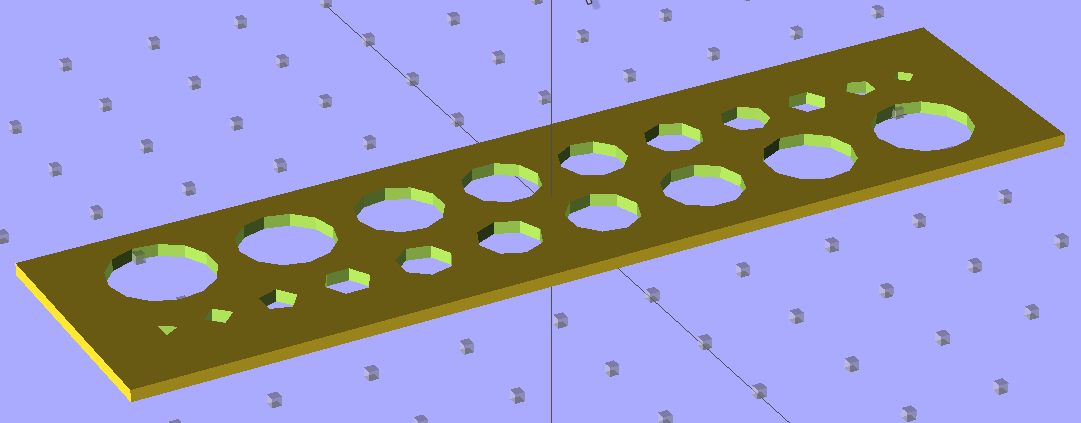
Which came out like this:
Small Hole Calibration – solid model
To find out where I’m starting from, I printed it (0.33 mm x 0.66 mm, 30 mm/s, 200 °C / 110 °C) with both correction factors set to “no change” and got a nice-looking plate that didn’t require any cleanup at all:
Small Hole Calibration object – HoleFinagle 0.00
Note that the similar-looking holes in the two rows aren’t the same size: the row with the tiny triangle has *.0 mm holes, the tiny square marks the *.5 mm holes.
The Skirt thread thickness was 0.31 to 0.38 mm, so this object’s size should be about as good as it gets.
The point of the game is to circumscribe polygonal holes around a cylinder of a given diameter. I don’t have a set of metric drills (or drill rods), so I bracketed the holes with the nearest sizes of hard-inch number and letter drills:
Nominal
Free fit
Snug fit
1.00
0.98
1.04
2.00
2.05
2.18
3.00
2.93
3.03
4.00
3.99
4.04
5.00
5.06
5.13
6.00
6.21
6.23
no-go
7.00
6.98
7.12
8.00
7.50
8.19
9.00
8.77
9.05
10.00
9.92
10.19
tight
The “snug fit” column means the holes are definitely smaller than that measurement, so the maximum hole size comes out just about spot on; an error of 0.1 mm or so seems too small to quibble over.
So, for whatever reason, my previous Finagle Constant of 0.20 seems no longer necessary and, for sure, the Fudge Factor doesn’t bring anything to the table at this scale.
It’s definitely true that the height of the first layer affects the hole size for the next few layers, even with the Z-minimum switch measuring the build plate height. The Skirt threads generally measure within ±0.05 mm of the nominal 0.33 mm and I think much of that variation comes from residual snot on the nozzle when it touches the switch. I have no idea what the firmware’s resolution might be.
Given that I’ve been adding 0.2 mm to small-hole diameters all along, I suspect all these errors are now of the same general size:
The main tube connects the camera mounting plate and the snout on the front, so it’s a structural element of a sort. The ID fits over the non-moving lens turret base on the camera and the inner length is a few millimeters longer than the maximum lens turret extension:
Camera mount tube – interior
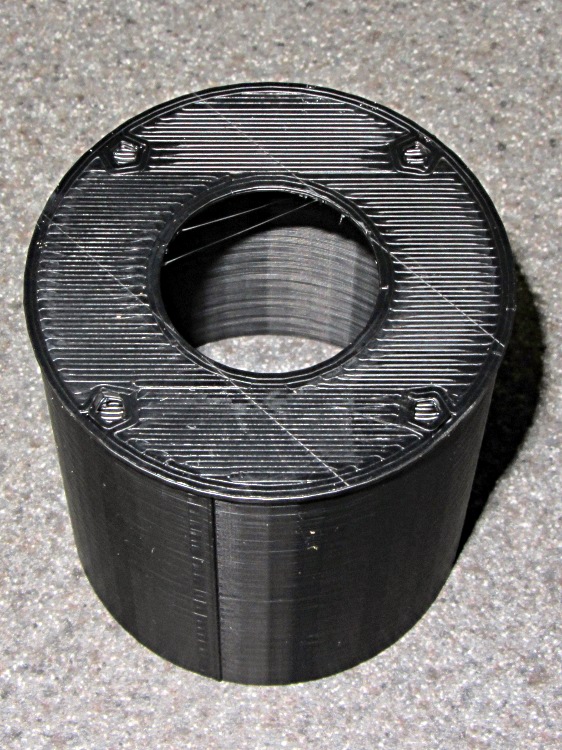
As you might expect by now, the front bulkhead has four alignment peg holes for the snout:
Camera mount tube
The OpenSCAD code sets the wall thickness to 3 thread widths, but Skeinforge prints two adjacent threads with no fill at all. I think the polygon corners eliminate the one-thread-width fill and the perimeter threads wind up near enough to merge properly.
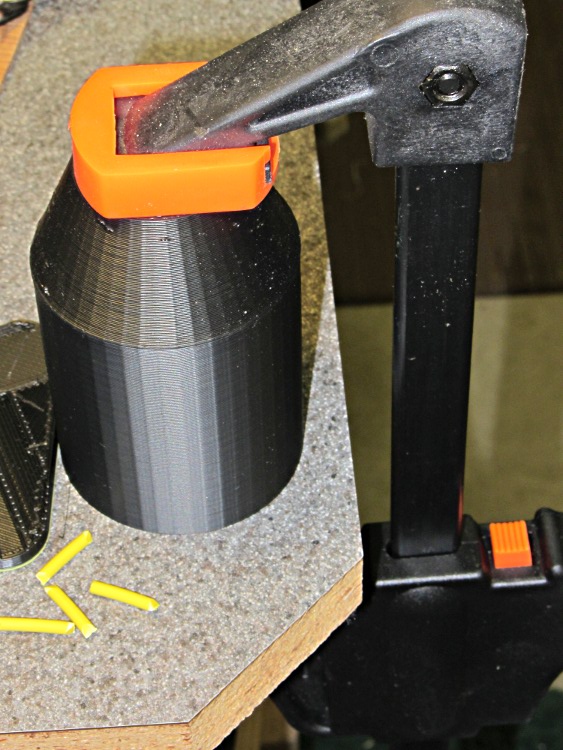
I assembled snouts to main tubes first, because it was easier to clamp bare cylinders to the bench:
Microscope eyepiece adapter – snout clamping
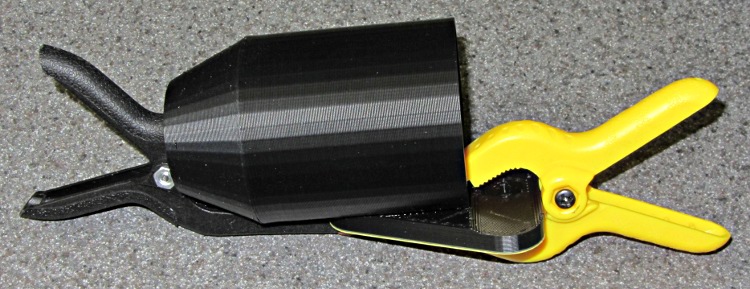
Then glue the tube to the mounting plate using a couple of clamps:
Microscope eyepiece adapter – baseplate clamping
The alignment is pretty close to being right, but if when I do this again I’ll add alignment pegs along the trench in the mounting plate to make sure the tube doesn’t ease slightly to one side, thusly:
SX230HS Macro Lens mount – solid model – exploded with pegs
You can see the entrance pupil isn’t quite filled in the last picture there, so a bit more attention to detail is in order. A bigger doublet lens would help, too.
The current version of the OpenSCAD source code with those pegs:
// Close-up lens mount & Microscope adapter for Canon SX230HS camera
// Ed Nisley KE4ZNU - Nov 2011

Mount = "LEDRing";			// End result: LEDRing Eyepiece

Layout = "Show";			// Assembly: Show
							// Parts: Plate Tube LEDRing Camera Eyepiece
							// Build Plates: Build1..4

Gap = 10;					// between "Show" objects

include </home/ed/Thing-O-Matic/lib/MCAD/units.scad>
include </home/ed/Thing-O-Matic/Useful Sizes.scad>
include </home/ed/Thing-O-Matic/lib/visibone_colors.scad>

//-------
//- Extrusion parameters must match reality!
//  Print with +1 shells, 3 solid layers, 0.2 infill

ThreadThick = 0.33;
ThreadWidth = 2.0 * ThreadThick;

HoleFinagle = 0.2;
HoleFudge = 1.00;

function HoleAdjust(Diameter) = HoleFudge*Diameter + HoleFinagle;

Protrusion = 0.1;			// make holes end cleanly

function IntegerMultiple(Size,Unit) = Unit * ceil(Size / Unit);

//-------
// Dimensions

// doublet lens

LensDia = 25.0;
LensRad = LensDia/2;
LensClearance = 0.2;

LensEdge = 6.7;
LensThick = 8.6;
LensRimThick = IntegerMultiple((2.0 + LensThick),ThreadThick);

// LED ring light

LEDRingOD = 50.0;
LEDRingID = 36.0;
LEDBoardThick = 1.5;
LEDThick = 4.0;
LEDRingClearance = 0.5;
LEDWireHoleDia = 3.0;

// microscope eyepiece

EyepieceOD = 30.0;
EyepieceID = 24.0;
EyepieceLength = 25.0;

// camera
// Origin at base of [0] ring, Z+ along lens axis, X+ toward bottom, Y+ toward left

CameraBodyWidth = 2*10.6;							// 2 x center-to-curve edge
CameraBaseWidth = 15.5;								// flat part of bottom front to back
CameraBaseRadius = (CameraBodyWidth - CameraBaseWidth)/2;	// edge rounding
CameraBaseLength = 60.0;							// centered on lens axis
CameraBaseHeight = 55.0;							// main body height
CameraBaseThick = 0.9;								// downward from lens ring

echo(str("Camera base radius: ",CameraBaseRadius));

TripodHoleOffset = -19.0;							// mount screw wrt lens centerline
TripodHoleDia = Clear025_20;						// clearance hole

TripodScrewHeadDia = 14.5;							// recess for screw mounting camera
TripodScrewHeadRad = TripodScrewHeadDia/2;
TripodScrewHeadThick = 3.0;

// main lens tube

TubeDia = 		[53.0,	44.0,	40.0,	37.6];		// lens rings, [0] is fixed to body
TubeLength = 	[8.1,	20.6,	17.6,	12.7];

TubeEndClearance = 2.0;								// camera lens end to tube end
TubeEndThickness = IntegerMultiple(1.5,ThreadThick);
TubeInnerClearance = 0.5;

TubeInnerLength = TubeLength[0] + TubeLength[1] + TubeLength[2] + TubeLength[3] +
				  TubeEndClearance;
TubeOuterLength = TubeInnerLength + TubeEndThickness;

TubeID = TubeDia[0] + TubeInnerClearance;
TubeOD = TubeID + 6*ThreadWidth;
TubeWall = (TubeOD - TubeID)/2;
TubeSides = 48;

echo(str("Main tube outer length: ",TubeOuterLength));
echo(str("          ID: ",TubeID," OD: ",TubeOD," wall: ",TubeWall));

// camera mounting base

BaseWidth = IntegerMultiple((CameraBaseWidth + 2*CameraBaseRadius),ThreadThick);
BaseLength = 60.0;
BaseThick = IntegerMultiple((1.0 + Nut025_20Thick + CameraBaseThick),ThreadThick);

// LED ring mount

LEDBaseThick = IntegerMultiple(2.0,ThreadThick);	// base under lens + LED ring
LEDBaseRimWidth = IntegerMultiple(6.0,ThreadWidth);
LEDBaseRimThick = IntegerMultiple(LensThick,ThreadThick);

LEDBaseOD = max((LEDRingOD + LEDRingClearance + LEDBaseRimWidth),TubeOD);

echo(str("LED Ring OD: ",LEDBaseOD));

// alignment pins between tube and LED ring / microscope eyepiece

AlignPinOD = 2.9;

SnoutPins = 4;
SnoutPinCircleDia = TubeOD - 2*TubeWall - 2*AlignPinOD;		// 2*PinOD -> more clearance

// alignment pins between tube and base plate

BasePins = 2;
BasePinOffset = 10.0;
BasePinSpacing = BaseLength/3;

//-------

module PolyCyl(Dia,Height,ForceSides=0) {			// based on nophead's polyholes

  Sides = (ForceSides != 0) ? ForceSides : (ceil(Dia) + 2);

  FixDia = Dia / cos(180/Sides);

  cylinder(r=HoleAdjust(FixDia)/2,h=Height,$fn=Sides);
}

module ShowPegGrid(Space = 10.0,Size = 1.0) {

  Range = floor(50 / Space);

	for (x=[-Range:Range])
	  for (y=[-Range:Range])
		translate([x*Space,y*Space,Size/2])
		  %cube(Size,center=true);

}

//-------

//- Camera body segment
//	Including lens base and peg for tripod hole access
//	Z=0 at edge of lens base ring, X=0 along lens axis

module CameraBody() {

  translate([0,0,-CameraBaseThick])
	rotate(90)
	  union() {
		translate([0,0,(CameraBaseHeight/2 + CameraBaseRadius)])
		  minkowski() {
			cube([CameraBaseWidth,
				  (CameraBaseLength + 2*Protrusion),
				  CameraBaseHeight],center=true);
			rotate([90,0,0])
			  cylinder(r=CameraBaseRadius,h=Protrusion,$fn=8);
		  }

		translate([0,0,(TubeDia[0]/2 + CameraBaseThick)])
		  rotate([0,90,0])
			rotate(180/TubeSides)
			  cylinder(r=(TubeDia[0]/2 + CameraBaseThick),
					  h=(CameraBodyWidth/2 + Protrusion),
					  $fn=TubeSides);

		translate([CameraBodyWidth/2,0,(TubeDia[0]/2 + CameraBaseThick)])
		  rotate([0,90,0])
			cylinder(r=TubeDia[0]/2,h=TubeLength[0]);

		translate([(TubeLength[0] + CameraBodyWidth/2),
				  0,(TubeDia[0]/2 + CameraBaseThick)])
		  rotate([0,90,0])
			cylinder(r=TubeDia[1]/2,h=TubeLength[1]);

		translate([(TubeLength[0] + TubeLength[1] + CameraBodyWidth/2),
				  0,(TubeDia[0]/2 + CameraBaseThick)])
		  rotate([0,90,0])
			cylinder(r=TubeDia[2]/2,h=TubeLength[2]);

		translate([(TubeLength[0] + TubeLength[1] + TubeLength[2] + CameraBodyWidth/2),
				  0,(TubeDia[0]/2 + CameraBaseThick)])
		  rotate([0,90,0])
			cylinder(r=TubeDia[3]/2,h=TubeLength[3]);

		translate([0,TripodHoleOffset,-BaseThick])
		  PolyCyl(TripodHoleDia,(BaseThick + 2*Protrusion));

	  }
}

//- Main tube

module Tube() {

  difference() {
	cylinder(r=TubeOD/2,h=TubeOuterLength,$fn=TubeSides);

	translate([0,0,TubeEndThickness])
	  PolyCyl(TubeID,(TubeInnerLength + Protrusion),TubeSides);

	translate([0,0,-Protrusion]) {
	  if (Mount == "LEDRing")
		cylinder(r=LensRad,h=(TubeEndThickness + 2*Protrusion));
	  if (Mount == "Eyepiece")
		cylinder(r=EyepieceID/2,h=(TubeEndThickness + 2*Protrusion));
	}

	for (Index = [0:SnoutPins-1])
	  rotate(Index*90)
		translate([(SnoutPinCircleDia/2),0,-ThreadThick])
		  rotate(180)			// flat sides outward
			PolyCyl(AlignPinOD,TubeEndThickness);

	for (Index = [0:BasePins-1])
		translate([0,-(TubeOD/2 + Protrusion),
				  (TubeOuterLength - BasePinOffset - Index*BasePinSpacing)])
		  rotate([-90,90,0])					// y = flat toward camera
			PolyCyl(AlignPinOD,(TubeWall + 2*Protrusion));
  }

}

//- Base plate

module BasePlate() {

  union() {
	difference() {
		linear_extrude(height=BaseThick)
		  hull() {
			translate([-(BaseLength/2 - BaseWidth/2),0,0])
			  circle(BaseWidth/2);
			translate([ (BaseLength/2 - BaseWidth/2),0,0])
			  circle(BaseWidth/2);
			translate([0,(0.75*BaseLength),0])
			  circle(BaseWidth/2);
		  }

		translate([0,0,BaseThick])
		  CameraBody();

		translate([0,(TubeOuterLength + CameraBodyWidth/2),
				  (BaseThick + TubeDia[0]/2)])
		  rotate([90,0,0])
			PolyCyl(TubeOD,TubeOuterLength,$fn=TubeSides);

		for (Index = [0:BasePins-1])
			translate([0,(CameraBodyWidth/2 + BasePinOffset + Index*BasePinSpacing),
					  3*ThreadThick])
			  rotate(90)										// flat toward camera
				PolyCyl(AlignPinOD,BaseThick);

		translate([0,0,3*ThreadThick])
		  PolyCyl((Nut025_20Dia*sqrt(3)/2),2*Nut025_20Thick,6);	// dia across hex flats

		translate([0,0,-Protrusion])
		  PolyCyl(Clear025_20,(BaseThick + 2*Protrusion));

		translate([TripodHoleOffset,0,3*ThreadThick])
		  PolyCyl((Nut025_20Dia*sqrt(3)/2),2*Nut025_20Thick,6);	// dia across hex flats

		translate([TripodHoleOffset,0,-Protrusion])
		  PolyCyl(Clear025_20,(BaseThick + 2*Protrusion));

		translate([-TripodHoleOffset,0,-Protrusion])
		  PolyCyl(TripodScrewHeadDia,(TripodScrewHeadThick + Protrusion));
	}

	translate([-TripodHoleOffset,0,0]) {				// support for tripod screw hole
	  for (Index=[0:3])
		rotate(Index*45)
		  translate([-ThreadWidth,-TripodScrewHeadRad,0])
			cube([2*ThreadWidth,TripodScrewHeadDia,TripodScrewHeadThick]);

	  cylinder(r=0.4*TripodScrewHeadRad,h=(BaseThick - CameraBaseThick),$fn=9);
	}
  }
}

//- LED mounting ring

module LEDRing() {

  difference() {
	cylinder(r=LEDBaseOD/2,h=LensRimThick,$fn=48);

	translate([0,0,-Protrusion])
	  PolyCyl((LensDia + LensClearance),
			  (LensRimThick + 2*Protrusion));

	translate([0,0,LEDBaseRimThick])
	  difference() {
		PolyCyl(LEDBaseOD,LensThick);
		PolyCyl(LEDRingID,LensThick);
	  }

	translate([0,0,LEDBaseThick])
	  difference() {
		PolyCyl((LEDRingOD + LEDRingClearance),LensThick);
		cylinder(r1=HoleAdjust(LEDRingID - LEDRingClearance)/2,
				 r2=HoleAdjust(LensDia + LensClearance)/2 + 2*ThreadWidth,
				 h=LensThick);
	  }

	for (Index = [0:SnoutPins-1])
	  rotate(Index*90)
		translate([(SnoutPinCircleDia/2),0,-ThreadThick])
		  rotate(180)			// flat sides outward
			PolyCyl(AlignPinOD,LEDBaseThick);

	rotate(45)
	  translate([0,LEDRingID/2,(LEDBaseThick + 1.2*LEDWireHoleDia/2)])
		rotate([0,-90,0])			// flat side down
		  rotate([-90,0,0])
			PolyCyl(LEDWireHoleDia,2*LEDBaseRimWidth);
  }

}

//- Microscope eyepiece adapter

module EyepieceMount() {

  difference() {
	cylinder(r1=TubeOD/2,
			 r2=(EyepieceOD + 8*ThreadWidth)/2,
			 h=EyepieceLength,
			 $fn=TubeSides);

	translate([0,0,-Protrusion])
	  PolyCyl(EyepieceOD,(EyepieceLength + 2*Protrusion));

	for (Index = [0:SnoutPins-1])
	  rotate(Index*90)
		translate([(SnoutPinCircleDia/2),0,-ThreadThick])
		  rotate(180)			// flat sides outward
			PolyCyl(AlignPinOD,6*ThreadThick);
  }

}

//-------
// Build it!

if (Layout != "Show")
  ShowPegGrid();

if (Layout == "Tube")
  Tube();

if (Layout == "LEDRing")
  LEDRing();

if (Layout == "Plate")
  BasePlate();

if (Layout == "Camera")
  CameraBody();

if (Layout == "Eyepiece")
  EyepieceMount();

if (Layout == "Build1")
  translate([0,-BaseLength/3,0])
	BasePlate();

if (Layout == "Build2")
  Tube();

if (Layout == "Build3")
  LEDRing();

if (Layout == "Build4")
  EyepieceMount();

if (Layout == "Show") {
  translate([0,TubeOuterLength,TubeDia[0]/2]) {
	rotate([90,0,0])
	  color(LTC) Tube();
	translate([0,(Gap/2 - TubeEndThickness - Protrusion),0])
	  rotate([-90,0,0])
		for (Index = [0:SnoutPins-1])
		  rotate(Index*90)
			translate([(SnoutPinCircleDia/2),0,0])
			  rotate(180)			// flat sides outward
				PolyCyl(AlignPinOD,(TubeEndThickness + LEDBaseThick));

	translate([0,Gap,0])
	  rotate([-90,0,0]) {
		if (Mount == "LEDRing")
		  color(OOR) LEDRing();
		if (Mount == "Eyepiece")
		  color(OOR) EyepieceMount();
	  }
  }

  translate([0,-CameraBodyWidth/2,0])
	color(PG) CameraBody();

  color(PDA)
	render()
	translate([0,-CameraBodyWidth/2,-(BaseThick + Gap)])
	  BasePlate();

  for (Index = [0:BasePins-1])
	  translate([0,(BasePinOffset + Index*BasePinSpacing),
				-Gap/2])
		rotate([180,0,90])										// flat toward camera
		  PolyCyl(AlignPinOD,BaseThick/2);

}
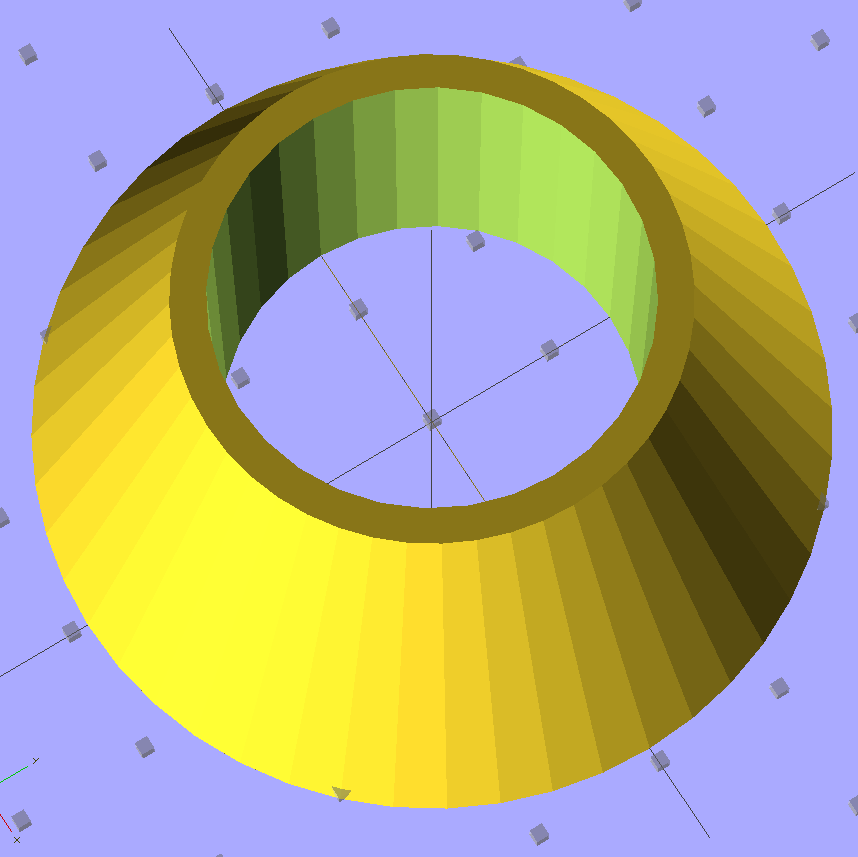
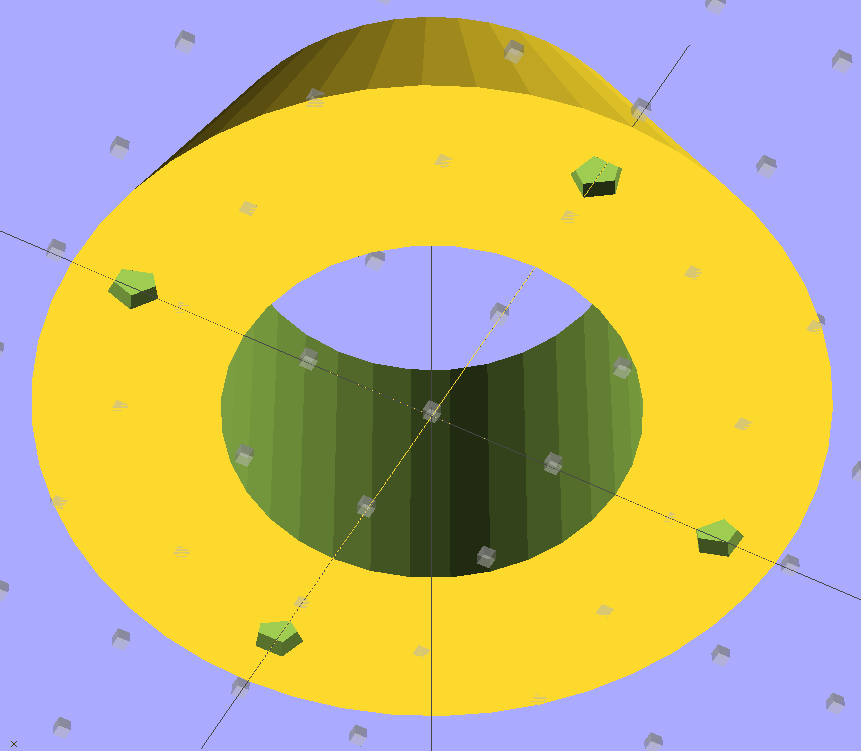
The microscope eyepiece adapter was easy enough: a cone with a cylinder punched out of it:
Microscope eyepiece adapter – front view
The thin part of the tip is four threads wide around the eyepiece OD, which makes for good fill.
The bottom has the usual four alignment pin holes:
Microscope eyepiece adapter – bottom view
The main tube opening ID is equal to the diameter of the flat rim around the microscope eyepiece, which provides a positive stop with plenty of surface area.
The macro lens adapter took shape around a nice 25 mm doublet lens from the Box o’ Lenses. The Canon SX230HS has a lens opening that’s just about 25 mm in diameter and a larger lens would be better, but at maximum zoom the image pretty much fills the camera’s entrance pupil. I ordered a pair of 50 mm LED ring lights from halfway around the planet and built the snout to hold the ring around the lens:
Macro lens snout with LED ring light
That’s the first pass to get the sizes right and work out some details. In particular, that small white ring inside the aperture below the lens didn’t work at all, so I made the main tube opening a bit smaller.
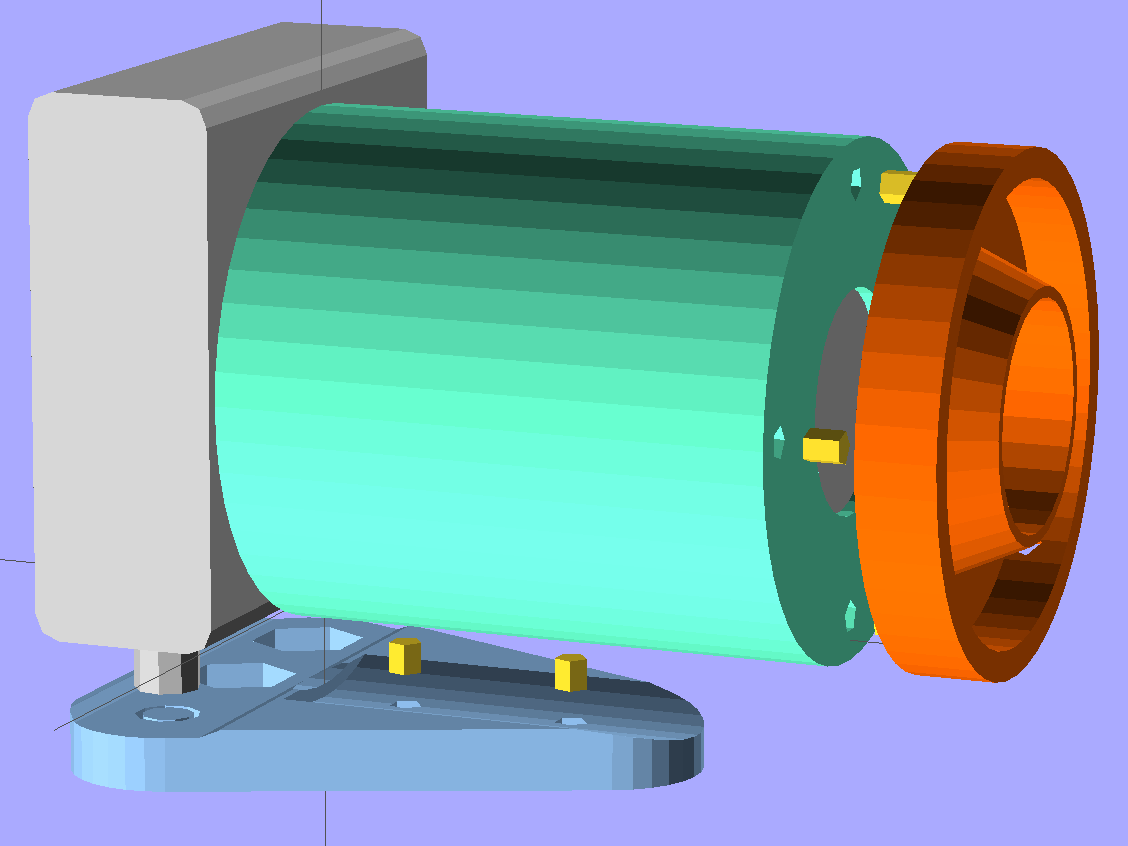
The solid model shows the details a bit better:
Macro adapter snout – solid model – front view
The inner cone shields the lens edges from (most of the) scattered LED light. I considered angling the side walls to concentrate the ring light, but wasn’t convinced it’d be worth the effort because the LEDs have such a broad beamwidth anyway. The little hole is for the LED power cable, which goes to a 12 V switching wall wart. The 5 strings of 3 LEDs draw about 70 mA, which suggests I should hack the ballast resistors down a bit to boost the current up to 20 mA per string. FWIW, the resistors give 25 mA per string at 13.8 V, so I could probably goose the current a lot higher.
The bottom has four shallow holes for the alignment pegs cut from ABS filament:
Macro adapter snout – solid model – bottom view
The hole in the front end of the main tube is marginally smaller than the lens diameter, as I used the OpenSCAD cylinder primitive instead of the PolyCyl module that slightly enlarges holes to make the answer come out right. The difference is just enough to form a solid stop that aligns the lens and prevents it from sliding into the body before the glue cures.
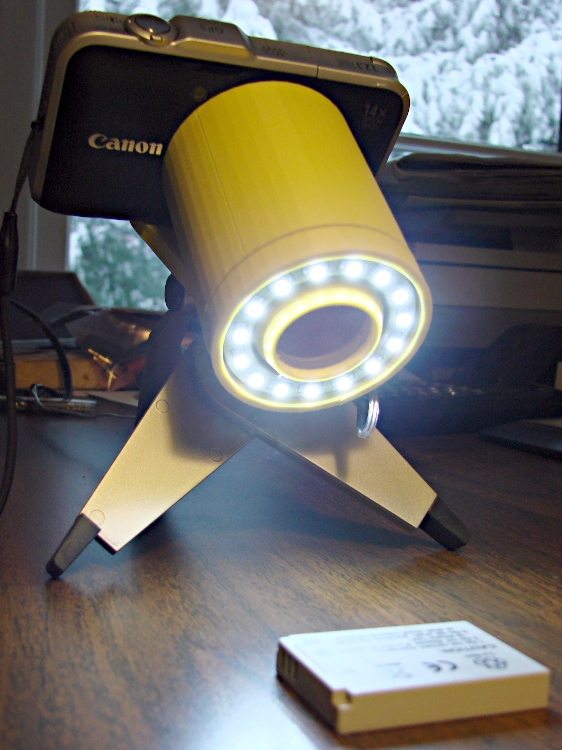
The whole affair looks pretty scary from the victim’s point of view:
SX230HS macro adapter LED ring light – front view
But the camera’s view seems OK, albeit with some vignetting:
Canon NB-5L battery through macro lens adapter
Limited by vignetting & entrance pupil filling, zooming controls the horizontal subject size from 25 mm to about 10 mm. Depth of field is a few mm, at best; the printing on the far end of that battery is fuzzier than it seems.
Best results so far come from:
Manual aperture at f/8
Manual focus at infinity (move the subject to focus)
Shutter delay = 2 seconds to let the camera stop shaking
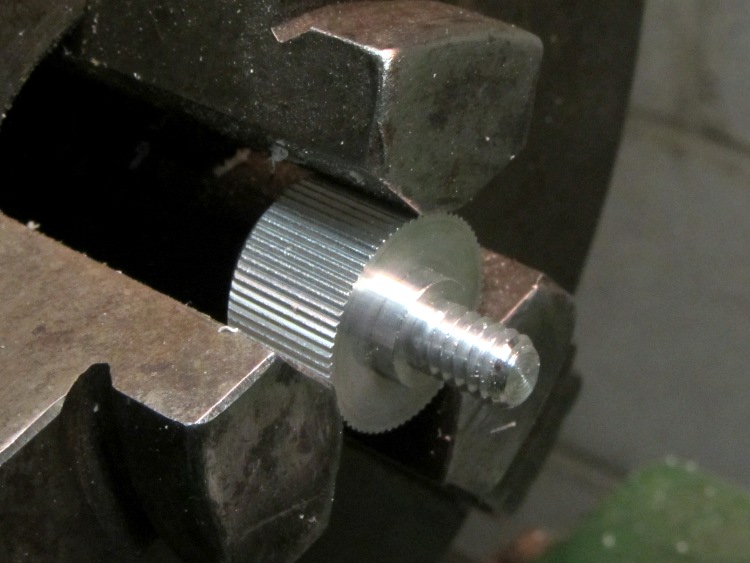
The microscope adapter needs a single screw to hold the camera to the mount. I used the same aluminum knob as on the adapter for my previous camera, shortening the screw so it didn’t bottom out in the camera socket:
Shortened camera mount knob screw
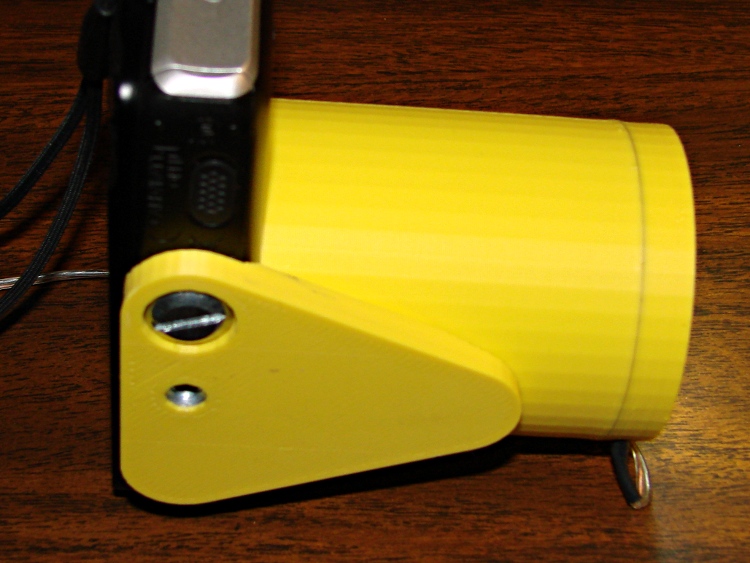
The boss is slightly shorter than the recess, so the knob body seats on the plate and works like this:
SX230HS microscope adapter – side view
When the camera isn’t on the adapter, the screw stores neatly in the 1/4-20 nut sunk in the middle of the mounting plate.
Although I can hand-hold the macro lens adapter, it’s much more stable on a real tripod. That requires a flat camera-mount screw that sits within the recess so the mounting plate can sit flush atop the tripod head:
Camera mount plate with screw – bottom view
However, it’ll be much easier to use the knob screw when I’m hand-holding the thing, so I drilled-and-tapped a hole in the knob for a place to store the flat screw when it’s not in use:
Camera mounting screws – end view
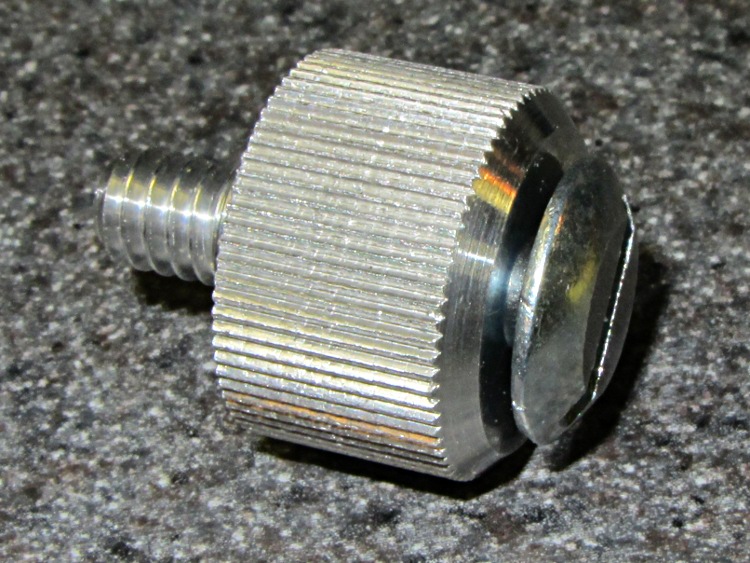
The threads in the knob don’t go quite far enough to seat the screw head against the knob, but that crude hack wouldn’t work in aluminum. Fortunately, it doesn’t matter:
Camera mounting screws – joined
This being a low-torque application, I filed the top off the already-pretty-flat truss head so the mounting plate recess didn’t have to be all that deep.
The knob+screw stores in the 1/4-20 nut between uses, too:
Knob and screw stored in macro adapter
Yeah, yellow probably isn’t appropriate for an optical structure; I’ll shoot a black rattle-can coat inside there after the weather warms up…
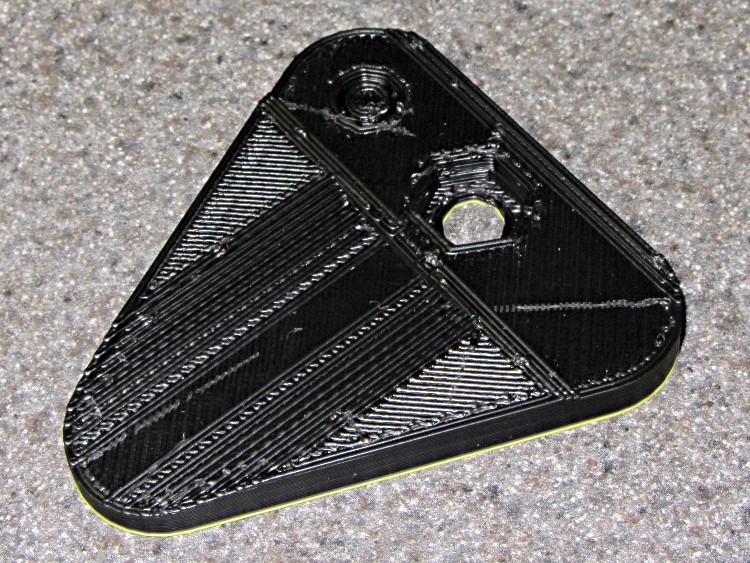
The Canon SX230HS tripod mounting screw sits offset from the lens axis, presumably because there’s no way to jam the screw socket under all the machinery that retracts the lens turret. I laid out the mounting plate as a round-cornered triangle with a 1/4-20 clearance hole for the screw that holds the camera to the plate and a 1/4-20 nut sunk under the lens axis for a tripod screw. The main adapter tube supporting the microscope mount or macro lens holder glues into the shallow trench:
Camera mount baseplate – top view
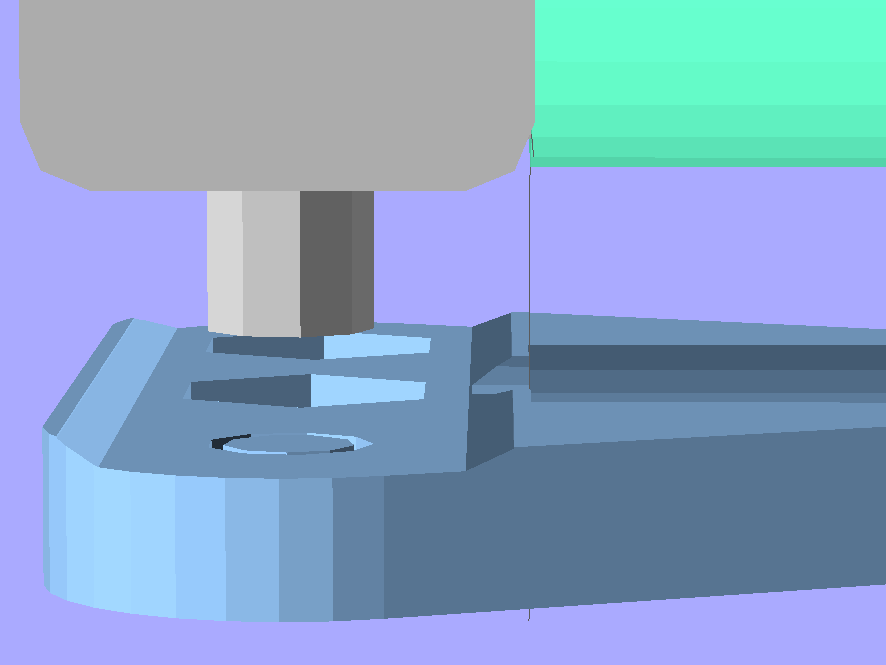
The barely visible trench along the back edge matches the bottom of the camera closely enough to align it against the main tube. This exploded view shows how that works:
Mounting plate camera interface – solid model
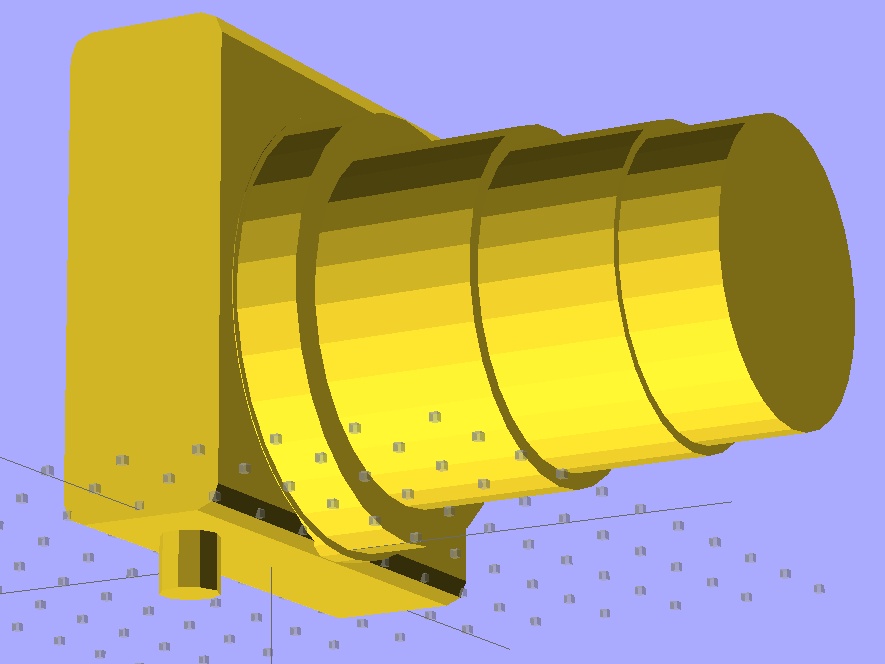
In fact, that trench and the hole under the camera’s tripod socket come from subtracting the whole camera model from the mounting plate. I added the fully extended lens turret just for completeness; the body is no wider then necessary to carve that trench:
Canon SX230HS Camera – solid model
The Z=0 plane cuts through the top of the curved bottom shell to simplify the subtraction. The post diameter clears the 1/4-20 tripod screw and is long enough to punch through the mounting plate.
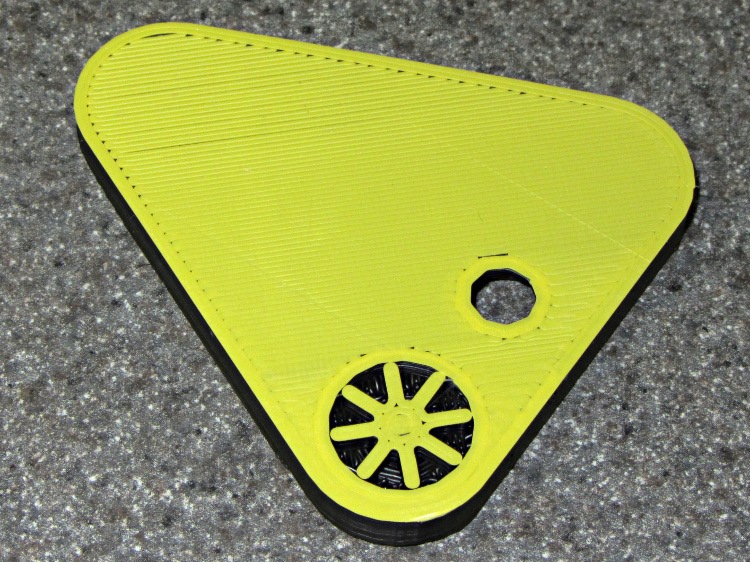
The bottom view shows the recess for the camera tripod screw head, with the support material (which blocks the hole in the picture above) removed:
Camera mount baseplate – support removed
It looks like this with the support plug in place:
Camera mount baseplate – bottom view – with support
Removing the support plug involves twisting the legs with a needle-nose pliers.
The yellow layer comes from switching colors in mid-print, but it certainly adds some much-needed contrast to the image.
The OpenSCAD code there sinks a second 1/4-20 nut that might be useful for an offset tripod mount if you need such a thing.










 The Smell of Molten Projects in the Morning