The Smell of Molten Projects in the Morning

Ed Nisley's Blog: Shop notes, electronics, firmware, machinery, 3D printing, laser cuttery, and curiosities. Contents: 100% human thinking, 0% AI slop.

Tag: CNC-3018XL

Small gantry router

  • CNC 3018-Pro: Milling the CD Fixture

    It turns out that the outer diameter of CD platters isn’t quite as perfectly controlled as you (well, I) might imagine, although the differences between CDs from different sources amounts to perhaps ±0.1 mm. Of course, instantly after putting the tape-down fixture into use, the next few discs atop my stack of scrap CDs were just large enough to not quite fit.

    The Sherline’s workspace can’t maneuver the holder’s perimeter around the spindle, so embiggening the OD calls for the rotary table. The general idea is to clamp the center of the fixture to the rotary table, run a small end mill about 0.1 mm into the fixture’s OD, spin the table one revolution, and be done with it.

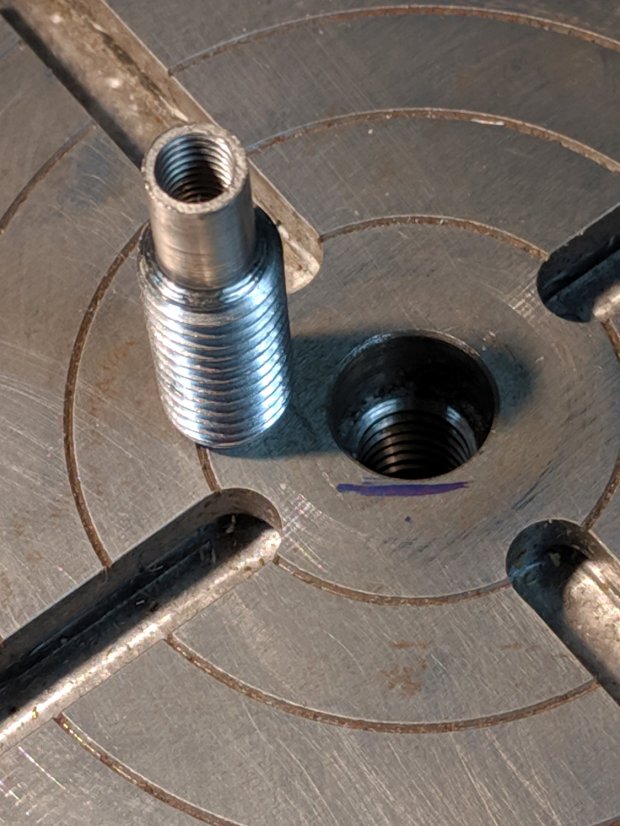
    Of course, the rotary table’s 3/8-16 threaded center hole doesn’t match the fixture’s 6 mm center hole: we need an adapter. Start with a 1 inch long 3/8-16 stainless steel hex bolt, center drill the end, peel off the hex head, then turn to 6 mm OD, going down far enough so the threads don’t stick up out of the table too much:

    CNC 3018-Pro - CD fixture milling - bolt turning
    CNC 3018-Pro – CD fixture milling – bolt turning

    The Sherline uses 10-32 screws, so poke a #16 drill 15 mm into the bolt to get maybe 25% thread depth (because it’s a blind hole into stainless steel for an application requiring minimal strength and I hate breaking taps), tap 10-32, clean out the hole, and call it All Good:

    CNC 3018-Pro - CD fixture milling - rotary table adapter
    CNC 3018-Pro – CD fixture milling – rotary table adapter

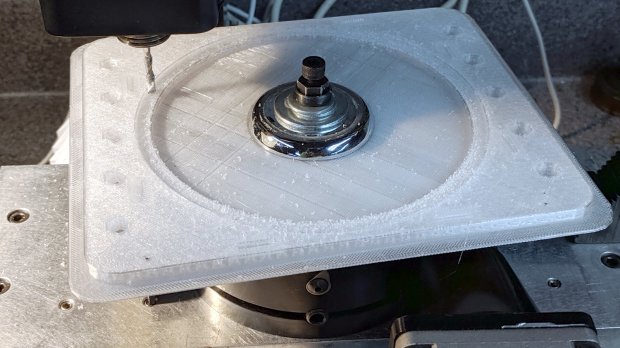
    Find the trim plate from an old faucet to reach around the central boss, stack up enough flat washers to meet the nut, snug a Sherline spherical nut + washer set (because it’s within reach), chuck up a 1/8 inch mill, and have at it:

    CNC 3018-Pro - CD fixture milling
    CNC 3018-Pro – CD fixture milling

    The fixture sits atop an aluminum plate cut to fit a smaller version of the table riser, but this requires zero fancy alignment. The 6 mm adapter centers the fixture on the rotary table and the cutter sits at a fixed radius from the center wherever it contacts the fixture rim; just spin the table and it cuts a neatly centered circle.

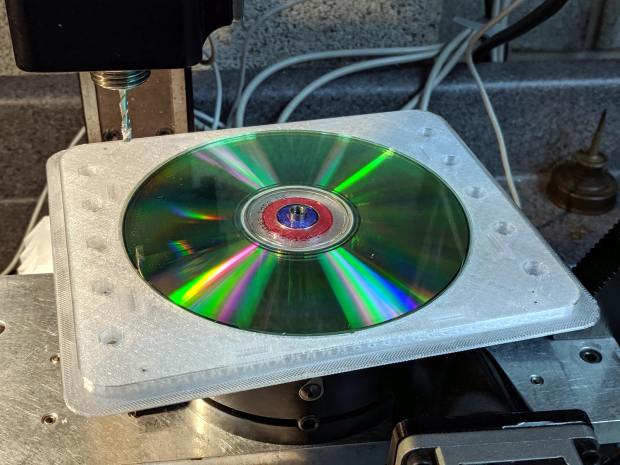
    A test fit showed the oversize discs fit perfectly:

    CNC 3018-Pro - CD fixture milling - test fit
    CNC 3018-Pro – CD fixture milling – test fit

    Bonus: a nice new adapter for the rotary table!

  • CNC 3018-Pro: Tape-Down Platter Fixture

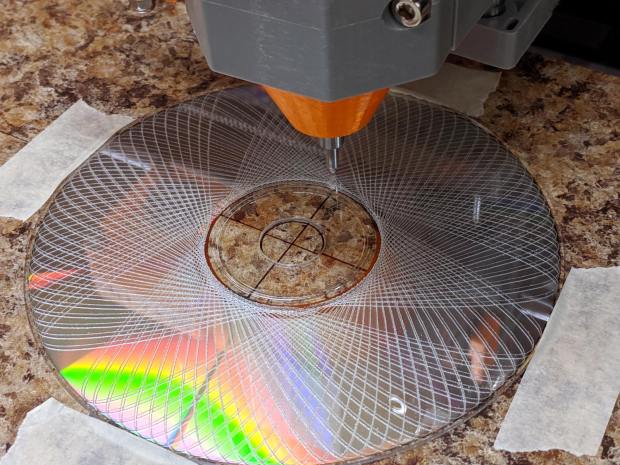
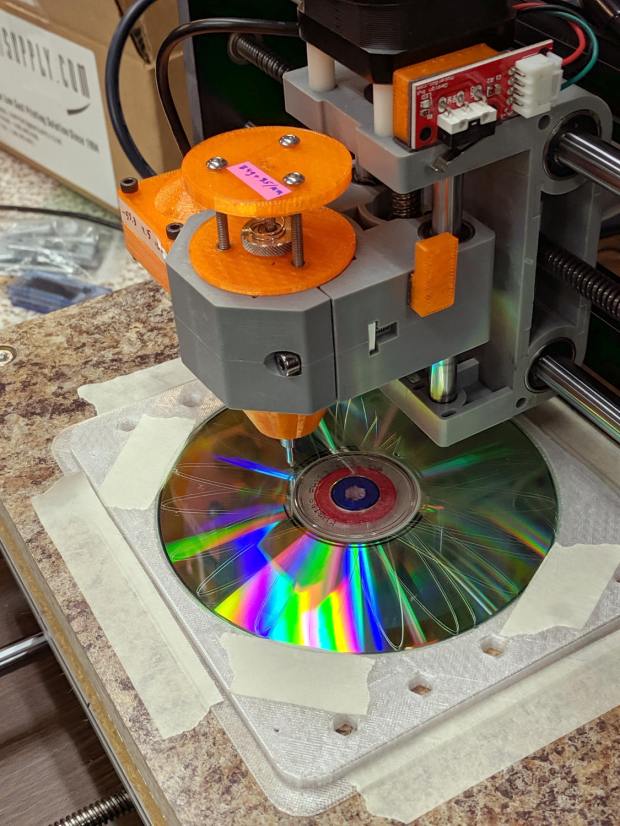
    Diamond drag engraving doesn’t put much sideways force on the platters, so taping the CD in place suffices to hold it:

    CNC 3018-Pro - CD taped to platform
    CNC 3018-Pro – CD taped to platform

    Wrapping a flange around the screw-down platter fixture provides plenty of surface area for tape:

    Platter Fixtures - CD on 3018 - tape flange
    Platter Fixtures – CD on 3018 – tape flange

    Which looks exactly as you think it would in real life:

    CNC 3018-Pro - CD fixture - taped
    CNC 3018-Pro – CD fixture – taped

    Admittedly, masking tape doesn’t look professional, but it’s low-profile, cheap and works perfectly. Blue painter’s tape for the “permanent” hold-down strips on the platform would be a colorful upgrade.

    It’s centered on the platform at the XY=0 origin in the middle of the XY travel limits, with edges aligned parallel to the axes. Homing the 3018 and moving to XY=0 puts the tool point directly over the center of the CD without any fussy alignment.

    The blue-and-red rings around the center hole assist probe camera alignment, whenever that’s necessary.

    The OpenSCAD source code as a GitHub Gist:

    // Machining fixtures for CD and hard drive platters
    // Ed Nisley KE4ZNU February … September 2016
    // 2019-08 split from tube base models
    PlatterName = "CD"; // [3.5inch,CD]
    CNCName = "3018"; // [3018,Sherline]
    TapeFlange = true; // Generate tape attachment
    PlateThick = 5.0; // [3.0,5.0,10.0,15.0]
    RecessDepth = 4.0; // [0.0,2.0,4.0]
    //- Extrusion parameters must match reality!
    /* [Hidden] */
    ThreadThick = 0.25;
    ThreadWidth = 0.40;
    HoleWindage = 0.2;
    Protrusion = 0.1; // make holes end cleanly
    inch = 25.4;
    function IntegerMultiple(Size,Unit) = Unit * ceil(Size / Unit);
    module PolyCyl(Dia,Height,ForceSides=0) { // based on nophead's polyholes
    Sides = (ForceSides != 0) ? ForceSides : (ceil(Dia) + 2);
    FixDia = Dia / cos(180/Sides);
    cylinder(d=(FixDia + HoleWindage),h=Height,$fn=Sides);
    }
    ID = 0;
    OD = 1;
    LENGTH = 2;
    //———————-
    // Dimensions
    P_NAME = 0; // platter name
    P_ID = 1; // … inner diameter
    P_OD = 2; // … outer diameter
    P_THICK = 3; // … thickness
    PlatterData = [
    ["3.5inch", 25.0, 95.0, 1.75],
    ["CD", 15.0, 120.0, 1.20],
    ];
    PlatterSides = 3*4*5; // polygon approximation
    B_NAME = 0; // machine name
    B_OC = 1; // … platform screw OC, use small integer for slot
    B_STUD = 2; // … screw OD clearance
    BaseData = [
    ["3018", [5.0, 45.0], 6.0], // slots along X axis
    ["Sherline", [1.16*inch,1.16*inch], 5.0], // tooling plate
    ];
    PlateRound = 10.0; // corner radius
    FlangeSize = [5.0,5.0,3*ThreadThick]; // all-around tape flange
    //– calculate values based on input parameters
    PI = search([PlatterName],PlatterData,1,0)[P_NAME]; // get platter index
    echo(str("Platter: ",PlatterName));
    Platter = [PlatterData[PI][P_ID],
    PlatterData[PI][P_OD],
    PlatterData[PI][P_THICK]];
    BI = search([CNCName],BaseData,1,0)[B_NAME]; // get base index
    echo(str("Machine: ",CNCName));
    AlignOC = IntegerMultiple(Platter[OD],10);
    echo(str("Alignment pip offset: ±",AlignOC/2));
    AlignSlot = [3*ThreadWidth,10.0,3*ThreadThick];
    StudClear = BaseData[BI][B_STUD]; // … clearance
    StudOC = [IntegerMultiple(AlignOC + 2*StudClear,BaseData[BI][B_OC].x), // … screw spacing
    BaseData[BI][B_OC].y];
    echo(str("Stud spacing: ",StudOC));
    NumStuds = [2,1 + 2*floor(Platter[OD] / StudOC.y)]; // holes only along ±X edges
    echo(str("Stud holes: ",NumStuds));
    BasePlate = [(20 + StudOC.x*ceil(Platter[OD] / StudOC.x)),
    (10 + AlignOC),
    PlateThick];
    echo(str("Plate: ",BasePlate));
    Flange = [BasePlate.x + 2*FlangeSize.x,BasePlate.y + 2*FlangeSize.y,FlangeSize.z];
    echo(str("Flange: ",Flange));
    //———————-
    // Drilling fixture for disk platters
    module PlatterFixture() {
    difference() {
    union() {
    hull() // basic plate shape
    for (i=[-1,1], j=[-1,1])
    translate([i*(BasePlate.x/2 – PlateRound),j*(BasePlate.y/2 – PlateRound),0])
    cylinder(r=PlateRound,h=BasePlate.z,$fn=4*4);
    if (TapeFlange)
    hull()
    for (i=[-1,1], j=[-1,1])
    translate([i*(Flange.x/2 – PlateRound),
    j*(Flange.y/2 – PlateRound),
    0])
    cylinder(r=PlateRound,h=FlangeSize.z,$fn=4*4);
    }
    for (i=[-1,0,1], j=[-1,0,1]) // origin pips
    translate([i*AlignOC/2,j*AlignOC/2,BasePlate.z – 2*ThreadThick])
    cylinder(d=4*ThreadWidth,h=1,$fn=6);
    for (i=[-1,1], j=[-1,1]) { // alignment slots
    translate([i*(AlignOC + AlignSlot.x)/2,
    j*Platter[OD]/4,
    (BasePlate.z – AlignSlot.z/2 + Protrusion/2)])
    cube(AlignSlot + [0,0,Protrusion],center=true);
    translate([i*Platter[OD]/4,
    j*(AlignOC + AlignSlot.x)/2,
    (BasePlate.z – AlignSlot.z/2 + Protrusion/2)])
    rotate(90)
    cube(AlignSlot + [0,0,Protrusion],center=true);
    }
    for (i=[-1,1], j=[-floor(NumStuds.y/2):floor(NumStuds.y/2)]) // mounting stud holes
    translate([i*StudOC.x/2,j*StudOC.y/2,-Protrusion])
    rotate(180/6)
    PolyCyl(StudClear,BasePlate.z + 2*Protrusion,6);
    translate([0,0,-Protrusion]) // center clamp hole
    rotate(180/6)
    PolyCyl(StudClear,BasePlate.z + 2*Protrusion,6);
    translate([0,0,BasePlate.z – Platter[LENGTH]]) // disk locating recess
    rotate(180/PlatterSides)
    linear_extrude(height=(Platter[LENGTH] + Protrusion),convexity=2)
    difference() {
    circle(d=(Platter[OD] + 2*HoleWindage),$fn=PlatterSides);
    circle(d=Platter[ID] – HoleWindage,$fn=PlatterSides);
    }
    translate([0,0,BasePlate.z – RecessDepth]) // drilling recess
    rotate(180/PlatterSides)
    linear_extrude(height=(RecessDepth + Protrusion),convexity=2)
    difference() {
    circle(d=(Platter[OD] – 10),$fn=PlatterSides);
    circle(d=(Platter[ID] + 10),$fn=PlatterSides);
    }
    }
    }
    //———————-
    // Build it
    PlatterFixture();
  • DRV8825 Stepper Driver: Adding a Home Output

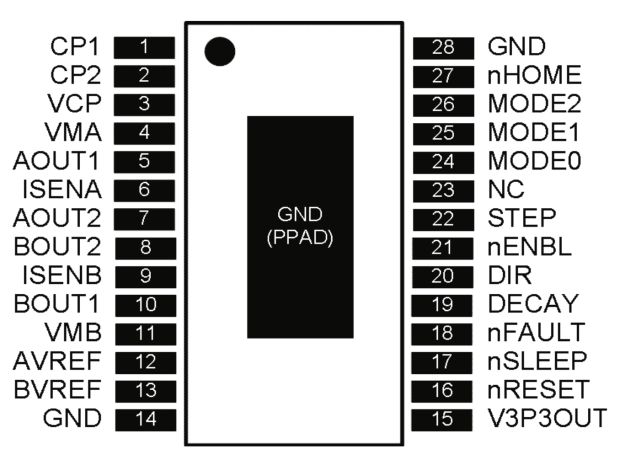
    The DRV8825 stepper driver chip has a -Home output going active during the (micro)step corresponding to 45°, where both winding currents equal 71% of the peak value:

    DRV8825 pinout
    DRV8825 pinout

    Unfortunately, pin 27 is another unconnected pin on the DRV8825 PCB, without even a hint of a pad for E-Z soldering.

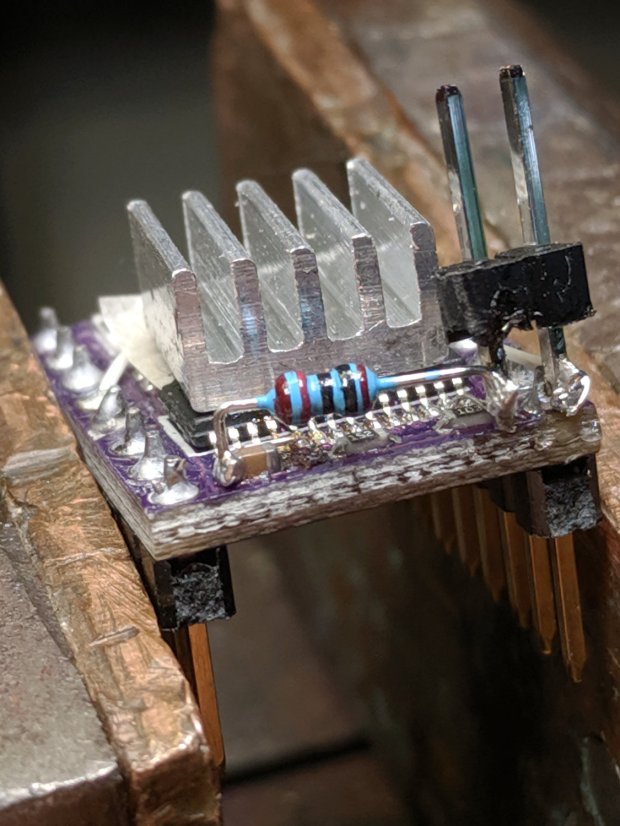
    It’s also an open-drain output in need of a pullup, so I globbed on a 1/8 W 10 kΩ resistor in addition to the tiny wire from the IC pad to the left header pin:

    DRV8825 PCB - Home signal output
    DRV8825 PCB – Home signal output

    Read it from the right: brown black black red gold. Even in person, the colors don’t look like that, not even a little bit: always measure before installation!

    The right header pin is firmly soldered to the PCB ground pin I also used for the 1:8 microstep hack. The whole affair received a generous layer of hot melt glue in the hope of some mechanical stabilization, although hanging a scope probe off those pins can’t possibly end well.

    The general idea is to provide a scope sync output independent of the motor speed, so I can look at the current waveforms:

    3018 X - Fast - 12V - 140mm-min 1A-div
    3018 X – Fast – 12V – 140mm-min 1A-div

    The alert reader will note the pulse occurs on the down-going side of the waveforms, which means I have the current probes clipped on backwards or, equivalently, on the wrong wire. The point is to get a stable sync, so it’s all good no matter which way the current goes.

  • CNC 3018-Pro: LM6UU Linear-bearing Diamond Drag Bit Holder

    The CNC 3018-Pro normally holds a small DC motor with a nicely cylindrical housing,so this was an easy adaptation of the MPCNC’s diamond drag bit holder:

    CNC 3018-Pro - Diamond bit - overview
    CNC 3018-Pro – Diamond bit – overview

    The lip around the bottom part rests atop the tool clamp, with the spring reaction plate sized to clear the notch in the Z-axis stage.

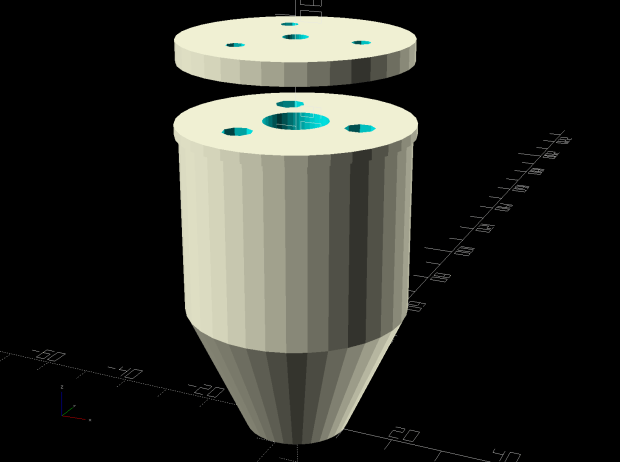
    The solid model looks about like you’d expect:

    Diamond Scribe - Mount - solid model
    Diamond Scribe – Mount – solid model

    The New Thing compared to the MPCNC holder is wrapping LM6UU bearings around an actual 6 mm shaft, instead of using LM3UU bearings for the crappy diamond bit shank:

    CNC 3018-Pro - Diamond bit - epoxy curing
    CNC 3018-Pro – Diamond bit – epoxy curing

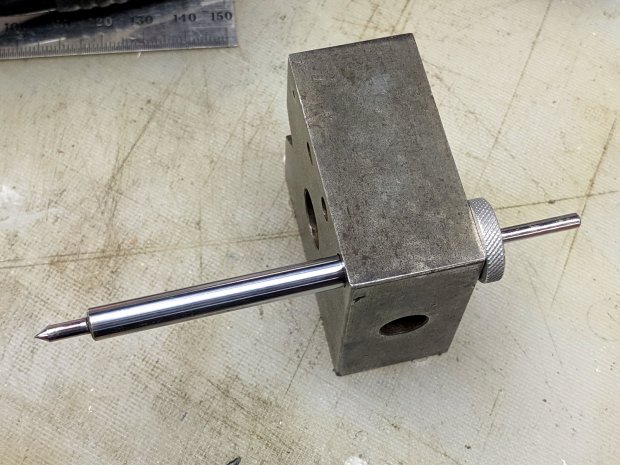
    I cut the shank in two pieces, epoxied them into 3 mm holes drilled into the 6 mm shaft, then epoxied the knurled stop ring on the end. The ring is curing in the bench block to stay perpendicular to the 6 mm shaft.

    The spring constant is 55 g/mm and it’s now set for 125 g preload:

    CNC 3018-Pro - Diamond bit - force measurement
    CNC 3018-Pro – Diamond bit – force measurement

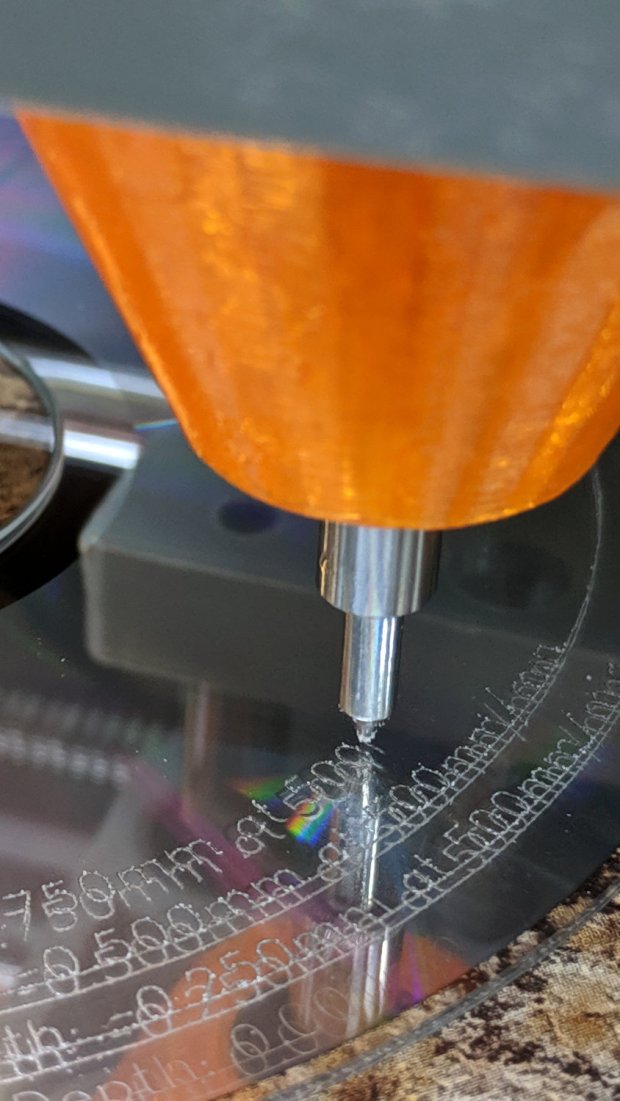
    A quick test says all the parts have begun flying in formation:

    CNC 3018-Pro - Diamond bit - test CD
    CNC 3018-Pro – Diamond bit – test CD

    It’s definitely more rigid than the MPCNC!

    The OpenSCAD source code as a GitHub Gist:

    // Diamond Scribe in linear bearings for CNC3018
    // Ed Nisley KE4ZNU – 2019-08-9
    Layout = "Build"; // [Build, Show, Base, Mount, Plate]
    /* [Hidden] */
    ThreadThick = 0.25; // [0.20, 0.25]
    ThreadWidth = 0.40; // [0.40, 0.40]
    /* [Hidden] */
    Protrusion = 0.1; // [0.01, 0.1]
    HoleWindage = 0.2;
    inch = 25.4;
    function IntegerMultiple(Size,Unit) = Unit * ceil(Size / Unit);
    ID = 0;
    OD = 1;
    LENGTH = 2;
    //- Adjust hole diameter to make the size come out right
    module PolyCyl(Dia,Height,ForceSides=0) { // based on nophead's polyholes
    Sides = (ForceSides != 0) ? ForceSides : (ceil(Dia) + 2);
    FixDia = Dia / cos(180/Sides);
    cylinder(r=(FixDia + HoleWindage)/2,h=Height,$fn=Sides);
    }
    //- Dimensions
    // Knife holder & suchlike
    ScribeOD = 3.0; // diamond scribe shaft
    Bearing = [6.0,12.0,19.0]; // linear bearing body, ID = shaft diameter
    Spring = [4.5,5.5,3*ThreadThick]; // compression spring around shaft, LENGTH = socket depth
    //Spring = [9.5,10.0,3*ThreadThick]; // compression spring around shaft, LENGTH = socket depth
    WallThick = 4.0; // minimum thickness / width
    Screw = [3.0,6.75,25.0]; // holding it all together, OD = washer
    Insert = [3.0,5.0,8.0]; // brass insert
    //Insert = [4.0,6.0,10.0];
    Clamp = [43.2,44.0,34.0]; // tool clamp ring, OD = clearance around top
    LipHeight = IntegerMultiple(2.0,ThreadThick); // above clamp for retaining
    BottomExtension = 25.0; // below clamp to reach workpiece
    MountOAL = LipHeight + Clamp[LENGTH] + BottomExtension; // total mount length
    echo(str("Mount OAL: ",MountOAL));
    Plate = [1.5*ScribeOD,Clamp[ID] – 0*2*WallThick,WallThick]; // spring reaction plate
    NumScrews = 3;
    ScrewBCD = Bearing[OD] + Insert[OD] + 2*WallThick;
    echo(str("Retainer max OD: ",ScrewBCD – Screw[OD]));
    NumSides = 9*4; // cylinder facets (multiple of 3 for lathe trimming)
    // Basic mount shape
    module CNC3018Base() {
    translate([0,0,MountOAL – LipHeight])
    cylinder(d=Clamp[OD],h=LipHeight,$fn=NumSides);
    translate([0,0,MountOAL – LipHeight – Clamp[LENGTH] – Protrusion])
    cylinder(d=Clamp[ID],h=(Clamp[LENGTH] + 2*Protrusion),$fn=NumSides);
    cylinder(d1=Bearing[OD] + 2*WallThick,d2=Clamp[ID],h=BottomExtension + Protrusion,$fn=NumSides);
    }
    // Mount with holes & c
    module Mount() {
    difference() {
    CNC3018Base();
    translate([0,0,-Protrusion]) // bearing
    PolyCyl(Bearing[OD],2*MountOAL,NumSides);
    for (i=[0:NumScrews – 1]) // clamp screws
    rotate(i*360/NumScrews)
    translate([ScrewBCD/2,0,MountOAL – Clamp[LENGTH]])
    rotate(180/8)
    PolyCyl(Insert[OD],Clamp[LENGTH] + Protrusion,8);
    }
    }
    module SpringPlate() {
    difference() {
    cylinder(d=Plate[OD],h=Plate[LENGTH],$fn=NumSides);
    translate([0,0,-Protrusion])
    PolyCyl(Plate[ID],2*MountOAL,NumSides);
    translate([0,0,Plate[LENGTH] – Spring[LENGTH]]) // spring retainer
    PolyCyl(Spring[OD],Spring[LENGTH] + Protrusion,NumSides);
    for (i=[0:NumScrews – 1]) // clamp screws
    rotate(i*360/NumScrews)
    translate([ScrewBCD/2,0,-Protrusion])
    rotate(180/8)
    PolyCyl(Screw[ID],2*MountOAL,8);
    }
    }
    //—–
    // Build it
    if (Layout == "Base")
    CNC3018Base();
    if (Layout == "Mount")
    Mount();
    if (Layout == "Plate")
    SpringPlate();
    if (Layout == "Show") {
    Mount();
    translate([0,0,1.25*MountOAL])
    rotate([180,0,0])
    SpringPlate();
    }
    if (Layout == "Build") {
    translate([0,-0.75*Clamp[OD],MountOAL])
    rotate([180,0,0])
    Mount();
    translate([0,0.75*Plate[OD],0])
    SpringPlate();
    }
  • CNC 3018-Pro: Table Riser

    With the 3018-Pro used for drag engraving on CDs and hard drive platters, there’s no need for all the clearance below the Z-axis carriage required for the OEM motor and ER11 collet chuck. A chunk of laminate countertop and a hunk of Celotex foam insulation produce a nicely flat surface 47 mm above the platform:

    CNC 3018 Table Riser
    CNC 3018 Table Riser

    It’s surprisingly flat:

    Table Flatness Measurement - 2019-08-30
    Table Flatness Measurement – 2019-08-30

    Those are millimeters of clearance between the gray plastic clamp around the diamond drag tool holder (about which, more later) and my trusty bench block, measured at 50 mm intervals across the platform. The lower figures appeared after tightening the upper-left screw by a little over 1/6 turn = 0.2 mm, making the entire platform flat & aligned within ±0.1 mm.

    Yeah, not bad for a scrap countertop!

    The four M6 socket head cap screws pass through the stack into T-nuts in the platform:

    CNC 3018 Table Riser - screw clearance
    CNC 3018 Table Riser – screw clearance

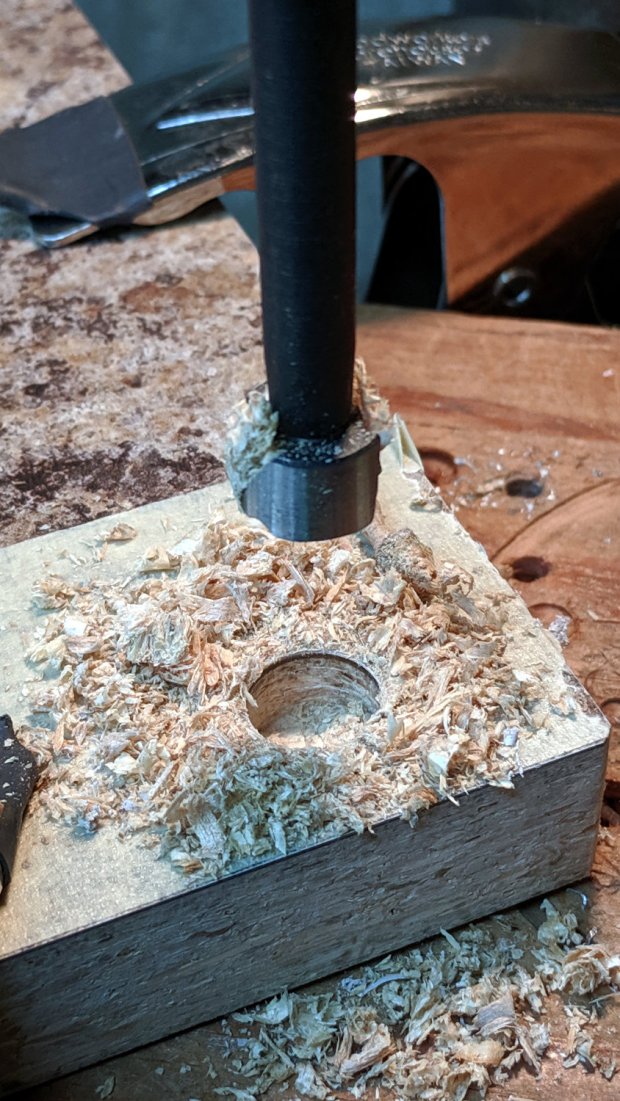
    The countertop was thick enough to allow countersinking the screws slightly below the surface:

    CNC 3018 Table Riser - screw countersink
    CNC 3018 Table Riser – screw countersink

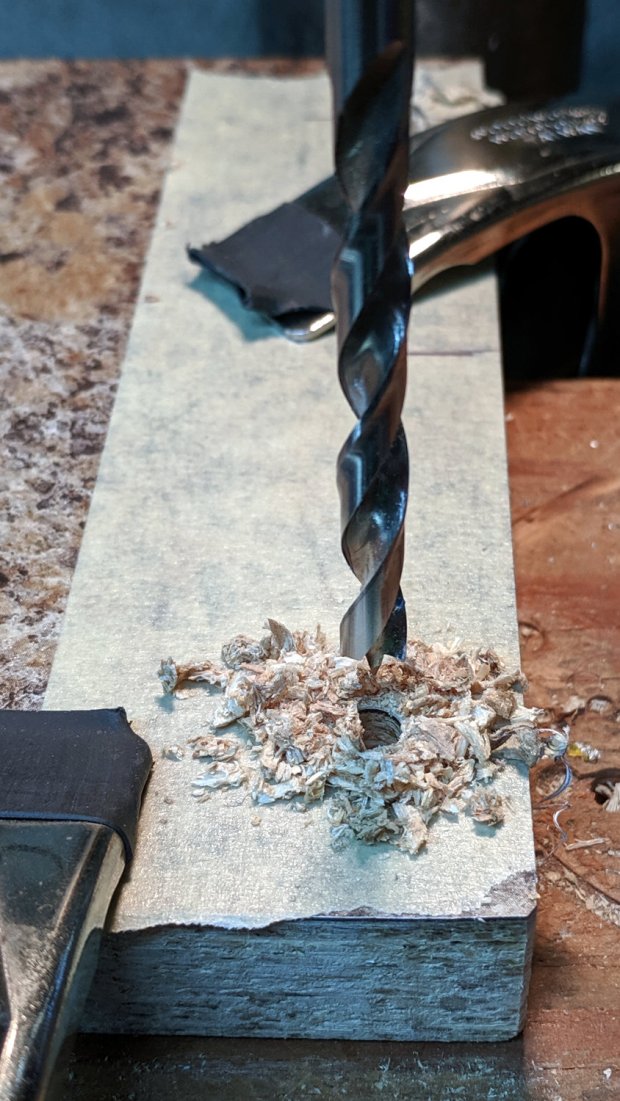
    I transfer-punched the screw clearance hole locations into the Celotex and drilled it with an ordinary twist drill. It wasn’t pretty, but nobody will ever notice.

    Two sheets, maybe 1 mm thick, of closed-cell foam below the Celotext provide enough squish to align the top surface without straining anything. The screws are firmly tight, so they shouldn’t work their way loose under minimal engraving loads.

    Taping the CDs to the surface works well for now, although a simpler version of the fixture may be in order.

  • CNC 3018-Pro: Probe Camera Case for Anonymous USB Camera

    The anonymous USB camera I used with the stereo zoom microscope not only works with VLC, but also with bCNC, and it has a round PCB with ears:

    CNC 3018-Pro - Probe Camera - PCB
    CNC 3018-Pro – Probe Camera – PCB

    Which suggested putting it in a ball mount for E-Z aiming:

    CNC 3018-Pro - Probe Camera - ball mount
    CNC 3018-Pro – Probe Camera – ball mount

    Black filament snippets serve as alignment pins to hold the ball halves together while they’re getting clamped. They’re epoxied into the upper half of the ball, because who knows when I’ll need to harvest the camera.

    The clamp mount descends from the Tour Easy Daytime Running Lights, with more screws and less fancy shaping:

    USB Camera - Round PCB Mount - solid model - build
    USB Camera – Round PCB Mount – solid model – build

    The clamp pieces fit around the ball with four M3 screws providing the clamping force:

    USB Camera - Round PCB Mount - solid model sectioned
    USB Camera – Round PCB Mount – solid model sectioned

    The whole affair sticks onto the Z axis carrier with double-sided foam tape:

    CNC 3018-Pro - Probe Camera - alignment
    CNC 3018-Pro – Probe Camera – alignment

    It barely clears the strut on the -X side of the carriage, although it does stick out over the edge of the chassis.

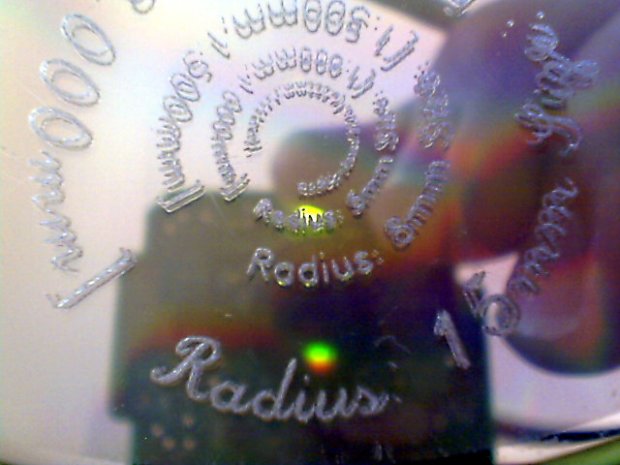
    After the fact, I tucked a closed-cell foam ring between the lens threads and the ball housing to stabilize the lens; the original camera glued the thing in place, but some fiddly alignment & focusing lies ahead:

    Alignment mirror - collimation
    Alignment mirror – collimation

    It’s worth noting that the optical axis of these cheap cameras rarely coincides with the physical central axis of the lens. This one requires a jaunty tilt, although it’s not noticeable in any of the pictures I tried to take.

    All in all, this one works just like the probe camera on the MPCNC.

    The OpenSCAD source code as a GitHub Gist:

    // CNC 3018-Pro Probe Camera mount for anonymous USB camera
    // Ed Nisley KE4ZNU – August 2019
    Layout = "Show"; // [Show, Build, Ball, Clamp, Bracket, Mount]
    //——-
    //- Extrusion parameters must match reality!
    // Print with 2 shells
    /* [Hidden] */
    ThreadThick = 0.25;
    ThreadWidth = 0.40;
    HoleWindage = 0.2;
    Protrusion = 0.1; // make holes end cleanly
    function IntegerMultiple(Size,Unit) = Unit * ceil(Size / Unit);
    inch = 25.4;
    ID = 0;
    OD = 1;
    LENGTH = 2;
    //——-
    // Dimensions
    //– Camera
    PCBThick = 1.2;
    PCBDia = 25.0;
    KeySize = [28.0,8.5,IntegerMultiple(PCBThick,ThreadThick)];
    KeyOffset = [0.0,2.0,0.0];
    KeyRadius = IntegerMultiple(sqrt(pow(KeySize.y – KeyOffset.y,2) + pow(KeySize.x/2,2)),0.01);
    echo(str("Key radius: ",KeyRadius));
    Lens = [14.0,18.0,25.0];
    BallID = PCBDia;
    BallOD = IntegerMultiple(2*KeyRadius,5.0);
    echo(str("Ball OD: ",BallOD));
    WallThick = 3.0;
    CableOD = 3.75;
    NumPins = 3;
    Pin = [1.75,1.8,5.0];
    Screw = [
    3.0,6.8,25.0 // M3 ID=thread, OD=washer, LENGTH=below head
    ];
    RoundRadius = IntegerMultiple(Screw[OD]/2,1.0); // corner rounding
    ClampSize = [BallOD + 2*WallThick,BallOD + 2*WallThick,20.0];
    echo(str("Clamp: ",ClampSize));
    MountSize = [5.0,BallOD,25.0];
    MountClearance = 1.0; // distance between clamp and mount
    Kerf = 2*ThreadThick;
    ScrewOC = [ClampSize.x – 2*RoundRadius,ClampSize.y – 2*RoundRadius];
    echo(str("Screw OC: ",ScrewOC));
    Insert = [ // brass insert: body, knurl,length
    3.9,4.9,8.0
    ];
    UseInsert = false;
    NumSides = 12*4;
    //——-
    module PolyCyl(Dia,Height,ForceSides=0) { // based on nophead's polyholes
    Sides = (ForceSides != 0) ? ForceSides : (ceil(Dia) + 2);
    FixDia = Dia / cos(180/Sides);
    cylinder(r=(FixDia + HoleWindage)/2,
    h=Height,
    $fn=Sides);
    }
    //——-
    // Components
    module CamBall(Section="Both") {
    Offset = (Section == "Both") ? 0 :
    (Section == "Upper") ? BallOD/2 :
    (Section == "Lower") ? -BallOD/2 :
    0;
    render(convexity=4)
    intersection(convexity = 3) {
    difference() {
    sphere(d=BallOD,$fn=NumSides);
    sphere(d=BallID,$fn=NumSides); // interior
    PolyCyl(CableOD,2*BallOD,8); // cable & lens holes
    translate([0,0,-Lens[LENGTH]])
    PolyCyl(Lens[OD],Lens[LENGTH],NumSides);
    translate([0,0,-PCBThick])
    PolyCyl(PCBDia,PCBThick,NumSides);
    translate(KeyOffset + [0,-KeySize.y/2,-PCBThick/2]) // PCB key
    cube(KeySize,center=true);
    for (i=[0:NumPins – 1])
    rotate(i*360/NumPins)
    translate([0,-(BallID + BallOD)/4,-Pin[LENGTH]/2])
    PolyCyl(Pin[OD],Pin[LENGTH],6);
    }
    translate([0,0,Offset])
    cube([BallOD,BallOD,BallOD] + 2*[Protrusion,Protrusion,0],center=true);
    }
    }
    module Clamp(Section="Both") {
    Offset = (Section == "Both") ? 0 :
    (Section == "Upper") ? ClampSize.z/2 :
    (Section == "Lower") ? -ClampSize.z/2 :
    0;
    render(convexity=4)
    intersection() {
    difference() {
    hull()
    for (i=[-1,1], j=[-1,1])
    translate([i*ScrewOC.x/2,j*ScrewOC.y/2,0])
    cylinder(r=RoundRadius,h=ClampSize.z,$fn=NumSides,center=true);
    sphere(d=BallOD + 2*HoleWindage,$fn=NumSides); // space around camera ball
    for (i=[-1,1], j=[-1,1]) // screws
    translate([i*ScrewOC.x/2,j*ScrewOC.y/2,-ClampSize.z])
    PolyCyl(Screw[ID],2*ClampSize.z,6);
    if (UseInsert)
    for (i=[-1,1], j=[-1,1]) // inserts
    translate([i*ScrewOC.x/2,j*ScrewOC.y/2,-(ClampSize.z/2 + Protrusion)])
    PolyCyl(Insert[OD],Insert[LENGTH] + Protrusion,8);
    cube([2*ClampSize.x,2*ClampSize.y,Kerf],center=true); // clamping gap
    }
    translate([0,0,Offset])
    cube([ClampSize.x,ClampSize.y,ClampSize.z] + 2*[Protrusion,Protrusion,0],center=true);
    }
    }
    module Bracket() {
    translate([ClampSize.x/2 + MountSize.x/2 + MountClearance,0,MountSize.z/2 – ClampSize.z/2])
    cube(MountSize,center=true);
    translate([ClampSize.x/2 + MountClearance/2,0,-(ClampSize.z + Kerf)/4])
    cube([MountClearance + 2*Protrusion,MountSize.y,(ClampSize.z – Kerf)/2],center=true);
    }
    module Mount() {
    union() {
    Clamp("Lower");
    Bracket();
    }
    }
    //——-
    // Build it!
    if (Layout == "Ball")
    CamBall();
    if (Layout == "Clamp")
    Clamp();
    if (Layout == "Bracket")
    Bracket();
    if (Layout == "Mount")
    Mount();
    if (Layout == "Show") {
    difference() {
    union() {
    color("Purple")
    Clamp("Upper");
    Mount();
    color("LimeGreen")
    CamBall();
    }
    rotate([0,0,45])
    translate([-ClampSize.x,0,0])
    cube(2*ClampSize,center=true);
    }
    }
    if (Layout == "Build") {
    Gap = 0.6;
    translate([-Gap*BallOD,Gap*BallOD,0])
    CamBall("Upper");
    translate([-Gap*BallOD,-Gap*BallOD,0])
    rotate([0,180,0])
    CamBall("Lower");
    translate([Gap*ClampSize.x,-Gap*ClampSize.y,ClampSize.z/2])
    rotate([0,180,0])
    Clamp("Upper");
    translate([Gap*ClampSize.x,Gap*ClampSize.y,ClampSize.z/2]) {
    rotate(180)
    Mount();
    }
    }
  • CNC 3018-Pro: Probe Camera Case for Logitch QuickCam Pro 5000

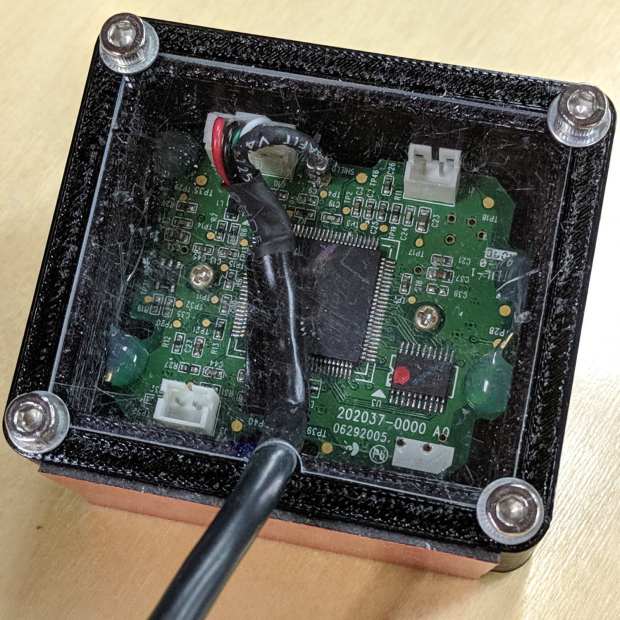
    The ball-shaped Logitch QuickCam Pro 5000 has a rectangular PCB, so conjuring a case wasn’t too challenging:

    Probe Camera Case - Logitech QuickCam Pro 5000 - bottom
    Probe Camera Case – Logitech QuickCam Pro 5000 – bottom

    That’s more-or-less matte black duct tape to cut down reflections.

    The top side has a cover made from scuffed acrylic scrap:

    Probe Camera Case - Logitech QuickCam Pro 5000 - top
    Probe Camera Case – Logitech QuickCam Pro 5000 – top

    The corners are slightly rounded to fit under the screw heads holding it in place.

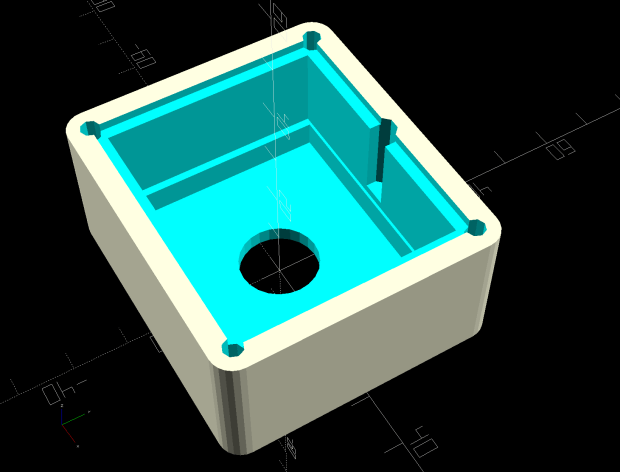
    The solid model shows off the internal ledge positioning the PCB so the camera lens housing rests on the floor:

    3018 Probe Camera Mount - solid model
    3018 Probe Camera Mount – solid model

    The notch lets the cable out, while keeping it in one place and providing some strain relief.

    I though if a camera was recognized by V4L2 and worked with VLC, it was good to go:

    Logitech QuickCam Pro 5000 - short focus
    Logitech QuickCam Pro 5000 – short focus

    Regrettably, it turns out the camera has a pixel format incompatible with the Python opencv interface used by bCNC. This may have something to do with running the code on a Raspberry Pi, rather than an x86 box.

    The camera will surely come in handy for something else, especially with such a cute case.

    The OpenSCAD source code as a GitHub Gist:

    // Probe Camera Mount for CNC 3018-Pro Z Axis
    // Ed Nisley – KE4ZNU – 2019-08
    Layout = "Block"; // [Show,Build,Block]
    Support = false;
    /* [Hidden] */
    ThreadThick = 0.20;
    ThreadWidth = 0.40;
    HoleWindage = 0.2;
    Protrusion = 0.1; // make holes end cleanly
    function IntegerMultiple(Size,Unit) = Unit * ceil(Size / Unit);
    ID = 0;
    OD = 1;
    LENGTH = 2;
    inch = 25.4;
    //———————-
    // Dimensions
    PCB = [45.0,38.0,1.5]; // Logitech QuickCam Pro 5000 ball camera
    PCBLip = 1.0; // max non-component border
    PCBChamfer = 3.0; // cut along XY axes for corner bevel
    PCBClearTop = 15.0; // cables & connectors
    PCBClearSides = [0.5,0.5]; // irregular edges & comfort zone
    PCBClearBelow = 5.0; // lens support bracket rests on floor
    Lens = [11.5,14.2,3.0]; // LENGTH = beyond PCBClearBelow bracket
    LensOffset = [-1.5,0.0,0]; // distance from center of board
    CableOD = 4.5;
    BaseThick = Lens[LENGTH];
    Screw = [
    3.0,6.8,18.0 // M3 OD=washer, LENGTH=below head
    ];
    RoundRadius = IntegerMultiple(Screw[OD]/2,1.0); // corner rounding
    ScrewOC = [PCB.x + 2*sqrt(Screw[OD]),PCB.y + 2*sqrt(Screw[OD])];
    echo(str("Screw OC: ",ScrewOC));
    Lid = [ScrewOC.x,ScrewOC.y,1.0/16.0 * inch]; // top cover plate
    echo(str("Lid: ",Lid));
    BlockSize = [ScrewOC.x + 2*RoundRadius,ScrewOC.y + 2*RoundRadius,
    BaseThick + PCBClearBelow + PCB.z + PCBClearTop + Lid.z];
    echo(str("Block: ",BlockSize));
    NumSides = 2*3*4;
    //———————-
    // Useful routines
    module PolyCyl(Dia,Height,ForceSides=0) { // based on nophead's polyholes
    Sides = (ForceSides != 0) ? ForceSides : (ceil(Dia) + 2);
    FixDia = Dia / cos(180/Sides);
    cylinder(r=(FixDia + HoleWindage)/2,
    h=Height,
    $fn=Sides);
    }
    // Basic shapes
    // Overall block
    module Block() {
    difference() {
    hull()
    for (i=[-1,1], j=[-1,1])
    translate([i*ScrewOC.x/2,j*ScrewOC.y/2,0])
    cylinder(r=RoundRadius,h=BlockSize.z,$fn=NumSides);
    for (i=[-1,1], j=[-1,1]) // corner screws
    translate([i*ScrewOC.x/2,j*ScrewOC.y/2,BlockSize.z – Screw[LENGTH]])
    cylinder(d=Screw[ID],h=2*Screw[LENGTH],$fn=8); // cylinder = undersized
    translate(LensOffset + [0,0,-Protrusion]) // lens body
    PolyCyl(Lens[OD],2*BlockSize.z,NumSides);
    translate([0,0,BlockSize.z/2 + BaseThick]) // PCB lip on bottom
    cube([PCB.x – 2*PCBLip,PCB.y,BlockSize.z],center=true);
    translate([0,0,BlockSize.z/2 + BaseThick + PCBClearBelow]) // PCB clearance
    cube([PCB.x + 2*PCBClearSides.x,PCB.y + 2*PCBClearSides.y,BlockSize.z],center=true);
    translate([0,0,BlockSize.z – Lid.z/2]) // lid recess
    cube(Lid + [0,0,Protrusion],center=true);
    translate([0,Lid.y/2 – CableOD/2,BaseThick + PCBClearBelow + PCB.z]) // cable exit
    hull()
    for (j=[-1,1])
    translate([0,j*CableOD/4,0])
    rotate(180/8)
    PolyCyl(CableOD,BlockSize.z,8);
    }
    }
    //- Build it
    if (Layout == "Block")
    Block();
    if (Layout == "Show") {
    Block();
    }
    if (Layout == "Build") {
    Block();
    }