-
Quartz Resonator Test Fixture: 32 kHz Quartz Tuning Fork
Soldering a 32.768 kHz quartz tuning fork resonator into the test fixture:
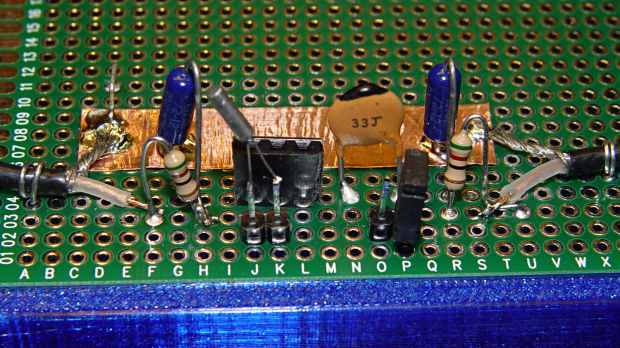
Quartz crystal resonance test fixture The HP 8591 tracking generator doesn’t go below 100 kHz, so I used the FG085 DDS function generator as a source. I trust the 8591’s calibration more than the FG805’s, but right now I’m more interested in the differences between successive frequencies and the DDS can step in 1 Hz increments.
The output appears on the 8591, with a big hump comes from the analyzer’s 30 Hz IF filter response sweeping across what’s essentially a single-frequency input. The hump is not the crystal’s response spectrum!
With the jumper installed to short the 33 pF cap, the output peaks at 32.764:
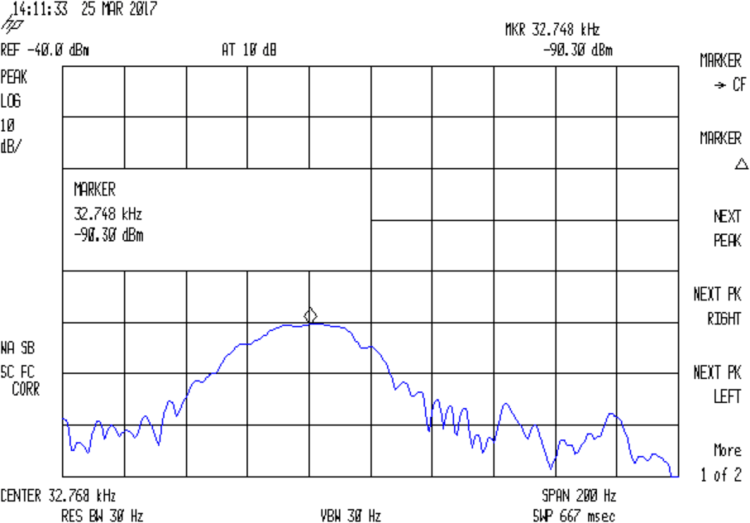
Quartz Resonator 32.763 kHz – no cap 
Quartz Resonator 32.764 kHz – no cap 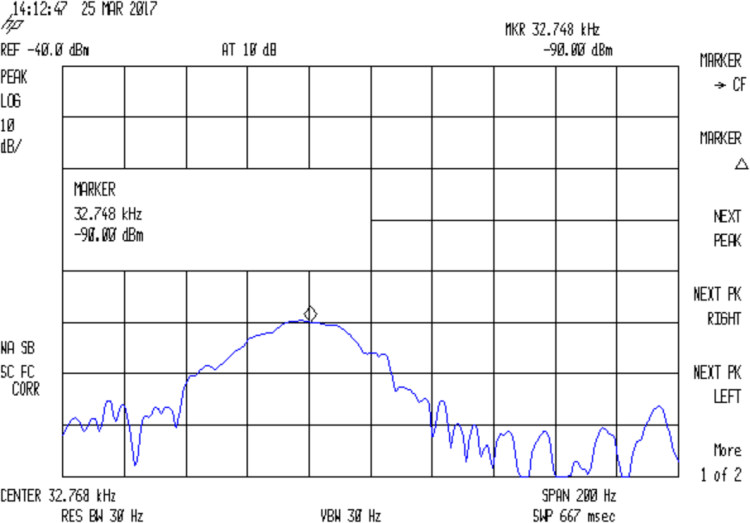
Quartz Resonator 32.765 kHz – no cap 
Quartz Resonator 32.766 kHz – no cap Removing the jumper to put the cap in the circuit, the response peaks at 32.765 kHz:

Quartz Resonator 32.763 kHz – 34.6 pF 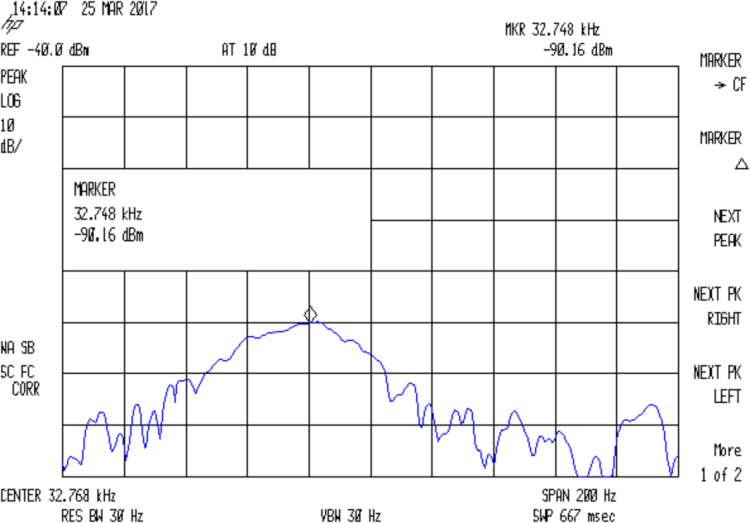
Quartz Resonator 32.764 kHz – 34.6 pF 
Quartz Resonator 32.765 kHz – 34.6 pF 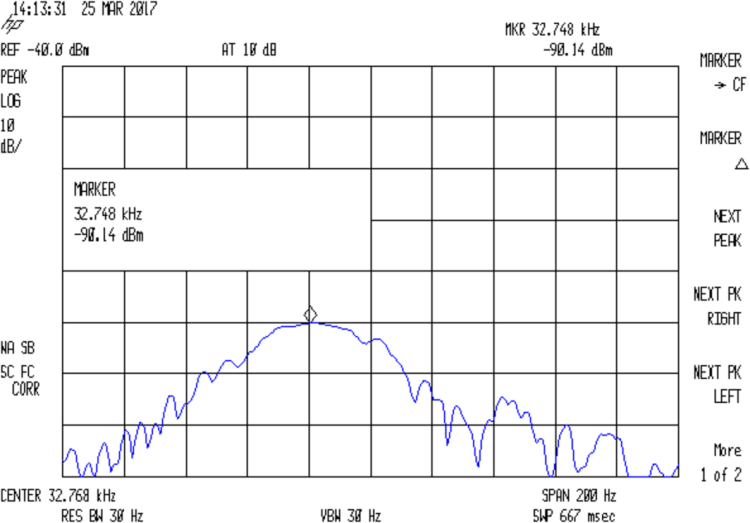
Quartz Resonator 32.766 kHz – 34.6 pF The marker delta shows the difference between the two peaks, ignoring their 1 Hz difference:
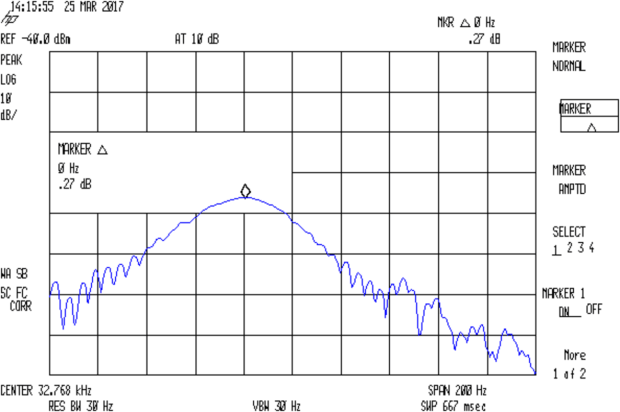
Quartz Resonator 32.764-5 no-34.6 pF delta So I’d say the cap really does change the resonator series resonance by just about exactly 1 Hz.
With the jumper installed to remove the cap from the circuit, setting the reference marker at the 32.764 kHz peak, and measuring the relative response at 32.765 kHz :
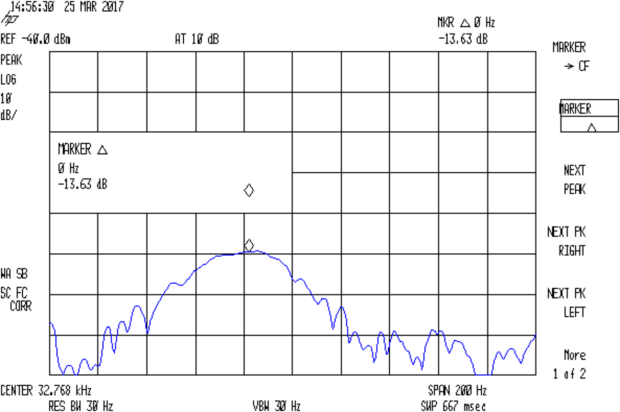
Quartz Resonator 32.764-5 no cap delta So the response peak is much much narrower than 1 Hz: being off-peak by 1 Hz knocks 13-ish dB from the response.
What’s painfully obvious: my instrumentation is totally inadequate for crystal measurements at these frequencies!


-
Subscribe
Subscribed
Have a WordPress.com account? Log in now.

