-
Solid Modeling: Support Puzzle
I’ve been putting this type of support structure inside screw holes & suchlike for years:

Browning Hi-Power Magazine Block – solid model – Generic 1 – support detail It’s basically a group of small rectangles rotated around the hole’s axis and about one thread thickness shorter than the overhanging interior.
I’ve found that incorporating exactly the right support structure eliminates Slic3r’s weird growths, eases removal, and generally works better all around.
So doing this for the baseplate of the Glass Tile frame came naturally:

Glass Tile Frame – octagonal support This OpenSCAD snippet plunks one of those asterisks in each of four screw holes:
  if (Support)
    color("Yellow")
      for (i=[-1,1], j=[-1,1])
        translate([i*InsertOC.x/2,j*InsertOC.y/2,0])
          for (a=[0:45:135])
              rotate(a)
                translate([0,0,(Screw[LENGTH] - ThreadThick)/2])
                  cube([Screw[OD] - 2*ThreadWidth,2*ThreadWidth,Screw[LENGTH] - ThreadThick],center=true);
The “cubes” overlap in the middle, with no completely coincident faces or common edges, so it’s 2-manifold. Slic3r, however, produces a weird time estimate whenever the model includes those structures:
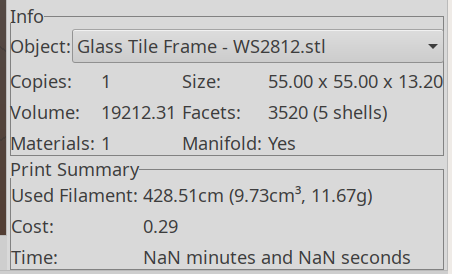
Slic3r – NaN time estimate NaNstands for Not A Number and means something horrible has happened in the G-Code generation. Fortunately, the G-Code worked perfectly and produced the desired result, but I’m always uneasy when Something Seems Wrong.Messing around with the code produced a slightly different support structure:
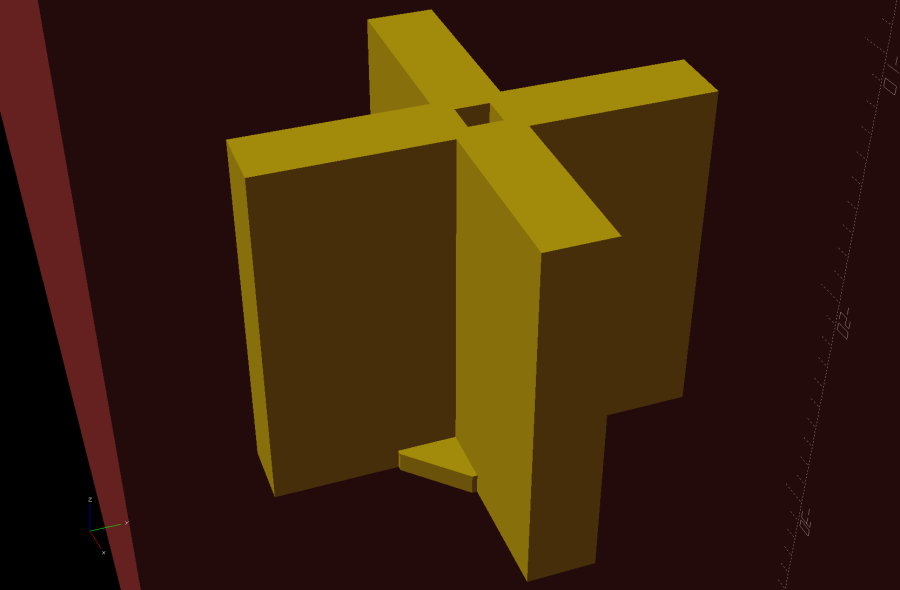
Glass Tile Frame – quad support The one thread thick square on the bottom helps glue the structure to the platform and four ribs work just as well as eight in the octagonal hole:
  Fin = [Screw[OD]/2 - 1.5*ThreadWidth,2*ThreadWidth,ScrewRecess - ThreadThick];
  if (Inserts && SupportInserts)
    color("Yellow")
      for (i=[-1,1], j=[-1,1])
        translate([i*InsertOC.x/2,j*InsertOC.y/2,0]) {
          rotate(180/8)
            cylinder(d=6*ThreadWidth,h=ThreadThick,$fn=8);
          for (a=[0:90:360])
              rotate(a)
                translate([Fin.x/2 + ThreadWidth/2,0,(ScrewRecess - ThreadThick)/2])
                  cube(Fin,center=true);
        }
Which changed the NaN time estimates into actual numbers.
One key difference may be the small hole in the middle. The four ribs (not two!) now overlap by one thread width around the hole, so they’re not quite coincident and Slic3r produces a tidy model:
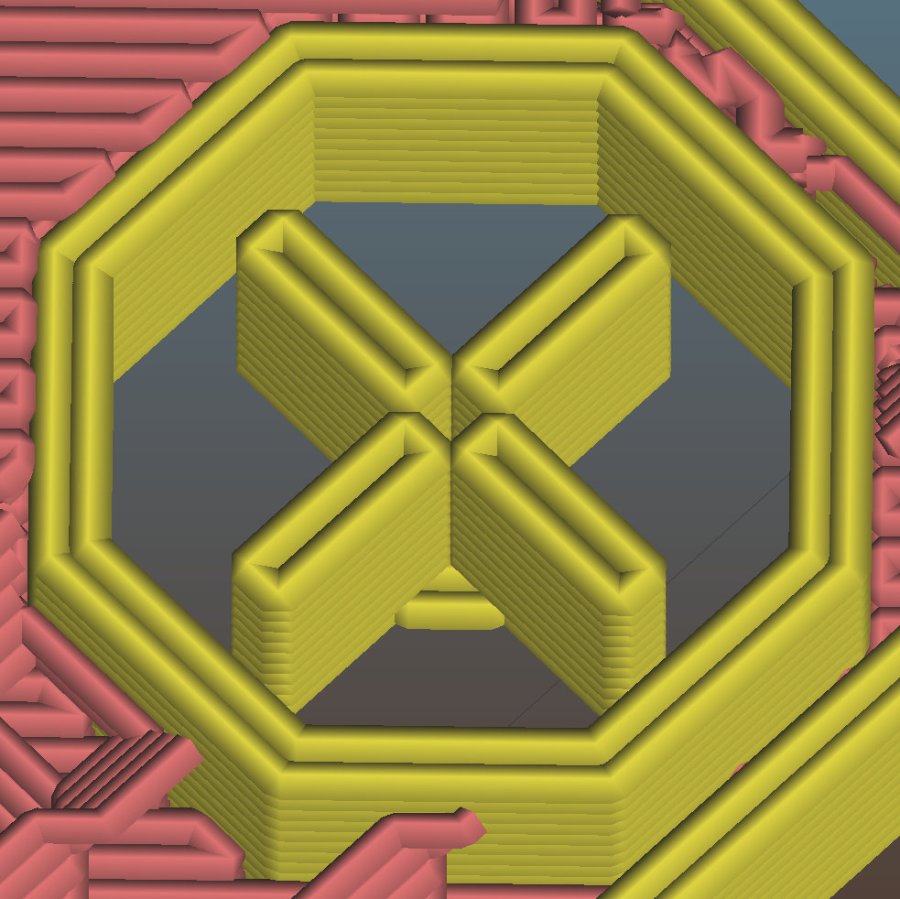
Glass Tile Frame – quad support – Slic3r The hole eliminates a smear of infill from the center, which may have something to do with the improvement.
In any event, I have an improved copypasta recipe for the next screw holes in need of support, even if I don’t understand why it’s better.
-
Subscribe
Subscribed
Have a WordPress.com account? Log in now.

