The Smell of Molten Projects in the Morning

Ed Nisley's Blog: Shop notes, electronics, firmware, machinery, 3D printing, laser cuttery, and curiosities. Contents: 100% human thinking, 0% AI slop.

Category: Science

If you measure something often enough, it becomes science

  • Fitbit VO2Max Estimation

    Fitbit VO2Max Estimation

    My Fitbit Charge 5 exercise tracker estimates my VO2Max as somewhere between 51 and 55. That seems absurd for a guy of my age, where “Excellent” is a bit under 40. I am most certainly not a highly trained athlete at the top of my form, so I wondered what the real value might be.

    Fitbit calculates VO2Max from the ratio of my maximum to resting pulse rates, probably according to the Uth formula using a coefficient applicable to a much younger man.

    It also computes my maximum heart rate from my age as 220 – 72 = 148, much lower than the values I routinely see while biking around the area. Reviewing a few months of data suggests an actual value around 170, although I did see 185 on one occasion.

    Forcing a maximum heart rate of 170 changed the VO2Max estimate to 50-54, which still seemed absurdly high. At least that change made the Fitbit’s “heart rate zones” a little more reasonable, as ordinary bike rides no longer have me in the Peak zone nearly as often.

    The Rockport walking test calculates VO2Max from a timed walk over a one mile “track” course, so I laid out a half-mile out-and-back route on Zack’s Way, which is a quarter mile from home.

    Maintaining a brisk pace covered the mile in 15:49 and left me with a 110 pulse; it’s obvious I’m not a trained athete. Feeding those numbers and a few other vital details into the Rockport formula gives me a much more realistic VO2Max of 28.5, putting me somewhere between the 50th and 75th percentile.

    Which is good, but not extraordinary.

    Bottom line: don’t believe the hype.

    An obligatory picture and link for enhanced SEO:

    FitBit Charge 5 stand - installed
    FitBit Charge 5 stand – installed
  • Polydryer Humidity: Another Month of Data

    Polydryer Humidity: Another Month of Data

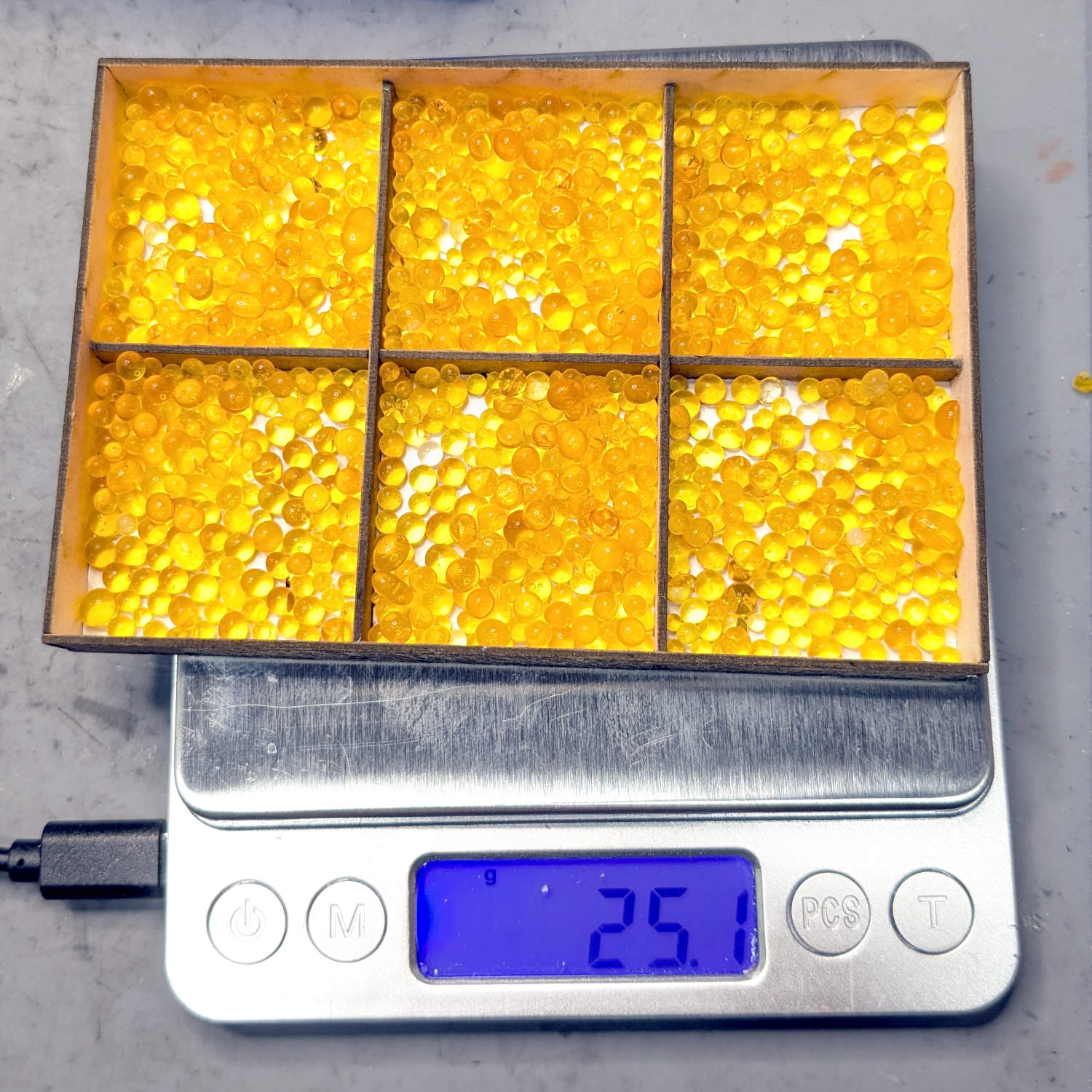
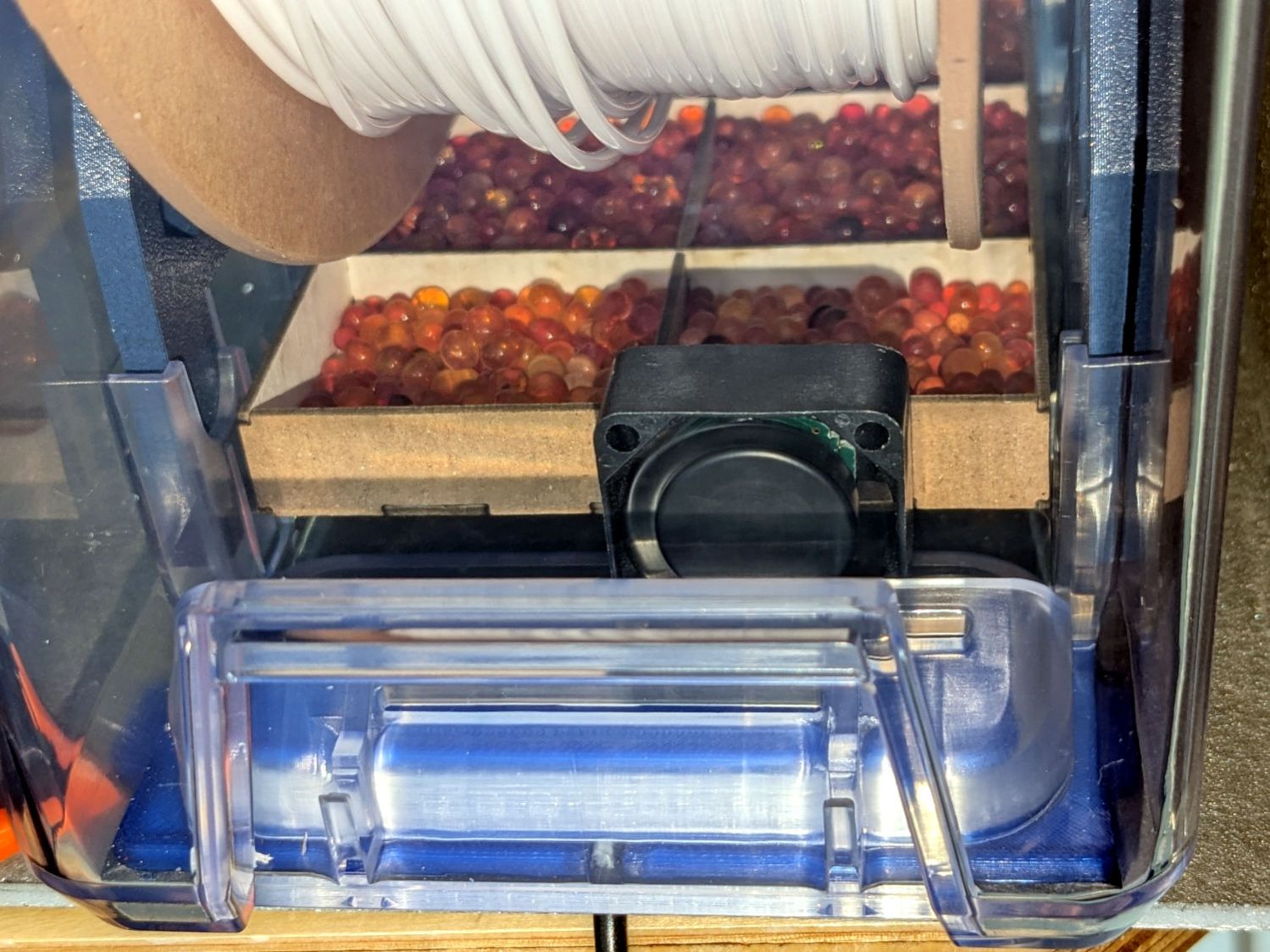
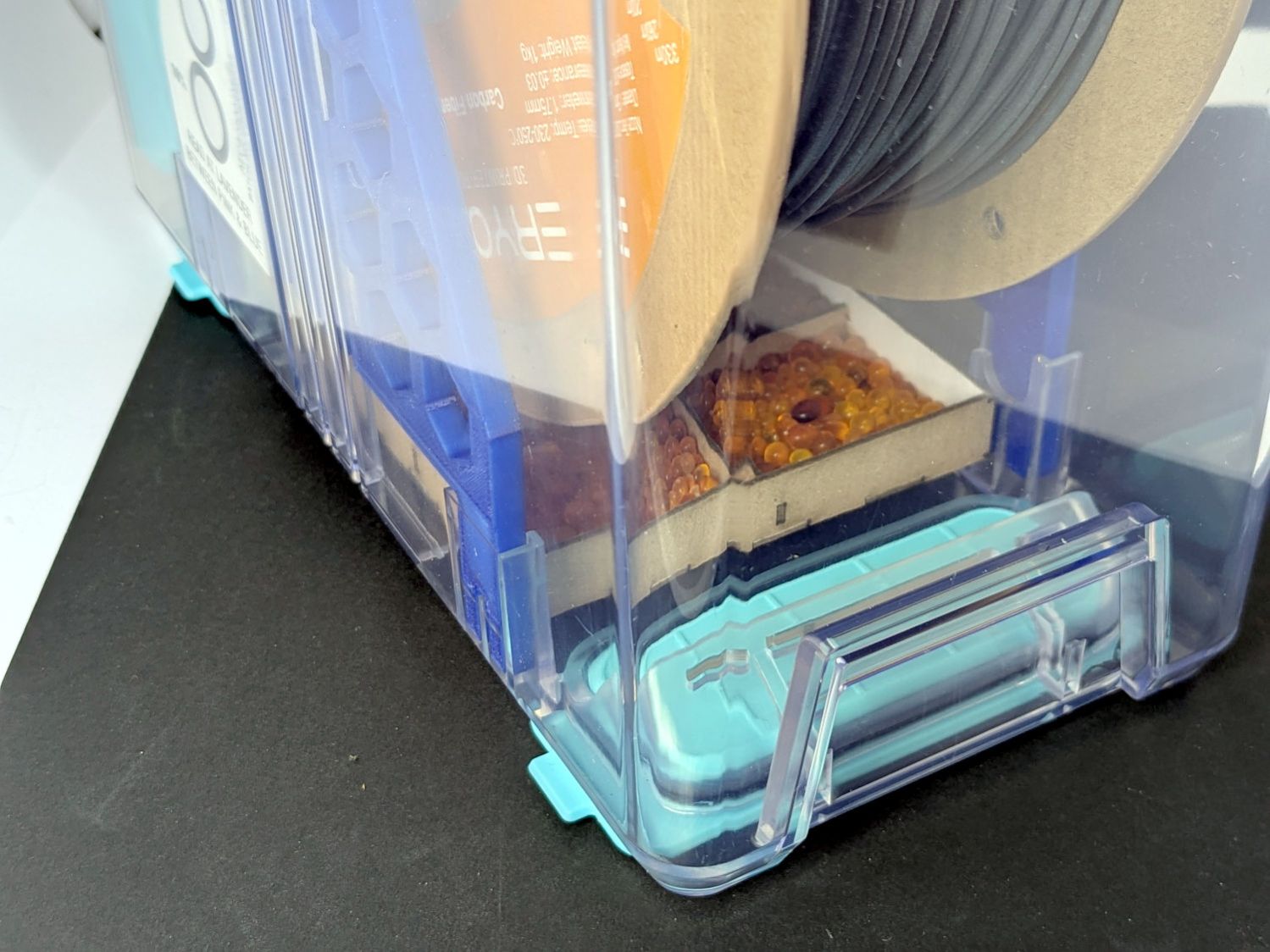
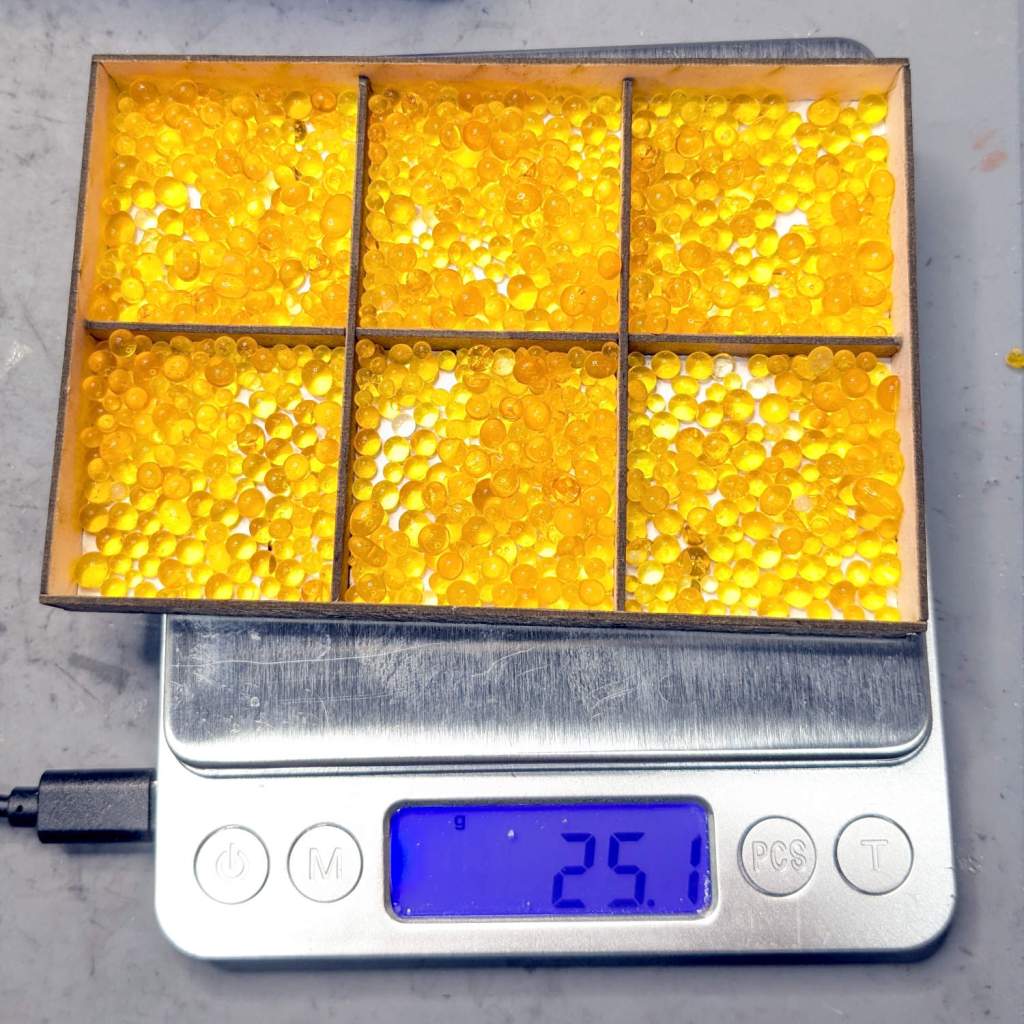
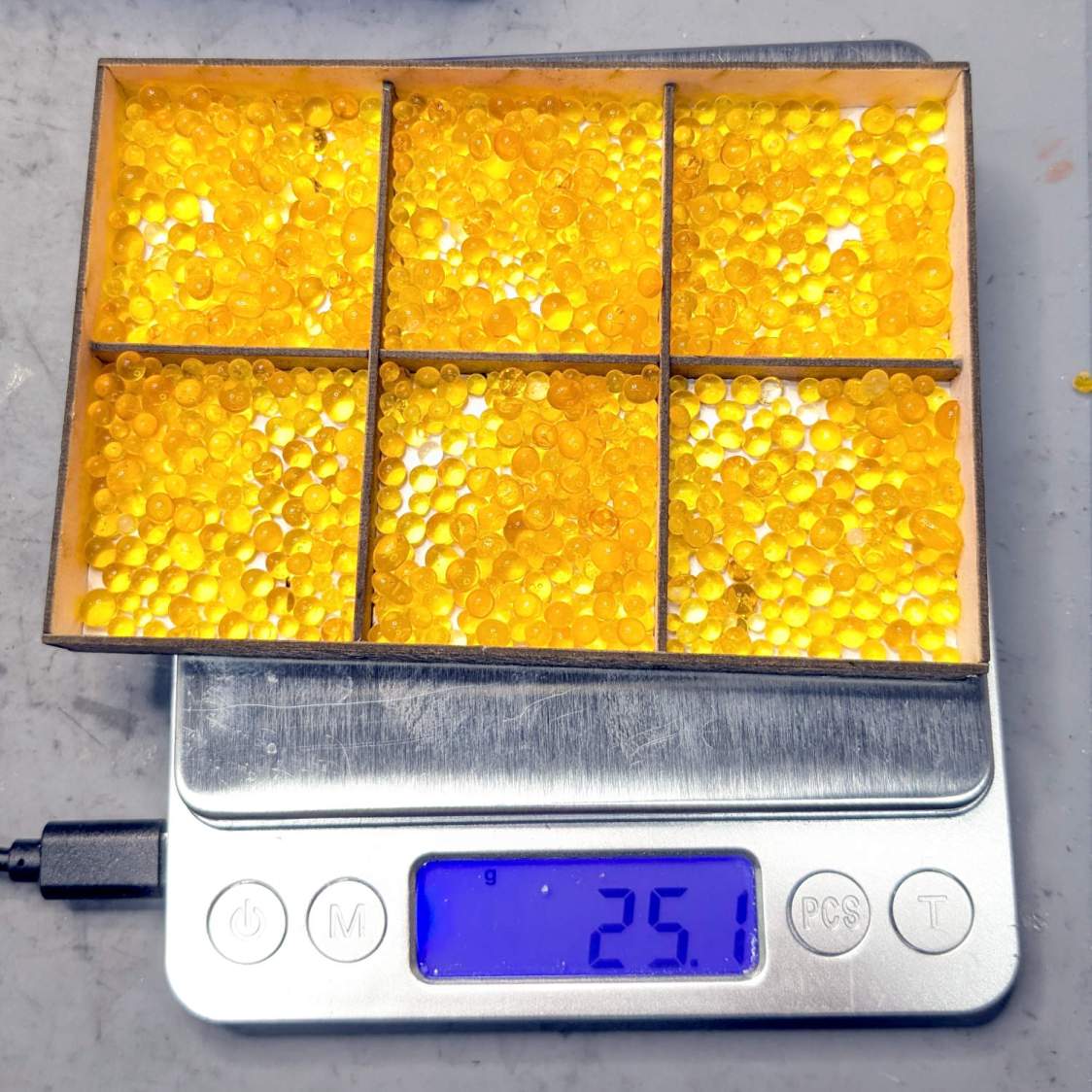
    The 25 g of silica gel in each Polydryer box produced these results after a month:

    8 Sept 202511 Sept23 Sept
    Filament%RHWt – gWt gain – g%RH%RH
    PETG White2527.62.61521
    PETG Black2227.32.31520
    PETG Orange2127.22.22123
    PETG Blue1927.32.31415
    PETG-CF Blue2427.42.42122
    PETG-CF Black2127.32.31519
    PETG-CF Gray2727.12.12426
    TPU2527.42.42224
    Empty 151no geln/a2730
    Empty 23527.92.91928

    The humidity levels seem higher than before, with a bit under 10% weight gain.

    The two “Empty” boxes show the difference between ambient basement humidity and letting 25 g of silica gel work on the box for a month. Comparing the latter’s weight gain with the other boxes shows occupying (much of) the interior with (relatively) dry filament reduces the desiccant’s workload.

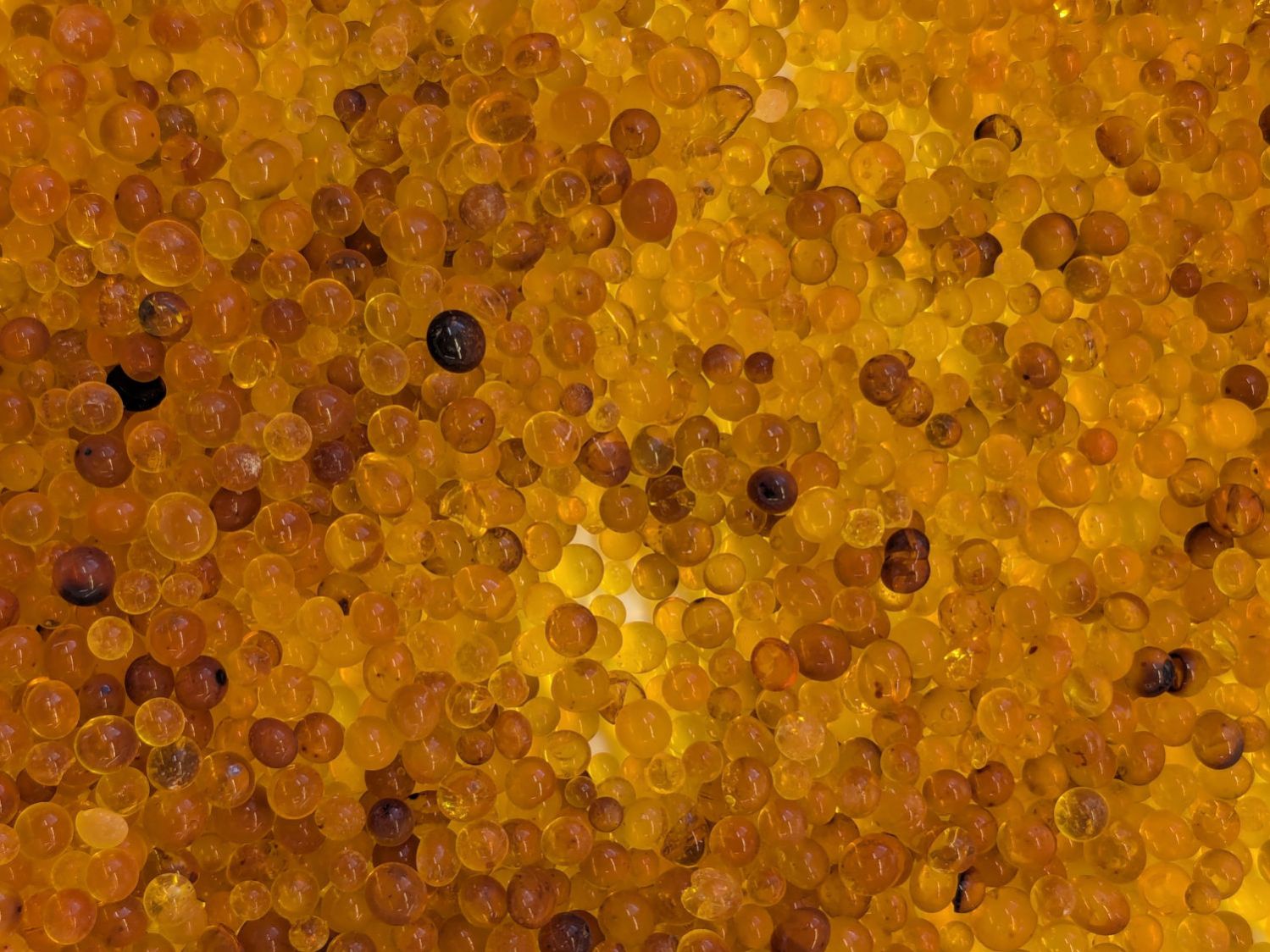
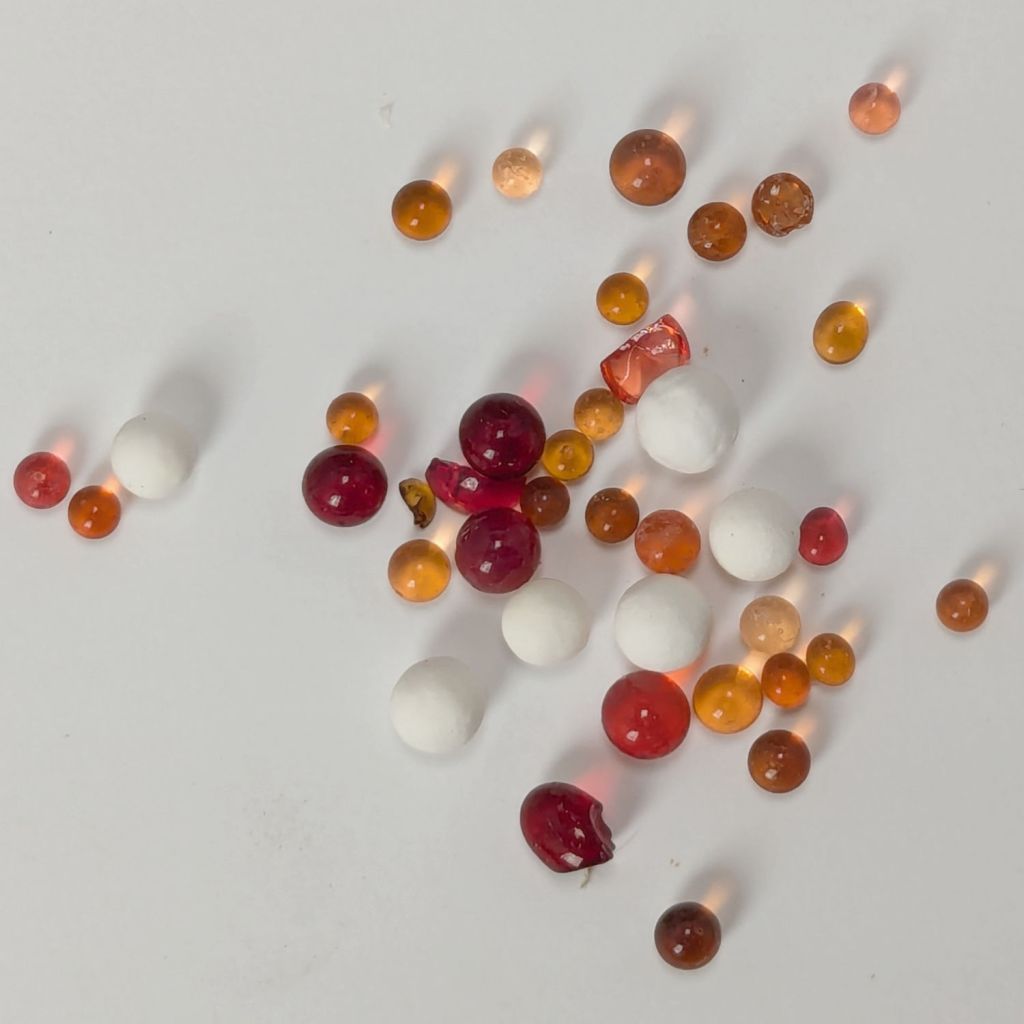
    The beads in the “Empty 2” box were definitely darker after soaking up an entire box full of 50 %RH air:

    Polydryer - 37%RH meter - empty
    Polydryer – 37%RH meter – empty

    The meter reads 37%, rather than 35%, due to being out of the box for a few minutes.

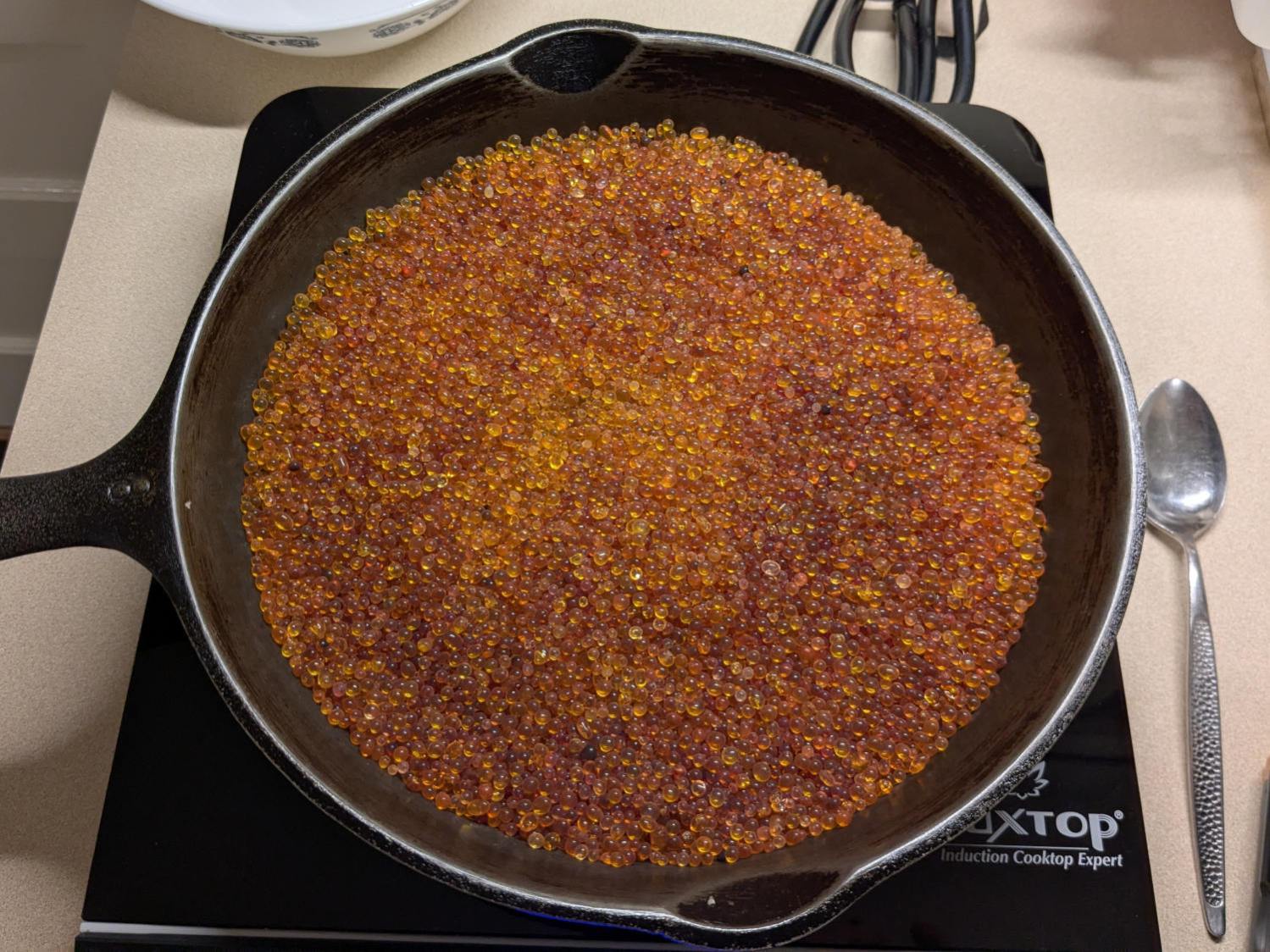
    They’re the darker swirl in the pan of beads:

    Silica Gel regeneration - starting bead colors
    Silica Gel regeneration – starting bead colors

    That’s an accumulation of beads from a few months, not just what you see in the table.

    I used an induction cooktop to heat the cast-iron pan. Some fiddling with the cooktop’s constant-temperature mode got the beads to 200 °F with a 460 °F setting in about an hour. Setting the cooktop to 50% in constant-power mode worked better, as the beads reached 220 °F in an hour and 230 °F after another hour.

    The bead weights at various stages:

    • Start = 531 g
    • +1 hr at constant temperature = 491 g
    • + 1 hr at 50% constant power = 483 g
    • + 1 hr ditto = 480 g

    The 41 g weight loss is 8.5% of the dry weight, roughly what you’d expect from the humidity readings.

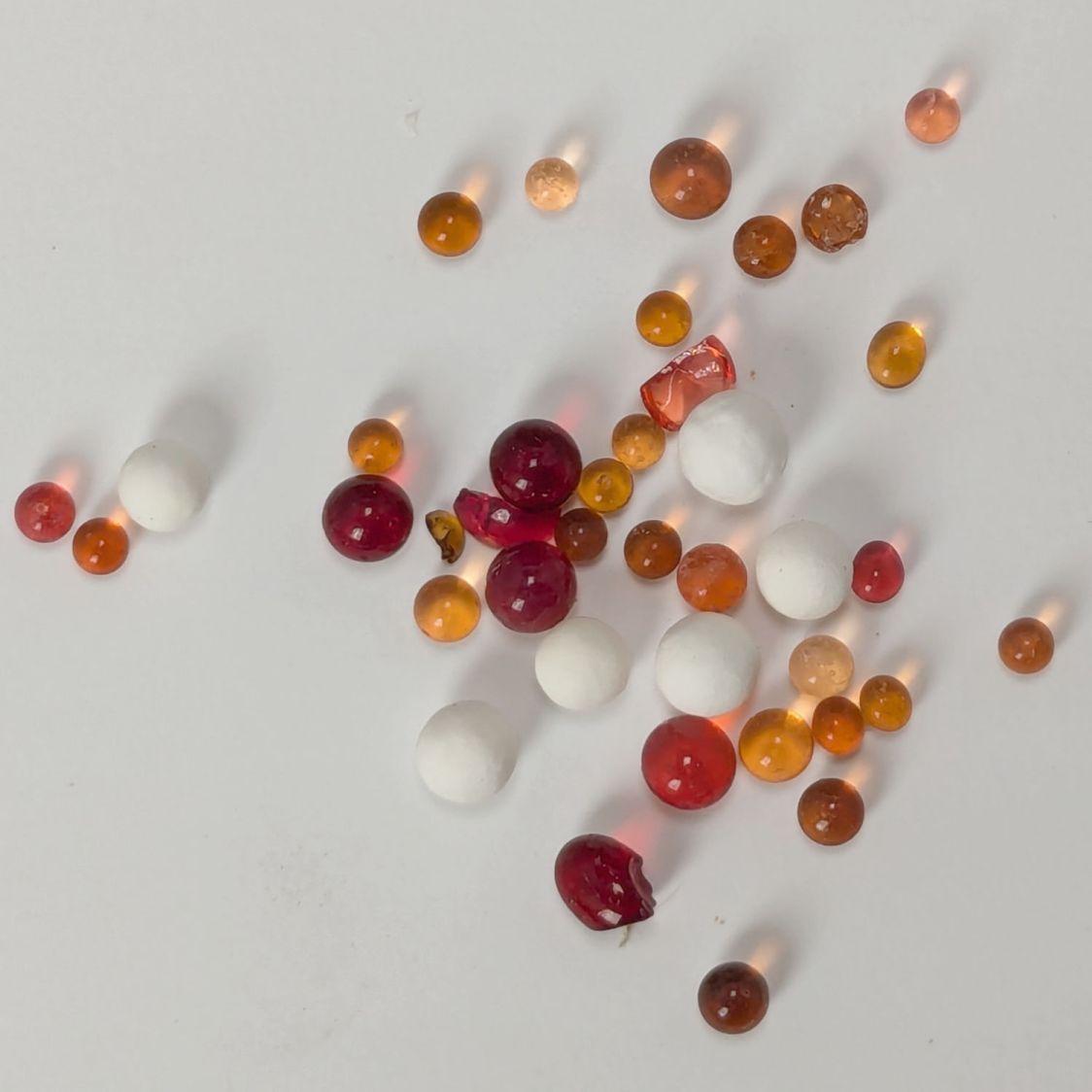
    After reloading the meters with 25 g of alumina beads, the 11 Sept humidity readings are slightly lower and the 23 Sept readings are roughly comparable.

  • All’s Well Who Ends Well

    All’s Well Who Ends Well

    Eventually this happened:

    Negative COVID tests
    Negative COVID tests

    Three weeks, more or less, from my exposure to clearing the hurdle. Mary, being tougher than I, got it done in two.

    For the better part of the first two weeks I was in bed ten hours every night, plus an hour or two of afternoon nap (no milk & cookies, drat), plus dragging around the house getting nothing done.

    No major health problems, good blood oxygen levels throughout, no loss of smell apart from what you’d expect during three days of complete nasal blockage, and we’re both feeling OK-ish now.

    However, we are making more than the usual number of stupid mistakes, which is one way we know we’re not really OK yet.

    Back to the Basement Shop, with considerable caution …

    Memo to Self: That was the first time in four years you didn’t wear a mask in close quarters. Don’t ever do that again.

  • Wasp Blower: Carnage

    Wasp Blower: Carnage

    The day after I set up the Wasp Blower, the carnage was terrible to behold:

    Wasp Blower - carnage
    Wasp Blower – carnage

    Two weeks later, the blower is chopping up two or three wasps each day.

    As far as I can tell, the blower killed essentially every wasp leaving the nest and most of the returning foragers:

    Wasp Blower - shattered wasps
    Wasp Blower – shattered wasps

    After two weeks, (nearly?) all of the eggs remaining in the nest have hatched, the larvae / pupae have starved for lack of incoming food, and I’ve put out ant bait traps to discourage scavengers.

    The plan is to keep running the blower until a week goes by without any kills, then seal the crack under the door sill.

    I have no idea how the queens (Yellowjacket wasp nests have multiple queens!) are doing in there, but they must be getting pretty hungry and, we hope, will not survive the winter.

    This makes me feel awful, but not nearly bad enough to regret dealing with the critters.

  • Switchyard Hum

    Switchyard Hum

    For reasons not relevant here, I walked along IBM Rd to the end of Sand Dock Rd and back, passing the switchyard serving the IBM Poughkeepsie site:

    Street View - 1 Sand Dock Rd
    Street View – 1 Sand Dock Rd

    The overall capacity is surely in the tens of megawatts and there’s an overwhelming hum coming down that driveway:

    Switchyard hum
    Switchyard hum

    Those peaks and the corresponding lines in the waterfall show the equipment emits acoustic energy all the way up to about 480 Hz, call it the eighth harmonic of 60 Hz.

    Transformer steel has low magnetostriction, which produces most of the noise at even harmonics of the 60 Hz power line (because each cycle has two current maxima). The spectrogram shows the switchyard handles enough current to emit plenty of odd harmonic energy, with a notable peak at 180 Hz.

    For comparison, standing a few feet from the transformer behind a medical office building along IBM Rd:

    Transformer hum
    Transformer hum

    No 180 Hz energy from that transformer!

    Moving a few feet further away dropped those peaks into the background.

    Even with my deflicted ears, I think can hear the switchyard hum from a considerable distance along the road, so maybe the background isn’t as quiet as I think.

  • PolyDryer Humidity: 30 Days Later

    PolyDryer Humidity: 30 Days Later

    A month after the last desiccant change, the silica gel looks like this:

    Polydryer - 30 day beads
    Polydryer – 30 day beads

    The top cup contains fresh-from-stock dry (regenerated) silica gel beads and the others, left-to-right and top-to-bottom, come from PolyDryer boxes:

    Material%RHWeight – gIncrease – gWater gain – %
    PETG White1426.81.87.2
    PETG Black2026.81.87.2
    PETG Orange1326.81.87.2
    PETG Blue1526.91.97.6
    PETG-CF Blue1927.42.49.6
    PETG-CF Black2827.32.39.2
    PETG-CF Gray2727.12.18.4
    TPU Clear1326.81.87.2
    Sum of weights215.98.0
    Measured weight216.38.1

    I expected some correlation between the indicated humidity and the weight of adsorbed water vapor, but that’s not the case.

    The bottom row suggests there’s also little-to-no correlation between bead color and humidity, at least at this low end of the scale.

    The indicator cards tucked into the boxes roughly correlate with the meter reading, but they’re much easier to interpret in person.

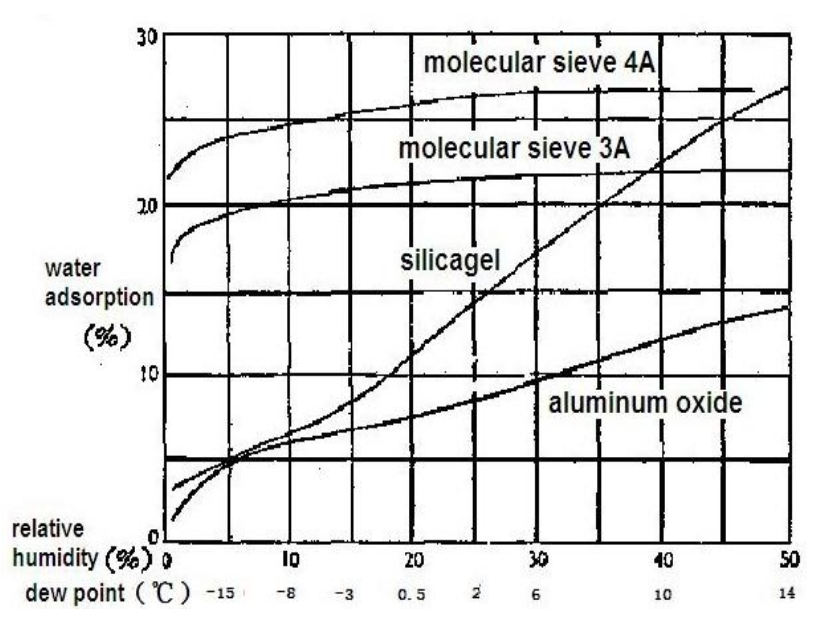
    The old chart of adsorption vs. relative humidity suggests the results are plausible, with the 27-ish %RH being higher than you’d expect from 9-ish % adsorption:

    Desiccant adsorption vs humidity
    Desiccant adsorption vs humidity

    So they’re all set up with 25 g of fresh silica gel, although the boxes no long have the same humidity meters they started with. This likely makes little difference, as I have no way to calibrate them.

  • Polymaker PolyDryer Desiccant: Trust, But Verify

    Polymaker PolyDryer Desiccant: Trust, But Verify

    The startup ritual for a PolyDryer box’s humidity meter includes:

    • Opening a small sealed bag containing …
    • The DO NOT EAT desiccant, to be cut open and …
    • Poured into the meter box

    Which looks like this:

    Polydryer - 14 pctRH - meter - white PETG
    Polydryer – 14 pctRH – meter – white PETG

    However, the desiccant packets for the most recent pair of boxes (intended to simplify changing the desiccant in the collection feeding the MMU3 atop the Prusa MK4 3D printer) produced this:

    Polydryer - as-received desiccant
    Polydryer – as-received desiccant

    The silica gel in the left cup looks OK-ish, maybe a little dark, but the fresh-from-the-bag beads in the right cup are crying out for regeneration after having adsorbed about all the water vapor they can.

    If you were using that silica gel in its original DO NOT EAT bag, where you can’t see what it’s telling you, you might wonder why it wasn’t doing such a great job of drying the box + filament. The same could happen with a bag of non-indicating gel, along the lines of what I was using a decade ago.

    So I dumped both in the Needs Rgeneration bottle and filled both meters with 25 g of fresh silica gel.