Ed Nisley's Blog: Shop notes, electronics, firmware, machinery, 3D printing, laser cuttery, and curiosities. Contents: 100% human thinking, 0% AI slop.
Maybe that stogie wasn’t lit, but I’m exceedingly glad I wasn’t close enough to be sure!
You may need to click on the picture to get the joke; I was high up on a gravel bank, but probably still within the blast zone.
My pocket camera was set to mandatory flash from whatever I’d been doing the last time I used it. The piddly little xenon tube even lit up the retroreflective tape on the semitrailer about 200 feet away across the highway.
My buddy Eks just replaced his hot-water furnace with a high-efficiency unit.
Can you tell that Eks is an engineer?
The plumber used one of those fancy pipe-compression tools that mashes the mating parts together with an O-ring for sealing. Faster and safer than sweating the joints together, but I want to fast-forward two or three decades to check out the durability.
An engineer’s furnace plumbing
Copper compression joints
As he put it, “You may be able to get a better furnace installation, but you probably can’t pay any more for it…”
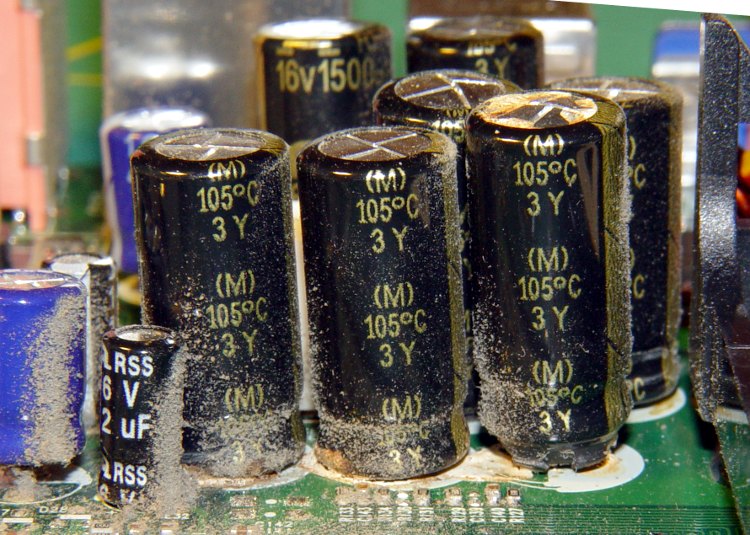
A friend dropped off a dead eMachines Celeron for my next recycling trip. Peering inside, what do my wondering eyes behold but a nasty case of Capacitor Plague!
Herewith, some pix of the victims within the box. Note the bulging tops ready to blow along the pressure-relief grooves, the distinct tilt caused by the bulging bottom plug, and the right-hand cap near the power supply on countdown for launch!
Found this hole in the plate glass window of a church.
The conchoidal fracture pattern is characteristic of a bullet impact at more-or-less right angles to the pane. I suppose, based on the very small entry hole and no damage to the opposite wall, that it was something like a BB gun at close range, rather than a 0.22-cal handgun or rifle far away.
Somehow, you just know the lunkheads doing this sort of thing have never repaired a window themselves… when you’re a constructor, you just don’t go around destroying things.
But maybe that attitude marks me as a fuddy-duddy.
In case you were wondering what goes on backstage at an event like that, here’s the truth: I play with dolls…
The Granny Doll was part of the Assistive Robotics contest: the robot had to locate a dish of food and carry it from a refrigerator to a table. She acted as an obstacle in the middle of the room; I had just finished duct-taping the stand to her rump in preparation for the practice runs on Saturday.
As it turned out, her overcoat consisted of cloth that rendered her invisible to the robots: the poor dear got run over, smacked aside, and pushed around.
Next year the scoring system will include Elder Abuse penalty points!
My eagle-eyed daughter spotted a Dell PC by the side of the road on her way home from school, so we snagged it en passant to a school meeting later that evening. We dropped it in the workshop, figuring that she could do some forensics, then install Puppy Linux or some such.
The next morning the entire Basement Laboratory was filled with the unmistakable odor of stale piss and I noticed that the back panel of the PC had two missing card slot covers. I immediately hauled the carcass outside and set a bunch of mouse traps around the basement.
When we popped the cover, we found a very well-built mouse nest covering the entire surface of the system board. The previous owners had evidently run the PC flat on the floor (it’s a Dimension 8100 beside-the-desk tower) with two of the back-panel card slot covers missing and the mice decided this was just about the finest neighborhood in the building.
Mouse nest below power supply
The power supply in this model covers the system board with an inch or so of clearance. We swung the supply box up on its hinges and found a thick layer of furry padding underneath; perhaps this was the sleeping quarters?
The mouse latrine was over by the CD burner, which was a dead loss, and corrosion had eaten one corner of the DVD ROM drive’s case. The previous owners had removed the hard drive (good for them!) and dislodged the CPU and heatsink. I think this model had an exhaust duct over the heatsink, which was missing.
We salvaged the CPU (for show-n-tell), heatsink (aluminum plate), DVD drive (amusement value), and the Soundblaster Live! audio card (on general principles). The rest wasn’t worth the risk of huffing more hantavirus; we tipped it into the trash. In theory, we’re supposed to recycle this stuff, but I’m not going to keep it around for a few months until hazmat day.
[Update: I just got a flyer saying that the next town hazmat day is mid-April, so I dug the damn thing out of the trash. I’ll run a bunch of dead PCs and toxins down the road; depending on the load, maybe I can use the bicycle trailer. That’s always good for a laugh around the dumpsters.]
All the prizes except the DVD drive’s guts went into a dishpan of hot soapy water and ought to be in good condition when they dry out. If the drive doesn’t smell bad, we’ll put it to some good use.
Clogged air inlets
Now, you might think the mice moved into a dead PC stored in a corner. As nearly as I can tell, that’s not the case: the CPU chip was in (relatively) pristine condition and, when we removed the front cover, the air inlets were clogged with a thick layer of fuzz. So I think the mice had a nice, heated nest with plenty of ventilation, right up until the system quite literally crapped out.
According to Dell’s records, this box shipped 20 August 2001 with WinXP home, 64 MB of Rambus memory, and a 40 GB hard drive.
Times have changed since then, in more ways than one…
it’s about that time of the year again: get ready to stock up on Kosher Coke!
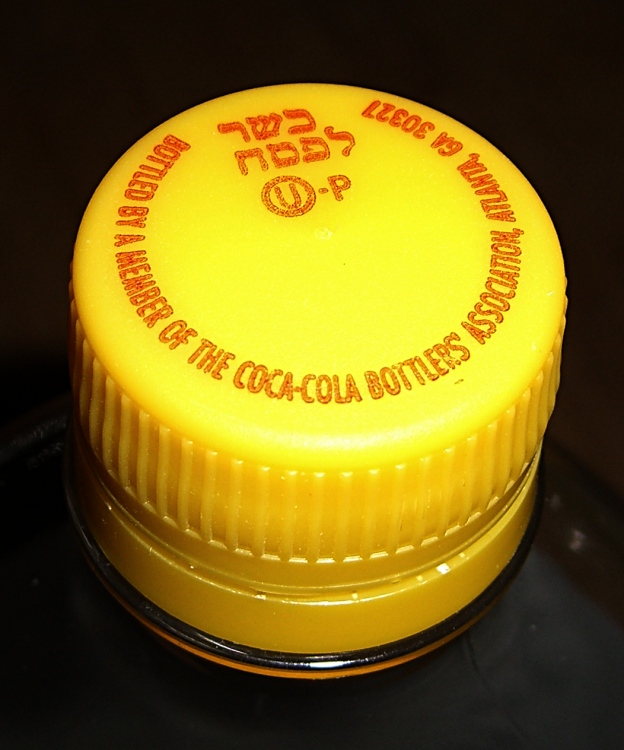
Turns out that Coca Cola produces sugar-based Coke shortly before Passover each year; their usual high fructose corn syrup, while Kosher, falls into the Chametz category of grains that cannot be eaten during Passover.
Kosher-for-Passover Coca Cola bottle cap
Bottles containing the special sugar-based formula wear a distinctive yellow cap, so they’re easy to spot against the usual all-red array. To cross-check: the ingredients list runs: Carbonated Water, Sucrose …
A friend brought me a few two-liter bottles from a Jewish grocery store in the metro NYC/NJ area last year, shortly before I discovered that the local Target had a generous stockpile on the top shelf of their soda section. It’s allegedly available in cans, but I’ve never seen any.
NB: Pepsi uses yellow caps around this time of year to mark their bottles for some dimbulb contest. At least they did that last year and I’m sure it’s no coincidence. If the cap doesn’t have distinctive Hebrew symbology and the ingredients still include HFCS, it ain’t been cleared for Passover consumption.
While sugar-based Passover Coke is not the same as the old-school Coke you remember from long ago if you’re enough of an Olde Farte to do so, it’s as close as you’re going to get in these degenerate times.
In actual point of fact, sugar Coke tastes pretty much like HFCS Coke. That should not be entirely surprising, given the bazillion dollars they spend on development. Run your own side-by-side comparison, blind if you can, and report back.
If you plan to stock up on the stuff anyway, give the caps an extra twist to ensure they’re on tight before you put ’em on the shelf. I just cracked the final bottle from last year and it’s still plenty fizzy enough for me.
The phosphoric acid in either formulation is really hard on your teeth & gut, so don’t overdo it.
Update: As of 22 April, the local Target had a shelf full of yellow-cap Coke; they had none the week before Passover. Perhaps they got the last pallet a day too late? In any event, I stocked up my year’s supply in one shot. Admittedly, it’s $1.89 / 2 liter bottle, but it’s just for special occasions… and half a dozen bottles is a year’s supply for me.