Ed Nisley's Blog: Shop notes, electronics, firmware, machinery, 3D printing, laser cuttery, and curiosities. Contents: 100% human thinking, 0% AI slop.
We attended a concert at Vassar College and found this fellow flitting about an upstairs hallway in Skinner Hall. He eventually settled down atop a door frame and I took this picture from across the hall; it’s a tiny crop from a much larger image because I didn’t want to spook him.
He’s most likely a Little Brown Bat and perfectly harmless. Anybody who can eat that many insects gets a free pass from me!
He was at least as scared of us as some of the students were of him. Flying in a hallway full of running people must be bewildering…
Somebody called Campus Security and I suppose they wiped the little guy out during the second part of the concert.
So I measured the thickness of the black acrylic sheet I’m using for the Totally Featureless clock and machined the rabbets to match. Went to assemble everything and the rabbets are too shallow!
Come to find out that the sheet varies in thickness from about 0.437 to 0.475 across the four pieces I’d cut and, of course, I’d measured the thinnest end of the thinnest piece. Makes no sense to me, as I’d expect the thickness to be pretty well controlled over a few feet of sheet, but that’s not how things went down.
The simplest solution was to mill a flat on the inside of the case to match the rabbet, so all four panel ends were the same thickness. The sketch below has the straight dope.
Acrylic sheet thickness fix
Milling with a 3/8-inch end mill at 2500 rpm, 10 ipm, in one pass with no cooling was OK.
I’ll insert some brass shimstock into the rabbets to make the outside edges wind up flush.
Maybe I’m misusing Adobe Reader, but I’ve always thought of it as a program that displays PDF files. In my case, that means data sheets for various & sundry electronic parts: I carefully squirrel both PDFs and parts away, having learned that physical parts can outlast both datasheets and company websites.
So I open quite a few PDFs that reside on my file server in the basement.
With that in mind, what’s missing from this row of toolbar icons?
Adobe Reader Default Toolbar
Go ahead, take your time…
Hint: the only active button lets you “start an Acrobat Connect meeting and share documents”.
This has been true for the last few versions; the Official Ubuntu Linux Version seems to be stuck at 8.1-ish. Let’s jump ahead a bit, fetch 9.3 directly from the Adobe download page, and install it:
Adobe Reader 9.3 Toolbar
Now I can not only “Share documents and collaborate live within PDF documents”, but also “Click to create PDF using Acrobat.com”.
What I can’t do is open a PDF file from disk by just clicking a button. That rarely used function is relegated to the File pulldown menu and, for those of us who can touch-type fairly well, hidden behind the arcane Ctrl-O keyboard chord.
Reconfiguring the toolbar is a few minutes of clickety-click action, but it seems odd to me that none of the focus group participants suggested putting an Open File button on the toolbar.
Although I never ascribe to malice what can be explained by stupidity, this continuing design decision does seem to require forethought.
As part of the Great Kitchen Cleaning, I was charged with replacing a missing foot on the banana gallows we received as a gift many years ago. I found a tiny hole in the bottom that we’d never noticed before, most likely because we mistook it for an ink dot or an imperfection in the wood.
The spot seemed to have something inside and a pass under the microscope showed the remains of a pupal case. I pried it out, destroying it in the process. The insect was, of course, long gone.
Those are millimeter ticks on the scale along the top edge, so the hole is the better part of 1.5 mm in diameter. Perfectly round, of course, as only an insect programmed to drill holes can produce.
The hole was 8 mm deep (likely deeper before the wood was planed), so the bug was qualified for gun drilling!
The stand is marked “Made in Thailand”, but who knows where the wood came from or where it’s been? We’ve had the stand for many years now, but I’m pretty sure the critter was in there when we got it.
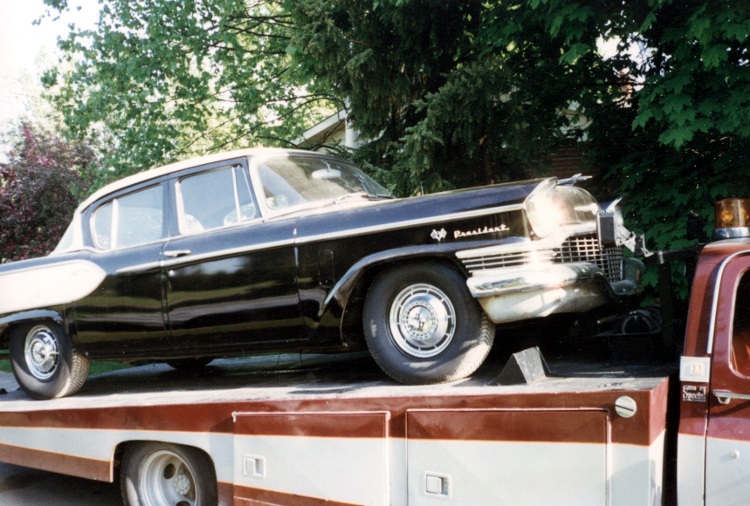
Thinking of my parents’ 1957 Studebaker President (in the context of our mixer leaking oil) prompted me to do a search on the obvious keywords, which produced this link. Search for “police unit” and you’ll find a nice picture of a black-and-white President with a gumball machine on the top. Here’s that picture, just in case link rot sets in.
That’s my parents’ car, right there!
Turns out that Mom sold it to a Canadian firm (probably Fawcett Movie Cars and a deep link there) that supplies cars to moviemakers; she’d put an ad in the Hershey Antique Auto Show flyer and it worked. A guy showed up with a trailer, money changed hands, and he hauled the poor thing away.
They transplanted a functional engine from a donor hulk, restored the dual exhaust system that my grandfather had the garage strip out (“Two mufflers cost too much!”), and did a perfect restoration of the rusted eyebrows over the headlights where road mud and salt always collected. While they had the hood up, they installed power steering; that thing always turned like a truck, what with a big iron V8 over the front wheels.
On the way to Rebound
The car appeared in Moonshine Highway in police livery and HBO’s Angel of Harlem (a.k.a. Rebound) in civilian dress. Here’s what it looked like on the way to the Rebound set.
A private collector in Ontario bought it from the movie folks and found a registration card in my father’s name stuffed behind the glove box. A bit of searching turned up me and now I know what happened to it.
So, if you just bought a nice black-and-white 1957 Studebaker President from a guy in Canada, there’s a bit of its history. I can tell you more, but nobody else really cares, I suspect…
For the first time ever, Digikey sent me a full-line catalog.
Digikey catalog
It’s 2778 pages long, three inches thick, and weight 2 kg.
Some time ago I made the mistake of replacing our large rusted-out mailbox with a much smaller one: the catalog presented a solid wall of paper when I opened the door.
Here’s a closeup…
Digikey catalog vs Arduino Duemilanovae
Now, I’d love to have you believe I’m such a high-rollin’ kind of engineer that Digikey spares no expense on my behalf, but the only explanation for this embarassing situation I can come up with is that their customer service system blew a gasket in my general direction…
What makes it even more ironic is that they’d recently sent me a survey asking how I’d like to get their catalog. I’d emphatically replied that I did not need a paper catalog or a USB stick with the PDFs. Just let me do the on-line searching and occasionally refer to the appropriate PDF pages and I’ll be fine.
The damned thing is basically useless; I hate to just toss it in the recycling, but I can’t think of any reason to keep it around.
I just removed my mailing address from their list, presumably leaving my account info intact; we’ll see if that sticks.







 The Smell of Molten Projects in the Morning