The Smell of Molten Projects in the Morning

Ed Nisley's Blog: Shop notes, electronics, firmware, machinery, 3D printing, laser cuttery, and curiosities. Contents: 100% human thinking, 0% AI slop.

Category: Oddities

Who’d’a thunk it?

  • Bald Cardinal: Continuing Feather Loss

    Bald Cardinal - left side
    Bald Cardinal – left side

    The bald cardinal still stops by the feeder in the evening. He’s now losing the smaller red feathers around his eye and above his beak. The black feathers bordering his beak seem unaffected, although it’s hard to tell through the window glass blur.

    This image is a tight crop from the Sony DSC-H5, which has a lens about two stops faster than my Canon SX230HS pocket camera and is much better suited for evening photography. I’ll add the tele adapter to the stack and try to get a better picture from the door; I think the autofocus assist light spooks the poor bird.

  • Northern Cardinal With Tumor

    That missing leg surely involves an accident, those missing feathers may be mites, but now we have a male Northern Cardinal with what looks like a tumor on his head:

    Cardinal with tumor
    Cardinal with tumor

    It’s not obvious in that picture, but the black patch seems to be the rubbed-raw top of a growth.

    Prior to these birds, in all the years we’ve been birdwatching we’ve never seen any damaged cardinals…

  • Why I Don’t Like Hotel Networks

    Perhaps this indicates most folks can’t configure network encryption with known parameters, but advising everybody to just turn that pesky WEP stuff off seems, well, misguided:

    Disable WEP
    Disable WEP

    Sniffing a guest’s private bits from an unencrypted link doesn’t pose any challenge at all and, given the hotel’s location in Hartford’s hot urban core, I’d expect absolutely no security-by-obscurity whatsoever.

    On the other paw, Dragorn of Kismet points out the triviality of a man-in-the-middle WiFi attack no matter what encryption you might (think you) have in effect. So maybe it doesn’t make much difference.

    And if you think the wired network is inherently more secure, that should change your mind.

  • Panic Button Variations

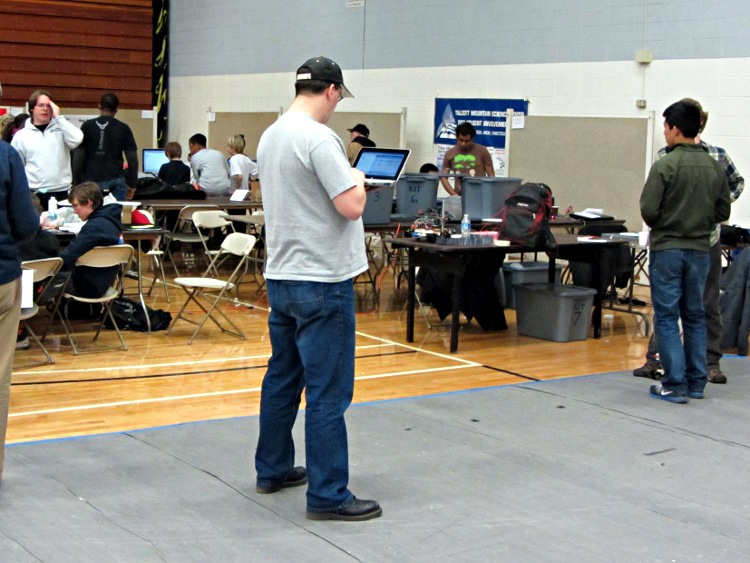
    Those panic buttons in the high school cafeteria still beg the question: who thought panic buttons would be a Good Idea? I recently served as a judge for the Science Fair qualification show and found some variations on the theme.

    One seems in good shape, although I don’t know if it’s been repaired:

    Intact panic button
    Intact panic button

    Several have missing buttons, but the innards seem intact:

    Buttonless panic button
    Buttonless panic button

    In the event of an actual panic, I suppose you simply yank the cage off the wall:

    Up-armored panic button
    Up-armored panic button

    I cannot imagine what logic justified protecting one button and leaving the others to the tender mercies of the student population.

    Our tax dollars at work, for sure…

  • Cassini Saturn Orbiter vs. Tin Whiskers

    Although I don’t often block-quote other sources, for this I’ll make an exception:

    The Cassini Plasma Spectrometer (CAPS, off since June 2011) was powered back on on March 16 based on the unanimous agreement of the review board at the CAPS turn-on review held on March 8. All went as planned for both the instrument and the spacecraft during the turn-on. The high rail to chassis short internal to the instrument that was part of what prompted it to be turned off last June was not present, and no changes were seen in the bus voltages or currents when the turn-on occurred. On Tuesday, March 20, the high rail to chassis short in the CAPS instrument returned, generating the same condition that existed at the time the instrument was turned off. However, based on the tin whisker model developed by the NESC team, this condition is believed to be understood and is not expected to cause any problems for either the instrument or the spacecraft. The CAPS instrument has been left powered on and is sequenced to operate as originally planned for the 75 kilometer Enceladus flyby coming up on March 27.

    Having seen a forest of tin whiskers myself, that’s a pretty scary diagnosis. One assumes NASA takes extensive precautions, based on their experience, but … 15 years in hard vacuum and free fall will do odd things to spacecraft.

    Remember those Toyota unintended acceleration problems? Guess what caused some of them: yup. Read their report to find out what makes metal whiskers so hard to detect. Hint: combine a minimum threshold voltage with a very low current capacity.

    You could subscribe to the Cassini Significant Events newsletter.

  • CH-47 Flyover

    I have no idea what’s going on around here any more…

    CH-47 helicopter formation
    CH-47 helicopter formation

    Those northbound CH-47 Chinooks looked to be barely over treetop level, but the rotors are 60 feet in diameter and they were much higher than they seemed. Shook the house and brought all hands outside to watch the show.

    I remember getting a tour inside one, a long time ago, at a military air show.

  • Bald Cardinal

    Something weird is going on with the Northern Cardinals at our feeder. First a female missing a leg, now a male minus his head feathers:

    Bald Cardinal - right side
    Bald Cardinal – right side

    A view from the other side:

    Bald Cardinal - left side
    Bald Cardinal – left side

    A bit of searching with the obvious keywords produced that writeup, which suggests feather mites or other parasites. Given that this was in March, that cardinal is definitely not molting!

    Those pictures are tight crops from a hand-held Canon SX230HS at dusk, through two layers of 1950-vintage glass. Sorry about that, but the bird spooks whenever I crack the door open for a better view.