The Smell of Molten Projects in the Morning

Ed Nisley's Blog: Shop notes, electronics, firmware, machinery, 3D printing, laser cuttery, and curiosities. Contents: 100% human thinking, 0% AI slop.

Category: Machine Shop

Mechanical widgetry

  • Tour Easy Running Lights: Same, But Different

    Tour Easy Running Lights: Same, But Different

    Having just finished another set of daytime running lights, we once again have a matched pair of Tour Easy recumbents:

    Tour Easy Running Light - two tail lights
    Tour Easy Running Light – two tail lights

    Although both ‘bents have Bafang 750 W motors with 48 V lithium batteries and both motor controllers have “light” outputs, they are different.

    The controller on Mary’s bike (on the right) has a 6.3 V output that goes active when you press the 500C display’s + button for a few seconds. Those running lights simply use the light output for power, with a bit of tweakage to keep their current draw within the 500 mA limit.

    The controller on my bike (on the left) has a 12 V output that goes active when I press-and-hold the headlight button on the DPC-18 display’s pad. Unlike the 500C, however, the DPC-18 dims its display when the lights are on, rendering it completely illegible in sunlight.

    Because the running lights must operate with the headlight output inactive, a buck converter from a randomly named Amazon seller steps the 48 V battery down to 6.3 V. Note that the usual buck converters have a 36 V upper limit, so you want one with an LM2596HV regulator.

    Because the regulator should be turned off when the motor controller is off, it must have a control input to enable / disable it; even if the regulator has the input pin, most boards don’t bring it out to a pad. The PCB I used has a SW input that must be low to enable the regulator, as shown in the middle doodle amid these scratches:

    Tour Easy running light - buck converter SW control doodles
    Tour Easy running light – buck converter SW control doodles

    The SW pad on the PCB drives a voltage divider made from a 3.3 kΩ and a 10 kΩ resistor, with the regulator’s control (pin 5) looking at the junction. Running the numbers suggested a 220 kΩ resistor from the battery + terminal would provide enough current to hold the pin high, while not drawing more than a few hundred microamps, and a transistor could pull it low to turn the regulator on.

    The DPC-18 display has a USB port to charge your phone on the go, so I hijacked that to get +5 V when the controller is turned on:

    Tour Easy Running Light - Bafang DPC-18 USB plug
    Tour Easy Running Light – Bafang DPC-18 USB plug

    It’s a cut-down USB breakout board with two 24 AWG wires stripped from a ribbon cable soldered in place and coated with epoxy. The silicone port cover sticks out on the left; I eventually jammed it under the display panel in lieu of cutting it off.

    Although I want the running lights on whenever the controller is on, It Would Be Nice™ to have a steady headlight / taillight in the unlikely event I ever ride after dark. With that in mind, the USB power pair joins another pair from the motor controller’s LIGHT connector (via a red 2-pin Juliet plug), so the firmware can tell when the headlights should be on, and the resulting 4-wire ribbon cable wanders off to the battery mounting plate:

    Tour Easy running light - wire routing doodle
    Tour Easy running light – wire routing doodle

    The connectors along the way are 4-pin JST-SM 2.5 mm, which are most certainly not watertight. We’re fortunate in being able to not ride in the rain whenever we want, so the connectors won’t be exposed to water very often.

    The battery mounting plate has an aluminum casting with a small compartment, probably intended for a complete e-bike controller, that just barely holds the hardware required to produce the 6.3 V supply:

    Tour Easy Running Light - Bafang battery base circuitry - detail
    Tour Easy Running Light – Bafang battery base circuitry – detail

    Yes, those exposed battery terminals with soldered-on wires got a silicone tape wrap. No, there are no fuses involved. The two steel brackets holding the main power cable in place came pre-bent and pre-drilled in a random piece of scrap harvested from some dead equipment; they’re screwed into pre-tapped holes intended for the six TO-220 style power transistors of the missing motor driver.

    The perfboard in the upper left holds an optoisolator for the USB power → SW input and a pair of resistors for the LIGHT signal to the headlight and taillight:

    Tour Easy running light - control doodles
    Tour Easy running light – control doodles

    The optoisolators come from an ancient surplus deal; the bag I thought contained unmarked SFH615 parts apparently got mixed with some unmarked SFH6106 parts with the opposite transistor pinout.

    The sketched trimpot in the lower right was on the buck regulator board, where it stood just an itsy too tall to fit the space available. Given that I would never adjust it, I set it for 6.3 V, removed it, measured the resistances, substituted fixed resistors, and the board should produce 6.3-ish V forevermore.

    The regulator sits atop heatsink tape on a brass sheet with more heatsink tape isolating it from the housing and two nylon screws holding the stack in place.

    With the various cables soldered in place:

    Tour Easy Running Light - Bafang battery base circuitry - wired
    Tour Easy Running Light – Bafang battery base circuitry – wired

    The layout of all those cables:

    Tour Easy running light - cable sections doodle
    Tour Easy running light – cable sections doodle

    Surprisingly, It Just Worked™:

    Tour Easy Running Light - installed top view
    Tour Easy Running Light – installed top view

    More details to follow …

  • Bafang Battery Labeling

    Bafang Battery Labeling

    Based on Tee’s unfortunate experience, I finally got around to labeling the Bafang batteries on our Tour Easy ‘bents:

    Bafang battery labeling - charge jack
    Bafang battery labeling – charge jack

    On the other side, each lock is now color-coded to its key:

    Bafang battery labeling - lock and keys
    Bafang battery labeling – lock and keys

    It’s laser-safe polyurethane vinyl applied to the battery after vigorously wiping crud off the surface with denatured alcohol. Think of it as an outdoor testcase for PSA vinyl.

    I’m sure there’s a master key out there for all e-bike locks, but we remove them so rarely the color coding should suffice.

    Worst case, pick the lock with a piece of wire and a hex key.

  • Worm Bin Valve Transplant

    Worm Bin Valve Transplant

    For reasons not relevant here, I have a spare water heater drain valve with a thread matching the drain valve for the Can-o-Worms bin:

    Can-o-worms drain valve vs. water heater valve
    Can-o-worms drain valve vs. water heater valve

    It lacks the flange required to seal the O-ring against the outside of the bin, but I can fix that:

    Can-o-worms - sleeved valve
    Can-o-worms – sleeved valve

    It’s a chunk of PVC pipe faced to the proper length, bored to fit the valve body, then gooped in place with acrylic caulk.

    Snug the nut inside the bin and it’s all good:

    Can-o-worms - new valve installed
    Can-o-worms – new valve installed

    The original valve depended on having a smooth plug turning inside the outer shell, but years of grit scarred the interface enough to produce a slow drip. It also had the annoying mis-feature of aiming the opening inward, between the bin legs, where a jug didn’t quite fit.

    The water heater valve depends on compressing a smaller O-ring against a seat inside the body, which may tend to clog with crud. We added a mesh filter to hold back the worst of the gunk, so this is in the nature of an experiment using free hardware.

  • Mini-Lathe Carriage Stop Rebuild

    Mini-Lathe Carriage Stop Rebuild

    I finally managed to whack the mini-lathe’s carriage stop handle with the chuck, prompting a quick repair:

    Carriage Stop - handle epoxy clamping
    Carriage Stop – handle epoxy clamping

    I probably should have epoxied a rod into the recess under the handle, seated in a drilled hole into the hub, but let’s see how long this quick-n-dirty version lasts.

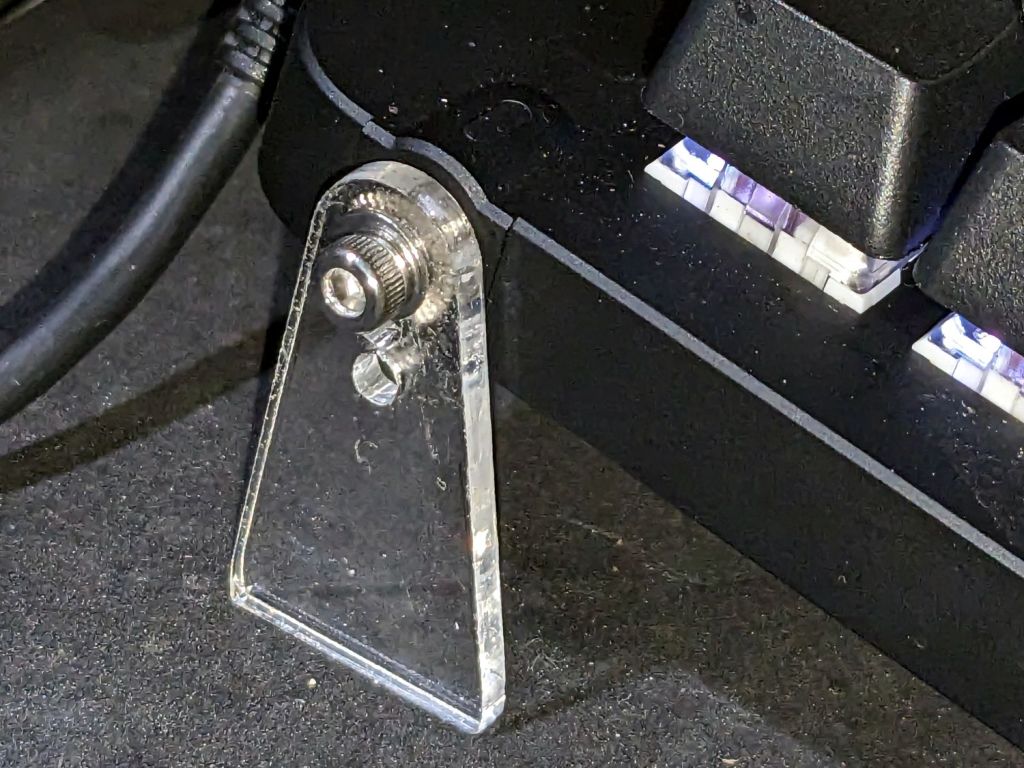
    While I had the hood up epoxy was curing, I lasered a block of edge-lit acrylic to replace the credit card shims:

    Carriage Stop - spacer
    Carriage Stop – spacer

    Which turned out to be one itsy too thick. Rather than sand / machine it down, the step over on the left grew a little brass shim:

    Carriage Stop - spacer and shim
    Carriage Stop – spacer and shim

    Both pieces depend on snippets of adhesive sheet to hold them in place, which seems reasonable because they’re always in compression. That also eliminates the hole and pin I originally thought would be necessary; living in the future is just grand.

    Thing looks like it grew there:

    Carriage Stop - installed
    Carriage Stop – installed

    The orange stripe on the handle is laser-safe PSA vinyl.

    That was easy …

  • SJCAM M50 Condensation: Redux

    SJCAM M50 Condensation: Redux

    The SJCAM M50 camera gasket seems unable to cope with The New Normal weather conditions around here:

    SJCAM M50 - screen condensation
    SJCAM M50 – screen condensation

    I think this was probably another case of diurnal pumping, given the exceedingly hot days and cool nights in late July.

    Plenty of water condensed on the bottom of the battery compartment cover:

    SJCAM M50 - battery lid condensation
    SJCAM M50 – battery lid condensation

    And inside the compartment around the AA cells:

    SJCAM M50 - battery compartment condensation
    SJCAM M50 – battery compartment condensation

    Unlike the previous leak, the camera lens wasn’t involved, so I did not disassemble the case. I let the opened camera (without batteries) dry out in the hot hot sun for the rest of the day and it seemed fine by evening.

    Keeping it out of full sunlight during the day definitely limits the locations I can use.

  • Craft Stick Plant Markers: Harvest Time

    Craft Stick Plant Markers: Harvest Time

    More craft stick markers followed the harvest home from Mary’s garden:

    Craft stick markers - deterioration 2023-08
    Craft stick markers – deterioration 2023-08

    As before, all-caps names survive longer:

    Craft stick marker - all caps 2023-08
    Craft stick marker – all caps 2023-08

    Although the name looks intact, the last few letters have cracks and would have fallen apart in a while.

    Pretty much as expected, thin wood markers are not forever.

  • Dandelion Weeder Repair

    Dandelion Weeder Repair

    This dandelion weeder was no match for the rugged weeds among the decorative grasses Mary planted along the road out front:

    Dandelion Weeder - bent
    Dandelion Weeder – bent

    You might expect the tang to extend well into the handle, but that’s not what you get in a cheap tool:

    Dandelion Weeder - ferrule detail
    Dandelion Weeder – ferrule detail

    The Bucket o’ Rod-like Materials had a rake handle about the right diameter, so I sawed off a suitable length, set up the steady rest with a bushing, and turned the end to match the ferrule:

    Dandelion Weeder - end turning
    Dandelion Weeder – end turning

    Pound the ferrule into place and drill the new handle to fit the tang:

    Dandelion Weeder - drilling setup
    Dandelion Weeder – drilling setup

    The handle seemed a bit raw and, as it was already chucked in the lathe, got a synthetic string wrap with clear epoxy coating:

    Dandelion Weeder - string epoxy
    Dandelion Weeder – string epoxy

    The pourable epoxy is reaching the end of its shelf life, but seemed entirely suitable for the purpose. I wrapped two layers of string around the dry handle, laid paper over the lathe bed, slathered epoxy over the whole affair, and let the lathe turn dead-slow for most of the day to even out the coat.

    The next day: hammer the blade mostly straight again, smear JB QuikWeld on the tang and into the hole, gently hammer them together, chuck the blade, apply more epoxy to the ends, and let it turn:

    Dandelion Weeder - end epoxy
    Dandelion Weeder – end epoxy

    A careful inspection reveals my casual disregard of the finer points of tool handle craftsmanship, but it came out surprisingly pretty:

    Dandelion Weeder - repaired
    Dandelion Weeder – repaired

    The blade remains the finest butter-soft cheap steel and still doesn’t extend the length of the handle, but Quality Shop Time™ is not to be sniffed at.

    And, hey, nary a trace of 3D printing or laser cutting!