The Smell of Molten Projects in the Morning

Ed Nisley's Blog: Shop notes, electronics, firmware, machinery, 3D printing, laser cuttery, and curiosities. Contents: 100% human thinking, 0% AI slop.

Category: Machine Shop

Mechanical widgetry

  • Laser Cut Plywood: Flame vs. Assist Air Flow

    Laser Cut Plywood: Flame vs. Assist Air Flow

    While cutting some oak plywood, I managed to get some interesting (to me, anyhow) pictures of how the assist air interacts with the laser kerf:

    Laser cut plywood flames - C
    Laser cut plywood flames – C

    The air flow is about 12 l/min from the pump in the bottom of the laser cabinet and is pushing most of the fumes through the kerf, where they ignite and burn merrily.

    The plywood is up on magnetic punk spikes to give the fumes plenty of room to disperse without making too much of a mess on the bottom surface. Unfortunately, the flame can blowtorch the cut parts after they fall through onto the honeycomb.

    Another view shows some smoke doesn’t make it through the kerf:

    Laser cut plywood flames - B
    Laser cut plywood flames – B

    The bulk of the flame seems to trail behind the beam as it cuts through the wood, which isn’t surprising:

    Laser cut plywood flames - A
    Laser cut plywood flames – A

    Just like acrylic flame, it’s kinda pretty, but should serve as another reminder why you must never, ever run your laser unattended.

  • Moonlander Elevators

    Moonlander Elevators

    What else would you call things that raise the back of a Moonlander keyboard:

    Moonlander elevators - installed
    Moonlander elevators – installed

    The Moonlander comes with two adjustable struts, one for each keyboard half, which should hold the things at whatever angle you like. I put wood blocks underneath for better support, but finally gave up and laid out a quartet of elevators on scrap 3 mm acrylic:

    Moonlander elevators - laser cutting
    Moonlander elevators – laser cutting

    The upper hole is 30 mm from the base and that’s the only one I needed, so they’re even easier to make than they look.

    Done!

  • Laser Cutter: Backlash Test

    Laser Cutter: Backlash Test

    A backlash test found on the LightBurn forum puts the machine through a series of difficult maneuvers:

    Backlash test
    Backlash test

    That’s burned on the back of a paperboard box at 400 mm/s @ 15%/10% power, which is slightly too intense for the smaller patterns.

    The key point is that the machine has no detectable trace of backlash, with all the opposing lines matching up and equal spacing regardless of the approach direction.

    Whew!

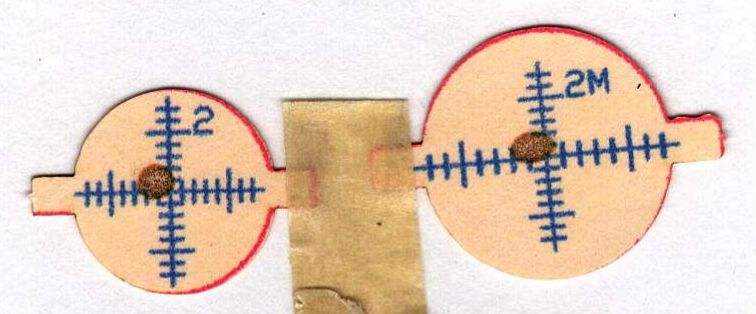
    The acceleration may be a little too high, as seen on some recent beam alignment targets:

    Print-and-Cut - perimeter matching
    Print-and-Cut – perimeter matching

    The larger targets on the right let the machine reach a speed closer to the nominal 400 mm/s around the arc, so the cut along the tape tab after the right-angle turn comes out a bit wobbly; the smaller targets are fine. The red lines are just under 0.5 mm wide and the wobble is on the same order, so it’s pretty close to being OK.

  • Tour Easy: Rewheeling

    Tour Easy: Rewheeling

    After 22 years and well over 30 k miles, I finally replaced the rear wheel rim on my Tour Easy, which went as smoothly as one could want.

    The tire showed considerable wear and damage, with this gash dating back three years:

    Schwalbe Marathon Plus - W5W gash
    Schwalbe Marathon Plus – W5W gash

    The pebble caught in this crater has worn flat on the outside and started cutting through the tire carcass into the tube:

    Schwalbe Marathon Plus - Stone gash
    Schwalbe Marathon Plus – Stone gash

    Gotta love those Marathon Plus tires!

    So my bike now has a new tire, tube, and rim on the back.

    The old spokes looked OK and tightened up without incident. For the record, the Park TM-1 tension meter puts the drive-side spokes at 25 and the other side just under 20, with the total runout & wobble under a millimeter.

    Having now replaced all four rims on our bikes over the course of two years, I sawed the three rims still awaiting recycling into samples:

    Tour Easy - 30 k mile rim wear
    Tour Easy – 30 k mile rim wear

    Unlike contemporary bikes, our Tour Easy recumbents have rim brakes and those original rims are pretty well worn out; they’re not supposed to be concave like that.

    All in all, more Quality Shop Time™.

  • Gelatin Capsule Filler Plate

    Gelatin Capsule Filler Plate

    Being a guy of a certain age with a diagnosis of Low Bone Density, I must increase my calcium intake. Rather than add a few hundred calories a day of calcium-rich food that my waistline does not need, I’ll see what adding 600 mg of calcium citrate can do.

    Being a guy of a certain type, I prefer to fill my own capsules, which of course involves Quality Shop Time:

    Gelatin 000 Capsule Fill Plate - cutting
    Gelatin 000 Capsule Fill Plate – cutting

    Quite some years ago, for reasons not relevant here, I acquired several of what were called “manual capsule filling machines” from the usual online sources. During the ensuing years, such devices have fallen under the purview of the DEA and vanished from the import market, leaving (AFAICT) one USA-ian supplier.

    The key difference between “machines” for different capsule sizes is the plate holding the capsule bodies:

    Gelatin 000 Capsule Fill Plate - installed
    Gelatin 000 Capsule Fill Plate – installed

    A complete machine includes three other capsule-size-related parts:

    • A plate holding the caps
    • A plate with conical holes used to shake caps & bodies into their respective plates
    • A guide plate helping mate caps with bodies

    In normal use, you put the “shake plate” on the body or cap plate, dump a pile into it, and shake until most of the caps / bodies fall into the holes. Then you manually insert the rest, invert any that fell in backwards, and generally mess around until they’re all properly oriented in their sockets. After filling the capsules, you put the cap + guide plates atop the bodies, press down firmly, and (ideally) produce 100 filled and sealed capsules.

    It turns out Size 000 capsules are sufficiently chonky that I have no trouble capping the bodies by hand without those other parts, so making just the body plate seemed Good Enough™. The story might be different for Size 1 capsules.

    The external dimensions and screw holes match the original plate, so this one fits the same base:

    Gelatin 000 capsule plate - LB layout
    Gelatin 000 capsule plate – LB layout

    Make one plate and four spacing clips from 6 (-ish) mm acrylic.

    If you can think of anything to do with 100 3/8 inch cylinders of 1/4 inch acrylic, clue me in.

    Size 000 bodies are close enough to 3/8 inch that I cleaned up the holes with a step drill for a nicer fit. Perhaps making the plate from 3 mm acrylic would produce better results.

    Four springs around the screws in the corners support the plate to allow pressing the caps in place. I adjusted the screws to put the top of the plate at exactly the height of the bodies above the blue base place, producing a smooth surface for scraping suspicious white powder into the bodies:

    Gelatin 000 Capsule Fill Plate - filled
    Gelatin 000 Capsule Fill Plate – filled

    Iterate filling and tamping until the capsule contents are firm-but-not-overstuffed, then press the plate downward and secure it with the spacer clips:

    Gelatin 000 Capsule Fill Plate - capped
    Gelatin 000 Capsule Fill Plate – capped

    The clips hold the plate at the proper distance to let the caps slip over the bodies and lock in place. This is tedious, but much faster than doing the entire process on individual capsules one-by-one.

    With the caps locked in place, flip the whole thing above a bowl, remove the clips, press the plate against the base, and 100 finished capsules shower into the bowl.

    You could build a complete filler without having the blue base plate & springs, but I’ll leave that project to your imagination.

    The LightBurn layout as a GitHub Gist:

    Loading
    Sorry, something went wrong. Reload?
    Sorry, we cannot display this file.
    Sorry, this file is invalid so it cannot be displayed.

    No, I am not making one for you. :grin:

  • Solar-Flattening Fiskars Cutting Mats

    Solar-Flattening Fiskars Cutting Mats

    Fiskars cutting mats must lie flat on the table to be of any use, but they’re remarkably sensitive to warping due to localized temperature variations; a hot cup of tea can wreak a remarkable amount of damage. Suggestions from the InterWebs generally involve a clothes iron, temperature tweaks, overnight cooling, and unpredictable results.

    Given that the mats are large polypropylene sheets, I figured applying moderate heat to the entire mat while it’s compressed between two flat plates would work better:

    Fiskars cutting mat - solar flattening
    Fiskars cutting mat – solar flattening

    That’s one of Mary’s 36×24 mats atop an MDF sheet (with pictures of wood laminated to both sides), under a 7/32 inch = 5.6 mm sheet of non-tempered glass, with a maple shelf supporting the last two inches of the unwarped edge, all sitting on the driveway in full sun.

    The first attempt started too late in the afternoon for good heating and, after a few hours, had only slightly reduced the warp. Laying it out the next morning got the mat up to about 110 °F = 43 °C around noon and the warp was completely gone by evening.

    I don’t trust the IR thermometer’s temperature measurements on glass, but the surrounding MDF and driveway were plenty hot.

    The next sunny day flattened the warp out of 24×18 inch mat on my desk, so success wasn’t a fluke.

    We noticed that the larger mat is now uniformly smaller by about 3/16 inch along the 36 inch width and 1/4 inch over the 24 inch height. It was a tag sale find with unknown provenance and, due to the warp, Mary had been using her other large mat for layout, so we don’t know if this one arrived a little short or if my technique both flattened and shrank it.

    The smaller mat seems unaffected by its similar treatment, so your mileage may vary.

    In any event, a flat mat is much more useful than a warped mat, so we’ll call the operation a success.

  • Coaster Cork Alignment Fixture

    Coaster Cork Alignment Fixture

    Having stuck many cork bottoms to many coasters and aligning nearly all of them pretty close, I finally made a fixture to get it right from now on:

    Coaster cork fixture - test fit
    Coaster cork fixture – test fit

    A plywood disk anchors four arcs cut from a remnant of acrylic mirror left over from the card-suit coasters, using strips of adhesive sheet cut 1 mm smaller than the arcs:

    Coaster cork fixture - adhesive sheets
    Coaster cork fixture – adhesive sheets

    Stick an arc in place, lay the cork inside the arc, and stick the rest of the arcs around the cork:

    Coaster cork fixture - cork fit
    Coaster cork fixture – cork fit

    Squish the arcs in place overnight with Too Many Clamps™:

    Coaster cork fixture - clamping
    Coaster cork fixture – clamping

    In use, peel the paper off the cork, lay it in place, ease the coaster atop it, press firmly, remove the perfectly aligned coaster, then put a stack of them in the overnight clamp to solidify the PSA bond.

    Should’a done this long ago …