The Smell of Molten Projects in the Morning

Ed Nisley's Blog: Shop notes, electronics, firmware, machinery, 3D printing, laser cuttery, and curiosities. Contents: 100% human thinking, 0% AI slop.

Category: Machine Shop

Mechanical widgetry

  • Prusa MK4 Y Motor Shim

    Prusa MK4 Y Motor Shim

    Having been viciously nerd-sniped by The Great Dragorn of Kismet, I’m in the process of building a Prusa MK4 3D printer with an MMU3. This has been a generally pleasant experience, although I am beginning to loathe Genuine Haribo Goldbären.

    Anyhow, the Y axis motor position puts the belt too close to one side of the pulley, with no further adjustment possible:

    Prusa MK4 Y axis motor mount - as-built
    Prusa MK4 Y axis motor mount – as-built

    The stepper motor stator laminations are the striped gray area on the far left, the 3D printed motor mount is the striped black area on the right, and the belt pulley is snugged up against the motor as far as it can go on the shaft.

    Pushing the motor a little more to the left requires a shim:

    Prusa MK4 Y axis motor mount - shim
    Prusa MK4 Y axis motor mount – shim

    Rather than fiddle with scanning the motor mount, I imported its STL model from the Prusa MK4 files:

    Prusa MK4 Y Axis Motor mount - solid model
    Prusa MK4 Y Axis Motor mount – solid model

    Importing the STL into OpenSCAD and converting the motor face into an SVG file is basically a one-liner:

    projection(cut=true)
    translate([0,0,-5.0])
    import("/mnt/bulkdata/Project Files/Prusa Mk4/Calibration/y_motor_holder_R3.stl");
    

    Import the SVG into LightBurn, round the corners a little, set it up for 1.5 mm Trocraft Eco, Fire. The. Laser. and it fits perfectly and stands out nicely:

    Prusa MK4 Y axis motor mount - shimmed
    Prusa MK4 Y axis motor mount – shimmed

    Having the right tools for a job makes it easy …

  • Home Depot Glacier Bay Kitchen Faucet: Round 2

    Home Depot Glacier Bay Kitchen Faucet: Round 2

    The kitchen faucet worked its way loose again. Attempting to shut off the water revealed a pair of leaky valves under the sink, so I shut off the house water in the basement, cut the valve pipes below the solder drips, and installed a pair of push-connect shutoffs:

    Kitchen faucet shutoff valve - push connection
    Kitchen faucet shutoff valve – push connection

    I loves me some good push-connect fitting action, which is new news to me. Back in the Bad Old Days™, I’d be under the sink with a propane torch, trying to solder a pair of wet pipes and failing miserably.

    With that out of the way and the faucet dismantled for the first time (by my hands, anyway), the threads holding the base to the spout column may have been damaged during factory assembly:

    HD Glacier Bay kitchen faucet - damaged threads
    HD Glacier Bay kitchen faucet – damaged threads

    I thought the gunk was thread lock compound, but it’s shredded plastic from the base fitting threads. The corresponding female threads inside the spout column are undamaged, so I think somebody tried screwing it together with the threads misaligned, backed off, then muscled it together.

    It’s worth noting there are no keys or stops fixing the correct orientation of any of these parts. In particular, the trim ring bearing the small Front label (facing you in the picture) has no fixed orientation: whoever assembles the faucet in the factory must position it correctly on the fly as the base screws into the column and jams tight.

    So I cleaned up the damaged threads as best I could, flipped the threaded brass tube end-for-end to put the cleanest part into the base, and reassembled everything with careful attention to starting the threads correctly:

    HD Glacier Bay kitchen faucet - flipped brass tube
    HD Glacier Bay kitchen faucet – flipped brass tube

    Tightening the base fitting into the column is much easier with everything on the kitchen counter, although centering the label on the molded opening required several tries.

    Protip: a pair of grippy gloves and rubber sheets help a lot.

    I want to find out how secure the original design, properly tightened and aligned, will be, so I did not apply any threadlocker.

  • Laser-cut Paper Pad Hooks

    Laser-cut Paper Pad Hooks

    Mostly because I could:

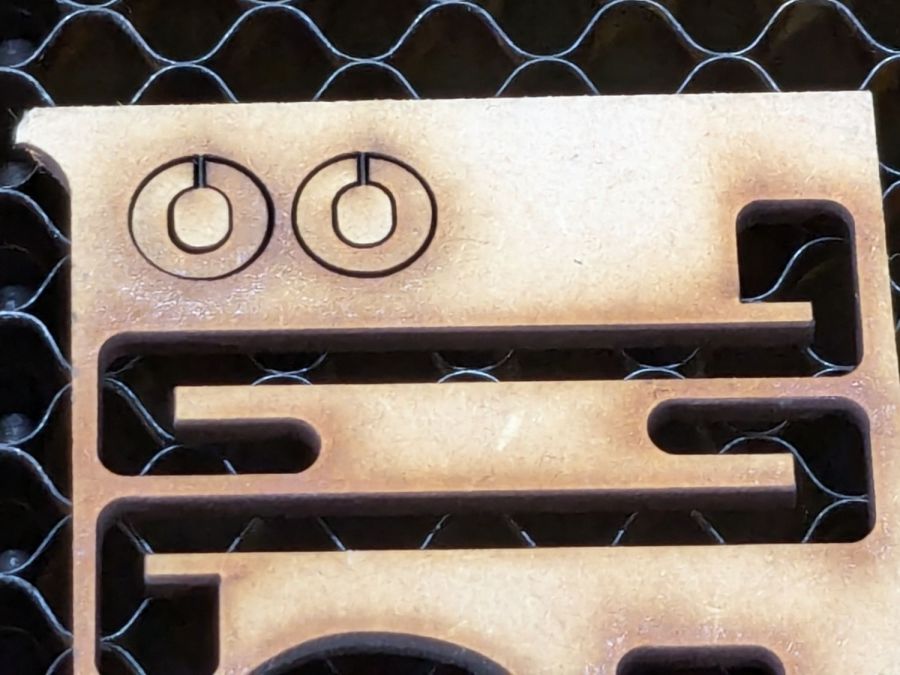
    Laser-cut MDF paper hooks
    Laser-cut MDF paper hooks

    Another pair of hooks support the far end of the sketch paper pad, all hanging on the end of the shelves holding laser materials & tooling.

    MDF isn’t particularly well-suited as a hook for anything weighing more than a dozen sheets of paper, but that pad is now out of the way where it won’t get curled.

    The shape comes from a bunch of rectangles welded together in LightBurn, with the obvious corners rounded off for stylin’.

  • Glass-top Patio Table Leg Brackets: Hardfought

    Glass-top Patio Table Leg Brackets: Hardfought

    A glass-top patio table came with our house and, similar to one of the patio chairs, required some repair. The arched steel legs fit into plastic brackets / sockets around the steel table rim under the glass top:

    Glass patio table - new brackets installed
    Glass patio table – new brackets installed

    The four glaringly obvious white blocks are the new brackets.

    The original brackets had, over uncounted years, deteriorated:

    Glass patio table - failed OEM bracket
    Glass patio table – failed OEM bracket

    Perhaps disintegrated would be a better description:

    Glass patio table - crumbled OEM bracket
    Glass patio table – crumbled OEM bracket

    Each leg has a pair of rusted 1-½ inch ¼-20 screws holding it to the central ring. As expected, seven of the eight screws came out easily enough, with the last one requiring an overnight soak in Kroil penetrating oil plus percussive persuasion:

    Glass patio table - jammed screw
    Glass patio table – jammed screw

    The four legs had three different screws holding them to the brackets, so I drilled out the holes and squished M5 rivnuts in place:

    Glass patio table - M5 rivnut installed
    Glass patio table – M5 rivnut installed

    Although it’s not obvious, the end of that tube is beveled with respect to the centerline to put both the top and bottom edges on the table rim inside the bracket. In addition, the tube angles about 10° downward from horizontal, which I did not realize amid the wrecked fittings, so the first bracket model failed instantly as I inserted the leg:

    Glass patio table - first bracket test
    Glass patio table – first bracket test

    The top & bottom walls of that poor thing were breathtakingly thin (to match the original bracket) and cracked when confronted with the angled tube. I could not measure all the sizes & angles without assembling the table on trial brackets, so getting it right required considerable rapid prototyping:

    Glass patio table - failed brackets
    Glass patio table – failed brackets

    Some trigonometry produced a solid model with features rebuilding themselves around the various sizes / angles / offsets:

    Glass Top Table - leg bracket - solid model
    Glass Top Table – leg bracket – solid model

    A sectioned view shows the angled tube position and end chamfer:

    Glass Top Table - leg bracket - section view
    Glass Top Table – leg bracket – section view

    The OpenSCAD code can produce a sectioned midline slice useful for laser-cut MDF pieces to check the angle:

    Glass patio table - chunky bracket installed - bottom
    Glass patio table – chunky bracket installed – bottom

    That eliminated several bad ideas & misconceptions, although trying to balance the leg on a 3 mm MDF snippet was trickier than I expected. In retrospect, gluing a few snippets together would be easier and still faster than trying to print a similar section from the model.

    The slightly elongated slot for the M5 screw shows that the original screw holes were not precisely placed or that the tubes were not precisely cut, neither of which come as a surprise. I finally built some slop into the design to eliminate the need for four different blocks keyed to four different legs.

    The outer rim, the notch on the bottom, and the tab on the top curve to match the four foot OD glass tabletop, with the inward side & ends remaining flat:

    Glass patio table - chunky bracket installed - top
    Glass patio table – chunky bracket installed – top

    The sector’s difference from a straight line amounts to half a millimeter and improved the fit enough to justify the geometric exercise. The bracket snaps into position with the notch over the table rim and the tab locked in the gap between the glass disk & the rim, although I suspect the weight of the tabletop would keep everything aligned anyway.

    The walls are now at least 4 mm thick and, printed in PETG, came out strong enough to survive assembly and some gentle testing. They’re arranged to print on their side to eliminate support under those slight curves and to align the layers for best strength vertically in the finished bracket:

    Glass Top Table - leg bracket - slicer preview
    Glass Top Table – leg bracket – slicer preview

    The leg cavity and screw hole built well enough without internal support.

    They’re relentlessly rectangular and I’m not going to apologize one little bit.

    Now to see how they survive out there on the screened porch.

    The OpenSCAD source code as a GitHub Gist:

    // Glass patio table leg brackets
    // Ed Nisley – KE4ZNU
    // 2024-08
    /* [Layout] */
    Layout = "Show"; // [Section,Projection,Show,Build]
    Part = "Leg"; // [Leg, RimPlate, Block, Bracket]
    /* [Hidden] */
    ThreadWidth = 0.40;
    ThreadThick = 0.25;
    HoleWindage = 0.2;
    Protrusion = 0.1;
    //—–
    // Dimensions
    /* [Hidden] */
    GlassOD = 1230.0; // inner edge of upper tab
    GlassThick = 5.0;
    WallThick = 4.0;
    TOP = 0;
    BOT = 1;
    TabWidth = [3.0,3.0]; // locking tabs, top & bottom
    TabHeight = [0.5,3.0]; // … height
    LegOA = [16.0,36.5,23.0]; // X insertion, Y around glass, Z upward
    LegAngle = 10;
    ScrewOffset = [8.0,10.0]; // from socket bottom
    ScrewOD = 6.0; // clearance hole
    Plate = [1.0 + 2*max(TabWidth[TOP],TabWidth[BOT]),
    LegOA.y + 2*WallThick,
    25.5
    ];
    echo(Plate=Plate);
    BlockOA = [LegOA.x*cos(LegAngle) + (LegOA.z/2)*sin(LegAngle) + WallThick,
    Plate.y,
    LegOA.z/cos(LegAngle) + 2*LegOA.x*sin(LegAngle) + 2*WallThick
    ];
    echo(BlockOA=BlockOA);
    //—–
    // Useful routines
    function IntegerMultiple(Size,Unit) = Unit * ceil(Size / Unit);
    module PolyCyl(Dia,Height,ForceSides=0) { // based on nophead's polyholes
    Sides = (ForceSides != 0) ? ForceSides : (ceil(Dia) + 2);
    FixDia = Dia / cos(180/Sides);
    cylinder(r=(FixDia + HoleWindage)/2,
    h=Height,
    $fn=Sides);
    }
    //—–
    // Table Leg
    // Including screw slot
    // Additional length to allow use as difference
    module Leg() {
    union() {
    difference() {
    rotate([0,90,0])
    translate([0,0,-LegOA.x])
    linear_extrude(height=4*LegOA.x,convexity=5)
    hull()
    for (j=[-1,1])
    translate([0,j*(LegOA.y – LegOA.z)/2])
    circle(d=LegOA.z);
    rotate([0,-LegAngle,0])
    translate([-2*LegOA.x,0,0])
    cube(4*LegOA,center=true);
    }
    hull()
    for (c = ScrewOffset)
    translate([each c + (LegOA.z/2)*sin(LegAngle),0,-LegOA.z])
    //rotate(180/6)
    PolyCyl(ScrewOD,LegOA.z,6);
    }
    }
    // Rim Plate
    module RimPlate() {
    n = 16*4*3;
    render(convexity=5)
    translate([-Plate.x,0,0])
    difference() {
    intersection() { // shape outer side to match table rim curve
    translate([0,-Plate.y/2,0])
    cube(Plate,center=false);
    translate([GlassOD/2 + TabWidth[TOP],0,0])
    cylinder(d=GlassOD + 2*TabWidth[TOP],h=Plate.z,center=false,$fn=n);
    }
    translate([GlassOD/2 + TabWidth[TOP],0,Plate.z – TabHeight[TOP]])
    cylinder(d=GlassOD,h=Plate.z,center=false,$fn=n);
    translate([GlassOD/2 + TabWidth[BOT],0,-(Plate.z – TabHeight[BOT])])
    difference() {
    cylinder(d=GlassOD,h=Plate.z,center=false,$fn=n);
    cylinder(d=GlassOD – 2*TabWidth[BOT],h=Plate.z,center=false,$fn=n);
    }
    }
    }
    // Block surrounding leg
    module Block() {
    intersection() {
    translate([BlockOA.x/2,0,0])
    cube(BlockOA,center=true);
    translate([0,0,BlockOA.x*sin(LegAngle) – BlockOA.z/2])
    rotate([0,LegAngle,0])
    translate([-2*BlockOA.x,-2*BlockOA.y,0])
    cube(4*BlockOA,center=false);
    }
    }
    // Complete bracket
    module Bracket() {
    difference() {
    union() {
    RimPlate();
    translate([0,0,Plate.z – BlockOA.z/2 – TabHeight[TOP] – 0*WallThick])
    Block();
    }
    translate([0,0,1*Plate.z/2 – 1*WallThick])
    rotate([0,LegAngle,0])
    translate([WallThick,0,0])
    Leg();
    }
    }
    //—–
    // Build things
    // Layouts for design & tweaking
    if (Layout == "Section")
    intersection() {
    Bracket();
    translate([0,BlockOA.y/2,0])
    cube([4*BlockOA.x,BlockOA.y,3*BlockOA.z],center=true);
    }
    if (Layout == "Projection")
    for (j = [1])
    translate([0,j*2*BlockOA.z])
    projection(cut=true)
    translate([0,0,j*5.0])
    rotate([90,0,0])
    Bracket();
    if (Layout == "Show")
    if (Part == "Leg")
    Leg();
    else if (Part == "RimPlate")
    RimPlate();
    else if (Part == "Bracket")
    Bracket();
    else if (Part == "Block")
    Block();
    // Build layouts for top-level parts
    if (Layout == "Build") {
    translate([0,0,Plate.y/2])
    rotate([90,0,0])
    Bracket();
    }

    Some dimension doodles, not all of which correspond to reality:

    Glass patio table - dimension doodle A
    Glass patio table – dimension doodle A
    Glass patio table - dimension doodle B
    Glass patio table – dimension doodle B

    See? It’s not all slotted animals all the time around here …

  • Slotted Bee and Mud Dauber Wasp

    Slotted Bee and Mud Dauber Wasp

    Continuing the Halloween theme with a Bee and a Mud Dauber Wasp:

    Bee and Wasp
    Bee and Wasp

    The little wasp has 0.5 mm slots perfectly suited for very light cardboard. It’s missing a few small pieces because at that scale they just don’t matter.

    The chunky bee uses the familiar 1.4 mm chipboard:

    Bee - right front
    Bee – right front

    A rear view to remind me where that long flat slab fits:

    Bee - right rear
    Bee – right rear

    They have far too many pieces for mass production!

  • Slotted Alligator

    Slotted Alligator

    An alligator head should look good at the front door in late October:

    Alligator - left side
    Alligator – left side

    The printing on the moving boxes makes it a bit less scary on the other side:

    Alligator - right side
    Alligator – right side

    Perhaps those are gang tats!

    The eyes are fluorescent acrylic and definitely improve the thing.

  • Wheelbarrow Drain Holes

    Wheelbarrow Drain Holes

    Attacking a plastic wheelbarrow with a ¾ inch hole saw prevents it from becoming a mosquito breeding station:

    Wheelbarrow drain holes
    Wheelbarrow drain holes

    We had been storing it tipped to one side, resulting in the wheel filling up with water, which can’t be a Good Thing.

    If it must carry a load of sand, I’ll just duct-tape the holes.

    One of Mary’s friend looked at, but did not order, this wheelbarrow on Amazon. Shortly thereafter, she received a wheelbarrow in two packages: the handles and a box with everything else strapped into the barrow. After a discussion with Amazon’s support / help staff, she was told to just keep it at no charge.

    Over the next few weeks, she received five more wheelbarrows, each prompting a discussion and keeping them at no charge. Eventually, somebody figured out how to stop the stream.

    So half a dozen gardeners now have free wheelbarrows, courtesy of a glitch in The Machine.

    Makes you wonder, doesn’t it?