Ed Nisley's Blog: Shop notes, electronics, firmware, machinery, 3D printing, laser cuttery, and curiosities. Contents: 100% human thinking, 0% AI slop.
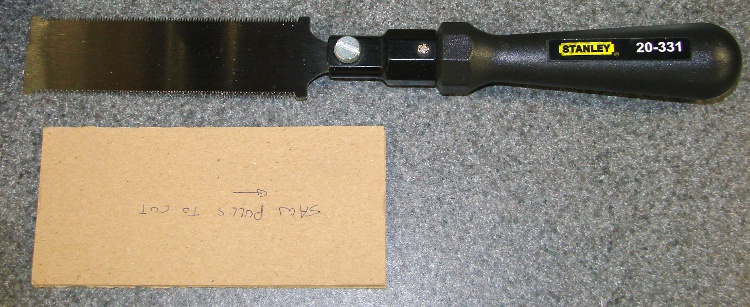
Trimming some poster frame edges brought this useful tool out of hiding. It’s an ordinary Stanley 20-331 flush-cut flexible-blade pull saw that I’d used while installing laminate flooring in the kitchen & laundry room some years ago; it cuts the bottom of moulding like nothing else.
Anyhow, what’s of interest here is the simple cardboard sheath I made to keep those delicate little teeth from getting bashed up in the tool drawer.
Saw and sheath
Here’s a closer end view. It’s nothing more than two large sheets of thin cardboard (think cereal box or maybe consumer electronics box) separated by two narrow sheets. The blade’s thinner than any practical cardboard you’ll find, so just do it. It’s held together with yellow wood glue, because that’s what I had nearby when I built it.
Saw sheath end view
The note written on the sheath reminds both my shop assistant and me which way the cutting happens. Sometimes, we need all the help we can get.
For what it’s worth, the new Stanley 20-331 listing shows a similar saw blade with a Fat Max handle. This is the older version, from back when thin was in.
As part of my clear-off-the-workbench effort, this flashlight emerged from the dark depths. It’s a few decades old and wasn’t a good design: the “switch” is a simple contact between the end of the cell casing and the reflector rim, activated by screwing the reflector tighter on the case.
Broken flashlight case
The failure is simple: the case cracks through at the stress raiser formed where the “switch” contacts rest on a sharp inside corner. That stiff little spring maintains pressure on the cells, so the case is always under tension and eventually fractures.
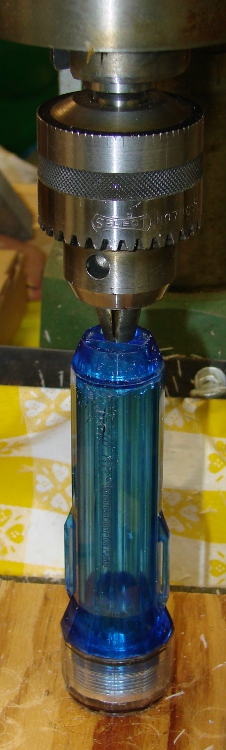
Flashlight clamped in mill
I grabbed the broken pieces in the lathe, turned off the fractured plastic, and wound up with a pair of nicely mating surfaces (and a somewhat shorter flashlight, but it’s still long enough). Apply enough Plastruct solvent glue to soften the new faces, then clamp them together. The big manual mill knows how to apply a strong, steady vertical force to a project like this.
It’s once again hanging by the basement door, where it gets used roughly once every other blue moon (yeah, it’s color-coordinated). This isn’t the first time this flashlight has failed that way, but it’ll be the last: next time, it’s in the trash.
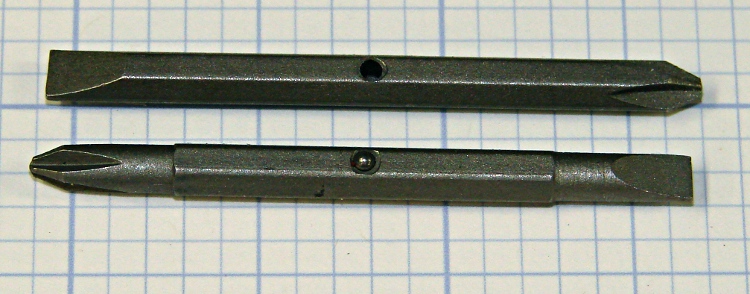
Went to use a small multi-bit screwdriver and the bit fell right out: evidently, the ball wasn’t swaged tightly enough; it and the spring went walkabout. Given that I don’t know when or where that might have happened, there’s no chance I’ll ever see those parts again.
Screwdriver bit with missing ball
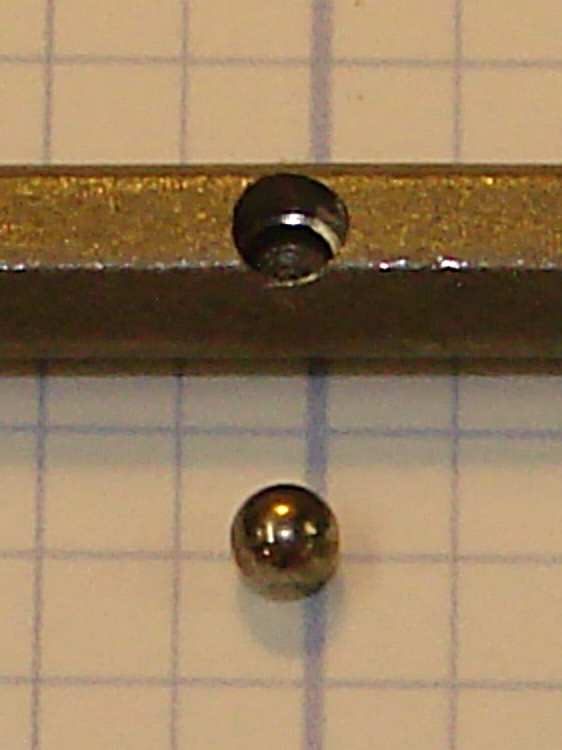
But I do have some 2 mm steel bearings that aren’t grossly oversized, so all hope is not lost. Alas, I have no idea what sort of spring to put in there, other than that I don’t have one of those.
Drilled hole with ball
This looks like an application for rubberdraulics: use compliant silicone snot rubber as a spring. Lautard described a use with a lock ring and an external screw to apply pressure, but here it’ll work fine to allow a small motion for a tiny ball.
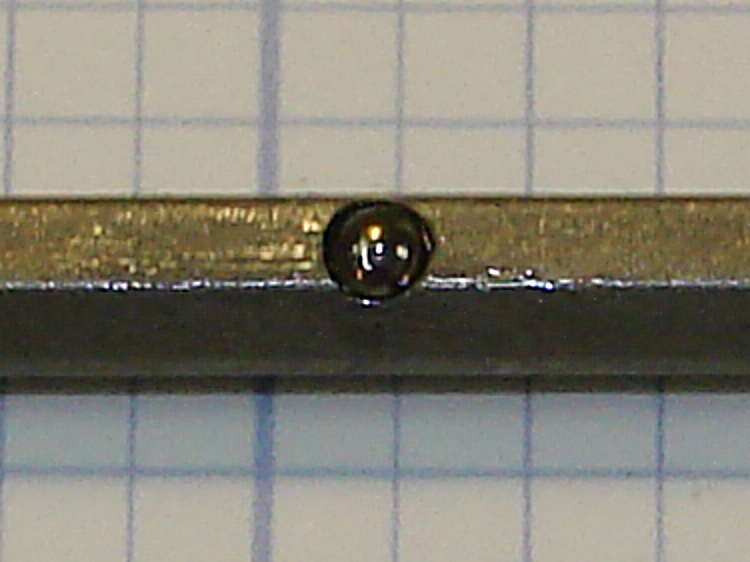
Drill out the recess barely larger than the ball: the slight clearance allows the cured rubber to squish out around the ball. I clamped it in the Sherline vise and jogged into position by eyeball, then poked a hole with G83 down 1.5 mm. The original recess was a bit over 2 mm deep, so there’s plenty of room for the silicone in the bottom.
Then mush some silicone into the hole, install the ball, push it down until it stands barely proud of the surface, scrape off the excess rubber, and let it cure overnight.
I’m putting together an Atom 510 box to replace the ancient Dell currently acting as the Sherline CNC controller, with the intent of seeing whether a rather anemic low-power CPU with two cores will work as well. The system board has room for one PCI card and I figured I’d install a second parallel printer while I had the hood up.
But then I realized that the only LPT cards in my stash had tall brackets that wouldn’t fit in the new mini-ITX case.
Well, it turns out that the LPT card itself would fit in the box, so all I had to do was reshape the bracket:
A bit of filing on the bottom knocked off a millimeter and put a tidy taper on the tab
A brief session with Mr Hammer bent the top flange over, so as to meet the case mounting flange
A somewhat surprised tin snips removed the excess length
A cylindrical file chewed out a somewhat generous screw clearance notch
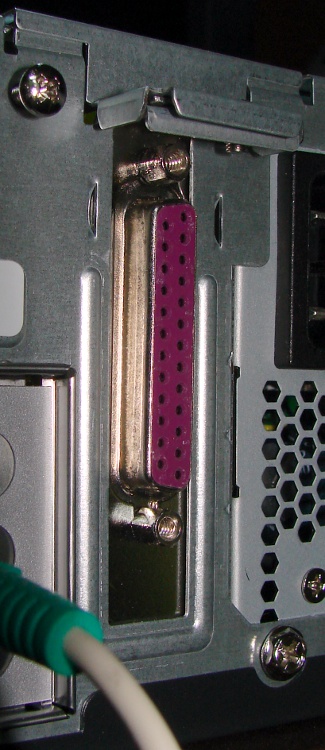
Finished LPT bracket
And then it’s just a matter of screwing things together.
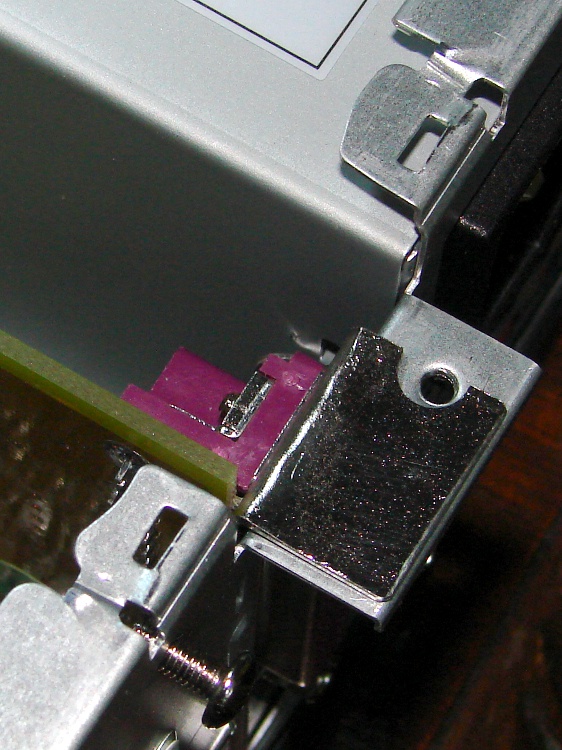
LPT Bracket – outsideLPT Bracket – top
I’ll admit the clearance from the top mounting screw to the flange is terrifyingly cozy, but I’m not averse to applying force majeure to either an unsuspecting LPT connector or the case itself…
The top view omits the screwdown clamp that secures the card to the case so you can see where the screw notch goes.
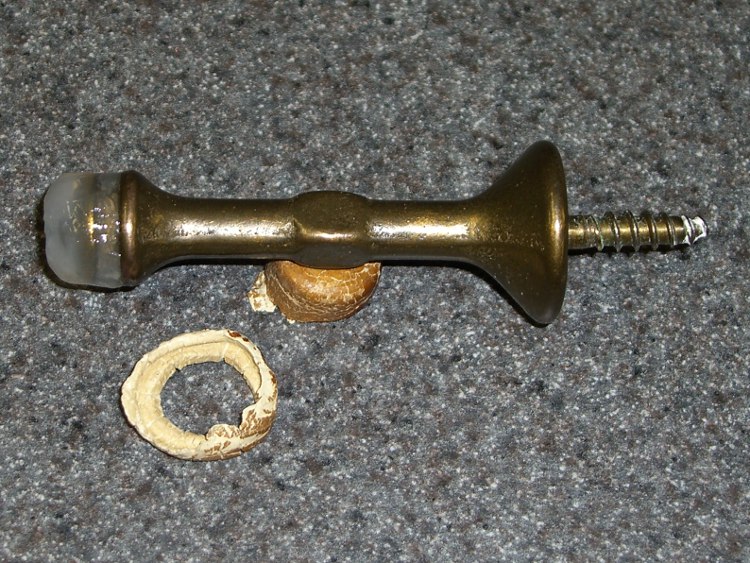
After slightly over half a century, the rubber bumpers on the doorstops around the house have stiffened up and, occasionally, one falls off.
Although I suppose I should just buy a new doorstop, molding a dab of silicone snot around the end of the nice brass post takes only a few minutes (plus an overnight cure). If what they tell us about silicone adhesives is true, this one is good until the sun goes dark…
Having successfully drilled and tapped eight 4-40 holes for the MOSFETs and two 8-32 holes for the heatsink clamps, I needed four more holes for the 6-32 standoffs that will mount the heat spreader to the base. As is always the case, the tap broke in the next-to-last hole…
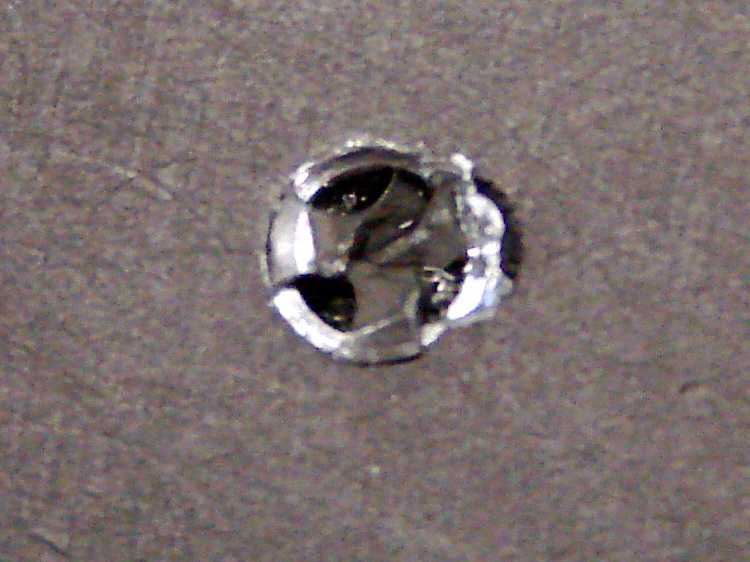
Broken tap
This is a three-flute tap, the break is recessed below the surface, and it looks like it’s cracked along one of the flutes. Bleh! I don’t have any tap extractors, mostly because I don’t do that much tapping, and I doubt the extractors work all that well on tiny taps.
I tried something I’d never done before: slit the top of the tap with an abrasive wheel and unscrew it. That didn’t work, of course, but it’s a useful trick to keep in mind. I think the tap was cracked lengthwise and, in any event, a three-flute tap doesn’t have the proper symmetry for a slot. Better luck with larger four-flute taps.
Slotted tap
So I must dig the mumble thing out…
Starting the moat
The overall plan:
Clamp the heat spreader to the Sherline tooling plate
Helix-mill a trench around the tap
Grab the stub with Vise-Grips
Unscrew it
Repair the damage
The clearance hole for a 6-32 screw is 0.1405 inch and that’s a 3/16-inch end mill: 70 + 93 = 163 mil radius, call it 0.170 inch. You really don’t want to kiss the tap flutes with the end mill, so you could make that the ID a bit larger.
Manual CNC, feeding commands into Axis and using the history list to chew downward 20 mils on each pass. With the origin in the middle of the broken tap and the cutter starting at (-0.170,0), the code looks like:
G2 I+0.170 Z=-0.020
G2 I+0.170 Z=-0.040
... and so on ...
About 3000 rpm and 2 inches per minute feed; the feed was too slow, because the aluminum chips were much too fine. I actually used cutting lube for this job: the heat spreader got nice and warm.
Coolant
I stopped at Z=-0.100 and made a final pass around the bottom of the hole to clean out the ramp. Then, try unscrewing the tap…
Tap stub – first attempt
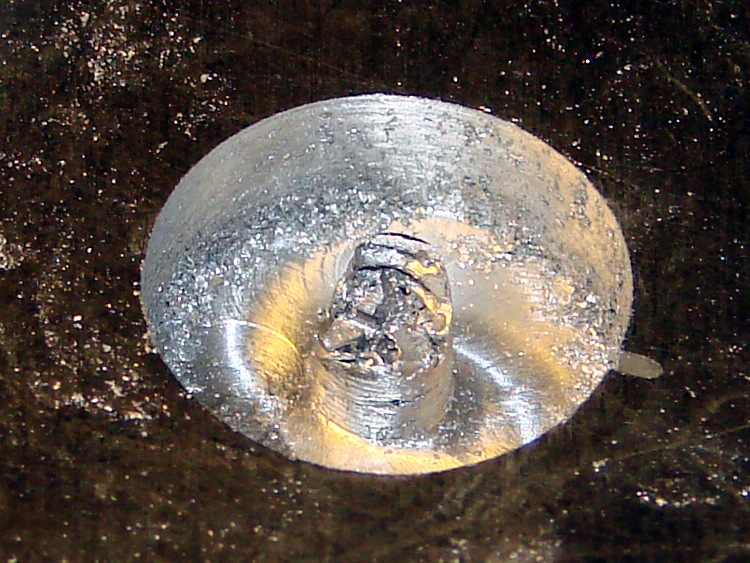
Of course, the stub broke off more or less flush with the bottom of the hole, so I continued milling downward to Z=-0.260, a bit more than halfway through the plate. This time, the needle-nose Vise-Grips got a good grip on an uncracked section and the remains twisted out with very little effort.
Grabbing the stub
Although the central pillar is outside the tap’s OD, leaving a solid aluminum shell, there’s not much meat to it. The shell broke off with the first twist and came out with the tap.
Those are not, by the way, gold-plated Vise-Grips. It’s a flash picture and the worklight is a warm-white compact fluorescent: the color correction that makes the aluminum look neutral gray turns the reflected CFL into gold.
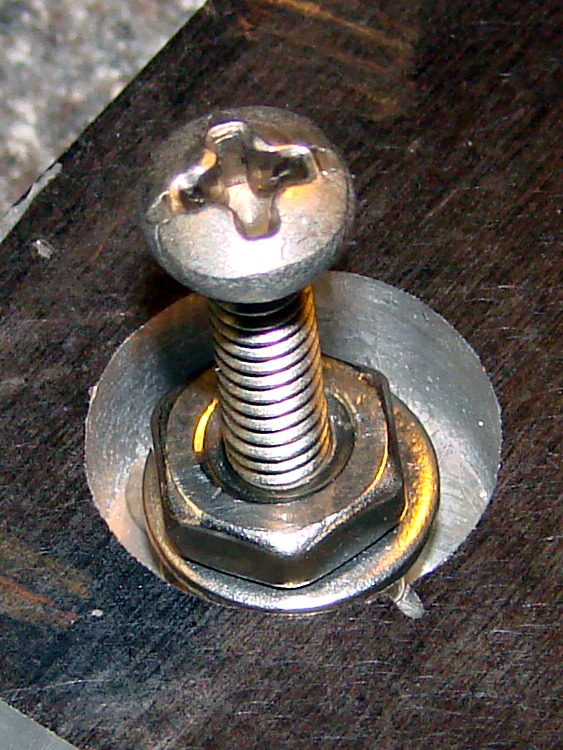
Aligning replacement nuts
I milled off the remains of the shell around the tapped hole, leaving a more-or-less flat bottom. If I cared enough, I’d machine a snug-fitting replacement aluminum plug, epoxy it into place, then (attempt to) drill-and-tap the hole again.
Instead, because the hole was deep enough for a pair of 6-32 nuts and a washer, I simply aligned those on a screw and filled the hole with JB Weld epoxy.
It doesn’t show in the picture, but the screw is well-lubricated with silicone grease to prevent it from becoming one with the nuts.
I eased epoxy into the recess, chasing out the inevitable air bubbles, and then scraped off most of the excess.
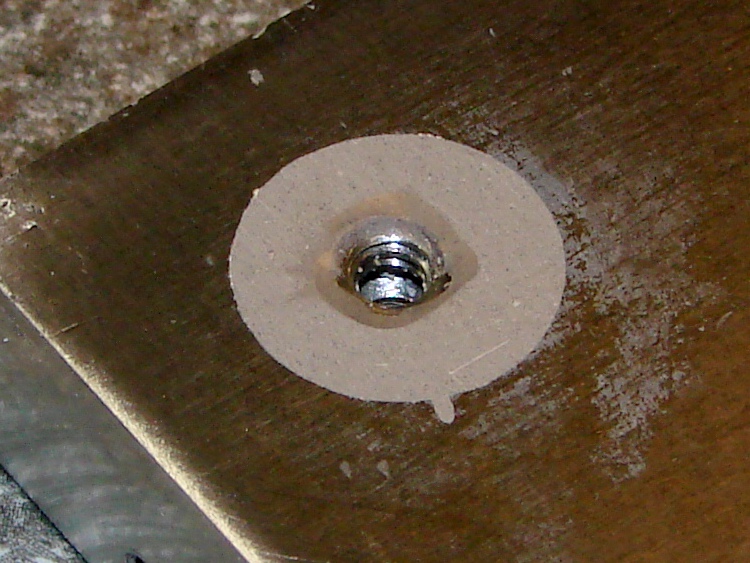
Epoxy fill
Let it cure overnight, scrub it on some sandpaper atop the sacrificial side of the surface plate, and it’s all good again…
Sanded flat
The little finger of epoxy sticking out to the front fills the end of the slit I carved into the top of the tap, which is visible in the other pictures if you look closely. The area around the hole isn’t stained; that’s smooth epoxy.
Of course, the thermal conductivity of epoxy is a lot less than that of solid aluminum. I’m not really pushing the limits of TO-220 packages, so this kludge will work fine in this application. It’s also nice that the repair is on the bottom of the heat spreader, where nobody will ever know I screwed up…
Now, to return to the project at hand, with even more motivation to avoid tapping holes in the future!
So, after a bit more than a year, I replaced the cracked backing plate in the other ERRC underseat pack on my Tour Easy. The first plate held up much better than I expected: hasn’t cracked or poked through the pack fabric.
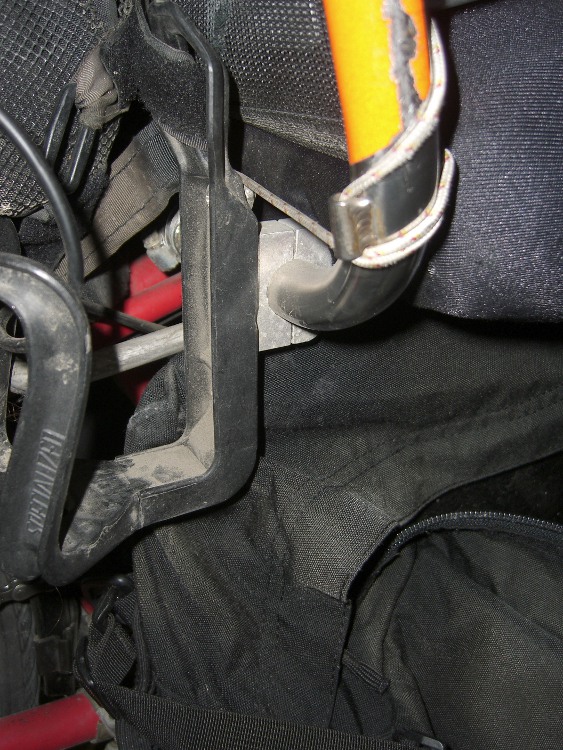
This repair followed the same outline, including cutting off the ripped netting on the outside of the pack and marching the pack into the clothes washer for a spin with a few shop rags. Reassembled everything, put it back on the bike, and … the new aluminum extrusion across top of the plate smacked firmly into the water bottle holder clamped to the rear of the seat frame for the amateur radio.
Underseat pack vs radio holder
The extrusion is the lump running horizontally, just under the seat cushion. The corner of the pack extended rearward (left) of the water bottle holder’s black plastic body.
The original flexy plastic pack plate simply bent out of the way, but that’s not going to work now.
So I loosened the clamp, moved it a bit more to the right, and tightened it up again. I’d originally located it at the far right end of the straight part of the seat frame, so it’s now edging into the curved part that eventually forms the right side of the frame, but it’s good enough.
My shop assistant says she wants another water bottle holder for an actual water bottle on her bike. I say she should just go to the shop and make whatever she wants, then install it. Negotiations continue…







 The Smell of Molten Projects in the Morning