The Smell of Molten Projects in the Morning

Ed Nisley's Blog: Shop notes, electronics, firmware, machinery, 3D printing, laser cuttery, and curiosities. Contents: 100% human thinking, 0% AI slop.

Category: Machine Shop

Mechanical widgetry

  • Thing-O-Matic: Wade/ScribbleJ Filament Tensioner

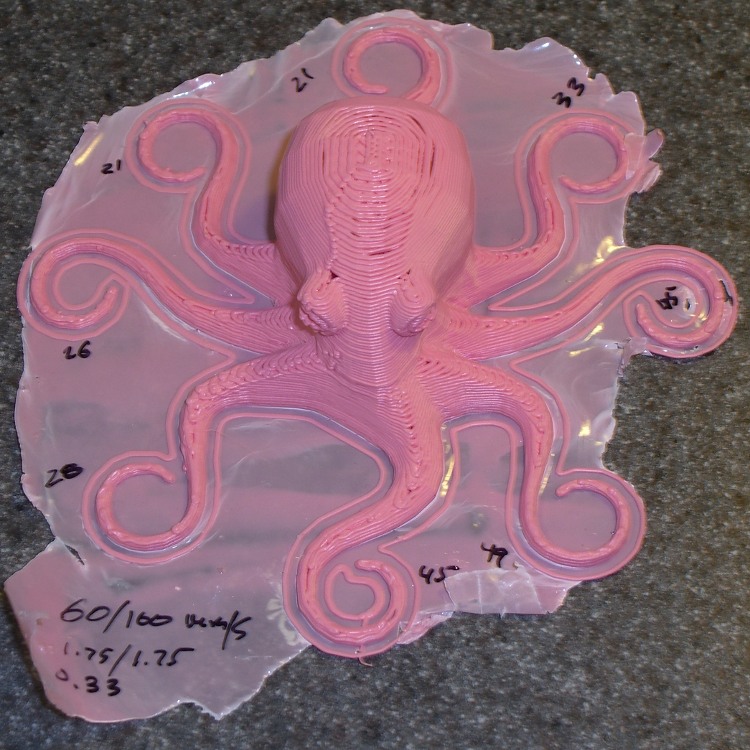
    Putting a geared stepper motor on the MK5 filament drive produced greatly improved print quality, which meant I could finally print ScribbleJ’s version of the classic Wade Filament Tensioner and expect that it’d come out right. It’s a rather large lump of plastic that printed quite nicely on an aluminum plate.

    Wade-ScribbleJ Filament Tensioner on plate
    Wade-ScribbleJ Filament Tensioner on plate

    The whole thing looks like this when it’s all assembled and adjusted:

    Complete Geared Stepper Extruder
    Complete Geared Stepper Extruder

    [Update: The motor comes directly from the usual eBay supplier. You won’t find another one like it, but this is directly from the label…

    • 38 mm case
    • Minebea-Matsushita 17PM-K150-P1V
    • No. T6824-02

    ]

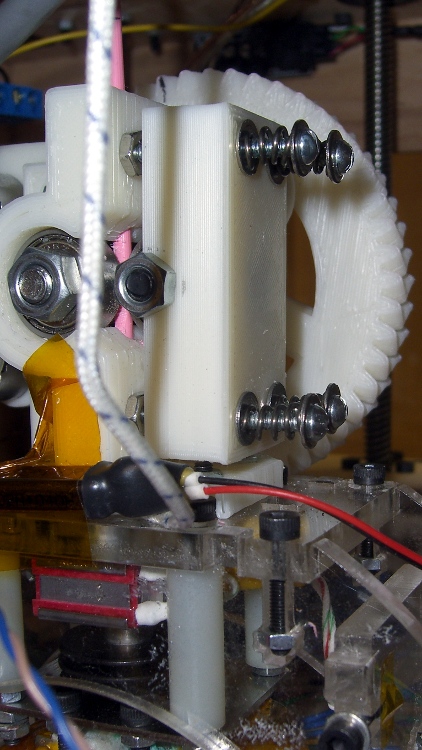
    You can see the two thermal switches near the bottom of the picture. The 100 °C switch is inside the acrylic frame on the Thermal Riser, the 40 °C switch is just taped to the filament tensioner’s base. The former is OK, the latter isn’t as secure as it should be. FWIW, Riser temperatures run around 70 °C during normal extrusion, albeit in a chilly Basement Laboratory without covers on the TOM’s windows.

    A better view of the shaft bearings and filament position:

    Filament tensioner - overview
    Filament tensioner – overview

    The four long screws are 1.5 inch 4-40 from my heap, although 2 inch screws would give more room for adjustment. Some folks mount the screws the other way around, with the nuts pressing on the springs and little knobs on the nuts. I gave up on the washers to get a bit more adjustment range.

    The springs came from my Big Box o’ Little Springs, sporting absolutely no pedigree at all. They’re not quite completely compressed, so there’s a bit of push left in them to handle filament diameter variations (which is the whole point of this exercise). I added four nuts (between the shaft bearing plate and the idler block) to keep the idler block from resting against the drive gear when there’s no filament in place: inserting a new filament became much easier.

    Somewhat to my surprise, the entire filament drive gear assembly is free-floating and self-aligning within the housing:

    Filament drive gear detail
    Filament drive gear detail

    I enabled the option to put a 5 mm diameter cleanout hole in the bearing housing, which turned out to be absolutely essential for monitoring the location of the drive gear inside all the machinery. You can barely see the hole in the first picture, on the left side of the curved section.

    A floating shaft means the 7-tooth motor drive gear’s position must line up with wherever the 51-tooth filament drive gear happens to be. There’s not much room to adjust the motor gear, but a few iterations sorted out the proper number and placement of all the filament drive shaft washers, nuts, and bearings.

    Filament drive gear - shaft spacing
    Filament drive gear – shaft spacing

    You (well, I) really really must put a flat on the shaft and use full-strength Loctite to hold the setscrew in place. I used an all-thread M6x40 bolt because that’s what I had on hand, but a partially threaded M6x50 bolt would provide better support for the bearings, more clearance for the spacers, and look a lot better; it’d require a custom-turned bushing instead of the nut against the big gear, though.

    Flatted filament drive shaft
    Flatted filament drive shaft

    I initially used low-strength Loctite. Word: a loose drive gear setscrew can convince you that Skeinforge’s Reversal plugin isn’t working after you make many changes with worsening results. Those fast reversals loosen the setscrew in short order.

    The diameters of the 7- and 51-tooth herringbone gears determine the center-to-center distance between the motor shaft and the extruder shaft. Alas, two of the motor mounting bolts wind up directly behind the larger gear. I marked the gear adjacent to the bolt heads and drilled a hole that just barely admits the hex wrench:

    Stepper Extruder - motor mount access hole
    Stepper Extruder – motor mount access hole

    If you knew where that hole was supposed to be, you could print it right into the gear, but I haven’t a clue as to how you might algorithmically determine the precise location on the as-printed gears.

    The modified OpenSCAD source produces two recesses for the bolt head and nut, but I just applied an end mill to the head side of the finished idler block. There’s no room for the bolt head between the block and the motor mounting plate.

    Idler housing with recessed bolt
    Idler housing with recessed bolt

    Of course, I modified the OpenSCAD code along the way:

    • Changing the bearing size moved the base: use front_bearing_r in the routine that punches the holes
    • Add a complete outer surface on the idler block; I thought I might want a flat metal plate to distribute the stress.
    • Add bolt head / nut recesses for idler block pulley shaft
    • Include base_wall_h in the calculation for idler_max_h
    • Tweaked spacing to get idler bolt heads out of the walls
    • Extend motor wall rightward to cover all of the base plate
    • Adjust base hole positioning: -10 / +4.0, not -10 / +3.5
      • But not all instances of 3.5 must change, I think
    • Filament offset may need further tweakage
    • Other miscellaneous tweaks

    Not all of those changes made it to the printed object shown here; if I ever print another one, they’ll be included. Use at your own risk!

    The OpenSCAD source, which is almost entirely ScribbleJ’s work:

    //  MK5 Wade's-Style Tensioner
    // (C)2011, Christopher "ScribbleJ" Jansen
    //
    // Released under the BSD license.
    
    // Modifications: Ed Nisley - KE4ZNU - Mar 2011
    
    // Parametric Settings
    
    // INTERESTING OPTIONS
    // 1 = on, 0 = off
    extend_shaft = 1 ;		// 0 will allow a bridge over the front of the motor hole
    make_stepper_holes = 1;	// 1 will create mounting holes for a stepper mount.
    make_dc_holes = 0;		// 1 will create mounting holes for a MK5 DC motor.
    motor_shaft_supports = 1;	// 1 will create angle supports to the motor shaft. (See options below for support angle/size)
    generate_for_viewing  = 0;	// 1 creates the model suitable for viewing.  0 creates the model suitable for printing.
    
    cleaning_hole_d = 5;		// The diameter of a cleaning hole to punch.  (0 = no cleaning hole)
    cleaning_hole_r = cleaning_hole_d/2;
    cleaning_hole_angle = 75;	// Angle offset from 9 o'clock position (i.e. directly left)
    
    hole_protrusion = 0.05;	// surface clearance for holes and suchlike
    
    hole_windage = 0.4;			// allowance for small hole shrinkage
    
    // _r = radius, _d = diameter, _h = height
    
    // REAR BEARING = bearing closest to motor
    rear_bearing_d = 17.0 + hole_windage;
    rear_bearing_r = rear_bearing_d/2;
    rear_bearing_h = 6.0;
    
    // EXTRA SHAFT = include an extra length of motor shaft.  This is useful
    // for giving your idler bolts enough room depth-wise.
    extra_shaft = 5;
    
    // FRONT BEARING = bearing furthest from motor  (Technically, front bearing diameter must be >= than rear to print properly... so
    // there are many places in the code that we assume the front bearing is the largest d.
    front_bearing_d = 17.0 + hole_windage;
    front_bearing_r  = front_bearing_d/2;
    front_bearing_h = 6;
    
    // EXTRA FILAMENT = extend the length of the filament column.  This is useful
    // for giving your idler bolts enough room height-wise.
    extra_filament = 40;
    
    filament_margin = 3.0;	// How wide is shaft on either side of filament?
    filament_d = 4;			// How wide is filament shaft hole?
    filament_r = filament_d/2;
    
    // FILAMENT OFFSET = How far from the center of the motor axis your MK5 plastic pusher gear thingy
    // or hobbed bolt groove is.
    filament_offset = 6;
    
    // MOTOR WALL = "rear" wall of tensioner.
    motor_wall_h = 5;  		// thickness of wall
    motor_bolt_d = 3.0 + hole_windage;		// diameter of motor mounting bolts
    motor_bolt_r  = motor_bolt_d/2;
    motor_bolt_h = motor_wall_h;
    motor_bolt_hex_d = 6.3 + hole_windage;	// diameter of motor mounting bolt hex caps
    motor_bolt_hex_r  = motor_bolt_hex_d/2;
    motor_bolt_hex_h = 3;			// height of hex caps
    motor_dropbolts   = 2.0;		// distance to sink bolts into wall
    motor_boltmargin = 5;			// Distance to allow between bolts and edges of wall.
    motor_shaft_width = 5;			// How thick is the wall around the motor shaft?
    motor_shaft_support_width = 10;	// How thick are the motor supports (if any)?
    motor_shaft_support_angle = 0;	// if non-0, will create three supports spaced apart this many degrees.
    								// 0 creates a single support if enabled above.
    
    // 31 is distance from center to bolt holes... do not chang this without changing hardcoded numbers
    // in the motor bolt generating module.
    motor_wall_w = 31 + (motor_boltmargin * 2) + motor_bolt_d;
    motor_wall_d = 31 + (motor_boltmargin * 2) + motor_bolt_d;
    
    // IDLER BEARING = the bearing that holds the plastic against the hobbed bolt/MK5 plastic pusher.
    // You should include about an extra 2mm over your actual bearing measurements here so it can spin freely.
    idler_bearing_d = 19 + 3;
    idler_bearing_r  = idler_bearing_d/2;
    idler_bearing_h = 6 + 2;
    h_i = idler_bearing_h/2;
    idler_bearing_bolt_d = 5;	// This is the size of the bolt holding the bearing in place.
    idler_bearing_bolt_r = idler_bearing_bolt_d/2;
    
    idler_bolt_d = 3.0 + hole_windage;		// This is the size of the (4) bolts holding the idler block in place.
    idler_bolt_r  = idler_bolt_d/2;
    idler_bolt_margin = 4;	// How much room to allow between bolt holes and edge of block.
    idler_bolt_hex_d = 7.0 + hole_windage;
    idler_bolt_hex_r  = idler_bolt_hex_d/2;
    idler_bolt_hex_h = 5;         // Arbitrarily large to be sure to punch through supports/shaft.
    idler_dropbolts   = 2.0;           // Try negative numbers here to catch your nuts on the supports.
    
    idler_wall = 2.5;			// thickness of wall to left of idler bearing
    
    idler_recess_dia = 9.0 + hole_windage;		// recess idler shaft bolt head & nut
    idler_recess_r = idler_recess_dia/2;
    idler_recess_depth = 3.0;
    
    // BASE = the bottom part that bolts onto the hot end.
    base_wall_h = 6;		// How thick or tall is the base.
    base_h=base_wall_h;
    base_bolt_d  = 3.0 + hole_windage;		// Size of bolts used to hold base -- rest of base settings are same as motor wall settings above.
    base_bolt_r   = base_bolt_d/2;
    base_bolt_hex_d = 6.3 + hole_windage;
    base_bolt_hex_r  = base_bolt_hex_d/2;
    base_bolt_hex_h = 5;
    base_dropbolts = 1.5;
    base_boltmargin = 6;
    base_filament_offset_x = 6;
    
    // 30/14.0 is distance from center to bolt holes...
    // do not change this without changing hardcoded numbers
    //  in the base bolt generating module.
    base_w = 30 + (base_boltmargin*2) + base_bolt_r;
    base_d  = 14.0 + (base_boltmargin*2) + base_bolt_r;
    
    // base_z_extra is used for configurations where base wall or motor wall
    //  would be unprintable due to differential in height.
    // shrinks or grows the base to fit.
    base_z_extra = ((idler_bearing_h/2) + rear_bearing_h + motor_wall_h) - ((base_d/2) + 3.5);
    base_filament_offset_z = -3.5;  // How far the filament hole is from the bolts furthest from the motor.
    base_d_use = base_d + base_z_extra;
    
    // make up difference between bottom of wall and base... not really necessary but more support more better.
    motor_wall_extra = front_bearing_r + (extra_filament/2) + base_h - (motor_wall_d/2);
    
    // Calculate maximum space for idler block.
    idler_max_h = idler_bearing_d + extra_filament + ((-base_bolt_hex_h+base_dropbolts)*2) - base_wall_h;
    half_idler_max_h = idler_max_h/2;
    idler_bolt_y = half_idler_max_h - idler_bolt_r - idler_bolt_margin;
    
    //idler_max_w = .55 * idler_bearing_d;
    idler_max_w = idler_bearing_r + idler_wall;			// enforce wall thickness on right side
    
    idler_max_d = extra_shaft+front_bearing_h+idler_bearing_h+rear_bearing_h+((-motor_bolt_hex_h+motor_dropbolts)*2);
    half_idler_max_d = idler_max_d/2;
    idler_bolt_z = half_idler_max_d - idler_bolt_r - idler_bolt_margin;
    
    echo(str("Idler block size: ",idler_max_d," x ",idler_max_h," x ",idler_max_w));
    echo(str("Idler bolt spacing: ",2*idler_bolt_z," x ",2*idler_bolt_y));
    
    // This module generates the bolt pattern for the idler, trying to fill the maximum space available.
    module IDLERBOLTS()
    {
    	// echo(idler_bolt_r, idler_bolt_d, idler_max_d, idler_bolt_z, half_idler_max_d);
    	// echo(idler_bolt_r, idler_bolt_d, idler_max_h, idler_bolt_y, half_idler_max_h);
    
    	translate([idler_bolt_z,idler_bolt_y,0]) cylinder(r=idler_bolt_r, h=40);
    	translate([idler_bolt_z,-idler_bolt_y,0]) cylinder(r=idler_bolt_r, h=40);
    	translate([-idler_bolt_z,idler_bolt_y,0]) cylinder(r=idler_bolt_r, h=40);
    	translate([-idler_bolt_z,-idler_bolt_y,0]) cylinder(r=idler_bolt_r, h=40);
    
    	translate([0,0,-idler_bolt_hex_h])
    	{
    		translate([idler_bolt_z,idler_bolt_y,0]) cylinder(r=idler_bolt_hex_r, h=idler_bolt_hex_h,$fn=6);
    		translate([idler_bolt_z,-idler_bolt_y,0]) cylinder(r=idler_bolt_hex_r, h=idler_bolt_hex_h,$fn=6);
    		translate([-idler_bolt_z,idler_bolt_y,0]) cylinder(r=idler_bolt_hex_r, h=idler_bolt_hex_h,$fn=6);
    		translate([-idler_bolt_z,-idler_bolt_y,0]) cylinder(r=idler_bolt_hex_r, h=idler_bolt_hex_h,$fn=6);
    	}
    
    }
    
    // This module generates an idler block, filling the maximum space available.
    module IDLER()
    {
    	difference()
    	{
    		translate([0,0,(idler_max_w/2)-(.25 * idler_bearing_bolt_d)]) cube([idler_max_d, idler_max_h, idler_max_w], center=true);
    		translate([0,0,(-.5 * idler_bearing_bolt_r) + idler_max_w]) rotate([0,180,0]) IDLERBOLTS();
    		#rotate([0,90,0]) cylinder(h=idler_max_d+1, r=idler_bearing_bolt_r,center=true);
    		#rotate([0,90,0]) cylinder(h=idler_bearing_h, r=idler_bearing_r, center=true);
    		translate([(idler_max_d/2 - idler_recess_depth),0,0])
    		  rotate([0,90,0])
    		  #cylinder(r=idler_recess_r,h=(idler_recess_depth + hole_protrusion),$fn=10);
    		translate([(-idler_max_d/2 + idler_recess_depth),0,0])
    		  rotate([0,270,0])
    		  #cylinder(r=idler_recess_r,h=(idler_recess_depth + hole_protrusion),$fn=10);
    	}
    	echo(str("IDLER BEARING BOLT LENGTH REQUIRED (longer is OK): ", idler_max_d, "mm"));
    }
    
    // This module creates the motor shaft hole pattern.
    module MOTORSHAFT()
    {
    	// idler bearing
    	cylinder(h=idler_bearing_h, r=rear_bearing_r, center=true);
    	// front bearing
    	translate([0,0,h_i]) cylinder(h=front_bearing_h, r=front_bearing_r);
    	if(extend_shaft == 1)
    	{
    		translate([0,0,h_i]) cylinder(h=front_bearing_h+(extra_shaft/2)+50, r=front_bearing_r);
    	}
    	// rear bearing
    	translate([0,0,0 - h_i - rear_bearing_h - (extra_shaft/2) - motor_wall_h])
    		cylinder(h=         rear_bearing_h + (extra_shaft/2) + motor_wall_h, r=rear_bearing_r);
    
    	echo(str("MOTOR SHAFT/BOLT LENGTH REQUIRED (longer is OK): ", front_bearing_h+idler_bearing_h+rear_bearing_h+motor_wall_h+(extra_shaft/2), "mm"));
    	echo(str("MOTOR SHAFT LENGTH FROM REAR OF MOUNT TO FILAMENT:", motor_wall_h+(extra_shaft/2)+rear_bearing_h+(idler_bearing_h/2), "mm"));
    }
    
    // This module creates an MK5 mount motor hole pattern with optional hex insets for bolt heads/nuts.
    module MK5_MOTORHOLES(include_dc = 1, include_stepper = 1, include_hex = 1)
    {
    	// The hardcoded numbers in the module below are simply the coordinates of the motor holes,
    	// relative to the center of the motor shaft.
    
    	// STEPPER MOUNT HOLES
    	if(include_stepper == 1)
    	{
    		translate([15.5,15.5,-motor_dropbolts-hole_protrusion])	cylinder(r=motor_bolt_r, h=motor_bolt_h+(2*hole_protrusion));
    		translate([15.5,-15.5,-motor_dropbolts-hole_protrusion])	cylinder(r=motor_bolt_r, h=motor_bolt_h+(2*hole_protrusion));
    		translate([-15.5,-15.5,-motor_dropbolts-hole_protrusion])	cylinder(r=motor_bolt_r, h=motor_bolt_h+(2*hole_protrusion));
    		translate([-15.5,15.5,-motor_dropbolts-hole_protrusion])	cylinder(r=motor_bolt_r, h=motor_bolt_h+(2*hole_protrusion));
    
    		if(include_hex == 1)
    		{
    			translate([15.5,15.5,motor_bolt_h-motor_dropbolts-hole_protrusion])	cylinder(r=motor_bolt_hex_r, h=motor_bolt_hex_h + (2*hole_protrusion), $fn=6);
    			translate([15.5,-15.5,motor_bolt_h-motor_dropbolts-hole_protrusion])	cylinder(r=motor_bolt_hex_r, h=motor_bolt_hex_h + (2*hole_protrusion), $fn=6);
    			translate([-15.5,-15.5,motor_bolt_h-motor_dropbolts-hole_protrusion])	cylinder(r=motor_bolt_hex_r, h=motor_bolt_hex_h + (2*hole_protrusion), $fn=6);
    			translate([-15.5,15.5,motor_bolt_h-motor_dropbolts-hole_protrusion])	cylinder(r=motor_bolt_hex_r, h=motor_bolt_hex_h + (2*hole_protrusion), $fn=6);
    		}
    	}
    
    	// DC MOUNT HOLES
    	if(include_dc == 1)
    	{
    		// DC MOUNT HOLES
    		translate([0,-15.5,-motor_dropbolts])					cylinder(r=motor_bolt_r,h=motor_bolt_h);
    		rotate([0,0,-60])  translate([0,-15.5,-motor_dropbolts]) 		cylinder(r=motor_bolt_r,h=motor_bolt_h);
    		rotate([0,0,-120]) translate([0,-15.5,-motor_dropbolts])	cylinder(r=motor_bolt_r,h=motor_bolt_h);
    		rotate([0,0,-180]) translate([0,-15.5,-motor_dropbolts])	cylinder(r=motor_bolt_r,h=motor_bolt_h);
    		if(include_hex == 1)
    		{
    			translate([0,-15.5,motor_bolt_h-motor_dropbolts])					cylinder(r=motor_bolt_hex_r,h=motor_bolt_hex_h, $fn=6);
    			rotate([0,0,-60])  translate([0,-15.5,motor_bolt_h-motor_dropbolts]) 	cylinder(r=motor_bolt_hex_r,h=motor_bolt_hex_h, $fn=6);
    			rotate([0,0,-120]) translate([0,-15.5,motor_bolt_h-motor_dropbolts])	cylinder(r=motor_bolt_hex_r,h=motor_bolt_hex_h, $fn=6);
    			rotate([0,0,-180]) translate([0,-15.5,motor_bolt_h-motor_dropbolts])	cylinder(r=motor_bolt_hex_r,h=motor_bolt_hex_h, $fn=6);
    		}
    	}
    }
    
    // This module creates MK5 hot-end hole patterns with optional hex heads for the bolts/nuts.
    module MK5_BASEHOLES(include_MK5boltheads = 1, include_filament = 1, include_hex = 1)
    {
    
    	// The hardcoded numbers in the routine below are simply the coordinates of the base holes,
    	// relative to the filament hole.
    	if(include_filament == 1)
    	{
    		translate([0,0,100/4]) cylinder(r=filament_r, h=100,center=true);
    	}
    
    	translate([-15,4.0,-base_dropbolts-hole_protrusion]) cylinder(r=base_bolt_r,h=base_h+(2*hole_protrusion));
    	translate([-15,-10,-base_dropbolts-hole_protrusion]) cylinder(r=base_bolt_r,h=base_h+(2*hole_protrusion));
    	translate([15,4.0,-base_dropbolts-hole_protrusion]) cylinder(r=base_bolt_r,h=base_h+(2*hole_protrusion));
    	translate([15,-10,-base_dropbolts-hole_protrusion]) cylinder(r=base_bolt_r,h=base_h+(2*hole_protrusion));
    
    	if(include_MK5boltheads == 1)
    	{
    		translate([17,9.5,-hole_protrusion]) cylinder(r=3, h=4);
    		translate([17,-15.5,-hole_protrusion]) cylinder(r=3, h=4);
    		translate([-17,9.5,-hole_protrusion]) cylinder(r=3, h=4);
    		translate([-17,-15.5,-hole_protrusion]) cylinder(r=3, h=4);
    	}
    
    	if(include_hex == 1)
    	{
    		translate([-15,4.0,base_h-base_dropbolts-hole_protrusion]) cylinder(r=base_bolt_hex_r,h=base_bolt_hex_h+(2*hole_protrusion), $fn=6);
    		translate([-15,-10,base_h-base_dropbolts-hole_protrusion]) cylinder(r=base_bolt_hex_r,h=base_bolt_hex_h+(2*hole_protrusion), $fn=6);
    		translate([15,4.0,base_h-base_dropbolts-hole_protrusion]) cylinder(r=base_bolt_hex_r,h=base_bolt_hex_h+(2*hole_protrusion), $fn=6);
    		translate([15,-10,base_h-base_dropbolts-hole_protrusion]) cylinder(r=base_bolt_hex_r,h=base_bolt_hex_h+(2*hole_protrusion), $fn=6);
    	}
    
    }
    
    // This module generates the mounting part of the Wade's-style tensioner.
    // The generated item is centered on the motor shaft in X,Y and the filament in Z.
    module MOUNT()
    {
    
    	difference()
    	{
    
    	union()
    	{
    		translate([0,0,-1 * (motor_wall_h/2)])
    		{  // MOTOR SHAFT RELATIVE TO FILAMENT IN Z, MOTOR SHAFT IN X,Y
    			cylinder(h=front_bearing_h + idler_bearing_h + rear_bearing_h + extra_shaft + motor_wall_h, r=front_bearing_r+motor_shaft_width, center=true);
    			translate([base_filament_offset_x,0,0]) cube([filament_d + (2 * filament_margin),   front_bearing_d + extra_filament,  front_bearing_h + idler_bearing_h + rear_bearing_h + extra_shaft + motor_wall_h], center=true);
    
    			if(motor_shaft_supports == 1)
    			{
    				translate([0,0,(motor_wall_h/2)]) {
    				intersection()
    				{
    					cylinder(	h=front_bearing_h + idler_bearing_h + rear_bearing_h + extra_shaft,  r1=(motor_wall_w/2),  r2=front_bearing_r+motor_shaft_width, center=true);
    					rotate([0,0,90]) translate([0,50,0]) cube([motor_shaft_support_width, 100, front_bearing_h + idler_bearing_h + rear_bearing_h + extra_shaft], center=true);
    				}
    				intersection()
    				{
    					cylinder(	h=front_bearing_h + idler_bearing_h + rear_bearing_h + extra_shaft,  r1=(motor_wall_w/2),  r2=front_bearing_r+motor_shaft_width, center=true);
    					rotate([0,0,90-motor_shaft_support_angle]) translate([0,50,0]) cube([motor_shaft_support_width, 100, front_bearing_h + idler_bearing_h + rear_bearing_h + extra_shaft], center=true);
    				}
    				intersection()
    				{
    					cylinder(	h=front_bearing_h + idler_bearing_h + rear_bearing_h + extra_shaft,  r1=(motor_wall_w/2),  r2=front_bearing_r+motor_shaft_width, center=true);
    					rotate([0,0,90+motor_shaft_support_angle]) translate([0,50,0]) cube([motor_shaft_support_width, 100, front_bearing_h + idler_bearing_h + rear_bearing_h + extra_shaft], center=true);
    				}
    				}
    			}
    		}
    
    		translate([0,motor_wall_extra/-2,((motor_wall_h/-2) + rear_bearing_h+(extra_shaft/2)+motor_wall_h+(idler_bearing_h/2)) * -1])
    		{ // MOTOR WALL RELATIVE TO MOTOR SHAFT X,Y
    			  union() {
    				cube([motor_wall_w, motor_wall_d+motor_wall_extra, motor_wall_h], center=true);
    				translate([base_filament_offset_x - (motor_wall_w - base_w)/2 + motor_wall_w/4,0,0])
    				  cube([motor_wall_w/2,motor_wall_d+motor_wall_extra, motor_wall_h],center=true);
    			  }
    		}
    
    		translate([filament_offset, -1* (front_bearing_r + (extra_filament/2) + (base_h/2)), base_filament_offset_z])
    		{  // BASE RELATIVE TO FILAMENT HOLE IN Z,X
    			translate([0,0,-(base_z_extra/2)])
    			  cube([base_w, base_h, base_d_use], center=true);
    			// extend filament shaft
    			translate([0,(front_bearing_d + extra_filament + base_h)/2, 0])
    			  cube([filament_d + (2 * filament_margin), front_bearing_d + extra_filament, base_d], center=true);
    		}
    
    	}
    
    	// Punch motor holes
    	translate([0,0,-1*((idler_bearing_h/2) + (rear_bearing_h) + (motor_wall_h) + (extra_shaft/2))])
    	  # MK5_MOTORHOLES(include_stepper=make_stepper_holes, include_dc = make_dc_holes);
    	// Punch motor shaft
    	MOTORSHAFT();
    	// Punch idler bolt holes
    	translate([filament_offset - filament_margin - (filament_r) + idler_dropbolts,0,0])
    	  rotate([90,90,90]) # IDLERBOLTS();
    	// Punch baseplate holes
    	translate([filament_offset, -1* (front_bearing_r + (extra_filament/2) + base_h), 0])
    	  rotate([-90,180,0]) # MK5_BASEHOLES();
    	// Punch idler bearing clearance
    	translate([filament_offset + idler_bearing_r - filament_r, 0,0])
    	  cylinder(h=idler_bearing_h + front_bearing_h + rear_bearing_h + extra_shaft + hole_protrusion, r=idler_bearing_r, center=true);
    	// Punch cleaning hole
    	rotate([-1 * cleaning_hole_angle,-90,0])
    	  cylinder(h=50,r=cleaning_hole_r);
    
    	}
    }
    
    if(generate_for_viewing == 1)
    {
    	MOUNT();
    	translate([filament_offset + idler_bearing_r,0,0]) rotate([0,90,0]) IDLER();
    }
    else if(generate_for_viewing == 0)
    {
    	translate([15.5+motor_boltmargin+motor_bolt_r+2.5,    0,   (motor_wall_h+(extra_shaft/2)+rear_bearing_h+(idler_bearing_h/2))]) MOUNT();
    	translate([(idler_max_d/-2)-2.5, 0, (-.5 * idler_bearing_bolt_r) + idler_max_w]) rotate([180,0,0]) IDLER();
    }


    Just. Do. It.

  • Thing-O-Matic: Manual Wipe and Splodge

    The first step of a good print requires nailing the extrusion to the build platform. The Skeinforge Splodge plugin seems to thicken the first part of each filament on the first layer, which is not helpful. So I turned that off and added a few lines to start.gcode that do a much better job.

    I also disabled the Wipe plugin, because you really can’t wipe the nozzle after the first few layers without having some part of the Z stage clobber the object. Rather than enable Wipe for just the first layer, I put a manual wipe in start.gcode, too.

    The relevant sections look like this; they fit after the homing sequence at the end of the file:

    (--- manual wipe ---)
    G0 X54 Y-57.0 Z15	(move above wipe start)
    G0 Z8   			(down to wipe level)
    M6 T0				(wait for temperature settling)
    M101				(Extruder on, forward)
    G4 P4000			(take up slack, get pressure)
    M103				(Extruder off)
    G4 P4000			(Wait for filament to stop oozing)
    G0 Y-40				(wipe nozzle)
    (--- manual splodge)
    G0 X-50 Y-55		(to front left corner)
    G1 Z0.50			(just over surface)
    M108 R2.0			(set stepper extruder speed)
    M101				(start extruder)
    G4 P2000			(build up a turd)
    

    Depending on a myriad imponderable factors, the manual wipe sequence flips off either a huge tangle or a tiny strand. That’s why I used a 4 second delay: it’s long enough to leave the extruder pressure in a consistent state no matter how it starts.

    The manual splodge location depends on your platform layout; I’m thinking of putting it entirely outside the build area. It must be somewhere near the front left corner, because Skeinforge starts each new layer from that direction. Two seconds of extrusion at 2 rev/min forms a blob with a generous contact patch, although the nozzle must plow through the side on its way out.

    Note that I leave the extruder running at the end of start.gcode, which means that it’s printing all the way to the outline. That won’t interfere with any part of the object, because (by definition) the first layer of the object lies entirely within the outline.

    The Outline plugin puts a single filament around the entire object, allowing me to measure the actual nozzle height and extrusion width on the first layer. More on that later.

    The final result looks like this:

    Manual Splodge with Companion Cube
    Manual Splodge with Companion Cube

    Notice that the splodge turd isn’t firmly glued to the platform, but the thread leading to the outline sticks like it was glued and the outline comes out perfectly formed. That’s the whole idea in a nutshell: paste the thread down from a stationary nozzle, then start moving with the turd acting as an anchor.

    Trying to start pasting the filament with the nozzle moving doesn’t work well, as witness the left edge of the outline around these test pieces:

    ABS coating on aluminum build plate
    ABS coating on aluminum build plate

    Admittedly, that was with a DC extruder, but the same principle applies to stepper extruders.

  • MK5 Extruder: Thermal Riser Temperatures – Operating

    Thermal Switches in place
    Thermal Switches in place

    My Parts Heap disgorged a somewhat larger TO-5 heatsink (a Thermalloy 228B, which they no longer make) with three fins and a collar having enough spring to fit tightly around the Thermal Riser Tube. It was intended for transistors on PCBs with horizontal air flow, but I hoped it would be more effective than the smaller heatsink that comes stock with the TOM.

    There’s certainly some air flow through the heatsink at the top of the arches, but I have no way of measuring that. The picture there shows another, much flatter, heatsink that I’d been using to cool the Thermal Riser after I found out how hot it was getting near the top.

    This heatsink didn’t get a thermocouple mount epoxied to it and, given my experience with the first set of measurements, I didn’t bother stuffing a thermocouple between the fins.

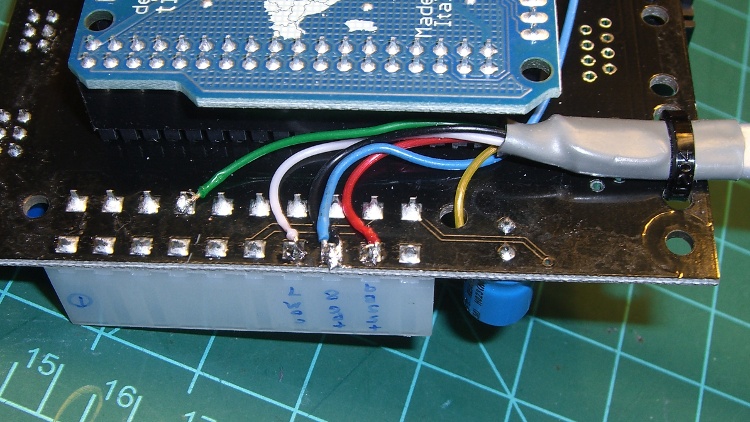
    The Thermal Switch Block now has a 100 °C NC Thermal Switch epoxied to it and, barely visible to the lower right, a 40 °C NO Switch is taped to the Z stage in the corner of the acrylic support base. The switch cable looks like this:

    Themal Switches - prepped and mounted
    Themal Switches – prepped and mounted

    With the meter’s T1 thermocouple bead behind the 40 °C switch and T2 tucked into the Thermal Switch Block, the results look thusly:

    Thermal Riser and Z stage Temperature Graph - block top
    Thermal Riser and Z stage Temperature Graph – block top

    The core went to 220 °C this time, with the ABP at 120 °C, and I started extruding at 20 minutes when the temperature had stabilized. The Switch Block temperature promptly dropped 6 °C as room-temperature filament entered the top of the Thermal Riser Tube at 2 rev/min × 10 cm drive dia × π = 63 mm/min ≈ 1 mm/sec.

    The previous test showed that the Thermal Switch Block stabilized at 90 °C and I think this one will be about the same, despite the larger heatsink, although the while-extruding temperature hovers around 70 °C. That’s better than 90 °C, so I’ll keep monitoring it and see how it plays in warmer weather inside a cozy build chamber. Obviously, having the Extruder ram cool filament into the Thermal Core holds the temperature down.

    Given those numbers, a 110 to 120 °C NC switch would be better; I’m sure one will eventually appear in my usual surplus sources. With a 30 °C margin and an assumed rise of 7 °C per 25 °C Thermal Core increase, the switch will trip when the Core passes 225 + (4 × 25) = 325 °C. That’s rather toasty, but the alternative seems to be having a switch that kicks out on a hot day.

    As expected, the Z stage temperature passed 40 °C at 10 minutes and the (yellow) Low Overtemperature LED blinked on. I wasn’t too surprised at that; the previous test had a cold ABP. I’ll move that switch to the top of the acrylic arch, taped against the base of the Filament Drive frame where it can measure the effect of the Thermal Riser on the plastic base. That picture shows the potential for high temperatures at that spot.

    The original data:

    Thermal Riser and Z stage Temperatures - block at top
    Thermal Riser and Z stage Temperatures – block at top
  • Thing-O-Matic / MK5 Extruder: Thermal Switch Block

    Thermal Switch Block on Thermal Riser
    Thermal Switch Block on Thermal Riser

    The best place to mount a thermal switch (or a thermal sensor, depending on how much you trust your circuitry) is on the MK5 Thermal Core, but that’s far too hot for the switches I have in hand. As a compromise, I decided to mount the switch on the Thermal Riser tube leading vertically upward to the Filament Drive gear: good thermal contact, a solid mount, and out of harm’s way.

    All the alternative locations seem worse. Tucking it inside the insulation wrap doesn’t provide a solid mechanical mount, so you don’t get a repeatable position and the leads get bent every time you move something. Bolting it to the plate over the Core looks solid, but that’s just a flat sheet of metal with four screws connecting it to the Core: no real thermal contact surrounded by lots of cooling air.

    One good omen: with an operating temperature well under 100 °C, JB Industro Weld epoxy will work fine and eliminate any need for fussy clamps and fittings.

    So I sawed off a random chunk of aluminum plate, squared it up in the Sherline mill, and poked a few holes in it. This doodle has dimensions roughly equivalent to the final object, but absolutely nothing is critical other than the 5/16 inch central hole:

    Switch block sketch
    Switch block sketch

    The 4-40 setscrew secures the block to the Thermal Riser. Aluminum expands considerably more than stainless steel, so I dropped a snippet of PTFE wire insulation into the hole as a rubberdraulic plunger.

    The lug on the top provides strain relief for the wires; it’s not an electrical connection. The modular phone cable trailing off to the Thermal Cutout box has wires insulated with low-temperature plastic, so a few inches of Teflon hookup wire keep them out of the Danger Zone.

    The small hole is just big enough for a thermocouple bead.

    This is what the thing eventually looked like, but I made some measurements before sticking that switch in place:

    Themal Switches - prepped and mounted
    Themal Switches – prepped and mounted

    Up next: measurements!

  • Thing-O-Matic Stepper Extruder: First Steps

    Over the past few weeks I’ve printed the gears and plate from TheRuttmeister’s Coloso-Gear MK5 extruder Thing and flatted the shaft on a moderately husky (but not hyperthyroid) NEMA 17 stepper motor. While tearing the Thing-O-Matic down to add thermal switches to the Extruder Head, I converted the MK5 Filament Drive into a stepper extruder. Much to my astonishment, when I plugged the cable in and fired up ReplicatorG … It Just Worked!

    Even more amazing: the first pinout arrangement turned the motor in the correct direction!

    Coloso-Gear Stepper Extruder
    Coloso-Gear Stepper Extruder

    Some nasty pincushion distortion makes the larger gear look misaligned, but it’s parallel to the mounting plate and correctly engaged with the drive gear.

    The motors arrived with short stubs of thin yellow wire on the IDC motor connectors, which I soldered directly to a much longer cable. The Parts Heap disgorged a chubby 8-conductor signal cable; I used pairs of wires for each motor connection, although one conductor would have entirely enough copper. The two cable ties around the motor prevent flexing those delicate wires as the Z stage moves.

    Two tweaks to the MK6 Stepstruder profile in thingomatic.xml produced the right answers:

    • Set motor_steps = 1456
    • Set stepspermm = 48.2

    Running the motor at 2.0 rpm for 30 sec should produce exactly 1 revolution of the big gear. I marked and counted the teeth on the larger gear as it rotated, and came up with 56 teeth. It’s a 51 tooth gear, so reducing the default 1600 steps/rev by 51/56 produces 1457. A defunct MBI stepper driver board that now only does full steps provides power; I resoldered all the chip pins and the fault isn’t due to external causes like no-lead solder.

    Then run it for 60 seconds at 2.0 rpm and it’s under by maybe 1/10 of the tooth-to-tooth spacing. Adjust 1457 x 101.9/102 = 1456. Run it for another minute and it’s spot on.

    I measured 60.45 mm for two revolutions of the big gear, so it’s 30.23 for one rev, which requires the aforementioned 1456 steps. Averaging more revolutions would yield more digits, but given the rubbery nature of molten filament, three significant figures seems entirely sufficient. I suspect this depends greatly on how deeply the extruder drive embosses the filament, so it’ll require some fine tuning.

    Back of the envelope for the DC extruder at 255 PWM: feed = 45 mm/s, 0.35 mm thickness, w/t = 1.7 = 0.56 mm width gives 6.9 mm3/s. The filament is about 2.9 mm dia = 6.6 mm3, so it passed through the extruder at a bit over 1 mm/sec. There’s some windage involved in all those numbers and the extruding rate obviously depends on the temperature.

    The stepper (from the usual eBay seller) is a Minebea 17PM-K150, which doesn’t appear in their catalog listing, so it’s likely one of their many custom motors. The stack length resembles the 17PM-K3xx series, which means roughly 1 A rated current. Setting the driver current to 500 mA (VREF = 1 V) produces enough torque that I cannot pull the filament back hard enough to stop it.

    The step rate at 2 rpm is:

    48.6 step/s = (2 rev/min) x (51/7) x (1 min/60 s) x (200 step/rev)
    

    At that lethargic pace, the K3xx motors have something like 0.250-0.300 N·m of torque at rated current. At half current, call it 0.100 N·m and multiply by 51/7 to get 0.700 N·m = 100 oz·in.

    The effective drive diameter is 30.23/π = 9.6 mm, so the available force on the filament is 0.7 N·m / 0.01 m = 70 N ≈ 7 kgf = 15 lb. Yeah, but that little 7-tooth gear will snap right off …

    The reversal plugin cranks the big gear backwards at 35 rpm, which works out to 850.5 step/s. That ought to work, particularly seeing as how it’s not actually pushing anything.

  • Thing-O-Matic: Flatting Motor Shafts

    The NEMA 17 steppers I picked up from eBay as part of the stepper extruder upgrade project have round shafts; that’s not surprising, as they came with pressed-on timing gear pulleys. In their new application they’ll sport plastic herringbone gears and those have setscrews.

    Herringbone gears with nut inserts
    Herringbone gears with nut inserts

    Both nuts have epoxy potting to prevent moving / rotating under duress. Remember to load the screw threads with beeswax and run it all the way through before you pot the nuts, lest the screw become one with the nut. Yes, the left gear fits a NEMA 23 stepper.

    (Those are 14-tooth gears. I’ll actually use a 7-tooth gear, but I printed a bunch of gears to get the hang of it.)

    Any time you tighten a setscrew on a motor shaft, it’ll raise a burr on the shaft. You can pull a plastic / printed gear off a ruined shaft because the burr will simply carve a gash through the plastic. A metal-hub gear or pulley will jam solid on the burr; you definitely don’t want that to happen.

    The solution, which comes standard on many motor shafts, is a flatted section where the screw can raise a burr without causing a problem. In addition, the flat prevents the screw from sliding around the shaft and producing a circular scar that makes the gear impossible to remove.

    Adding a flat requires a few minutes of Quality Shop Time, but will save you considerable hassle later on. Just Do It!

    Mummify the motor in masking tape to keep grinding grit and metallic dust out of the shaft bearings, then grab the shaft in a smooth- or soft-jaw vise. I grabbed a machinist’s vise in the bench vise, but use what you have.

    Masked motor in vise
    Masked motor in vise

    Apply a Dremel grinding stone / cutoff wheel along the shaft to produce a flat about the same width as the tip of the screw. The object of the game is to make the flat wide enough to keep the burr on the flat, but not grind half the shaft away.

    Don’t grind the shaft without clamping it, because the vibration will destroy the bearings. Clamp the shaft to stabilize it and isolate the motor, then do the grinding.

    Flatted shaft with screw
    Flatted shaft with screw

    Here’s the shaft after installing & removing the gear. Notice the burr:

    Flatted shaft with screw scar
    Flatted shaft with screw scar

    And a detail of the burr:

    Flatted shaft scar - detail
    Flatted shaft scar – detail

    It’s not like I’m over-tightening the screw, either: that’s what a hardened screw does to a soft motor shaft.

  • Building an LED Floodlight Into a Task Lamp

    Building an LED Floodlight Into a Task Lamp

    LED Gooseneck Floodlight
    LED Gooseneck Floodlight

    Eks forced me to take a pile of crap useful make-froms, including a gooseneck task lamp that was probably bolted onto a machine tool in its former life. It sported a 20 W halogen bulb, but looked to be just about exactly the right size for those LED floodlights, which is why I didn’t put up much of a fuss about taking it off his hands.

    The LED lamps are much bigger than the halogen bulb, but they fit neatly into the housing diameter. All they needed was a bit more front-to-back room, which looked a lot like a chunk of PVC pipe. The housing screws together with a 1.5 mm thread that I can’t produce on my inch lathe; I’m still not set up for thread milling. This being a low-stress application with a lamp that ought to outlast me, I figured I’d just make the belly band slip-fit the two threads, glue it in place, and move on.

    I sawed off a length of PVC pipe, faced off the ends in the lathe, then CNC milled a recess to clear the male threads on the gooseneck part (I hate precision boring in the lathe). Given the rather tenuous grasp of that 3-jaw chuck, I made two passes around the perimeter: pipe ID 52.1, thread OD 54.5, remove 1.2 mm all around, about 9 mm down.

    Milling top recess
    Milling top recess

    On the other end, the female thread ID = 52.2 and the pipe ID = 52.1, so I glued another ring of PVC pipe inside to provide enough meat to turn it down. Once again, saw off a ring, face the ends, then cut out a segment so that the OD circumference of the inner ring is just slightly smaller than the ID circumference of the outer pipe. The result looked like this:

    PVC insert sizing
    PVC insert sizing

    Apply a heat gun to the inner ring until it’s soft enough to stuff into the pipe, clamp it until it hardens, apply PVC cement, and clamp overnight. Contrary to appearances, the ends of the two pipes are flush at the surface. Once again, you cannot have too many clamps:

    Clamped PVC insert
    Clamped PVC insert

    Turning down the outside to fit the threads shows just how little meat was left on that pipe:

    Skinning down to the insert
    Skinning down to the insert

    While it was chucked up (and despite my dislike of boring) I bored a bevel to accept the LED lamp and adjusted the OD so the lamp fit snugly between the end of the belly band and the lens holder on the front of the housing:

    Floodlight in holder
    Floodlight in holder

    The switch comes from the Parts Heap. A D drill puts a slightly undersized hole that’s just right for the threaded switch; I simply turned it in by hand. A length of zip cord carries the power up the gooseneck, where various ends get soldered to the switch and lamp.

    I applied some hot-melt glue to the threads and pushed everything together:

    Finished LED Floodlight
    Finished LED Floodlight

    The glass lens on the front fits in a molded holder with an annular air gap. The LED lamp housing has all those fancy cooling fins against the inner pipe, so there’s a bit of cooling air flow around the lamp and out through the rear black section. A thermocouple reports the lamp temperature gets up around 75 °C in a 14 °C shop; a 50 °C rise might be a tad warm in the summer, but we’ll see what happens.

    The power supply came from the Parts Heap: a 12 V 1 A wall switching power supply in the shape of a wall wart. For now, the zip cord from the lamp terminates in a coaxial power jack that (amazingly enough) fits the wart’s connector, but I’ll eventually put a box in there somewhere.

    Clamped the butt end of the gooseneck to the backsplash on the countertop under the mill and It Just Works!