Ed Nisley's Blog: Shop notes, electronics, firmware, machinery, 3D printing, laser cuttery, and curiosities. Contents: 100% human thinking, 0% AI slop.
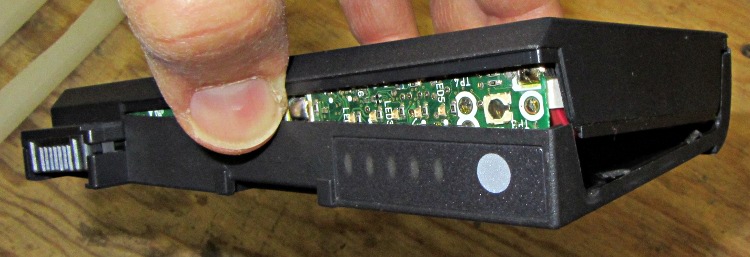
Crunching the battery case in the bench vise, plus a bit of screwdriver prying, did the trick:
Cracked-open Dell 75UYF battery
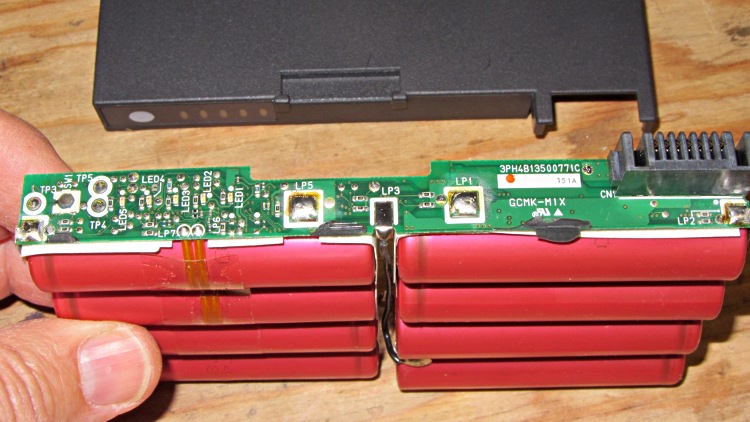
Peeling the case off revealed the eight lithium cells and the protective PCB:
Dell 75UYF battery contents
As you’d expect, each pair of cells has an individual contact to the PCB for monitoring and equalizing, which simplifies connecting the battery tester.
The case emerged from its ordeal with only superficial damage, so it’s now back in the laptop to fill up the slot. I tucked the PCB inside, although I doubt I’ll ever rebuild the battery with new cells.
Our Larval Engineer has begun writing the Arduino code (Baby’s First Real Program!) that will control ground effect lighting on her longboard, with RGB LED colors keyed to the wheel rotation speed. Her back of the envelope says the wheels spin at about 60 rev/s (= 17 ms/rev) at 30 mph, which rules out mechanical / reed switches; some experimentation with a simple mechanical switch showed why the Arduino bounce library is a Good Thing even for pushbuttons.
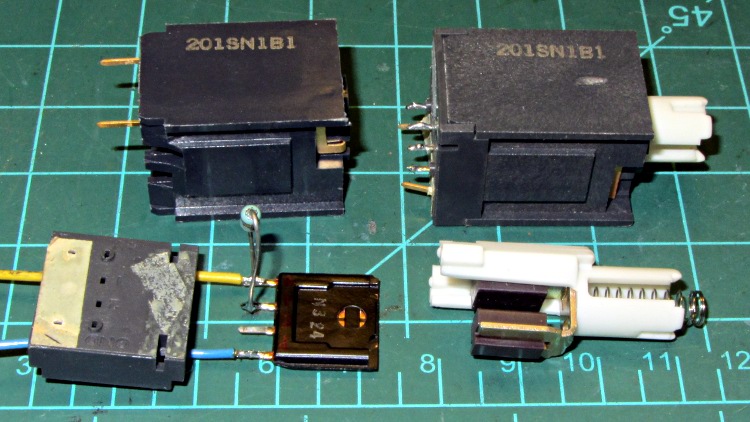
Some rummaging produced a collection of these Hall effect switches:
201SN1B1 Hall Effect Switch Components
I thought they were ordinary keyboard switches, but noooo… Honeywell 201SN1B1 switches turn out to be Mil-Spec items, with brethren serving in B-52 bombers, F-16 fighters, and even long-departed Peacekeeper ICBMs (most likely in the ground support equipment). There are no data sheets at this late date, but this compressed specs burst gives some hints:
General Characteristics Item Description: Switch body 1.060 in. l; 0.740 in. h; 0.740 in. w; hall effect solid state switching; alternate action; 5V dc; 9 ma.; operated at 0.4V dc max.; sinking 4 ma. per output; pulse output; printed circuit terminals
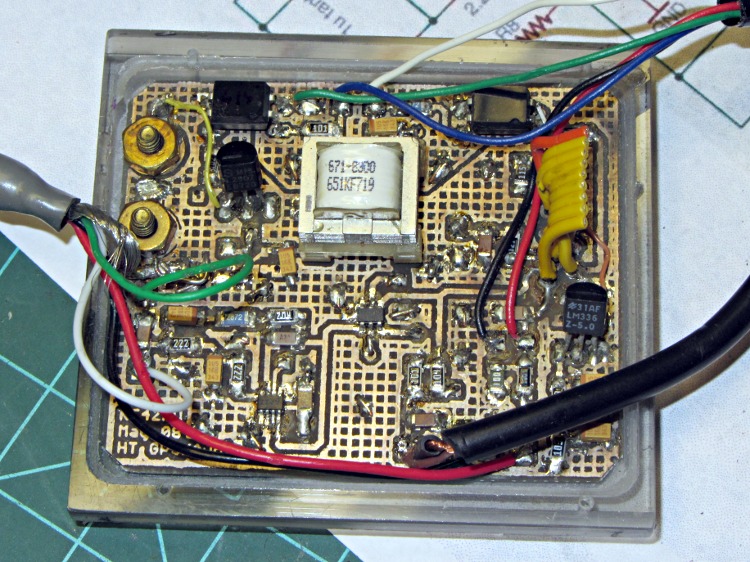
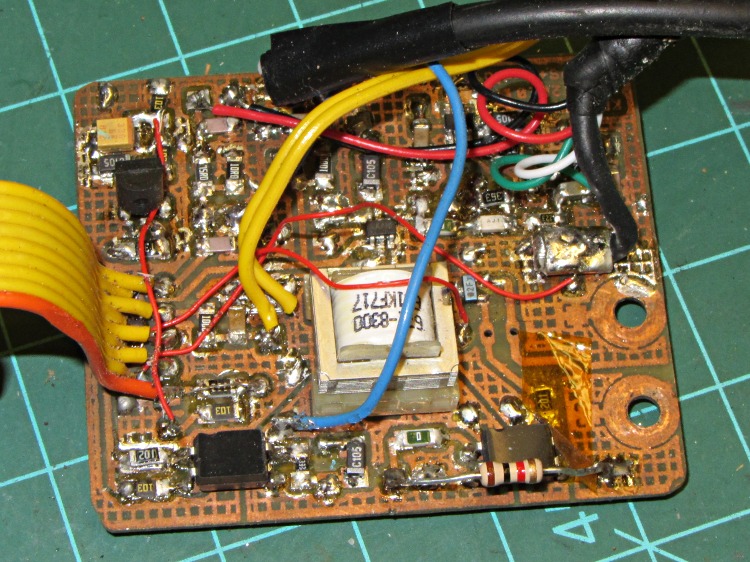
A gentle twist of a small screwdriver under the plastic latches releases the base plate and frees the Hall effect switch module, which is the square black plate above. It contains an IC (downward in the picture) with wire-bonded leads embedded in a flexible silicone seal that has pale gray smudges on its surface:
201SN1B1 IC – Overview
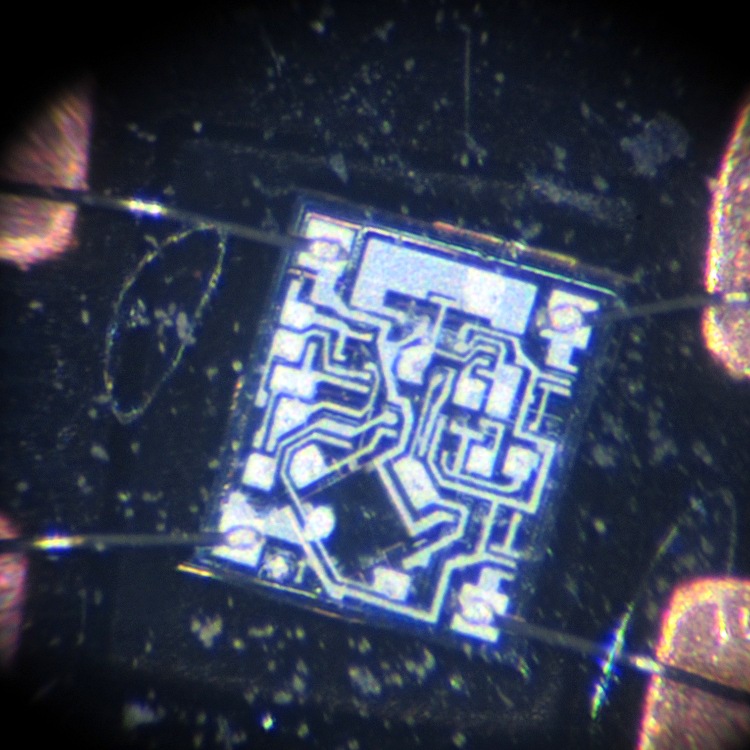
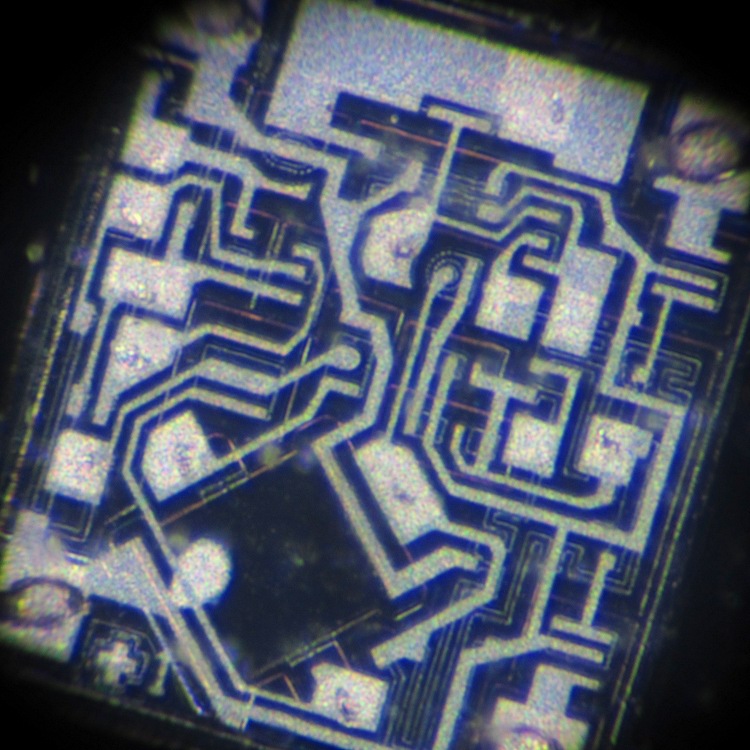
A closer look at the IC shows actual components:
201SN1B1 IC – Detail
That’s from back when you could see components on an IC…
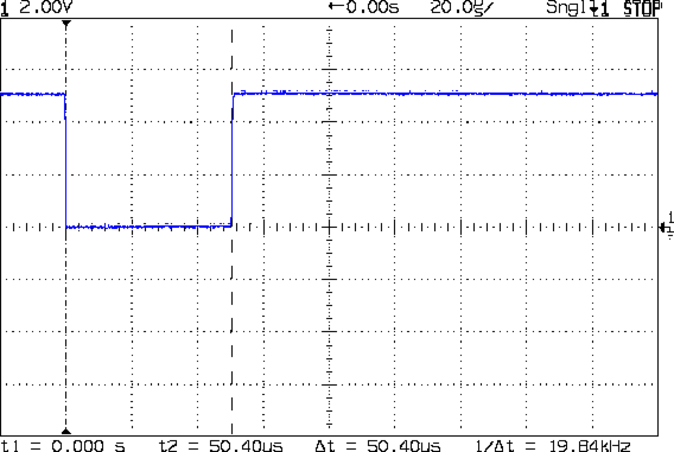
I soldered wires to the +V and Gnd pins, plus a 10 kΩ pullup resistor to one of the two output pins, applied 5 V from the bench supply, then waved a small neodymium magnet nearby:
201SN1B1 Switch Output
The two output pins appear to produce separate-but-equal 50 µs output pulses that are completely independent of the magnet’s proximity, speed, and polarity, which is a Nice Touch. The IC draws about 10 mA when inactive and 12 mA with the magnet nearby.
The form factor seems a bit awkward for a longboard wheel sensor, but it’ll get her closer to the goal. Most likely, it’ll wind up embedded in an epoxy block strapped to one of the wheel trucks.
The Arduino’s Bounce update function / method / whatever has a polled view of the input pin, which means that if you don’t call it during that 50 µs pulse you’ll completely miss that revolution. Sooo, the pulse must go into one of the Arduino’s external interrupt pins, which can catch short pulses with no trouble at all if you write a suitable interrupt handler.
Somewhere I have a handful of Hall effect motor commutation sensors, but they have an internal latch that requires alternating magnetic poles to switch the output, thus requiring two magnets halfway around the wheel circumference. Haven’t figured out how to embed the magnets in the wheels or mount the sensors, but …
Here’s a great example of painting yourself into a corner…
Back in the day, I made a voice-only interface that adapted a helmet-mounted electret mic and earbud to an ICOM IC-Z1A HT. A pair of those let us talk companionably as we rode along.
Along comes our daughter, with her shiny-new Technician amateur radio license. I took an early version of the Z1A interface board, force-fitted it into an early version of the machined case that lacked a top, acquired an ICOM W32A HT and another TT3+, did some tweakage, and defined the result as Good Enough. Time passes, she’s promoted to Larval Engineer, goes off to college, and leaves the bike behind (a faired Tour Easy is ill-suited to being left out in the rain and is not a dorm-room-friendly bike).
Knowing that the Z1A on my bike is failing, I get a Wouxun KG-UV3D HT and modify the Z1A interface to match. Then I build an interface PCB for the KG-UV3D, conjure up a nice case (which is why I bought a 3D printer), chop the TT3+ out of the W32A lashup, put everything together, and it’s all good.
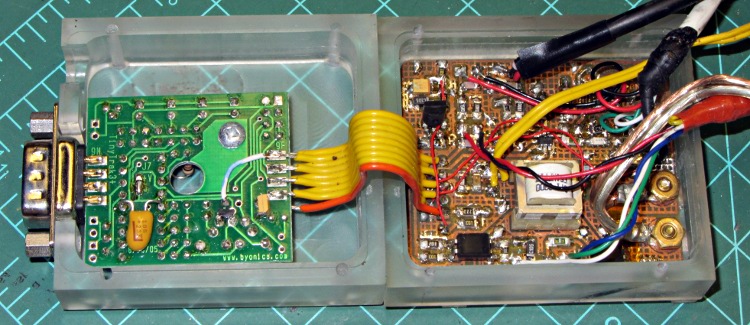
Here’s the carcass of the W32A interface in its half-case:
W32A PCB in case
Whereupon our Larval Engineer returns from college and once again needs a radio for her bike. At that point:
The W32A interface now lacks its TT3+.
The W32A PCB doesn’t fit in the Z1A case
The Z1A interface that would fit the W32A radio has the KG-UV3D modifications.
The Z1A radio has failed completely; it no longer even turns on.
Some alternatives:
Get another KG-UV3D, build another interface PCB + case, make it work
Transplant the TT3+ back to the W32A interface
Undo the KG-UV3D mods from the Z1A interface, put it on the W32A
Given that she’s going to vanish in another three months, tops, Choice 1 is out. Although the transplant in Choice 2 seems straightforward, it requires tedious soldering and produces an interface in a partial case.
So Choice 3 it is…
The Z1A board with the KG-UV3D modifications started out like this:
Z1A PCB modified for Wouxun KG-UV3D
Un-modified again and back in its machined case:
Z1A board minus mods – milled case
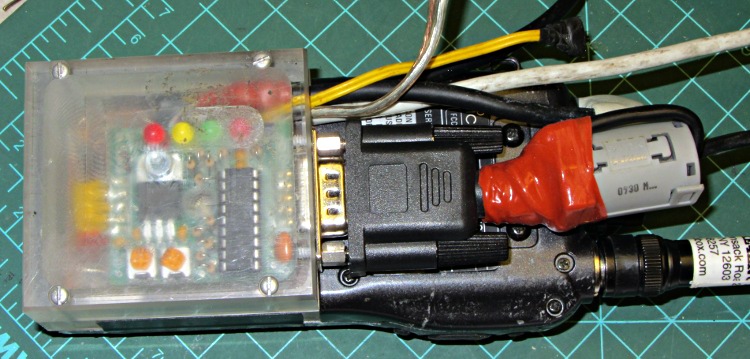
Buttoned up and ready to roll:
Z1A board on W32A – ferrite core
I put a clamp-on ferrite tumor around the GPS receiver cable to keep RF out of the TT3+, which seems quite sensitive to RFI; the poor thing locked up quite dependably on the bench with 5 W into a long rubber duck antenna, but not into a dummy load. The mobile antenna sits relatively far from the radio on the bike, but I think the TT3+ had problems in the early KG-UV3D lashup.
The TT3 audio level will probably require adjustment, as I’d cranked it up for the KG-UV3D, but that will require some on-the-air testing. Ditto for mic level.
When I get a KG-UV3D for Mary’s bike, I’ll buy two radios and build two interfaces, so as to finally have a working radio + interface on the shelf.
I’m mildly tempted by the new Yaesu VX-8GR, but that’s over $350 for a radio that also requires a new interface board design, a new case design, a new set of adapters, and other odds&ends. Not to mention that the radio’s built-in GPS antenna would live at the bottom of the seat frame beside the wheel and below my shoulder. I suppose I could conjure up an entirely new radio mount, but … the deterrents seem overwhelming.
Various versions of the schematics & PCB layouts for all those boards, plus solid models for the 3D printed case, are scattered here & there on other posts.
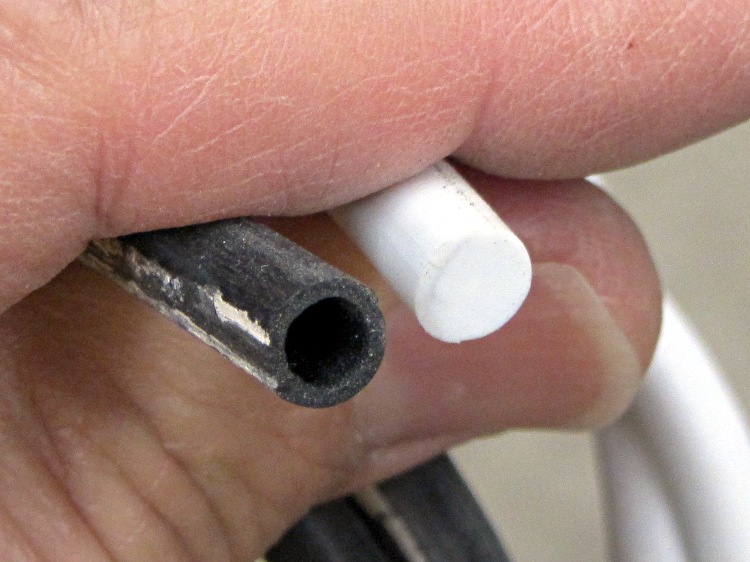
While doing something else, I rediscovered the fact that common 5 gallon plastic bucket lids have an O-ring gasket that seals against the top of the bucket. Some seals are hollow tubes, some are solid rods:
5 gallon can lid gaskets
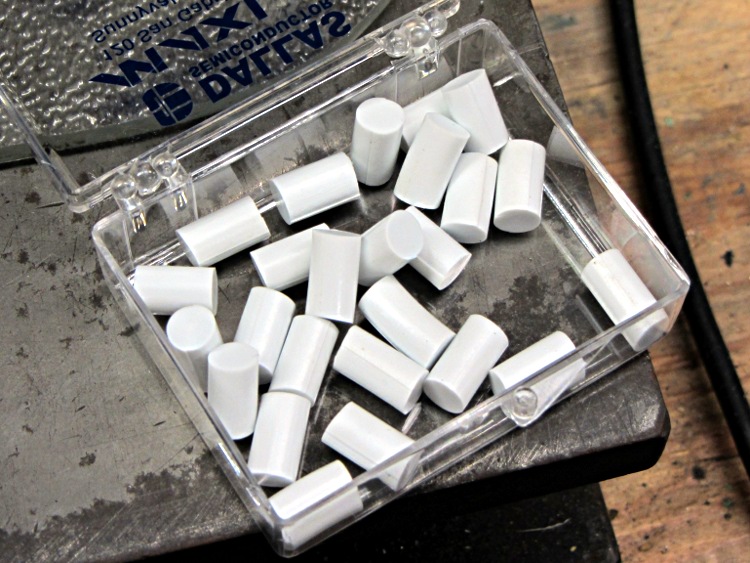
The white O-ring has about the right consistency to serve as a quilting pin cap, along the lines of those 3D printed and silicone rubber filled cylinders. Although the rubber / plastic stuff isn’t quite as squishy as silicone snot, it holds the pin point firmly without much of a push.
Chopping the O-ring into 10 mm sections produced another small box of prototypes:
Lid gaskets as pin caps
Garden planting season remains in full effect, shoving all quilting projects to the back burner and delaying the evaluation phase of the project…
Quite some time ago I got a Powermonkey Explorer set (the one with a solar panel charger) at a substantial closeout discount. After the marketspeak dissipates, it’s a single lithium-ion cell with a boost regulator and USB charger inside a screaming yellow case (the new ones seem more subdued) that’s somewhat water resistant, along with a kit of adapters for various widgets & phones. It stopped charging from the solar panel or a USB port, which suggested that I had little to lose by cracking it open.
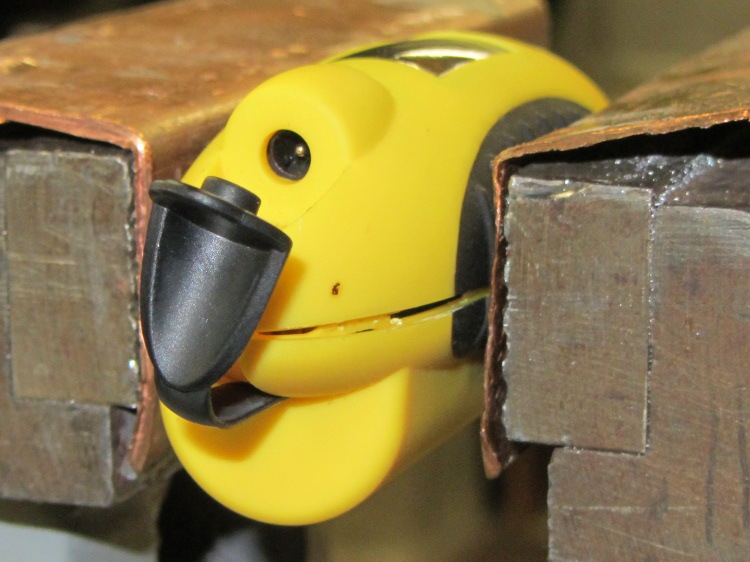
It’s an odd shape, but grabbing it across the equator and applying gentle pressure cracked one side:
Cracking Powermonkey case
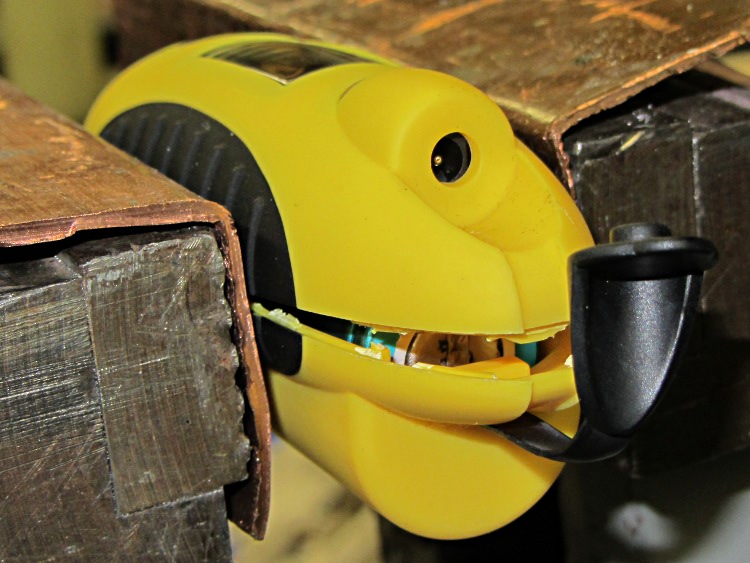
Wedging a screwdriver in the opening and twisting a bit freed the other side:
Enlarging Powermonkey case crack
Then it was just a matter of pulling gently to expose the cell & circuitry within:
Powermonkey interior
That seems to be a standard 18650, presumably similar to that 2.2 A·h cell.
I didn’t find anything obviously wrong, so I buttoned it up with screaming yellow silicone tape, put it on its wall-wart charger for a bit, and now it’s all good again: a shining example of a laying-on-of-hands repair.
The single button has much more travel than it should, so I think the internal foam supports have lost their springiness.
Mary uses an ancient paring knife (that, back in the day, my father had sharpened beyond all reason) to harvest garden veggies, which called for a scabbard to protect the blade, the bike pack, and the fingers.
I snagged a random block of acrylic from the heap, straightened the long sides, milled a channel just wide and thick enough for the blade down the middle, then added small recesses at the right end for the knife’s haft:
Garden knife scabbard – main block
The cover is an acrylic sheet, solvent-glued and clamped in place:
Garden knife scabbard – clamping cover
The cover exposes about 1/4 inch of channel so she can lay the point in place, rather than precisely aligning the point with the slot. I suppose I should have used gray acrylic to provide some contrast; maybe we’ll add a snippet of tape.
Then mill four sides flat, break the edges & corners with a file, and it’s all good (in a blocky kind of way):
Garden knife scabbard
The blade has become sufficiently bent over the years that simple friction holds it in the slot. It’s open on both ends so she can flush out the inevitable dirt.
I was going to engrave her name on the back, but came to my senses just in time…
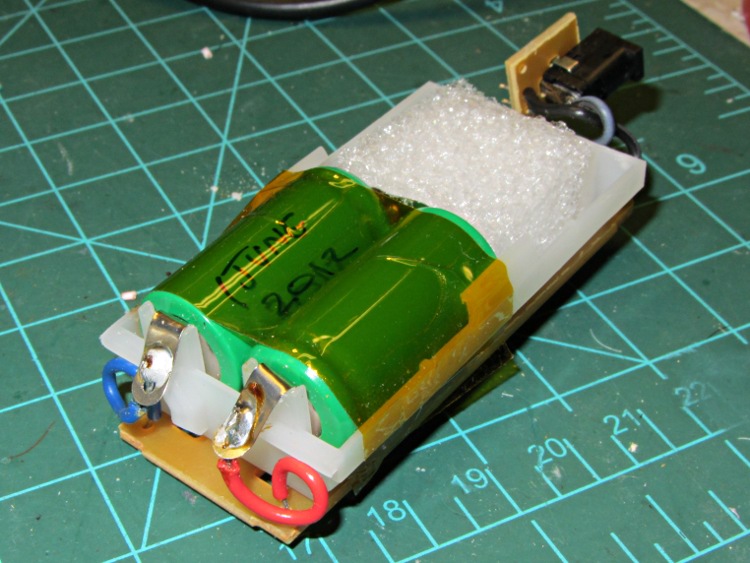
They’re rated at 600 mA·h, as are the much shorter 2/3 AA NiMH cells I also used for those phone packs:
Norelco T770 – rebuild
That’s a wrap of Kapton tape around the cells, plus a block of closed-cell foam to fill the cell holder. It’s not a high-stress environment, so this hack-job repair should work fine.
The trimmer’s charge / discharge cycle remains hostile to NiMH cells and I don’t expect a great lifetime from the new cells, either…