Having installed the 0.4 mm nozzle, being desirous of turning on Skeinforge’s Dimension plugin, and being therefore faced with recalibrating everything, I figured I might as well update all the software to the current versions before commencing. While this adventure turned out well in the end, it required fitting together a large number of moving parts; this is an overview / core dump of how I picked the pieces.
Note: I’ve certainly gotten something wrong in this mess, perhaps drastically so. Let me know, but consider the entire assembly before suggesting a different part.
ReplicatorG is the default Thing-O-Matic printer interface and consists of two parts: the Java-based Arduino-IDE-oid program on the PC and the firmware inside the printer (which is, itself, in two parts divided: Motherboard and Extruder Controller). Their mutual interfaces have become sufficiently tangled that they must upgrade in lockstep, as no versions have backwards or forwards compatibility.
RepG 29 bundles Skeinforge 35 as its default STL-to-G-Code converter, with 40 and 41 as experimental (i.e., largely unsupported) options. Skeinforge 35 is now ten full clicks behind the current version, came out on 6 November 2010, and has a number of fairly well-known problems. Although I understand the need for upstream stability, SF35 long ago fell off the thick edge of the wedge and even SF41 is 8 months old.
I have been using RepG with SF40 for much of the last year, having figured out the parameters essentially from scratch to suit my admittedly oddball configuration & preferences. Regressing to SF35 lacks appeal and, frankly, going just one click up to slightly less obsolescent SF41 isn’t in the cards, either. I have no particular aversion to using bone-stock Skeinforge, fetching the most current version as needed, and controlling the update process myself.
RepG manages Skeinforge profiles that collect its myriad parameters into named groups that can be selected for a particular build. RepG also includes a Print-O-Matic function that pre-sets / computes key SF parameters based on desired extrusion parameters within a given profile, but (apparently) only for SF35. Given that I want a single printer configuration that produces known-good results, putzing around with multiple profiles isn’t of interest and I’m unwilling to use an obsolete version of Skeinforge to sidestep them.
FWIW, I eventually figured out that having one master set of start.gcode, end.gcode, and alterations.csv files with symlinks from the profiles helps keeps the clutter under control, which is particularly important given the complexity of my homing routine. RepG doesn’t create symlinks in new profiles, but after you’re used to it, you just create a profile, blow away the copies, and install the symlinks.
So RepG really doesn’t provide what the B-school gurus called a compelling value proposition for my use case. The STL models I cook up using OpenSCAD emerge properly scaled, properly located, properly oriented, and ready to build. All I need is a way to convert those STL models to G-Code, then send G-Code to the printer. Everything else RepG does simply gets in the way.
The dealbreaker, however, was having RepG 28 occasionally freeze up solid, to the extent of requiring a killall java in a console window to dispose of the corpse. RepG 29 misbehaved the same way and both failed on two different machines with two different versions of Ubuntu. The hole may have been in my end of the boat, but I didn’t devote much time to diagnosing / reporting the problem, given the attention given to the last batch of tickets I opened.
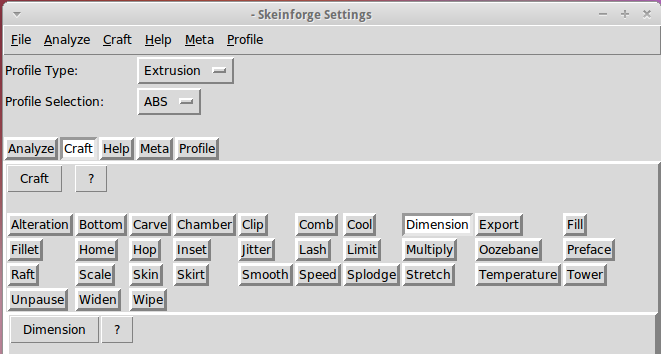
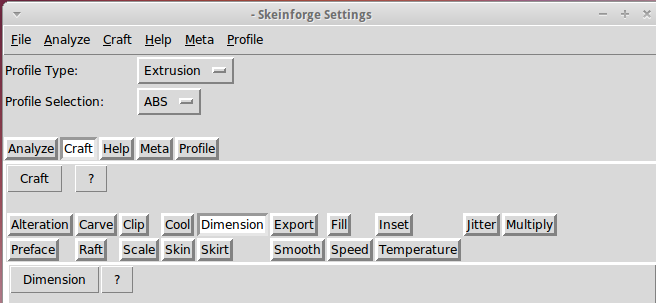
Freed from the confines of RepG, Skeinforge turns out to be not nearly so intimidating as one might be led to believe. Admittedly, a bit of option pruning helps, but after that you’re left with knobs controlling those things that need controlling.
Slic3r seems to be the up-and-coming alternative G-Code generator. The key problem, at least for the objects I create, is the lack of an equivalent to the Skeinforge Cool setting that enforces a minimum time for each layer. Printing exactly one of those caliper repair parts at 15 seconds per layer worked perfectly: no fans, no slumping, no hysteria. One could, I suppose, slow the motion throughout the entire object to make the top come out right, but that’s not appropriate for large parts with small towers. Slic3r is under heavy development, so who knows what the New Year will bring?
Incidentally, my experience with those earlier caliper parts explains why I’m unwilling to regress Skeinforge just to use RepG.
Kliment’s Printrun wins, hands down, as the RepRap UI that does what I need and very little else. The pronterface GUI presents a reasonably clean, single window printer interface. Even better, from my perspective, is the pronsole command-line interface; I generally do everything except actually print while sitting upstairs in the Comfy Chair, so being able to drive the printer with a command-line interface through a simple SSH session (shared keys, an oddball port, no root logins) is wonderful.
The pronterface G-Code preview pane has its origin at the lower-left corner, presumably from its RepRap lineage, while RepG puts (0,0) at the build platform’s dead center. Centering the origin avoids baking the platform dimensions into the G-Code and greatly simplifies the overall alignment, but the mismatch is not insuperable: I can ignore the preview and the printer will be perfectly happy.
However, MBI firmware expects to receive a binary version of the G-Code file, known as S3G and documented there, from the PC through the UI. As nearly as I can tell, nobody else does it that way and none of the other UIs do S3G translation / compilation. Not using RepG means ditching the MBI firmware inside the printer in order to use any other UI.
The current state-of-the-art open-source 3D printing firmware seems to be the Marlin branch of the Sprinter family tree. Its main appeal, at least for me, is motion control with acceleration limiting, which should resolve most of the problems with the MBI stock firmware and greatly enhance the printer’s performance & print quality. For more details on that topic, search herein for acceleration. Alas, Marlin runs on “single processor electronics” controllers, categorically excluding MBI’s Motherboard + Extruder Controller configuration.
While I could junk the entire contents of the Thing-O-Matic’s electronics bay and pop in a RepRap RAMPS 1.4, Generation 6, or Generation 7 electronics package just to use Marlin, that bears a strong resemblance to bad craziness, even by my relaxed standards (although, should another MBI stepper driver board go toes-up, it’ll make considerable economic sense). That comparison of various electronics packages may be helpful. The temperature sense hardware for most of those boards uses thermistors, which means tearing apart the Thermal Core to replace a thermocouple that delivers perfectly accurate results with a thermistor requiring fiddly calibration, which I’d be willing to do, but …
As it turns out, ScribbleJ’s SJFW firmware runs on both RepRap and MBI electronics, includes acceleration limiting, features automagic endstop position settings for both min & max positions, and seems reasonably stable. It has some quirks (no G0 rapid motion, no G28 homing, weird G-Code parsing assumptions / failures), but on the whole it does what’s needed.
So the software stack, from the top down, consists of:
- OpenSCAD
- Skeinforge
- Printrun UI — pronsole / pronterface
- SJFW Motherboard firmware
- Bone-stock MBI Extruder Controller firmware
Everything requires configuration / tweaking before plastic starts oozing out of the nozzle. Then I can begin retuning the printing process.
The overall workflow looks like this:
- Edit/save OpenSCAD program in external editor on right-hand portrait monitor
- Watch/examine OpenSCAD 3D rendering on left-hand landscape monitor, iterate
- Export to STL on file server
- Convert to G-Code using Skeinforge on PC at printer via SSH
- Examine proposed G-Code paths with Skeinlayer (set to auto-display), iterate
- Load/print with pronsole / pronterface via SSH/VNC
- Trot downstairs to watch the show
For the relatively simple models I build, CPU load generally isn’t a big deal. I’ll move the Skeinforge config from ~/.skeinforge to the server and add symlinks to it from both PCs, so as to run SF from either PC with the same settings and eliminate synchronization hassles.
I’ll be writing up my scattered notes over the next week or so…





 The Smell of Molten Projects in the Morning