Ed Nisley's Blog: Shop notes, electronics, firmware, machinery, 3D printing, laser cuttery, and curiosities. Contents: 100% human thinking, 0% AI slop.
While looking for something else, Mary came across a walker in the attic and mentioned that, if she ever had to use it, the shortest position of the adjustable legs would put the hand grips too high for comfort. Maybe they
Well, I can fix that:
Walker shortening – hole indexing
The holes are an inch apart, so I clamped the V blocks parallel to the X axis on the drill press, zeroed the X axis knob, slid the leg to get the drill bit into the last hole, clamp in place, crank the table an inch, then use a step drill to start the hole:
Walker shortening – hole drilling
The holes are just slightly larger than the 1/4 inch step on the drill, so the twist drill cuts them to size.
A tubing cutter sliced an inch off all four legs and all four frame tubes:
Walker shortening – latch relocation
The white plastic fitting in the frame tube prevents the legs from rattling, but I had to drill another hole to move the latch button, too.
Yeah, it’s just seven pairs of holes drilled with a 5/8 inch Forstner bit in a scrap 2×4, which was then introduced to Mr Belt Sander to peel off the dust of ages.
There’s a spare set of holes in front because I’m absolutely certain that, without them, another pair of pliers would suddenly pop into existence on the bench.
Those antibodies will gradually disappear during the next few months and, unfortunately, a past Lyme infection does not prevent future infections.
The tick also injected Babesia parasites which do not respond to antibiotic treatment:
Babesia test – 2021-11-10
The “titer” refers to the dilution required to produce a negative test result, with the 1:64 reference titer representing six successive 50% dilutions. My blood required ten 50% dilutions to produce a negative result for the IgG antibodies and (presumably) six 50% dilutions from a 20% base for the IgM antibodies.
As I understand the situation, IgM antibodies appear promptly upon infection and IgG antibodies follow along later, so my reaction to the Babesia infestation was ramping up after two weeks.
In the Bad Old Days™, quinine was the go-to treatment for parasitic infections, but it has a host of horrific side effects at the dosage required for traction against actual diseases; tonic water ain’t gonna get you where you need to go.
The new hotness is atovaquone, arriving as 100 ml of a yellow liquid with the consistency of latex paint, (allegedly) the taste of “tutti fruitti“, and a price (modulo your drug plan) making inkjet printer ink look downright affordable. You might expect to get a 5 ml measuring spoon along the the bottle, but suffice it to say it’s an exceedingly good thing I’m well stocked for printer cartridge refilling.
All of the diseases and drugs list “fatigue” / “drowsiness” / “malaise” as symptoms / side effects and I’m here to tell you knocking off a couple of hours in the recliner during the day does nothing at all to disturb another nine hours in the sack overnight.
A few weeks of low productivity in the Basement Shop™ will definitely count as a successful outcome.
The steel lump inside the base is the OEM weight that, in addition to two pounds of transformer, kept the whole affair from toppling over.
The transformer inside the DC supply weighs basically nothing:
LED Desk Lamp – Driver PCB
The original 12 VAC transformer powered a 50 W halogen bulb and loafed along at 14.7 VAC (yes, RMS) into the 4 W LED. The light is somewhat dimmer at 12 VDC, but not enough to worry about.
The Greatest Shopvac emitted an intense smell of electrical death while inhaling fuzzballs from the Basement Shop stairs, prompting me to tear it down. For the record, it’s a Genuine Shop·Vac QSP 10 (Quiet Super Power):
Shopvac QSP – label
Removing the handle and upper plate reveals a slab of (presumably) sound-deadening foam over the motor cooling fan. As far as I can tell, the last job this vacuum had before the previous owner discarded it was inhaling drywall dust without a filter:
Shopvac QSP – upper sound baffle
Flipping the motor assembly over and removing the bottom plate revealed a pair of equally solidified foam slabs baffling the main exhaust path:
Shopvac QSP – sound baffle foam
They eventually became Clean Enough™ after protracted rinsing, so maybe the thing now runs as quietly as the name would lead you to believe, if you believed in names.
Disconnecting and extracting the motor revealed the razor-sharp impeller disk. A shop rag prevents lacerations while torquing off the nut holding it to the shaft:
Shopvac QSP – impeller nut
Rust on the washer below the impeller, along with the layer of caked white cement, suggested water accompanied the drywall dust:
Shopvac QSP – impeller washer
Gentle suasion from the Designated Prydriver eventually eased the washer off the shaft and freed the motor:
Shopvac QSP – motor brush layout
It’s an old-school series-wound brushed universal motor. The plastic plate in the middle of the picture has a helical spring pressing the carbon brush against the commutator:
Shopvac QSP – motor brush detail
The rotor turned … reluctantly with the brushes in place and spun freely without them, suggesting the horrible smell of electrical death came from arcing across the gunk accumulated on the commutator:
Shopvac QSP – commutator as found
Many iterations of diligent scrubbing with denatured alcohol on cotton swabs and old t-shirt snippets got rid of the crud, although that commutator will never look all shiny-clean again:
Shopvac QSP – commutator cleaned
At least the brushes aren’t glued to it!
Reassembly is in reverse order, although I took the liberty of splicing a few inches of wire into the switch leads, because I’m not working under factory conditions with all the proper assembly fixtures:
Shopvac QSP – extended wires
The motor passed the smoke test and no longer smells like death, so it’s at least as good as it ever was.
It may run quieter with clean foam baffles, but I still turn off my power ears or don hearing protection when I fire up any shop vacuum.
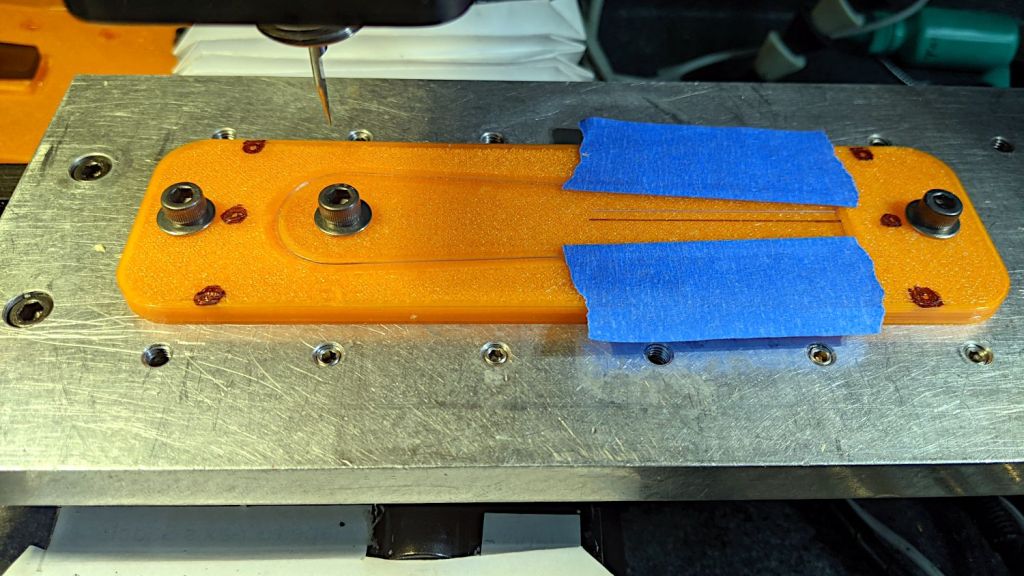
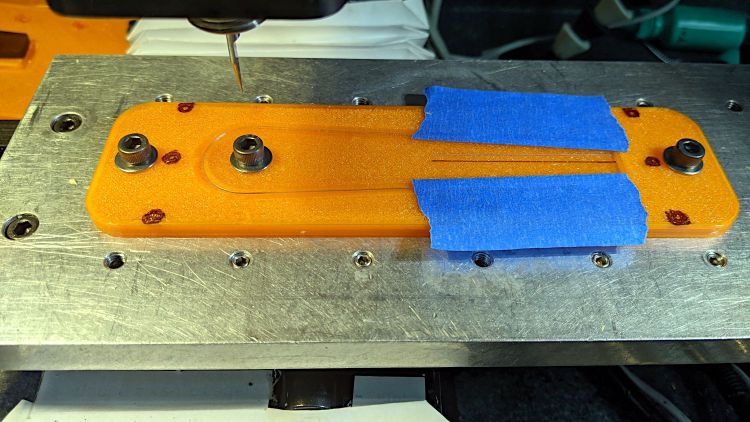
The CNC 3018 Z-axis stage has a plastic clamp holding the spindle motor, so I just duplicated the motor diameter in the mounts for my diamond drag bit, cheap pen, and fancy pen holders. For obvious reasons, I tend to err on the small side for anything intended to fit into anything else, which led to each of the holders sporting a small strip of tape to soak up the difference.
While poking around the 3018, I once again noticed the clamp’s crappy fit around the holder:
CNC3018 tool clamp – top
The inside should be circular, but it’s definitely not:
CNC3018 tool clamp – top detail
The end of the 30 mm M3 SHCS bottoms out before the clamp closes, although I’ve managed to crank the screw tight enough to put enough of a dent in there to snug the clamp:
CNC3018 tool clamp – side
Some awkward scraping and filing eroded enough of the plastic to let a 25 mm SHCS close the clamp firmly around the holder:
CNC3018 tool clamp – revised
The tool holders now slide in easily with the screw released and fit firmly with the screw tightened a reasonable amount, minus the tape snippets shimming the difference.
If I had the courage of my convictions, I’d take it all apart, bore the clamp out to a circular profile, realign the clamp screw passage to suit, then rebuild all those tool holders for the new diameter; it now works well enough to tamp that project down.
The blade on one of the Jonas vegetable peelers cracked, which suggests it’s the counterfeit version:
Jonas Peeler – cracked blade
I grooved the metal pin running through the handle:
Jonas Peeler – shaft grooving
A brass tube from the Little Tray o’ Cutoffs and some epoxy should hold things together forevermore:
Jonas Peeler – epoxy
The rainbow colors come from an instantly aborted attempt to silver-solder the parts together. The fact that I even tried a stunt like that shows I’m definitely not the brightest bulb in the chandelier these days.