The Smell of Molten Projects in the Morning

Ed Nisley's Blog: Shop notes, electronics, firmware, machinery, 3D printing, laser cuttery, and curiosities. Contents: 100% human thinking, 0% AI slop.

Category: Home Ec

Things around the home & hearth

  • Fixing an MTD Gas Cap Splash Shield

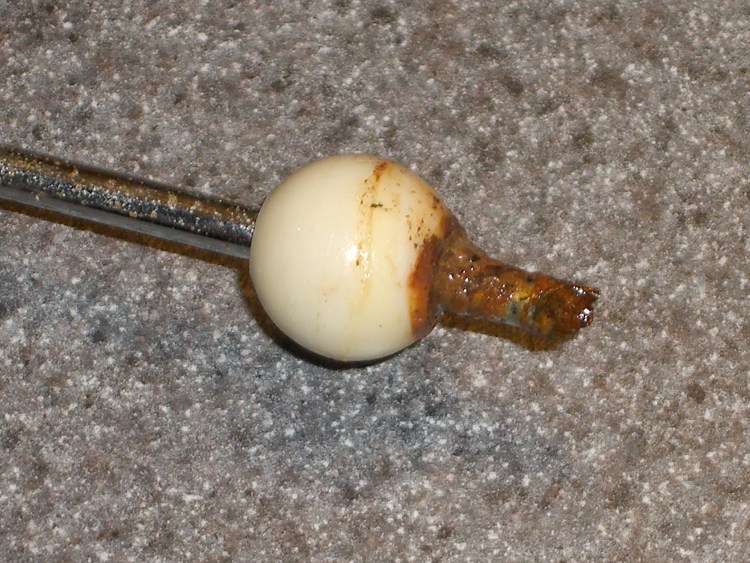
    OEM plastic post
    OEM plastic post

    MTD used the same design for the gasoline tank caps on our leaf shredder and snow thrower: an aluminum cone (which evidently serves to keep splashes away from the tank vent) mounted on a heat-staked plastic rod molded into the cap. It’s straightforward, but a bit suboptimal for high-vibration yard gadgets.

    The aluminum cone eventually worries its way through the plastic post and falls into the tank, taking the heat-formed button from the post along with it. Trust me on this, fishing those things out of the tank is an exquisite little inconvenience.

    4-40 screw post - inside
    4-40 screw post – inside
    4-40 screw post - exterior
    4-40 screw post – exterior

    The fix is straightforward.

    Chop off the remains of the post, drill a snug 4-40 tapping hole straight through the cap, and tap it accordingly. Secure the cone to the screw with a nut tightened against the head, run the screw through the cap, run a pair of nuts onto it, trim to length, then jam the nuts together so the cone is about where it started out. Loctite on the nuts is a Good Thing, but I don’t know how it feels about gasoline immersion.

    The snowblower cone is getting wobbly; I must make a preemptive strike on it to avoid fishing the debris out of the tank.

  • Hard Drive Magnets for Debris Collection

    Magnetic Staple Collector
    Magnetic Staple Collector

    We took down the deer netting around the garden yesterday, which involves pulling a zillion staples out of the wood posts. I put some salvaged hard-drive head motor magnets to good use: one magnet inside my jacket sleeve to hold the other magnet in place, then just drop staples near them.

    Shazam… no staples in the ground!

    You can actually buy such things, with cute Velcro straps and all, but why? You’ve been saving those magnets for years: put ’em to use!

  • Write Down What You Learn Where You’ll Need It

    A discussion there reminded me to mention a good habit taught by my buddy Eks: when you must look something up, write the information where you’ll see it the next time you need it.

    So, for example, each of the van wheels sports its own tire-rotation schedule inside the cover. When it’s time to swap tires in early spring and late autumn, I pry the cover off, read where the tire should go, and do the deed. I write ’em down four or five years at a time, so there’s not much thinking involved.

    The engine compartment has all the most-often-used wrench sizes and capacities.

    I write the oil change & inspection info in the maintenance schedule booklet that came with the van, although after a decade that’s pretty much full up.

    Sharpies FTW!

  • Alcohol Mist Flamethrower

    Alcohol hand sanitizer pump spray
    Alcohol hand sanitizer pump spray

    Our daughter snagged some tchotchkes from a high-school career fair, including one that she instantly recognized as a flamethrower: Antibacterial Hand Sanitizer Spray, 62% Ethyl Alcohol plus some other junk, in a handy pump-spray container. Heck, it even says

    Warnings Flammable. Keep away from open flame. Keep out of reach of children.

    I was so proud of her…

    Flare3.gif
    Flare3.gif

    After homework, she stuck a candle atop the garbage can by the garage and fired off a few shots while I ran the camera. Here’s the best one, converted to a low-speed animated GIF.

    We’re pretty sure that’s Sweet Babby Jeebus™ in the next-to-last frame of the flare. Maybe Madonna. Could go either way.

    Much as with the “movies” I made for trebuchets and tree frogs, I used ffmpeg to shred the camera’s mpg movie into separate jpg images, some bash to select the frames, then convert to stitch them back together into a gif.

    The general outline:

    mkdir Frames
    ffmpeg -i mov04990.mpg -f image2 Frames/frame-%03d.jpg
    cd Frames
    mkdir flare3
    for f in `seq 760 780` ; do cp frame-${f}.jpg flare3 ; done
    cd flare3
    convert -delay 50 frame-* Flare3.gif
    

    If my bash-fu was stronger, I could feed the proper file names directly into convert without the copy step.

    Now, kids, don’t try this at home. At least not without responsible adult supervision…

  • Cheese Garrotte

    Cheese Garrotte
    Cheese Garrotte

    Just chopped up a 5-lb lump of Provolone into 2-oz chunks for pizza, which brings this simple shop project to mind: a cheese garrotte.

    It’s about a foot of 0.011-inch (call it 0.25 mm) stainless steel wire with the ends wrapped around some aluminum rod, neatly tied off with heatshrink tubing.

    Usage is about what you’d expect: it cuts cheese like nothing else on earth. The only trick is maintaining a straight line, which is easier (for me, at least) when I cut vertically downward.

    It’s difficult to cut all the way to the bottom and that wire is rough on the fingertips, so I tend to flip the cheese over and pull sideways for the last inch or two. Maybe not a perfect cut, but good enough.

    Cheese Garrotte Handle Detail
    Cheese Garrotte Handle Detail

    Construction nuance: loop the wire around the handle once or twice, pass it through the hole, then do another loop before twisting the end. If you run the wire directly through the hole, it’ll break on the far-side sharp edge after a while, even when you countersink the hole.

    I put a shallow groove around the handle, but that’s likely not needed. You can certainly get fancier with the handles if you like. This one is dishwasher safe, which makes up for a lot.

    You really, really need heatshrink tubing over the bare wire ends, as the tip of a 11-mil stainless wire is indistinguishable from a needle.

  • Mysterious Noise in Toyota Sienna Minivan: Fixed!

    For about the last week I’ve noticed a soft clicking-buzzing sound somewhere near the dashboard / center console of our 2000 Toyota Sienna. I tried some on-the-fly isolation, but it wasn’t related to motion, engine on/off, CD or tape player, fan, or anything else. Finally Mary noticed it, too, and we spent half an hour in the garage yanking fuses and wiggling things until we tracked it down to below the passenger seat.

    Now, in the good old days, that was empty space, but in the Sienna it’s where the rear-area heater lives. Shoving the seat forward to the stop exposed the heater and, sure enough, it’s buzzing and clicking. Intermittently, somewhat randomly, but very steadily.

    Rear Temperature Control
    Rear Temperature Control

    With that as a hint, I twisted the rear-area temperature control (on the headliner behind the driver seat) and shazam the noise stopped. The control has detents and when moving the control to each detent the heater makes a faint buzzing. I suspect the control adjusts a valve that regulates engine coolant flow inside the heater.

    It’s not obvious whether the control is a pure-digital rotary encoder or a potentiometer, so I decided to investigate: it’s already sorta busted, what’s to lose? The bezel comes off by prying its door-side edge outward. The white plastic frame has two screws into the metal structure under the roof. The two electrical connectors are, of course, the positive-latching kind that you pull the little tab until you break your fingernail and then realize that you should push it instead.

    Temperature Control - Interior View
    Temperature Control – Interior View

    Taking the control apart reveals that it’s a potentiometer with some switching contacts. The two bifurcated spring-finger contacts on the black plastic disk short the resistive element to the inner metallic track.

    Resistive Element
    Resistive Element

    The metal contacts appeared slightly grody, but with no major corrosion. The resistive track looked just fine.

    The offending control position would be to the left side of the element as shown in the pictures here: there’s nothing obviously wrong at that spot. I think the maximum-heat position is off the resistive element entirely, resting on the far left end of the metal traces, but the control wasn’t quite set to that spot. Perhaps the problem was that the contacts became intermittent at the exact edge of the element.

    I smoothed the collection of anti-oxidation grease over the tracks, covered the contacts with their own blobs, put everything back together, and it works fine.

    We tend to put the control at A/C during the summer and at maximum heat during the winter. I suppose the poor thing got frustrated after we moved it a month or so ago…

    The money saved with this repair might just pay to have the Toyota dealer replace the spark plugs. The shop manual says that task starts by removing the windshield bezel and all the stuff above the engine intake manifold; the job costs upwards of 300 bucks. I can barely see the rear plugs with a looong inspection mirror angled just so while lying on the floor under the van, so it’s truly a nontrivial operation.

    I [delete] all over their [censored]…

  • Insurmountable Opportunity

    Ten Pound Hershey Bar
    Ten Pound Hershey Bar

    Several decades ago I got my esteemed wife a ten-pound Hershey bar for Christmas. She said that was a thoughtful gift, exactly what she wanted, and if I ever did that again, she would kill me.

    Turns out that I’d gotten such a bar myself, many many years ago…

    These days, of course, the biggest Hershey’s Chocolate bar you can get is a measly five pounds.