Ed Nisley's Blog: Shop notes, electronics, firmware, machinery, 3D printing, laser cuttery, and curiosities. Contents: 100% human thinking, 0% AI slop.
Mad Phil gave me his EMI Go-Kit, which contained a Tek P6401 logic probe (along with a short ton of ferrite cores):
Tek P6401 Logic Probe – kit
It’s slightly younger than dirt (copyright 1974, please forgive me) and still works fine on TTL-level logic. The red & green indicators use tiny grain-of-wheat incandescent bulbs, of course, so the thing draws nigh onto a quarter of an amp with both lights on.
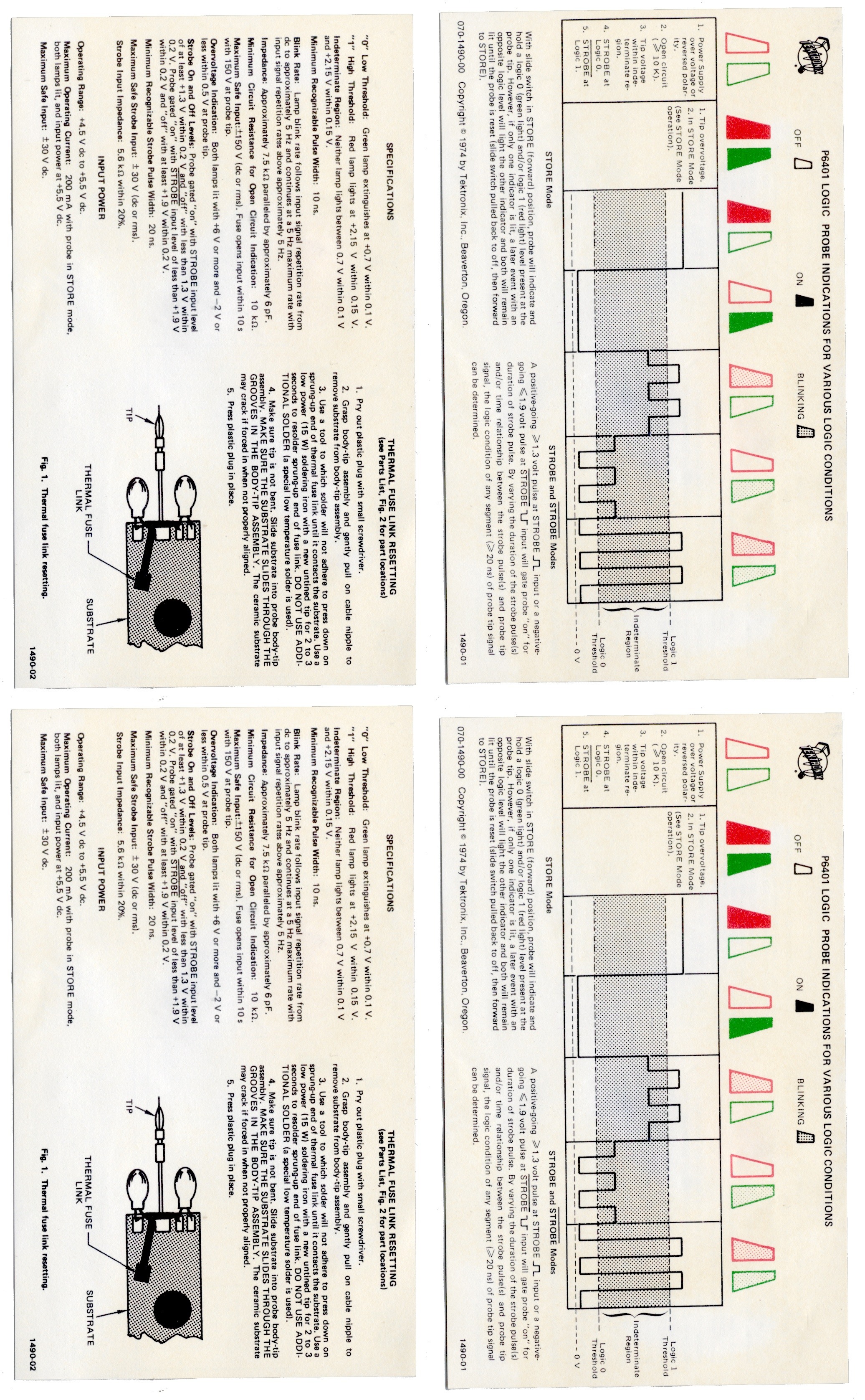
The front of the instruction card shows what the blinky lights mean and the back gives the specs; it’s doubled up so you can pass one along to a friend:
Tek P6401 Logic Probe – Specs and Usage Card
If you have one that doesn’t seem to work, check the internal thermal fuse: tack it back down with a hot dry soldering iron and it’ll probably outlive you…
There ought to be a survey marker pin at the front corner of the lot where it’d come in handy for locating the edge of the yet-to-be-contracted driveway paving, but if it’s there it’s been pushed below ground level. So I mooched a homebrew metal detector based on the Elenco K-26 PCB…
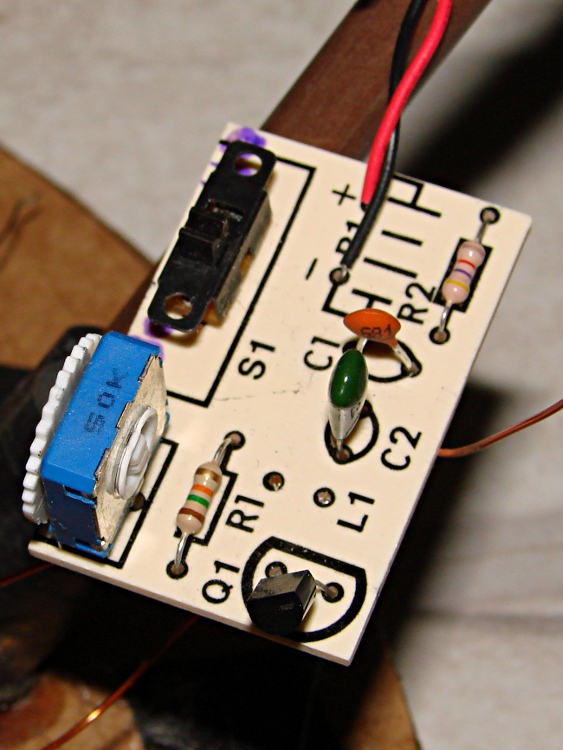
K-26 Metal Detector PCB
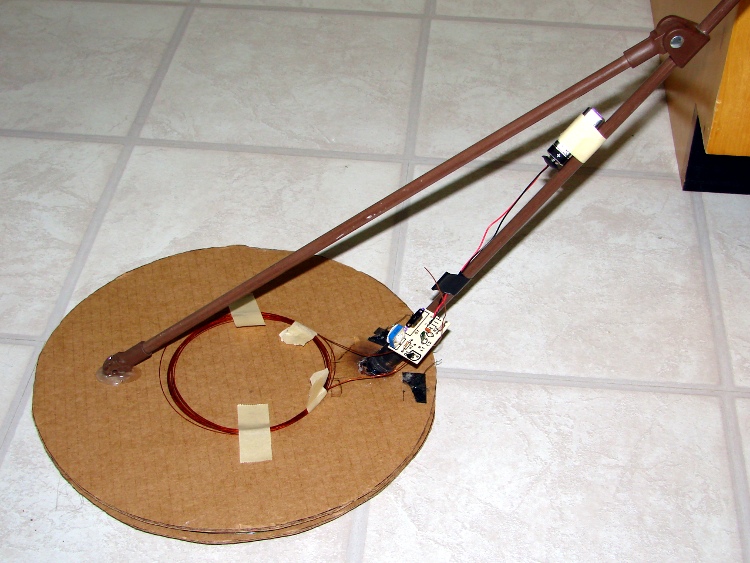
The kit included 45 feet of 22 AWG enamel wire that should have become a 5 inch diameter coil with 30 turns, but the as-built detector had a coil wrapped around a 1 foot diameter cardboard form. The coil inductance sets the oscillation frequency, which turned out to be around 300 kHz: far below the nominal 1000 kHz. So I wound 40 turns of 22 AWG magnet wire around an old CD-ROM spindle case (which is, quite coincidentally, just over 5 inches in diameter), and taped it atop the cardboard form.
The datasheet recommends a nonmetallic handle, so I swapped in a plastic umbrella support for the original metal mop (?) handle.
Rewound homebrew metal detector
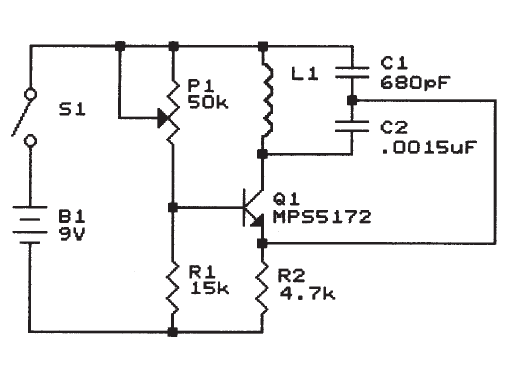
The K-26 schematic looks like a common-base Colpitts oscillator, with only the most utterly absolutely vital essential components:
K-26 Schematic
In round numbers, the oscillation frequency varies inversely with the number of turns:
F = 1/(2π√(LC)) (for a simple tank)
L = stuff × N2 (stuff = various constants & sizes)
F = stuff / N
The rewound coil oscillated at 350 kHz, so I spilled off a few turns at a time to produce these results and a tangle of wire on the floor:
L – µH
Freq – kHz
330
350
186
535
107
711
65
840
42
1140
For the record, the coil in the photo corresponds to the last line and has 12 turns.
Contrary to what the instructions imply, trimpot P1 does not adjust the oscillation frequency. It tweaks the transistor bias for best oscillation, so it’s more of an amplitude control than anything else. I adjusted P1 while watching an oscilloscope connected across the negative battery terminal and the emitter of Q1, but you could probably use a small sniffer loop to good effect.
It draws about 2 mA, so the battery should last quite a while; labeling the switch positions should help a lot.
The oscillator produces an unmodulated carrier, so I tuned a Kenwood TH-F6A HT in LSB mode for maximum squeal. Any variation in L changes the carrier frequency and thus the pitch of the demodulated audio; an earbud just barely in one ear makes this almost tolerable.
As you should expect from the picture, that metal detector lashup is mightily microphonic, to the extent that touching a blade of grass wobbles the audio pitch and bumping the cardboard plate against an object can detune the whole affair. A bit more attention to rigid coil mounting would certainly help, but this isn’t the most stable of designs to begin with and I doubt anything will help very much at all.
The coil can detect a chunk of rebar sticking out of the ground at a range of maybe half a foot, but it’s not clear how well it will cope with buried treasures (like, oh, let’s say a survey marker pin). In any event, I must mow the grass down there before going prospecting.
The motivation for gutting that Dell laptop battery was to find out if the cells could become a higher-capacity external battery for the Canon SX230HS camera. Those discharge curves suggest they can’t, but I also want to know what voltage levels correspond to the various battery status icons, which means I must feed an adjustable power supply into the camera… so I need a fake NB-5L battery with a cheater cord.
The first step: crack the case of the worst of the eBay junkers. I squeezed it in the bench vise to no avail, then worked a small chisel / scraper (*) into the joint. The lid was firmly bonded to the case, but it eventually came free:
NB-5L Battery – opened
The protective PCB sits at one end of the cell, with a strip of black foam insulating the components from the nickel strips:
NB-5L – protective PCB
It turns out that the cell’s metal shell is the positive contact, which I didn’t expect.
The component side of the PCB has a 10 kΩ resistor connected between the center and negative contacts. That should be a thermistor, but it’s a cheap eBay knockoff and I suppose I should be delighted that there’s not a gaping hole where that contact should be. The PCB fits against the small notch in the case and is held in place by small features on the top and bottom. The negative contact is on the far left:
NB-5L – PCB interior view
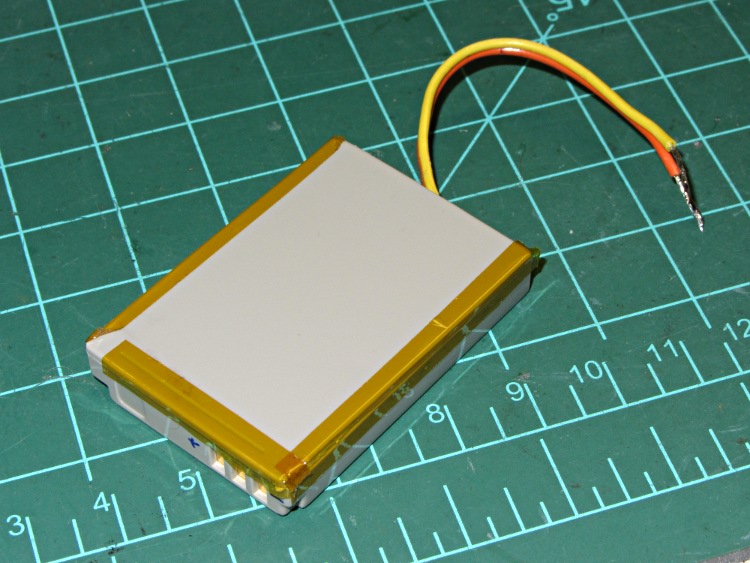
Canon sells an AC adapter for the camera that includes an empty battery with a coaxial jack that aligns with a hole in the battery compartment cover. I soldered a pair of wires to the PCB, drilled a hole in the appropriate spot, added some closed-cell foam and hot-melt glue to anchor the PCB, and made a cheater adapter. For the record, the orange wire is positive:
NB-5L – gutted case with pigtail
It turns out that the camera battery cover must be closed and latched before the camera will turn on, but the sliding latch mechanism occludes the hole. This cannot be an inadvertent design feature, but I managed to snake the wire out anyway.
Connecting that up to a bench supply (with a meter having 0.1 V resolution) produces the following results:
Voltage
Result
3.8
Full charge
3.7
2/3 charge
3.6
Blinking orange
3.5
“Charge the battery”
The camera draws about 500 mA in picture-taking mode, about 300 mA in display mode, and peaks at around 1 A while zooming.
The Genuine Canon NB-5L is good for 800 mA·h to 3.6 V, as are the two best pairs of the Dell cells. The latter remain over 3.7 V for 500 mA·h, which suggests one pair would run for about an hour before starting to blink. Maybe that’s Good Enough, but … a new prismatic battery is looking better all the time.
(*) Made by my father, many years ago, with a simple wood handle that eventually disintegrated. I squished some epoxy putty around the haft and covered it with heatshrink tubing, but (now that I have a 3D printer) I really should print up a spiffy replacement. I’ve been using it to pry objects off the printer’s build platform, so that’d be only fitting…
Putting that battery into the Dell 8100 laptop produced the dreaded blinky light of doom, so it has been on the shelf for maybe half a year. Having gutted the cells from the case, the next step was to discharge the cells completely, thereby producing the lower four curves in this plot:
Dell 8100 Laptop Battery Cells
I arbitrarily labeled the cell pairs 1 through 4. Pair 1 has the lowest remaining charge and the other three seem very closely matched.
I recharged the four cell pairs one-at-a-time from a bench power supply set to 4.2 V. Each pair started charging at about 2 A, somewhat lower than the pack’s 3.5 A limit, so the supply’s 3 A current limit didn’t come into play. You probably don’t want to do this at home, but …
The usual charge regime for lithium cells terminates when the charging current at 4.2 V drops below 3% of the rated current (other sources say 10%, take your pick). The pack’s dataplate sayeth the charging current = 3.5 A, so the termination current = 100 mA. I picked 3% of the initial 2 A current = 60 mA and stopped the charge there, so I think the cells were about as charged as they were ever going to get.
As nearly as I can tell, increasing the voltage enough to charge at a current-limited 3.5 A (a bit beyond my bench supply’s upper limit, but let’s pretend), then reducing the voltage to 4.2 V as the current drops would be perfectly OK and in accordance with accepted practice, but I’m not that interested in a faster charge.
Unlike the other three pairs, Pair 1 quickly became warm and I stopped the charge. Warming is not a nominal outcome of charging lithium-based cells, so those were most likely the cells that caused the PCB to pull the plug on the pack. The other pairs remained cool during the entire charge cycle, the way they’re supposed to behave.
However, even with that limited charge, Pack 1 had about the same capacity as the (presumably) fully charged Pack 2, showing that the cells get most of their charge early in the cycle. Pairs 3 and 4 had more capacity, but they’re not in the best of health.
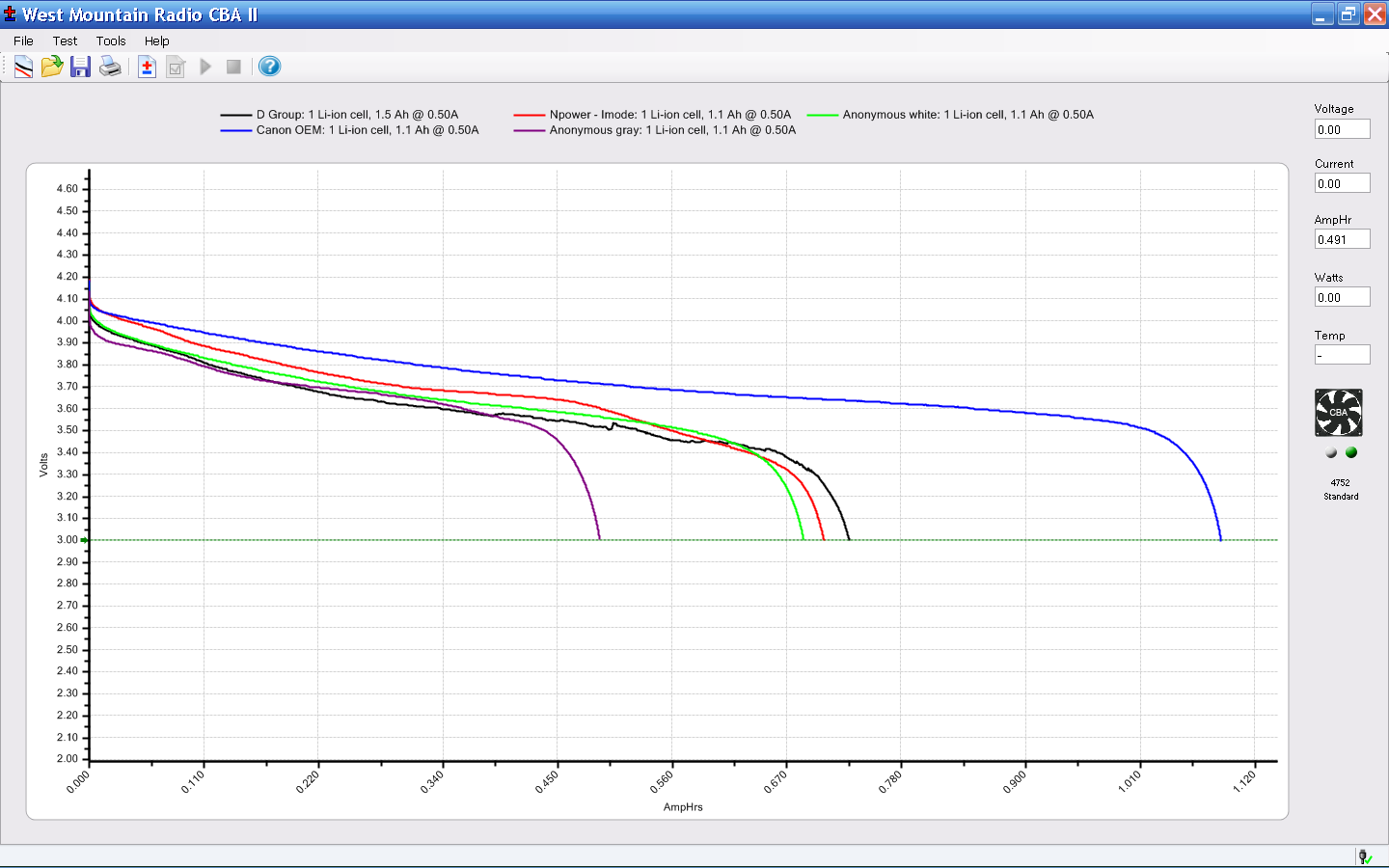
The blue curve in this graph shows the discharge curve for the 1.1 A·h Canon NB-5L battery (actually, a cell) that came with the SX230HS camera:
Canon NB-5L – first tests
Notice that it remains above 3.4 V until it produces 1.1 A·h at 500 mA, which is roughly its rated capacity. The other traces come from those crap eBay NB-5L batteries.
The two best pairs of Dell cells can each produce about 1.3 A·h at 1 A before dropping below 3.4 V (the cursor & box mark that voltage in the top graph), so they’re in rather bad shape. Strapping the best two pairs together would give a hulking lump with perhaps three times the life of the minuscule NB-5L battery, so I think that’s probably not worth the effort.
Particularly when one can get a prismatic 3.7 V 5 A·h battery for about $30 delivered, complete with protective PCB and pigtail leads…
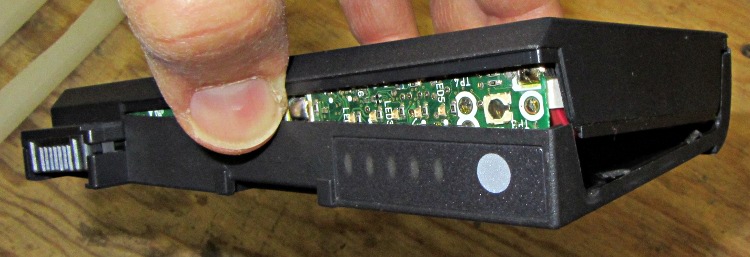
Crunching the battery case in the bench vise, plus a bit of screwdriver prying, did the trick:
Cracked-open Dell 75UYF battery
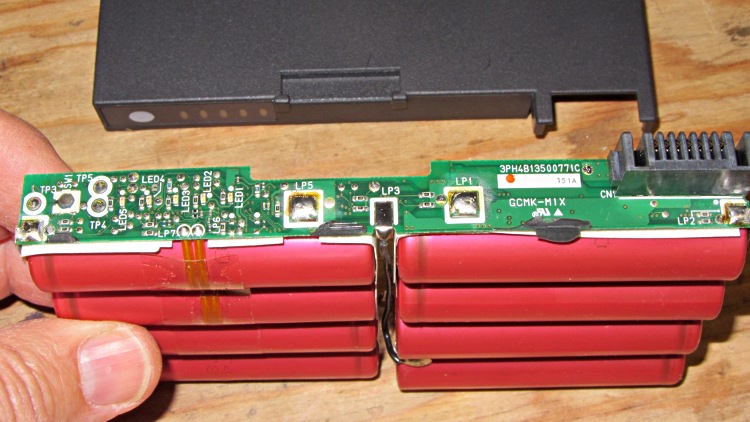
Peeling the case off revealed the eight lithium cells and the protective PCB:
Dell 75UYF battery contents
As you’d expect, each pair of cells has an individual contact to the PCB for monitoring and equalizing, which simplifies connecting the battery tester.
The case emerged from its ordeal with only superficial damage, so it’s now back in the laptop to fill up the slot. I tucked the PCB inside, although I doubt I’ll ever rebuild the battery with new cells.
Our Larval Engineer has begun writing the Arduino code (Baby’s First Real Program!) that will control ground effect lighting on her longboard, with RGB LED colors keyed to the wheel rotation speed. Her back of the envelope says the wheels spin at about 60 rev/s (= 17 ms/rev) at 30 mph, which rules out mechanical / reed switches; some experimentation with a simple mechanical switch showed why the Arduino bounce library is a Good Thing even for pushbuttons.
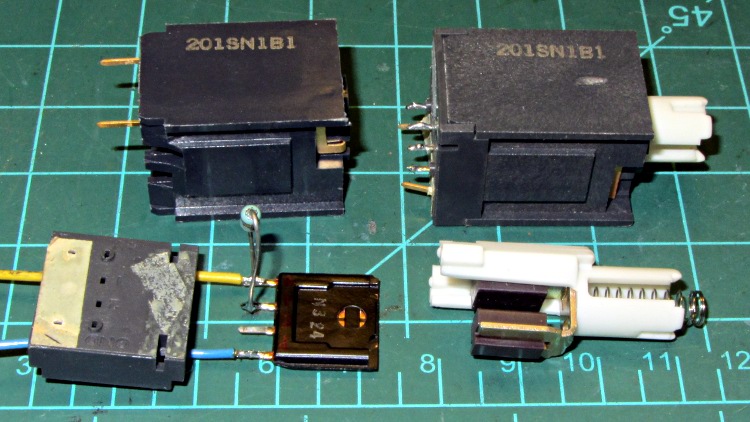
Some rummaging produced a collection of these Hall effect switches:
201SN1B1 Hall Effect Switch Components
I thought they were ordinary keyboard switches, but noooo… Honeywell 201SN1B1 switches turn out to be Mil-Spec items, with brethren serving in B-52 bombers, F-16 fighters, and even long-departed Peacekeeper ICBMs (most likely in the ground support equipment). There are no data sheets at this late date, but this compressed specs burst gives some hints:
General Characteristics Item Description: Switch body 1.060 in. l; 0.740 in. h; 0.740 in. w; hall effect solid state switching; alternate action; 5V dc; 9 ma.; operated at 0.4V dc max.; sinking 4 ma. per output; pulse output; printed circuit terminals
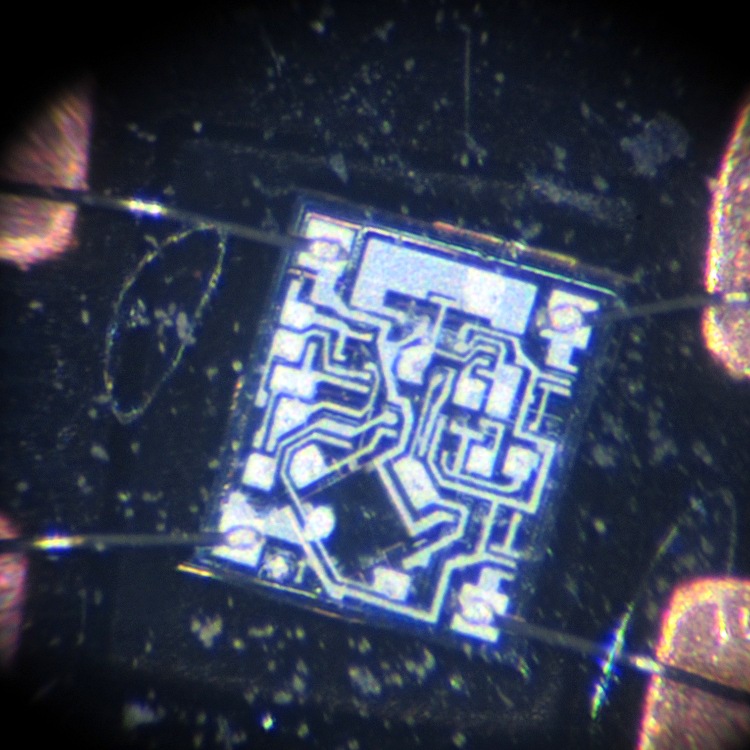
A gentle twist of a small screwdriver under the plastic latches releases the base plate and frees the Hall effect switch module, which is the square black plate above. It contains an IC (downward in the picture) with wire-bonded leads embedded in a flexible silicone seal that has pale gray smudges on its surface:
201SN1B1 IC – Overview
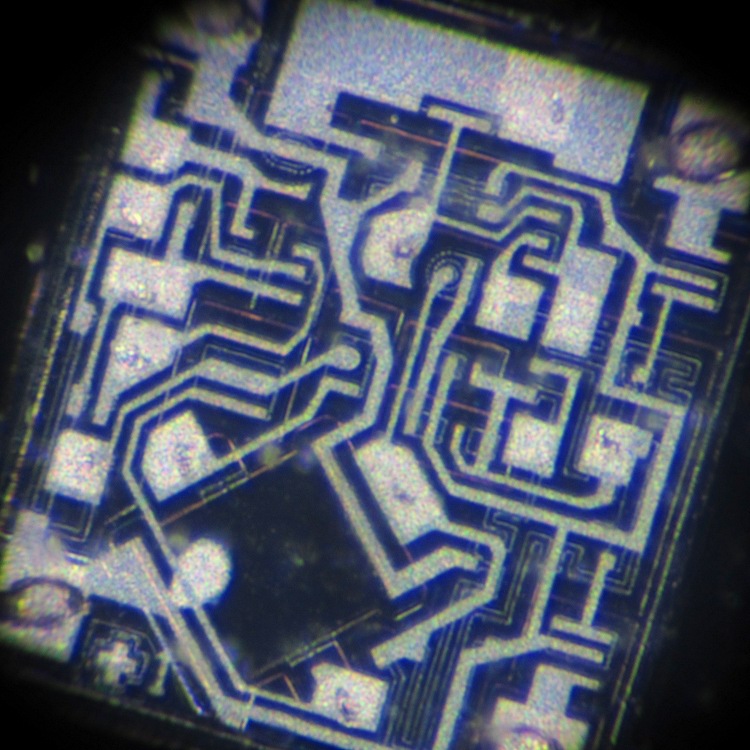
A closer look at the IC shows actual components:
201SN1B1 IC – Detail
That’s from back when you could see components on an IC…
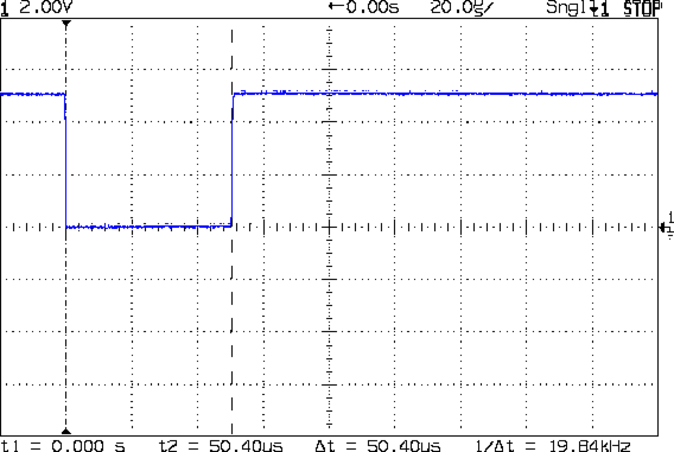
I soldered wires to the +V and Gnd pins, plus a 10 kΩ pullup resistor to one of the two output pins, applied 5 V from the bench supply, then waved a small neodymium magnet nearby:
201SN1B1 Switch Output
The two output pins appear to produce separate-but-equal 50 µs output pulses that are completely independent of the magnet’s proximity, speed, and polarity, which is a Nice Touch. The IC draws about 10 mA when inactive and 12 mA with the magnet nearby.
The form factor seems a bit awkward for a longboard wheel sensor, but it’ll get her closer to the goal. Most likely, it’ll wind up embedded in an epoxy block strapped to one of the wheel trucks.
The Arduino’s Bounce update function / method / whatever has a polled view of the input pin, which means that if you don’t call it during that 50 µs pulse you’ll completely miss that revolution. Sooo, the pulse must go into one of the Arduino’s external interrupt pins, which can catch short pulses with no trouble at all if you write a suitable interrupt handler.
Somewhere I have a handful of Hall effect motor commutation sensors, but they have an internal latch that requires alternating magnetic poles to switch the output, thus requiring two magnets halfway around the wheel circumference. Haven’t figured out how to embed the magnets in the wheels or mount the sensors, but …
A bit over two years ago, those six 9 V 5.4 A·h lithium packs delivered around 4.5 A·h. They’ve been charged and discharged, run down until their undervoltage lockout tripped, severely jounced and bounced, and they still deliver about 4 A·h at 500 mA!
External Li-Ion packs – 2012-05
That’s a Good Thing, because I haven’t seen anything like those packs since then…
Never did get around to installing a cutoff switch, as we ride often enough that the penalty for not pulling the plug gets lost in normal use. The Wouxun KG-UV3D seems perfectly happy with 9 V delivered to its battery terminals, providing little motivation to hack into the battery case for a direct tap to the 7.4 V from the cells.





 The Smell of Molten Projects in the Morning