Ed Nisley's Blog: Shop notes, electronics, firmware, machinery, 3D printing, laser cuttery, and curiosities. Contents: 100% human thinking, 0% AI slop.
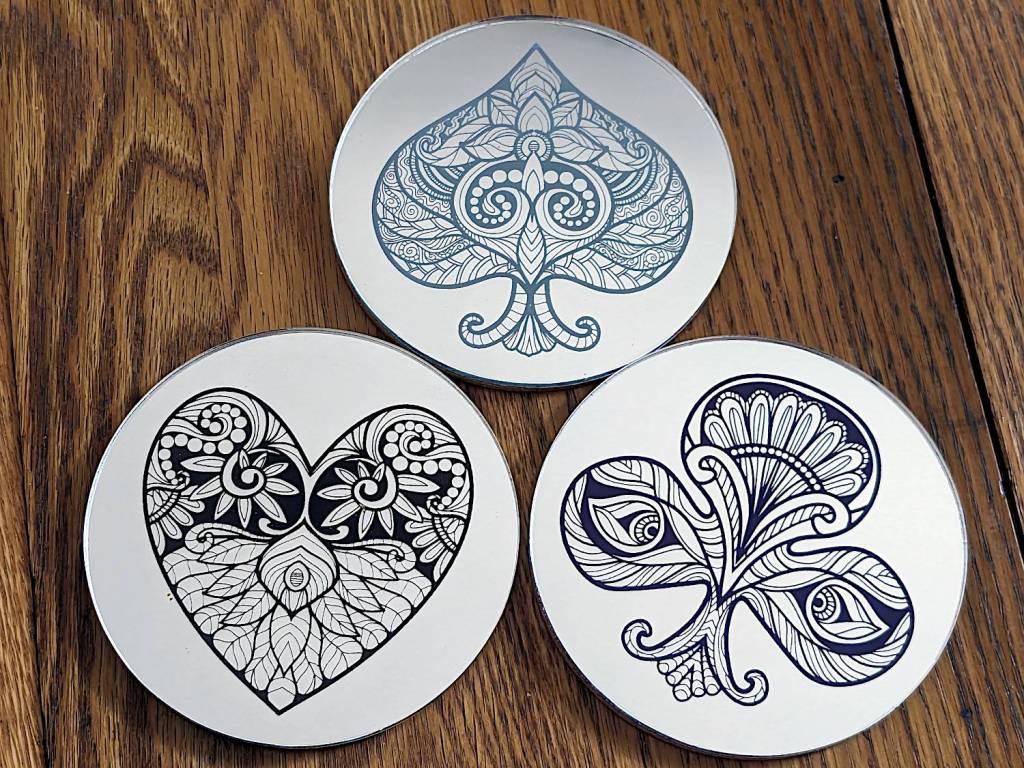
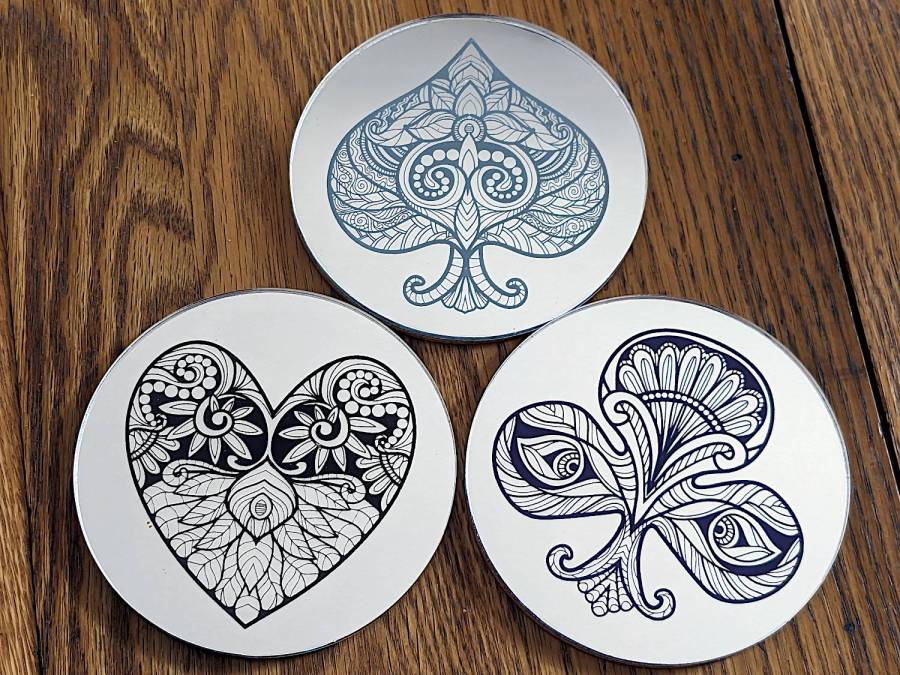
Having established that scribbling Sharpies on laser-cut acrylic is a Bad Idea™ due to stress cracking, I made some acrylic mirror coasters with rattlecan spraypaint on the back:
Back-painted mirror coasters
The colors, which look much more obvious in person, are gray, black, and blue. There should be a diamond to round out the playing card theme, but only three fit neatly on the remaining slab of mirror.
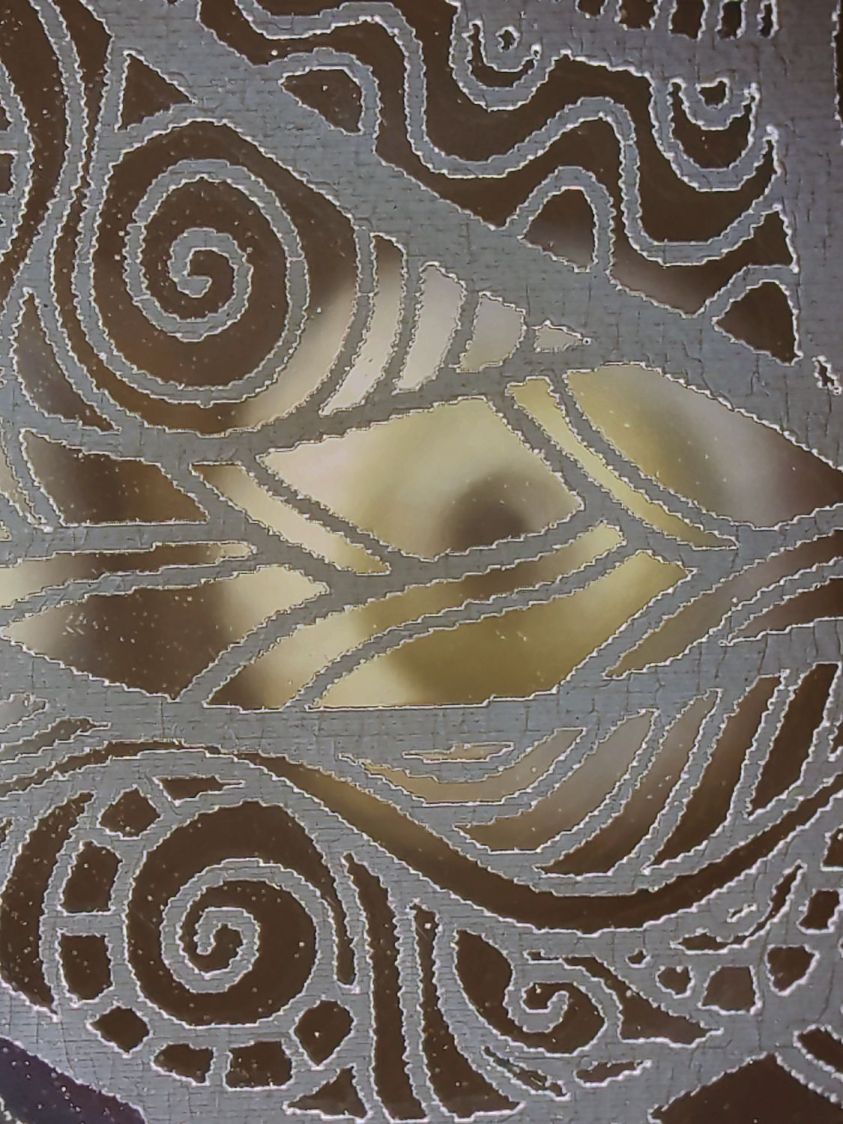
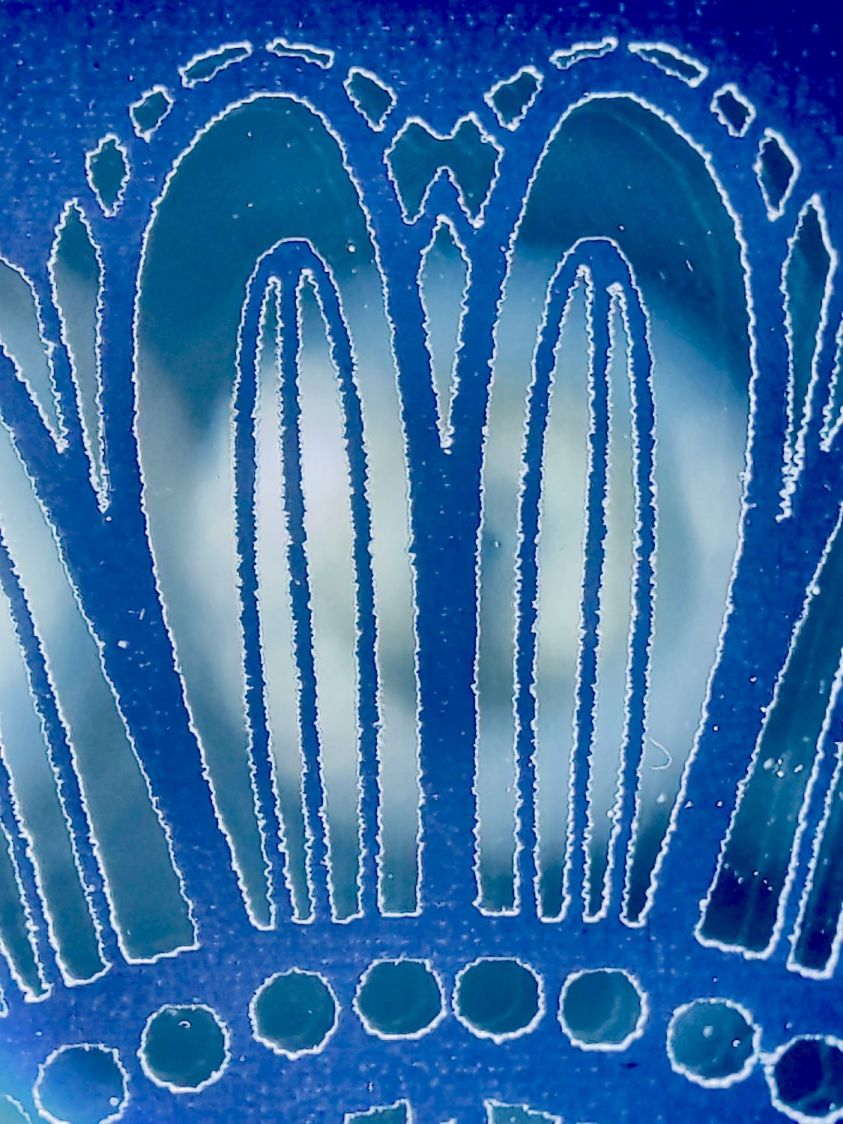
A slide show giving a closer look:
Back-painted mirror coaster – gray detail
Back-painted mirror coaster – black detail
Back-painted mirror coaster – blue detail
In person, all of the gritty edges and imperfections vanish, because they’re all well below eyeballometric resolution: you can see them, but only if you look hard.
Those are at 500 mm/s and 15% PWM, which is too fast for fine details due to the HV power supply’s bandwidth limitations. However, the tube doesn’t fire reliably below about 10% and tends to sprinkle speckles over the surface, so there’s not much leeway to slow down.
That’s after an inadvertent drop edgewise onto the concrete patio.
Stipulated: given what I’ve already done to / for the thing, the usual warranties do not apply.
The frame around the NP-BX1 lithium batteries held the glass fragments together surprisingly well:
Kitchen scale – shattered glass – detail
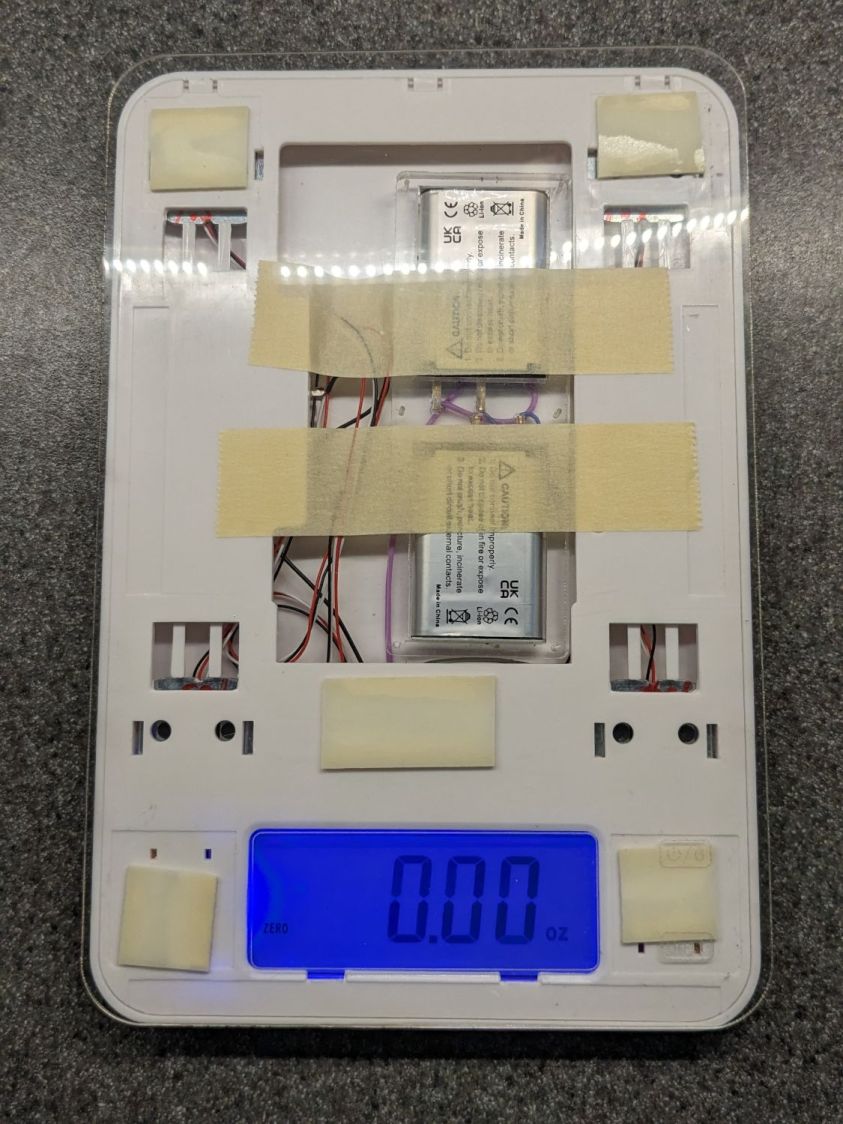
Of course, harvesting the good stuff resulted in a pile of fragments, but the carcass cleaned up nicely and, after grafting a temporary top made from scrap acrylic it still worked:
Kitchen scale – temporary surface
I expected to just cut a slab of 6 mm acrylic to match the original 5 mm glass, but for reasons probably related to dielectric constants, the touch controls do not work through that much acrylic. In fact, they don’t work through anything other than the 1.5 mm acrylic shown above, which seems a bit too flimsy for normal use.
The original glass had a design screened on the back surface and covered with paint, which I can certainly mimic, but right now I’m unsure how much effort to put into the thing.
This required her to take her left hand off the handlebar to fiddle with the assist level and, as it turned out, used her thumb in position causing some distress. Given that changing the assist level happens a lot as we ride, it was time for a change.
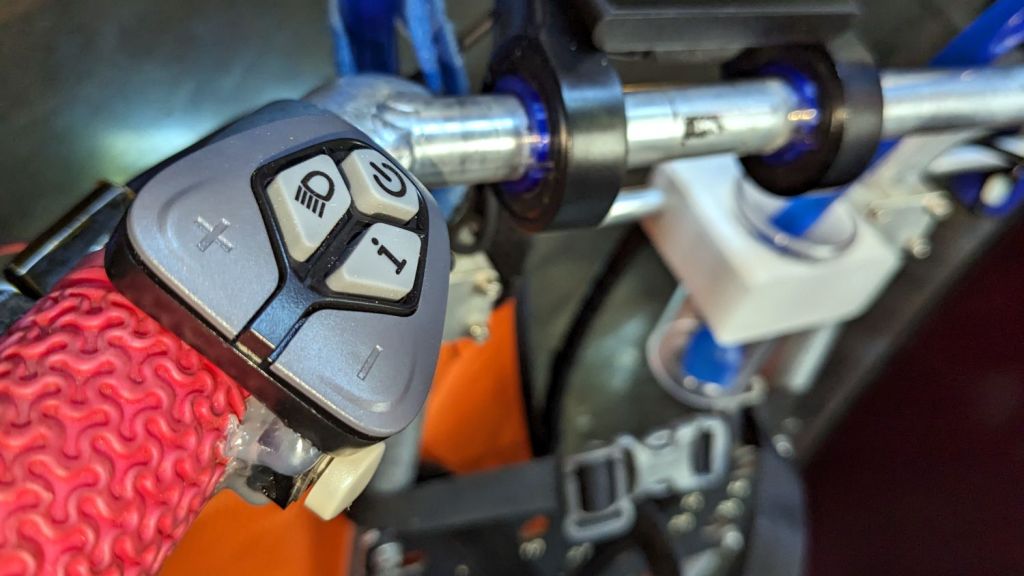
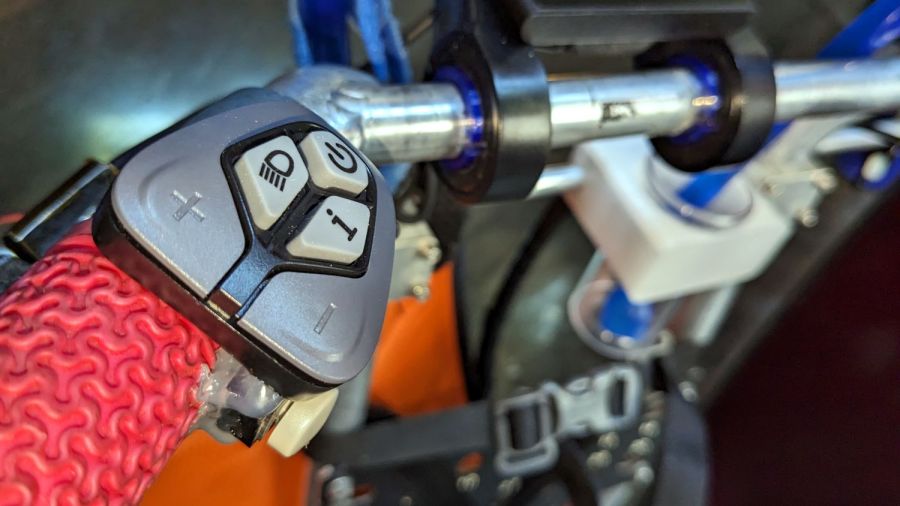
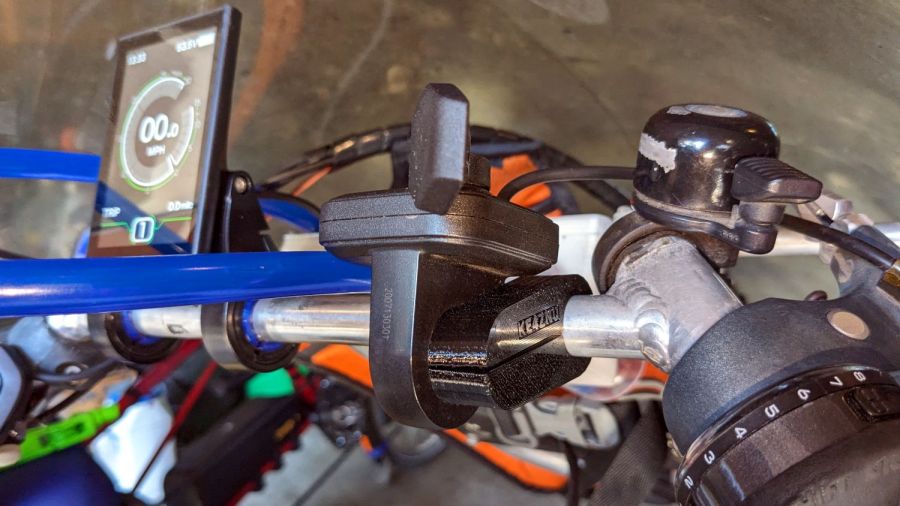
So I replaced the 500C with a DPC-18 display like the one on my bike, with the key advantage of putting the buttons on the handgrip:
Tour Easy Bafang Controls – DPC-18 buttons
She preferred a higher position for the buttons than I do, with the PTT button for the Baofeng amateur radio below the housing.
That location requires a bit of dexterity, but let us move the twist-grip shifter upward on the handgrip where it is more comfortable. She rarely uses the throttle, so we’ll try this for a while.
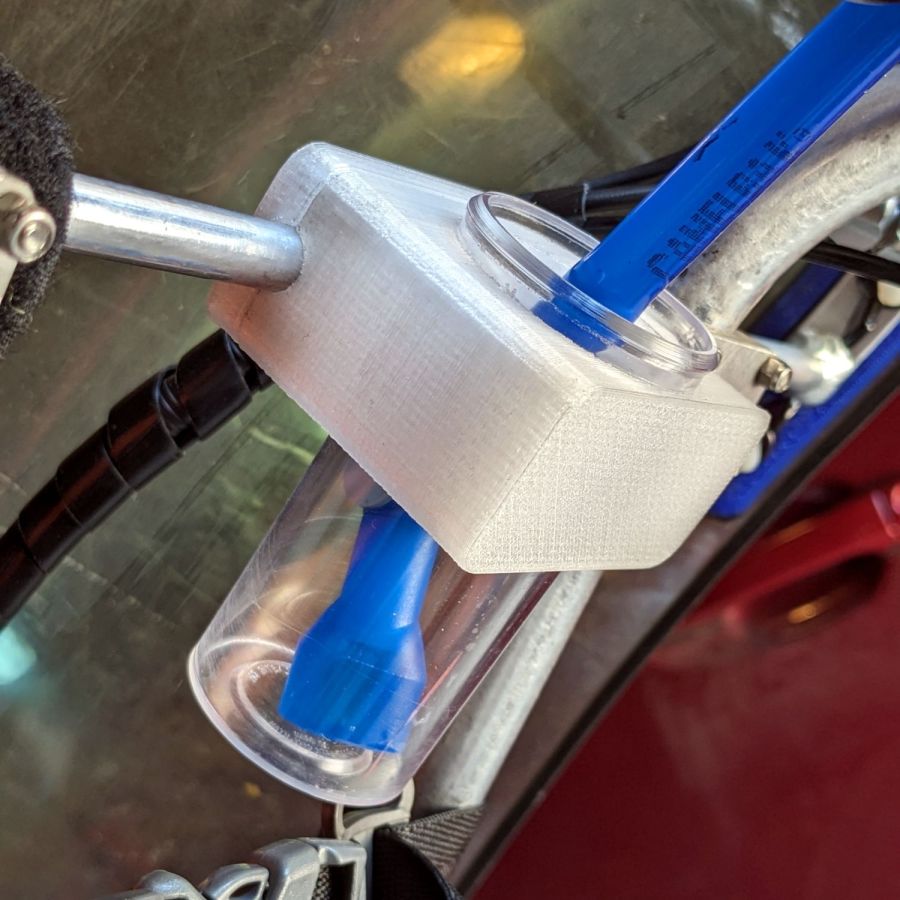
The DPC-18 has an awkward portrait-mode display with an incredible amount of wasted space, with the side detriment of displacing the blue Camelbak hose. After a few iterations, we settled on a receptacle to catch the mouthpiece without requiring any fancy snaps / clips / fasteners:
Tour Easy Bafang Controls – Camelbak nozzle catcher
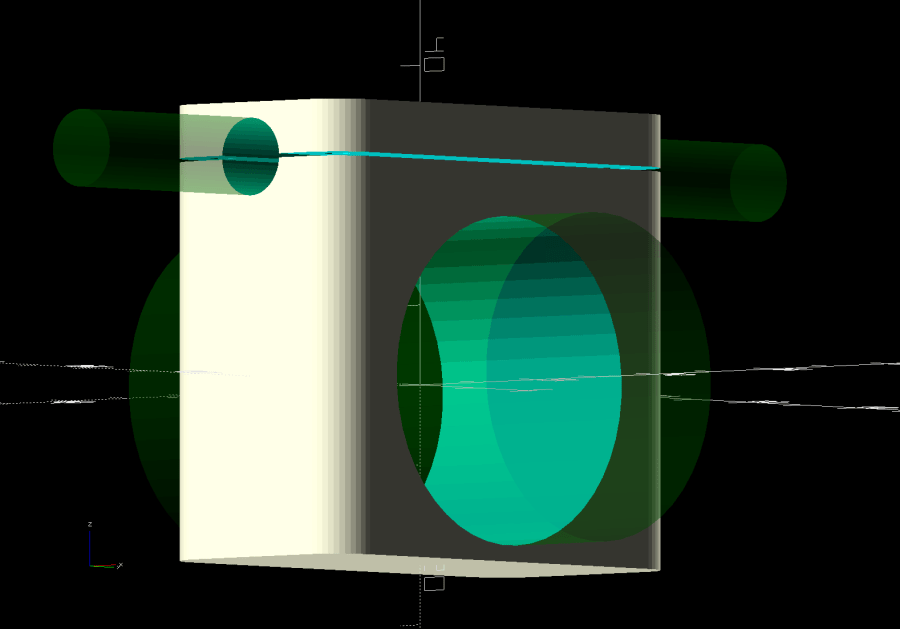
The solid model descends from the Zzipper fairing mounts on that same aluminum bar, with the bottle simply jammed into the big hole:
Zzipper Fairing – Camelbak nozzle catcher – show layout
There being no real forces on the holder, I omitted the aluminum load-spreading plate across the top and just epoxied four threaded brass inserts into the bottom part.
Early reports suggest a happier thumb and no problems stashing the hose, so it’s all good.
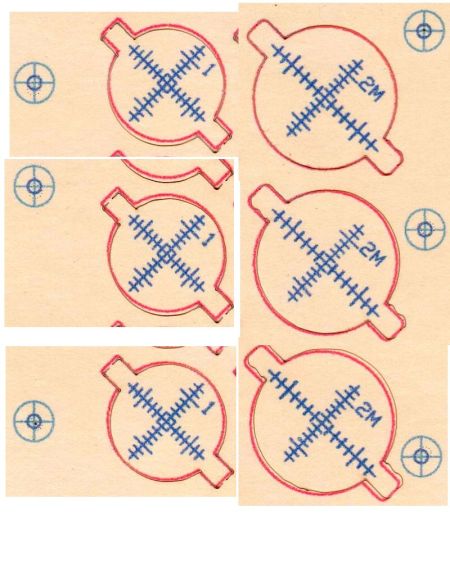
The smaller targets fit neatly into the hole perpendicular to the beam:
OMTech CO2 Mirror 2 mount – Y Z screws
The larger ones sit flush on the mirrors at 45° to the beam, so stretching the horizontal scale by 1.414 = √2 makes each tick mark correspond to 1 mm of perpendicular beam offset.
All of which worked surprisingly well, with some caveats.
The first gotcha: ordinary consumer-grade inkjet printers do not have CNC accuracy. The corner targets are on 150 mm horizontal centers and 240 mm vertical centers in the LightBurn layout, but my Epson ET-3830 printer put them on 150×241.3 mm centers. This isn’t unexpected, particularly for laser printers, but it means you must use LightBurn’s scaled version of the P-n-Cut alignment.
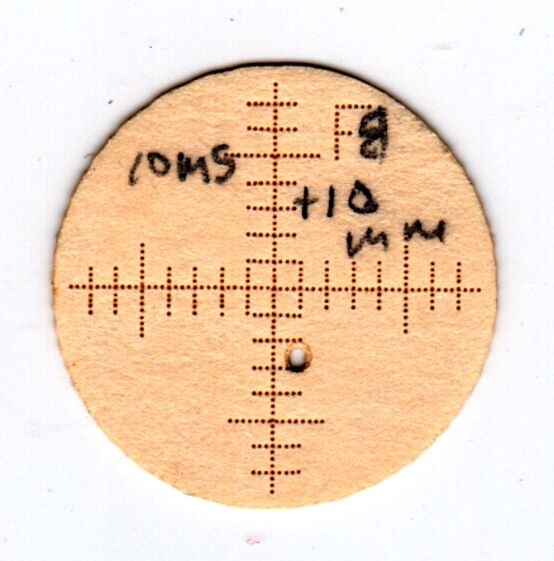
I used the upper-right and lower-left targets for the P-n-Cut alignment step, confirming the positioning with a laser pulse putting a tiny hole in the paper:
Print-and-Cut – target accuracy
The lines are 0.5 mm wide and the inner circle is 2 mm in diameter, so my alignment at the upper right is as good as it’s gonna get and the lower left is off by maybe 0.3 mm. While it may be possible to be more accurate, I think half a millimeter is a reasonable error budget for targeting accuracy.
The laser-perforated circles should overlay the inner printed circles after LightBurn applies the P-n-C corrections. That they obviously do not indicates the effect of the small target errors. In any event, the maximum error seems to be 1 mm, which gives you an idea of just how precise P-n-C might be.
The perimeter laser cuts are off by about the same amount & direction as the dotted circle in the adjacent target:
Print-and-Cut – perimeter matching
Overall, errors around 1 mm seem possible with careful attention to detail, but expecting anything better than a few millimeters is probably unreasonable, particularly for layouts larger than a Letter size page.
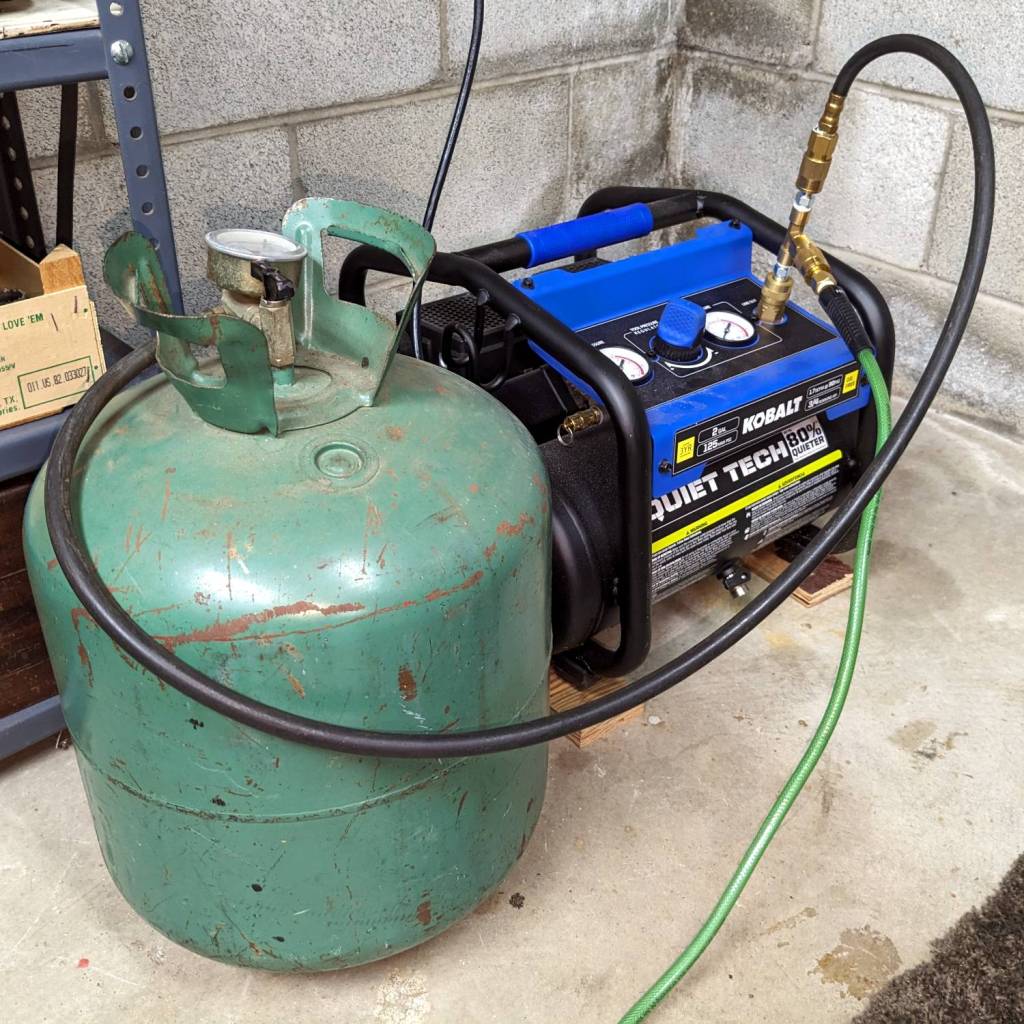
The normal dual-flow assist air setup has a flow control valve (the knob sticking up on the right) normally set for 2 l/min from the air pump:
OMTech Laser – air assist – plumbing
I cranked that valve completely open to allow unrestricted flow with the solenoid (block in the middle) closed and varied the compressor’s output pressure while measuring the air flow.
Without further ado, the assist air flow rate as a function of the inlet air pressure just upstream of the Y fitting on the left:
Assist Air flow vs inlet pressure
Fairly obviously, the flow is not 5.5 l/min at 0 psi inlet pressure and the long & skinny air hose limits the flow above 15 l/min. The eyeballometric line looks pretty good in the middle, though.
Other measurements not shown here suggested the outlet pressure, as measured just downstream of all the plumbing / upstream of the flowmeter & hose to the laser head, is about 1 psi at 10 to 12 l/min flow, with 0.2 psi at 8 l/min. My pressure gauges have terrible accuracy at such low pressures, so I don’t trust those numbers, but the plumbing definitely accounts for most of the inlet-to-outlet pressure drop.
The nozzle on the laser head is 4.1 mm ID → 13.2 mm²:
Magnetic Honeycomb Spikes – MDF
A flow of 10 l/min produces a 13 m/s = 28 mile/hr wind through the nozzle, which seems adequate to blow the fumes out of the kerf, and the low-flow default of 2 l/min might be a 5 mph breeze.
More air pressure would produce more wind, but it’s not clear how much better the resulting cuts would be.
A rear spoke snapped on Mary’s Tour Easy while we were at the far end of a ride. Unlike most broken spokes, the flanged end that I couldn’t maneuver the stub out of the hub and deploy the FiberFix, so we rode home slowly while avoiding as much rough pavement as feasible.
Once in the shop, pulling the sprocket and extracting the stub posed no problem:
Tour Easy broken spoke
Install the new spoke, crank to 23 on the Park Spoke Tension Meter to match the rest of the wheel, check the truing, and it’s all good.
At some point in the last two decades of riding, it seem the chain fell off the high side and gouged the spokes around the hub:
Tour Easy broken spoke – damage
If another spoke snaps in the near future, I’ll replace the lot of them, but until then, well, there’s riding to be done …
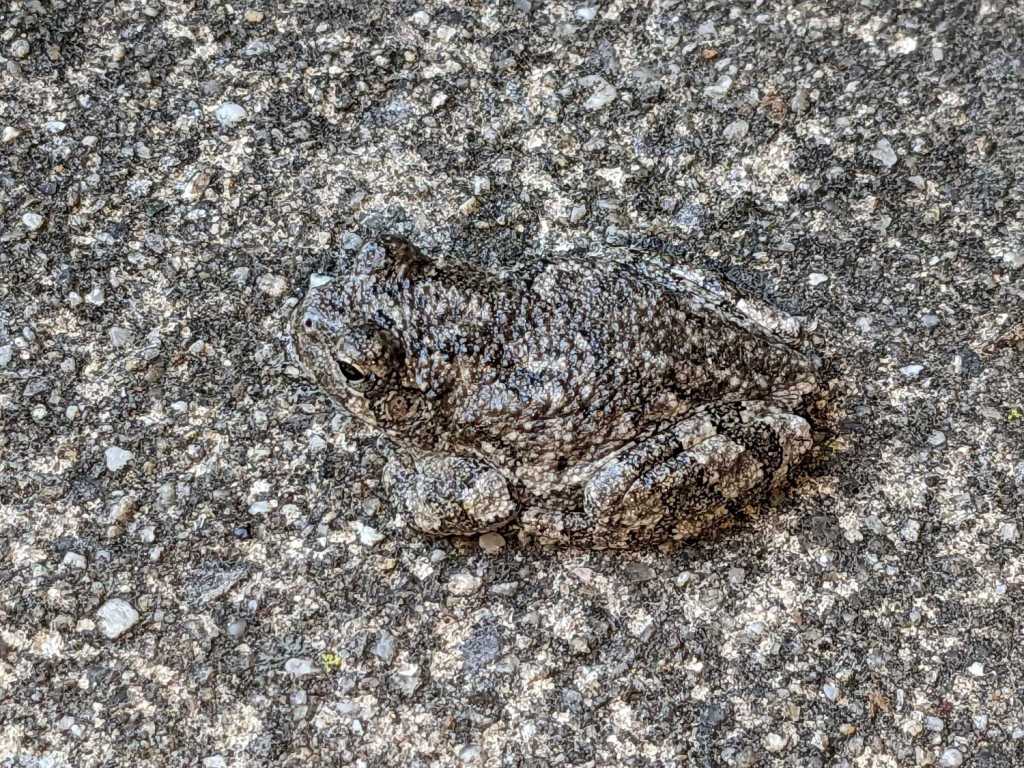
If I hadn’t seen it with my own eyes, I wouldn’t have believed it:
Gray Tree Frog on concrete
In point of fact, I almost didn’t see it.
This was the fourth time Mary deported the critter from her gardening shoe, whereupon it hopped out of her hands onto the concrete patio. She hauled it to the far end of our lot and wished it well; so far it has not returned.
We are reliably informed it’s a gray tree frog, not a toad as we originally thought.








 The Smell of Molten Projects in the Morning

