Ed Nisley's Blog: Shop notes, electronics, firmware, machinery, 3D printing, laser cuttery, and curiosities. Contents: 100% human thinking, 0% AI slop.
My buddy Eks just replaced his host-water furnce with a high-efficiency unit.
Can you tell that Eks is an engineer?
The plumber used one of those fancy pipe-compression tools that mashes the mating parts together with an O-ring for sealing. Faster and safer than sweating the joints together, but I want to fast-forward two or three decades to check out the durability.
An engineer’s furnace plumbing
Copper compression joints
As he put it, “You may be able to get a better furnace installation, but you probably can’t pay any more for it…”
Having decided to try getting sunglasses from one of those “our lab is in Hong Kong” places, the question arises: what lens & frame size do I need?
Rummaging through the heap produces this assortment:
Frame label
Lens size
Frame width
Earpiece
Commentary
53-19
53×40
141
145
Current glasses
55-16
55×45
142
140
Current sunglasses
54-16
54×45
133
135
Old sunglasses
56-16
56×45
137
133
Wire rims, aviators
52-19
52×39
140
140
Clear, previous daily
56-16
58×50
135
130
Aviators, too big
The obvious conclusion is that any lens in the low 50s x 40-ish range will suffice. Pity that the LPS (low-price supplier) doesn’t have anything non-aviator-ish or un-dorky (even by my slack standards) in the 40-ish range, but maybe it’ll work out OK.
Some general observations.
I used to wear relatively large aviator-style lenses, as I worked on little parts that occasionally went sproing. Not enough energy to merit safety glasses, but annoying enough to want good eye coverage. These days, alas, I tend to wear a headband magnifier.
Progressive bifocals require a relatively tall (and, it seems, currently unstylish) lens. Aviators solve that problem, but really are too large for my face. No matter that I wore them for years.
Anti-reflection coating is wonderful. Pity that the LPS can’t put it on tinted lenses; I’ll see how that works out.
I wear one pair of glasses all day, every day, and take fanatic care of them; we have an ultrasonic cleaner pretty much dedicated to eyewear. By and large, my lenses last forever. The frames, as you’ve seen there, tend to fail first.
[Update: It turns out 53×35 lenses really aren’t tall enough for gray 20% transmission sunglasses: the progressive transition is a bit cramped and there’s too much daylight around the top & bottom. I think they’ll be OK for biking, as I wear hideous goggles to keep the dust out of my eyes. A pupillary distance of 62 seems OK. About $63 delivered.]
The turkeys were discussing their activities yesterday evening while getting ready for bed in the trees out back. This isn’t unusual, but they seemed rather louder than usual.
We walked out the driveway, me with the Sony DSC-F717 in IR Night Shot mode, and eavesdropped for a while. The two early birds in the trees may have been air bosses for the rest of the flock, as nobody else arrived while we were there.
So I didn’t get any pictures, but it reminded me of some I took a few years ago when a hen with a gaggle of chicks roosted in a maple directly in front of the house.
Three peeps are easy to see, but she had at least two others snuggled up on her left side!
As described there, I set up a cron job to back up our low-budget file server to an external USB drive and turn it off for the night.
After a while, it became painfully obvious that
shutdown -P now
was, at best, intermittently successful at turning off the power. The shutdown sequence would sometimes hang near the end, with a blank screen, after unmounting all the drives (so there are no logs), with the power on. Keyboard & mouse were dead, tapping the power button produced a display about acpid being unhappy, but nothing I could follow up.
Oddly, that same command issued from a terminal window would work perfectly for as long as I was willing to restart the machine.
Even more oddly, the box would shut off properly from the GUI or the GDM login scren.
A puzzlement…
After several days of tedious “try this” experimentation and rummaging through the scripts in /etc/init.d/, it seems this command works in the cron job the way it’s supposed to
halt -p -f
The -p calls for a power-down and -f says to force the halt (rather than calling shutdown, which we know won’t work).
So, finally, I can hack 25% off the power bill for that thing.
Memo to self: some day, figure out exactly how the whole shutdown sequence works.
Maybe it’s just me, but all of the laser pointers I’ve bought, even the relatively spendy ones, have crappy switches and unstable battery contacts.
For example, this is the business end of a $12 (!) pen-style pointer. The battery contact was off-center and poorly secured; I pried the white plastic retainer out, bashed the spring into submission, and replaced the retainer with a length of heat-shrink tubing. It wasn’t pretty.
This pointer has an actual mechanical switch module inside, with a clicky mechanism actuated by the external button. Cheaper pointers seem to rely on bare PCB contacts bridged by the button’s base. Ugh.
Laser pointer battery orientation: positive DOWN
Memo to Self: The AAA cells fit into the housing with the positive terminal away from the laser head. The white plastic plug has a molded cross that could be mistaken for a + symbol, but it’s not.
When you put together a presentation, add this slide at the very end.
Display it while you’re setting up the projector so you can make sure all the corners are on-screen, all the colors work, and that the circles are actually circular. Your audience will appreciate your consideration.
The text font should be whatever you’re using for the main body text in the presentation. If you think the text I’ve used is too large, then you’ve never sat in the back of your own presentation…
When you’re ready to start, whack the Home key and your regular title slide will appear.
Here it is as a single-slide PowerPoint presentation, because WordPress doesn’t allow uploading OpenOffice ODP presentations. Copy the slide into your own file and let your audience move around accordingly.
Mary recently replaced her well-worn REI packs with a pair of Novara Transfer panniers, chosen because they’re just about the biggest packs available without insanely specialized world-touring features. They seem rather less rugged than the older ones, so it’s not clear how long they’ll last.
They fit her Tour Easy recumbent fairly well, but there’s always a bit of adjustment required.
Ramp on front edge of lower clamp rail
She hauls tools and clothing and veggies to & from her gardens, food from the grocery store, and the Token Windows Laptop to presentations. She brings the packs inside, rather than leave them on the bike, so they get mounted & dismounted for every ride.
The packs hang from the top bar of the rear rack, with a sliding clamp near the bottom of the pack that engages the rack’s vertical strut. I adjusted the clamp to the proper fore-and-aft position, but we found that the front end of the rail holding the clamp jammed against the seat support strut. That’s not a problem found on a diamond-frame bike.
The top picture shows the solution: Mr Pack, meet Mr Belt Sander. A ramp chewed onto the front end of the rail lets it slide neatly over the strut and all is well. The only trick was to avoid sanding through the pack fabric: the line perpendicular to the rail is sanding dust, not a gouge!
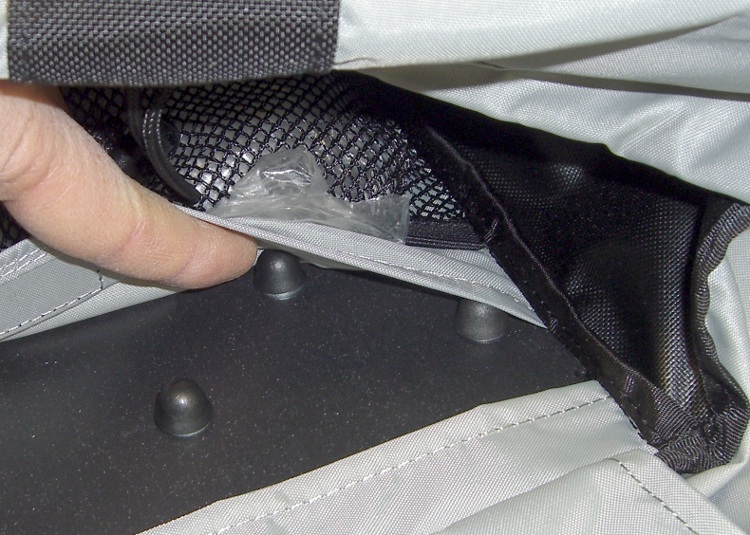
Acorn nut caps inside pack
Each top rack hanger mounts to the plastic pack frame with three bolts covered by plastic acorn nuts on the inside; the acorns cover actual metal nuts, so it’s a lot more secure than it looks. Three more bolts secure the bottom rail to the frame, with three more acorns poking into the pack, for a total of nine acorn nuts.
Most folks carry clothing and suchlike in their packs, so the 10 mm bump at each acorn presents no problem. Unfortunately, those things look like a nasty bruising hazard for soft veggies and groceries.
Top hanger pad – outside view
I sliced up some closed-cell foam packing material (everybody saves some of that stuff, right?), punched holes at the appropriate locations, and tucked the pads over the acorns. An inner fabric layer covering the frame and nuts should hold the pads in place.
Bottom pads with hole punch
It’s not clear the bottom pads will stay in position, but I wanted to try this without adhesives, mostly because I doubt any adhesive can secure polyethylene foam to whatever plastic the pack frame is made from or coated with. Perhaps double-sided foam tape will work?









 The Smell of Molten Projects in the Morning