The Smell of Molten Projects in the Morning

Ed Nisley's Blog: Shop notes, electronics, firmware, machinery, 3D printing, laser cuttery, and curiosities. Contents: 100% human thinking, 0% AI slop.

Author: Ed

  • Tour Easy Rear Brake Noodle Extension

    Noodle Extension and Parts
    Noodle Extension and Parts

    Our Tour Easy recumbents have linear-pull brakes on the rear and, for some reason, the noodle on Mary’s bike didn’t quite clear the frame: the cable bent slightly around the frame when the brake was active.

    That made the brake difficult to adjust, as linear-pull brakes depend on an exact balance between the restoring springs on each side. With the cable pulling to the right, the left-side pad would contact the rim first and give the brake lever a mushy pull until the right-side pad clamped down.

    A quick lathe session applied to some nylon scrap turned out an extension tube that fit between the steel noodle and the (slightly broken) plastic hoodickie that engages the brake arm. I used nylon (or something slippery like that) to make sure the cable wasn’t going to bind on it.

    Epoxy Potting
    Epoxy Potting

    The noodle originally fastened into the plastic hoodickie with a small collar that snapped into a pair of holes, but I took a shortcut: JB Kwik Epoxy. The shank end of a small drill slip-fit into the hoodickie’s cable passage kept the extension aligned while the epoxy set up. The masking tape prevented the epoxy from drooling out through the two small holes: the cured epoxy plug will have a pair of retaining posts in exactly the right places. The smears on the plastic parts chipped right off, not that anybody will ever notice.

    I’m depending on spring force to hold the noodle in the extension, which seems to be working just fine. This is one of those jobs where everything’s under compression all the time and the cable tension ensures good alignment.

    The socket on the extension’s fat end is a snug fit to the collar swaged on the noodle; other noodle varieties seem to have other sorts of ends, so check to make sure this will work for you.

    Noodle Extension Installed
    Noodle Extension Installed
    Added Brake Cable Clearance
    Added Brake Cable Clearance

    These pix show the brake assembly from below (the paint failed on the frame cross-member early on and I’ve been meaning to slather some rust converter on that spot for years. Sigh.) and the now-positive clearance between the brake cable and the frame with the brake applied.

    And, for future reference, the dimensions…

    Noodle and Extension Dimensions
    Noodle and Extension Dimensions
  • Avid Rollamajig Repair

    Avid Rollamajig with new ball socket
    Avid Rollamajig with new ball socket

    Mary’s shifter cable broke at the rear derailleur, causing the Avid Rollamajig to undergo spontaneous auto-disassembly. The only part we couldn’t find was the socket between the ball and the derailleur’s adjusting thimble.

    Good news: my parts heap had the Rollamajig from my bike, which I’d replaced because the most recent derailleur has an integrated gadget that serves much the same purpose.

    Bad news: the socket had a chunk broken out of it and I didn’t want to put a broken part on Mary’s bike.

    Good news: at least I could measure the dimensions to build a new socket.

    Bad news: it needs a spherical socket for what measures out to be a 6.8 mm (0.268 inch) plastic ball and that’s not one of the three ball-end mills I have in the tooling cabinet.

    Good news: this isn’t a really critical high-speed / high-stress rotating joint. Pretty good will be close enough.

    Sherline chuck in lathe chuck
    Sherline chuck in lathe chuck

    Turning the part was a quick lathe job on a random hunk of what’s probably nylon.

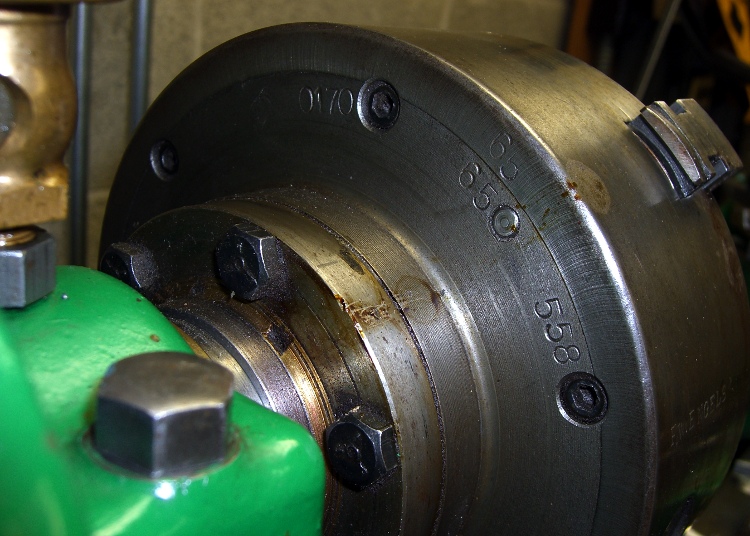
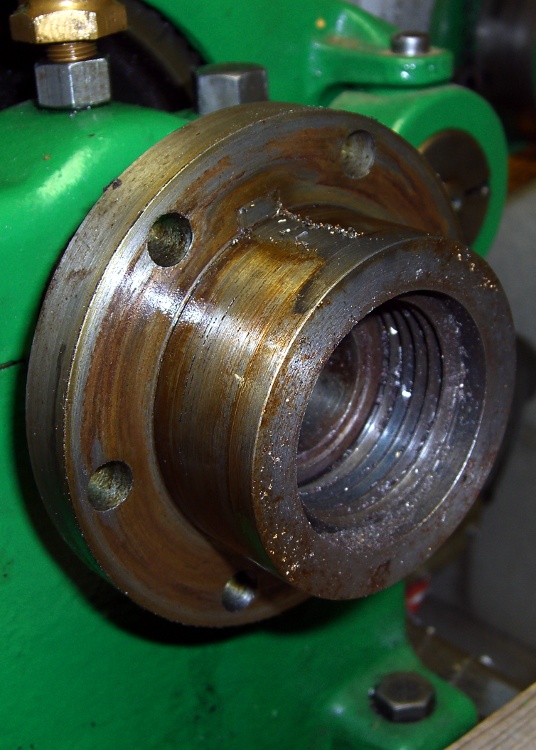
    Bad news: the nylon was a rectangular cutoff from a slab and the three-jaw chuck on my lathe has been firmly stuck for the last year. It’s resisted all the non-Armageddeon-scale techniques; I fear I must machine the damn thing off.

    So I…

    • mounted the nylon in the Sherline 4-jaw chuck
    • grabbed that teeny little chuck in the lathe’s much bigger 3-jaw
    • converted one end of the square hunk into a cylinder
    • removed the small chuck
    • mounted the cylinder end in the 3-jaw
    • completed the mission
    Offset roughing mill
    Offset roughing mill

    Lacking the appropriate ball-end mill, I offset a ball-end roughing mill in the tailstock chuck so the near side was at the right radius from the lathe axis, then poked it into the end of the socket-to-be.

    Which, of course, produced a not-quite-spherical dent that was a bit too shallow, so I chucked up a too-small ball mill (on the centerline) and carved out the bottom of the socket. The result was a more-or-less spherical socket of about the right depth, pretty much.

    The right way to do this, and what I was going to do before I came to my senses, was turn the part on the lathe, drill the axial cable hole, then chuck it up on the Sherline CNC mill. Getting a spherical socket of exactly the right radius and depth using a too-small ball-end mill is then a simple matter of G-Code. Maybe I should write that up for my Digital Machinist column…

    Yeah, you could use a ball-turning attachment, if you should happen to have one. Sue me.

    Broken and new sockets
    Broken and new sockets

    Anyhow, it all worked out OK. The new socket is slightly longer than the old one, as it’s made to fit the derailleur thimble at hand. The end around the socket is slightly thicker, too, as it seemed more meat would add more durability where it was most needed.

    The Rollamajig seems to be discontinued, although some of the smaller online sources still offer it. Building one looks like a straightforward shop project to me.

    Ball socket dimensions
    Ball socket dimensions

    The sketch has dimensions in inches, because I was doing this on the lathe. Our daughter measured it in metric and came out with much the same answers, so it’s all good.

  • Serial Ports in Wine

    Setting up serial ports in Wine is evidently automagic for the old-standard-hardware ports that appear as /dev/ttyS0. Unfortunately, that seems to not work for USB serial ports that appear as /dev/ttyUSB0 (or whatever is next in line when it’s plugged in).

    The quick-and-dirty solution is to set up symlinks, thusly:

    cd ~/.wine/dosdevices
    ln -s /dev/ttyUSB0 com3

    and so forth. As long as the USB gadget pops up with the same number, that’ll work.

    It is best to avoid any built-in hardware ports that already have automagic com1 / com 2 / whatever identifiers. Start with com3 or higher unless you know com1 / com2 are vacant. I suppose some laptop IRDA (remember that?) ports may still show up as com3 / com 4.

    Unlike the other devices, there’s no trailing colon. They’re also lowercase, although Windows sort of expects uppercase; that’s evidently handled under the covers.

    This would be better handled by UDEV magic that creates the appropriate links on the fly based on the USB device ID, but just hand-creating the links works well enough for my simple needs so far.

  • Cellular Toad

    Toad in planter cell
    Toad in planter cell

    Mary left a plant starter pot on the patio overnight and found an unexpected resident when she picked it up: a toad tucked neatly into a vacant cell.

    It’s difficult to tell with toads, but we think that’s a smug expression. The cell was just exactly body-sized, so maybe it’s a snug expression.

    Toad in garden
    Toad in garden

    Put back in more natural surroundings, in the garden with abundant flies & bugs, the critter faded right out of sight.

    The plant is celeriac, which sounds like it should be a computer built around 1946…

  • Bird Box Entrance Reducer

    Wren-sized entrance reducer in place
    Wren-sized entrance reducer in place

    We put out bird boxes to encourage more House Wrens, but House Sparrows often take over the boxes. This year we kept the boxes down until the sparrows had already started their nests in the bushes, hoping that the wrens would get a head start on their nests. Two days after we put the boxes up, we had a nesting pair of wrens… and two days later a pair of sparrows had evicted them and were installing their own nest.

    Rechecking the box specs, it seems wrens prefer a hole somewhere between 7/8″ and 1-1/8″, but I’d drilled 1-1/2″ holes for bluebirds (a long time ago, before we knew bluebirds vastly preferred the edges of open fields). Making a hole larger is easy, making one smaller is more difficult.

    Cutting off the barb
    Cutting off the barb

    I thought of making a wood bushing, then came to my senses: a 3/4″ thick wood ring with 1/4″ walls just wasn’t going to work. Given that the wrens (or their ancestors or relatives) have already tried nesting in our gardening boots, bicycle helmets, and tool trays, I figured they wouldn’t be too fussy about the material around their entrance hole.

    To the Basement Laboratory Machine Shop Wing!

    The parts heap disgorged a box of huge hose barb fittings, one of which had a 1.1″ ID and a 1.4″ OD: close enough. I parted off 3/4″ from the end of the barb, using a bit not really suited for the purpose that gave a nearly perfect edge in the soft plastic. One swipe with a deburring tool and it’s done.

    Bushing ready to install
    Bushing ready to install

    A few wraps of duct tape provided a nice press fit and a springy retaining force without gluing the barb in place. This is pretty, mmmm, barbaric, but if it survives one nesting cycle I’ll do something much nicer.

    Time is definitely of the essence here, as we fear the wrens have been driven away: we haven’t heard them since their eviction. I did three boxes in about half an hour; we’ll see what transpires.

    The bottom pic shows the box from the front yard, where Downy Woodpeckers nested for a few years. They thought the hole needed a bit of renovation… and they have the tools for the job!

  • Terracycle Idler Shaft Cleanup

    Crusty Sliding Shaft
    Crusty Sliding Shaft

    I installed a Terracycle Idler on Mary’s Tour Easy when the old chain tensioner wore out. It’s significantly quieter than a double-idler tensioner, but the rear derailleur can barely handle the 11-34 sprocket / 30-42-52 chainring combination.

    She likes it, that’s what counts.

    Anyhow, while poking around under the bike, I noticed that the idler no longer slid left-to-right on the shaft through the bearing. The bearing itself spun fine, but the shaft… ugh, they should have used stainless steel.

    The sliding motion is important, as the idler should self-adjust to the chainline during shifting. I don’t know how long this one has been jammed, but it could contribute to the noises she’s been mentioning of late and that have prompted me to embark on a major maintenance project.

    Cleaned Shaft Installed
    Cleaned Shaft Installed

    It shined up nicely with a Scotchbrite wheel in the drill press and now looks merely horrible; you can see the copper plating (wrong: see Update below) showing through. I had to hit one end of it with a medium diamond file to knock off an invisible high spot.

    I added a bit of lube and reinstalled it; the bearing slides back & forth like it used to, but I have my doubts as to how long this will last. Fairly obviously, the plating is shot.

    The next time it fails, I’m sure I’ll wind up trying to turn an exact 0.3125-inch diameter stainless-steel shaft with a polished surface…

    Oh, and the three orange retro-reflective strips? The idler turns backwards because it’s on the return side of the chain: it’s rather disconcerting and I figured it’d be fun to highlight it.

    Update: The folks at Terracycle say it’s plated zinc over a brass bushing… which (Ah-ha!) explains the corrosion.

    The zinc forms an anode against everything else on the bike; nothing is more anodic than zinc. Because the plating has no volume, it turns into a Fizzy at the merest sight of the usual road salt around here.

    Unplated brass would be better: more volume, cathodic against steel, anodic but pretty close to stainless, just as slippery. Might tend to wear against the inner bearing race, but I’d expect it to be at least as durable as the plating.

    Worn Terracycle Idler shaft
    Worn Terracycle Idler shaft

    Here’s a pic of the shaft from another Terracycle Idler I had on my TE for a while. While it’s not corroded, it’s worn through to the brass underneath. So maybe the plating isn’t buying much, anyway.

    I spent some quality one-on-one shop time with a random hunk o’ stainless hex rod, came up with a good-looking 0.304-inch OD (a nasty bit of overshoot, but I haven’t done any lathe filing in recent memory and forgot how fast it removes metal), and verified that the race will cock-and-jam rather than sliding nicely.

    The Terracycle folks will send a replacement shaft; they’re good folks who build quality stuff and stand by their products. I’m obviously abusing the poor thing…

    Update: The stainless shaft arrived and is sized for the 6 mm bolt they’re using in new production. When we discussed this, I said it’d be no big deal for me to adapt it to the existing 5 mm bolt. A length of heat-shrink tubing does the deed, as it’s rigidly held on both ends. A dab of Loctite, a dot of oil, and it’s back in service. We’ll see what happens after a few months of riding under my regime of benign neglect.

    Old brass shaft, new stainless steel shaft, 5 mm bolt with heatshrink
    Old brass shaft, new stainless steel shaft, 5 mm bolt with heatshrink

    A tip o’ the cycling helmet to Terracycle!

  • Quieter Luggage

    Muted zipper pull tabs
    Muted zipper pull tabs

    Luggage now comes with a pair of sliders on each zipper, which means that the two sliders come together when the zipper is closed. That allows you to lock the slider pulls together, which is a nice touch for those of you who think luggage locks actually improve security.

    It also means that the metallic pull tabs jingle and jangle merrily together in the back of the van all the way to grandmother’s house as we go, we go.

    Not to be tolerated, sez I.

    Apply a length of heat shrink tubing to each tab. If you’re a locking kind of person, leave the holes on the end exposed. If you’re a real cheapskate, you could get away with shrinking just one tube per pair, but even I’m not that far gone.