Ed Nisley's Blog: Shop notes, electronics, firmware, machinery, 3D printing, laser cuttery, and curiosities. Contents: 100% human thinking, 0% AI slop.
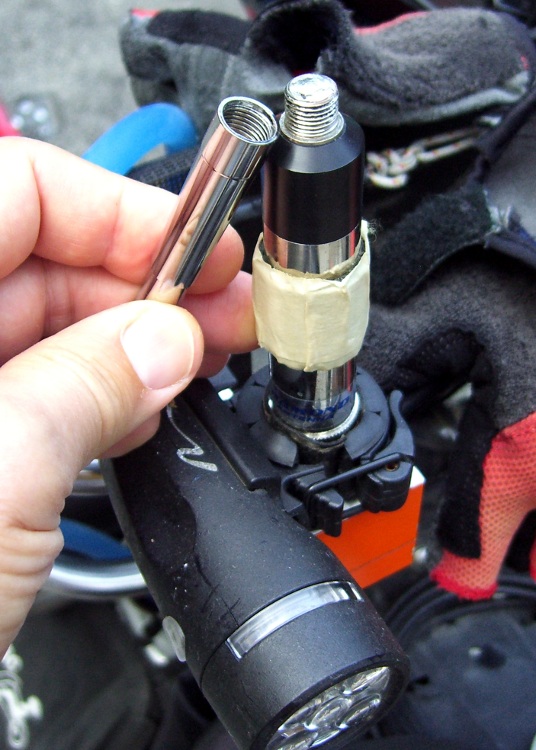
Vibration is a real killer for bike-mounted hardware. The antenna mast on my bike has been unscrewing itself, despite my repeated attempts to tighten it. Fortunately, I’ve managed to notice the rattle before the mast falls off into traffic.
We’ll see if a dab of medium strength (blue) Loctite will do the job.
One thing to worry about: this is an electrical as well as a mechanical joint. I hope there’s still enough metal-to-metal contact to get RF energy to the radiating part of the whip!
[Update: Yup, works just like you’d expect. Problem solved.]
The antennas on the other two bikes have remained tight, so maybe it’s just that my riding style generates more vibration? Hard to imagine; it’s not like I venture off-road.
More details on the homebrew mount are there and how commercial mounts fail are there.
The unsightly masking tape wrap is where I attached a reflector for a (rare) after-dark ride a while ago. Making a set of bushings for the reflector clamps is a low-priority job in the queue right now.
After dumping last month’s data, I conjured up a piece of double-sided circuit board and soldered a turret terminal to each side. It’s thin enough to fit between the cell’s positive cap and the holder’s contact without distorting things too much.
The lowest range on most of my digital meters is 200 mA, which is far too high. I tried an ancient analog meter with a 50 µA range, but the meter’s resistance was too high to keep the Hobo’s PC program happy: it claimed there was no logger out there. Finally I found a digital meter with a 4 mA range and 1 µA resolution, which was just right.
Turns out that the logger draws 8 or 9 µA between readings, which is pretty much what it should be. At that rate, a CR2032 lithium coin cell with a capacity of 230 mA should have a lifetime of 23 k hours: call it three years. Obviously, it’ll be less than that, what with periodic loggings and dumpings and suchlike.
The current’s the same with the external temperature probe plugged in and doesn’t change when I poke the capacitors. So the logger seems to be working perfectly.
Which means I got a bad batch of Renata CR2032s two years ago. I just pulled one from another logger that I installed 5 Feb 09: all of six months ago. If I installed a series of really feeble cells in this logger, well, that would explain what I experienced.
I’m currently using Energizers in the other loggers, so we’ll see what happens a year from now.
But I’ll keep the alkalines on the back of this logger, as they should last basically forever at this rate.
I picked up a Plantronics phone headset that’s nominally compatible with Kyocera phones, but of course not with the Virgin Mobile K127 Marbl I have. More on why I have that phone there. There are, as nearly as I can tell, no third-party headsets available for this phone.
The Plantronics headset has the pinout shown to the upper right in the note below. It’s straightforward:
shell — common
ring 1 — left audio
ring 2 — right audio
tip — mic + button
Plugging the headset in causes the phone to throw a hissy fit.
Jamming an open-circuit plug into the phone’s jack has no effect; the phone thinks there’s nothing going on and still routes the audio to the internal speaker.
Evidently, the phone expects a different combination on the plug.
Some Webbish rummaging produced a list of headset pinouts, which goes to show that there’s nothing like having enough standards that everybody can have one…
Headset Pinouts
More tinkering is in order, but I found this list while I was clearing away the rubble from some completed projects and figured I should put it somewhere obvious.
So our whoop-dee-doo Sears Kenmore HE3 clothes washer started emitting horrible scratching & grinding noises, but only every now and then during the high-speed spin cycle or, more rarely, the washing agitation cycle.
In an ordinary washer, you’d suspect the transmission was going bad, but the HE3 has a direct-drive 3-phase motor: no transmission to wear out.
A bit of searching shows HE3 washer drums may fall apart at their welded (?) seams, but that didn’t seem to be the case here. So I press-ganged our daughter into a plumbing job; the machine is something over six years old, so it’s not as if we have any warranty to void.
Move the washer out where you can get to the back without contortions. Pull the plug, turn off the water, unscrew the water supply hoses at the back panel, squash the hose clamp & remove the drain hose.
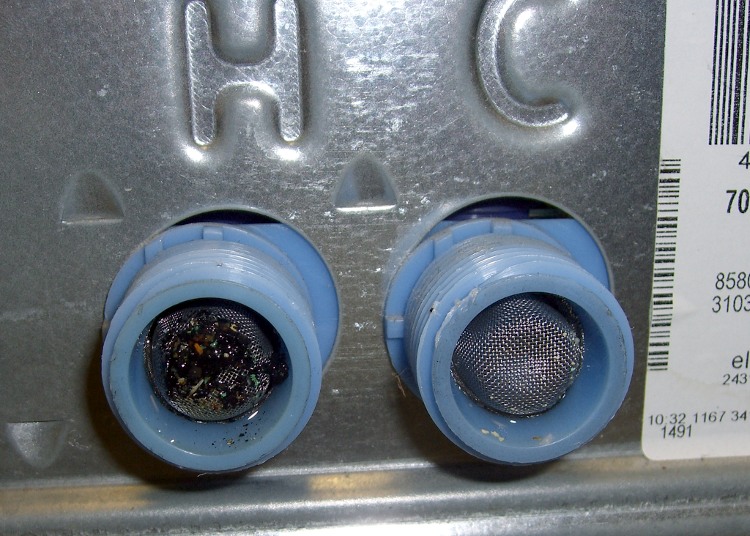
Sediment buildup in hot water inlet
One obvious, but unrelated, problem appeared when we disconnected the water hoses: plenty of black grit in the hot water inlet. Looks like it’s time to drain & flush the hot water heater again, which will turn into a major project because the anode rod has firmly rust-welded itself in place. That’s a project for another day…
Disassembling the cabinet requires a Torx T-20 bit. There are a lot of screws, so fetch a stable container to hold them all.
Take off the top cover (three screws, then slides back) to reveal the angle brace across the back that holds all the electronics and valves and suchlike. Pull the big vapor vent tube (on the right as you face the rear) out of that bracket, remove the eight (!) screws holding the bracket in place, and move it up out of the way.
Remove the back cover, taking care to not loosen the screws holding the frame crossmembers in place; those are the screws in the U-shaped cutouts along the edges.
Note: you can remove just the back cover by removing the lower screws in the angle brace, all the screws holding the cover, then sliding it down and out at the bottom. It’s easer to see what’s going on if you take the top cover off and moving the angle brace frees up a lot of gimcrackery that gets in your way. Your choice.
Everything connects to the drum housing through exceedingly flexible rubber boots held on by circumferential wire clamps. Grab the ends with Vise-Grip pliers, squash ’em together, and the clamp should slide off the housing onto the boot. Peel the boot off and you can look inside.
Foreign Object Sighted
Peering in through the pressure sensor opening in the bottom rear of the housing revealed something odd: a loose black cylinder. A bit of deft tweezer and grabber work pulled out a much-the-worse-for-wear ballpoint pen housing, minus the cap, point, and pocket clip. The fiber-fill ink reservoir formed a tuft at one end.
Mmmm, that would account for the blue water in the drain tube…
Combine the number of missing parts with an inability to see any of them in the bottom of the housing: more surgery is indicated.
Tub drain boot
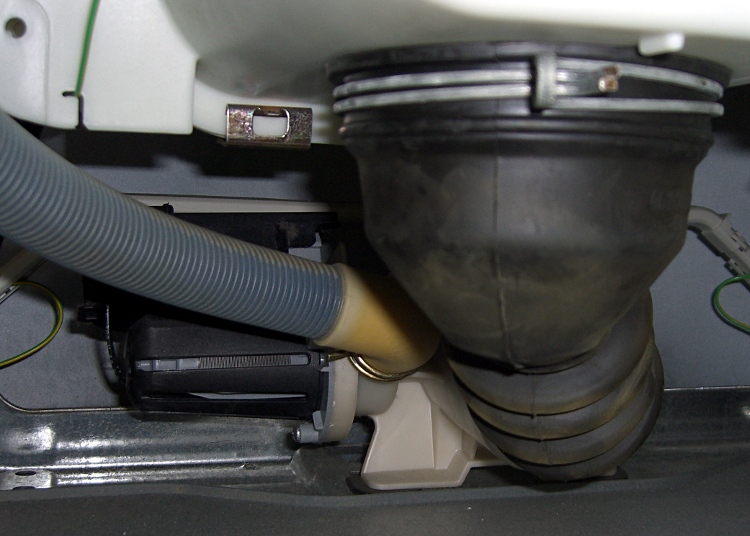
The housing drains into the ejector pump through that huge black boot clamped onto the bottom of the drum housing. Put a pan underneath the pressure sensor hole, squeeze the boot, and water will bloosh out the sensor hole, generally landing in the pan. There’s a floating-ball check valve inside the boot that prevents backflow to the housing, so you may need some wiggly-jiggly action to work the water around the valve. A few reps will get most of the water out of the drain boot.
Drain Boot Removed – Pump Inlet
Remove the boot from the housing and pump inlet, remove the ball, and admire the innards. We found most of the rest of the pen in the drain boot, plus a generous helping of slime and gunk. Oh, and a hairband and a big chunk of a pencil.
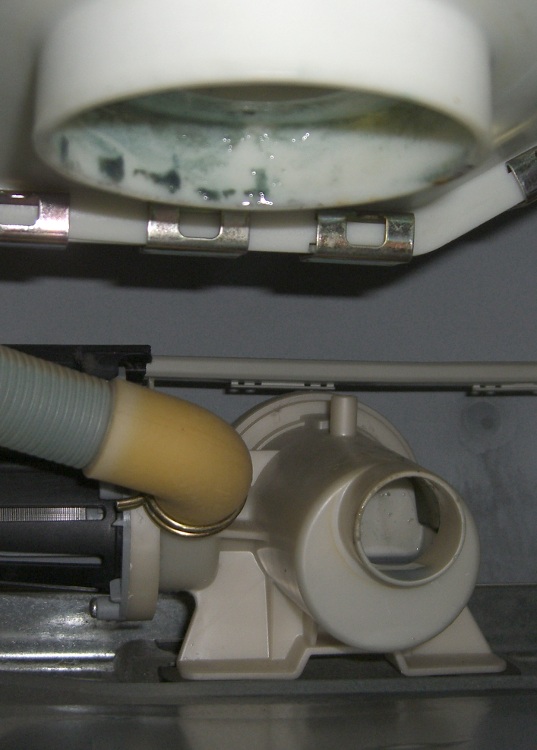
The pump has a juice-can-size reservoir just inside its inlet, which I think is there to collect debris: a barrier keeps most of the big chunks out of the pump impeller. There’s no way to get stuff out other than lying flat on your stomach and sticking your finger into that slimy hole, so get over it. We extracted the remaining pen bits and most of the rest of the pencil.
While you’re in there, roll over onto your back, reach up inside the drum housing and feel around to get anything else out. Your assistant can shine a flashlight down through the drum perforations; you’ll be able to see the shadows cast by any odds & ends that are lying on the housing.
Wipe the slime off the rubber boots, reassemble in reverse order, and you’re done!
However: the bottom of the washer consists of a big metal pan that will, most likely, start to rattle just after you push the washer back in position. Removal isn’t really an option because one of the front screws is under the motor drive box, but you can sort of pry up the edges and stuff thin cardboard, strips of duct tape, or other elastic stuff between the pan and the washer frame. It took me far too many iterations to figure out what was rattling around in there: it is not obvious!
Debris From Washer
Here’s what we found in the drum housing, drain boot, and pump settling tank: the corpse of one of my favorite Uni-Ball Micro pens, a tiny screw, bits of a pencil that my assistant had been looking for, and one of her hairbands.
That pretty much explains the intermittent grinding sounds: the drum would rotate normally until the swirling water swept the pen housing into contact with the drum, at which point the 800-some-odd RPM rotation would grind the pen against the housing for a few laps. Ditto for the pencil.
Now, the mystery is how that stuff got from inside the drum past the rubber sealing gasket into the space between the drum and the housing. There doesn’t seem to be any way to get a long rigid object through there, but obviously it happens!
Slime Behind Door Gasket
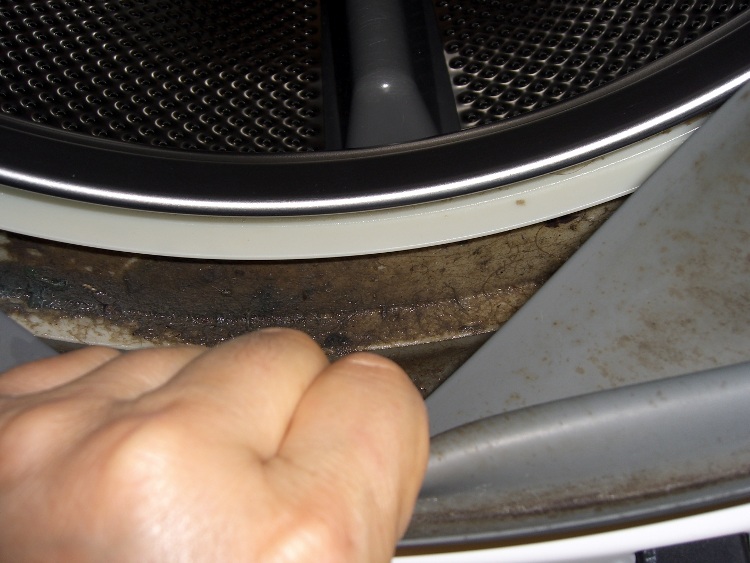
After you move the washer back into position, take ten minutes and a generous handful of rags to wipe the abundant collection of mold & mildew from behind the rubber gasket. You can sort of evert the gasket, which simplifies access to the edge of the drum. As you can see, ours has a nice biofilm going on in there; not visible is the gunk growing on the back side of the gasket.
It seems HE3 washers have a reputation for smelling bad, due to that sort of growth in hidden places. Oddly, we don’t have an odor problem, obviously not through any action on our part. Rumor has it that running a pure-bleach hot-water cycle helps, as does a product for dishwashers that removes their stink, but we don’t have any experience with those.
As a mental math exercise, I had my assistant divide the $300 bucks a plumber would have billed for this repair by the $7/hr she’d get for a typical minimum-wage shit job. She’s thinking that becoming a plumber might beat smiling at retail customers in a dying mall… but I think she should concentrate more on her math & science.
[Rant: Not that America seems to value tech jobs much these days, but she has the advantage of being female, so maybe she can still get a tech gig. Don’t get me started, you know how I get.]
Anyhow, the washer runs just as quietly as it ever did, which is to say that like a turbojet engine spooling up during the spin cycle. At least it doesn’t sound like it’s ingesting a bird every now & again…
Got a Digital Concepts CH-3988S charger with quartets of AA & AAA cells from buy.com (which no longer sells it, no surprise, but it’s still available elsewhere) on closeout for about 12 bucks delivered, down from the “regular” price of something like $40; anybody who paid that much got well and truly hosed.
I fully expected the cells to be crap and they were: they don’t even bear a manufacturer’s name. Tellingly, they weigh 25 grams each, lighter than the 28-30 grams of more cough reputable brands.
No-name AA NiMH – Charge 1
The upper trace (click the graphs for readable pix) is the four AA NiMH after the charger said it was happy with them. The trace drops off the cliff at about 25 mAh. Call it 1% of nominal capacity.
The four lower traces are the individual cells after another trip through the charger. The far-right end of those bottom curves is 70 mAh, with the cell voltage barely over 1 V for the entire discharge.
Fairly obviously, they’re not accepting a charge.
Charging the cells in a known-good 400 mA charger (roughly C/6) brought the best cell up to 160 mAh, with the rest around 100 mAh; the charger was happy with them after far less than 6 hours, so apparently the cells display a much higher terminal voltage than they should.
So I plunked them in a dumb 250 mA slow charger and let ’em cook for the full 8 hours. That should, in principle, give them roughly 2 Ah of charge, no matter what the terminal voltage may be; I measured 1.8 V, which is far too high for that rate.
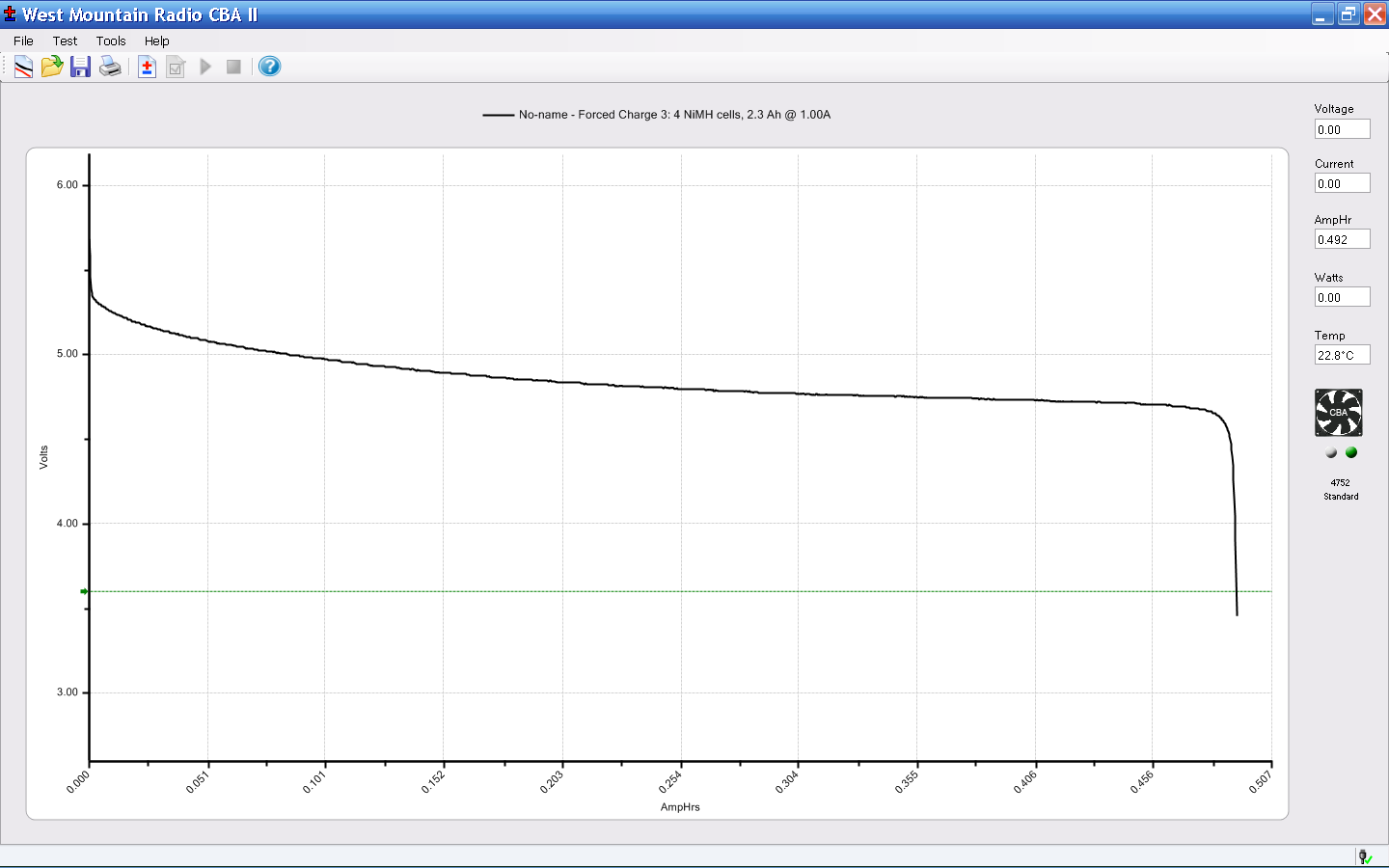
No-name AA NiMH – Forced Charge 3
So, here’s the result…
Crap. Pure, utter, unadulterated crap. The cells supplied 500 mAh, much more than before, but that’s so far below their rating it’s not even funny. There’s obviously one cell in there that’s bad, but the others can’t possibly be far behind.
I didn’t waste any time on the quartet of AAA cells, but I expect they’re pretty much the same.
It’s faintly possible that exercising these turkeys will bring them up to maybe 50% of capacity, but it’s not like that’d make me ecstatic. The reviews you’ll find here and there support the conclusion that something is wrong with these cells.
No-name AA NiMH – Charge 4
Here’s the result of the next cycle, after a night in their very own charger. The upper trace is all four of them together, once again failing after 500 mAh.
The four lower traces labeled “Cell x” are the individual cells, tested without recharging. Three of the four have about 700 mAh left in them, which would bring their total capacity to 1200 mAh, roughly half of their nominal capacity.
Cell B, the green trace, is obviously the weak link, as it failed almost instantly. Recharging it on a known-good charger got it back up to 530 mAh (the “Cell B recharge” curve), roughly 25% of its nominal capacity. So much for the idea it’ll get better if you treat it right.
Now, turning to the charger…
The Digital Concepts CH-3988S charger is advertised on its package as a “2 Hour Charger”, but its manual / datasheet indicates that claim is, mmmm, not strictly correct:
CH-3988S Charging Times
Remember that the nominal AA cell capacity is 2.3 Ah, so charging the four AA cells included with it requires three or four hours. Well, OK, only 2.5 hours if you do ’em pairwise, but that’s five hours total.
On the other paw, the charger does (seem to) monitor the cell voltage and cut off automagically, on either negative delta-V or maybe just peak voltage. Unleashing it on a pair of partially discharged Tenergy RTU 2.3 Ah cells indicates that it cooks the piss right out of them, there toward the end.
The charger is (probably) OK for low-rate charging of known-good cells, which is what I got it for; the cells accompanying it are crap. It’s not worth returning for twelve bucks, seeing as how the shipping would eat half of that.
So, anyway, if you ever wondered what a bottom-dollar charger-with-cells offer gets you, now you know.
Bezel bottom 3.3 mm thick, excluding depression on bottom surface
Screw head sticks out of depression 0.9 mm
Some deft work on the bezel installed in the camera, using the blunt end of a transfer punch, a pin vise, and a calculator reveals these protrusions:
1.4 mm does not trigger anything
2.1 mm triggers the half-pushed focus action
2.4 mm reliably triggers the shutter
So the new stem can stick out about 1.4 mm when the button is released and must not stick out more than 2.4 mm with the button fully depressed: a whopping 1 mm of travel!
Eyeballing the shutter release on my DSC-H5, that seems to be about right. I think it has more travel between “released” and “half pressed” than those measurements indicate, but it’s close. And sloppy, too: the H5’s button has a lot of side-to-side wobble, indicating that the stem is not a close fit in the bezel hole.
The screw head is 3 mm dia after being turned down and that’s about the right size for the nut that will adjust the travel distance, as it must fit into the recess in the bezel. The nut sets the protrusion when the shutter button is released: 1.4 mm.
The distance from the shutter button’s bottom to the bezel sets the travel from “released” to “click”: 1 mm, more or less. They’re held apart by the spring, so that’s the default state.
Circular Milling the Nut
I re-centered the 3-jaw chuck under the spindle, put a 1-72 nut on the turned-down screw, and applied some gentle manual CNC to convert the nut from a hex to a disk. The trick is to approach the nut from the right side (the +X side) and go clockwise around it (climb milling), so that the cutting force tends to jam the nut against the screw head. Do it the other way and the nut will zip downward away from the cutter
Surprisingly, I got that right the first time.
Using a 2 mm end mill and figuring a 2.9 mm final diameter, the radius of the circle to move the end mill around the nut is: R = (2.9 + 2.0) / 2
So the G-code for one pass looks like:
#<R>=[[2.9+2.0]/2]
G1 X#<R> F150
G2 I[0-#<R>]
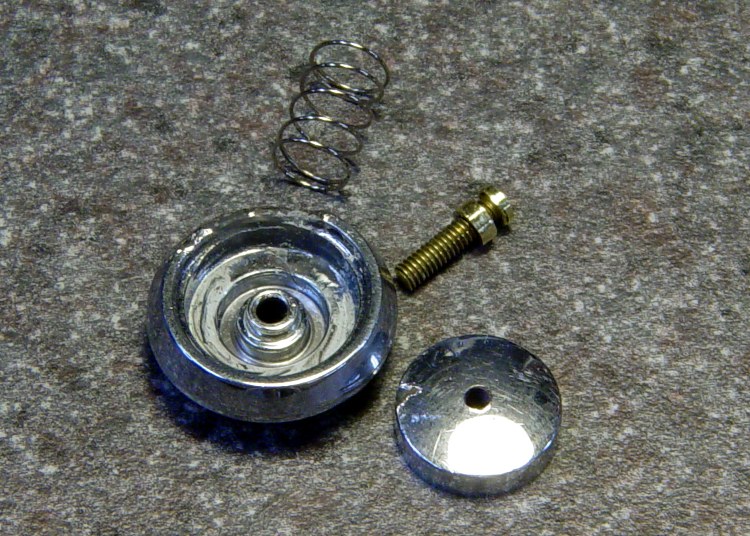
Shutter Button Parts
Now, given the fragility of that setup, you don’t cut it all at once. You start from a diameter of maybe 4 mm and go down by 0.2 mm until you hit 3.0, then make a final pass at 2.9 mm. EMC2’s AXIS MDI mode makes this easy enough: type in the commands for a pass at 4.0 mm, then click on the previous command, change 4.0 to 3.8, and then just clickety-click.
Spindle far too slow at 3000 RPM, feed at 150 mm/min seemed fine. Sissy cuts worked out OK.
After the first few passes, my dim consciousness became aware of the fact that this is how I should have turned down the screw head…
Button Assembly – Top
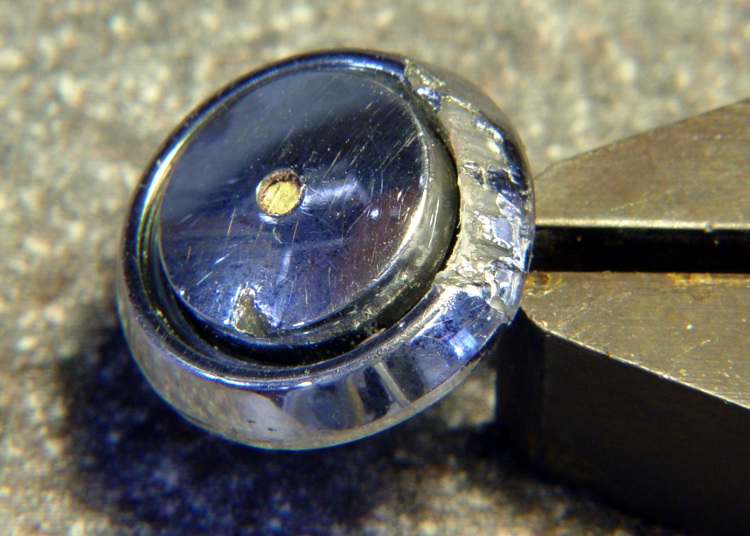
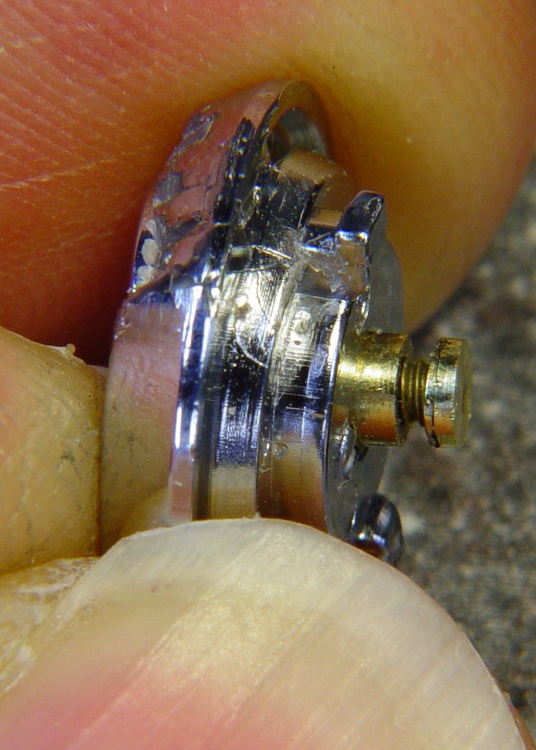
I cleaned up the bezel by putting it in an ultrasonic cleaner to shake the crud off, put it on a warm firewall router overnight to dry it out, then slobbered some Plastruct solvent adhesive into the cracks and clamped it for another night. The bezel was slightly out-of-round from the damage, so I hand-trimmed the bent plastic using a “high speed cutter” (#193, basically an end mill) in a Dremel flexible shaft at about 1/3 max speed until the shutter button bottomed out smoothly within the inner recess. Not a bit of CNC to be seen: hand held all the way.
Button Assembly – Bottom
Then loosen the nut a bit, poke the screw through the bezel, put the spring on, and screw the shutter button in place. Adjust the nut so the screw head is 1.4 – 1.5 mm from the bottom of the bezel with the nut resting in the recess.
Button Assembly – Pressed
Twiddle the shutter button until the screw head protrudes 2.4 mm from the bezel with the button pressed down.
That’s measured with the hole-depth tang of a caliper, sitting atop the screw head. I don’t believe there’s 0.1 mm accuracy in the measurements, but they’re close enough. I did file off a few mold flash bumps from the shutter button & bezel during this adventure.
Mark the screw threads above the button, unscrew it, chop the screw off with a stout diagonal cutter (it’s brass and not very thick, it’s OK), file the end flat, clean up the threads.
The trick seems to be that the button must rest just below the inner ring of the bezel, so that it bottoms out smoothly when pressed. If it’s above the ring, then one side will hang up. The ring depth thus seems to limit the maximum travel, although I can’t say whether this is the way it’s supposed to work or not.
I iterated & filed until the screw was flush with the top of the button with it screwed down to the proper position. It helped to figure out that one turn of the shutter button on the screw changed the “pressed” protrusion by 1/72″ = 0.35 mm.
Urge some low-strength Loctite under the nut and into the shutter button’s hole, reassemble everything, and you’re done.
Urethane Adhesive on Body Socket
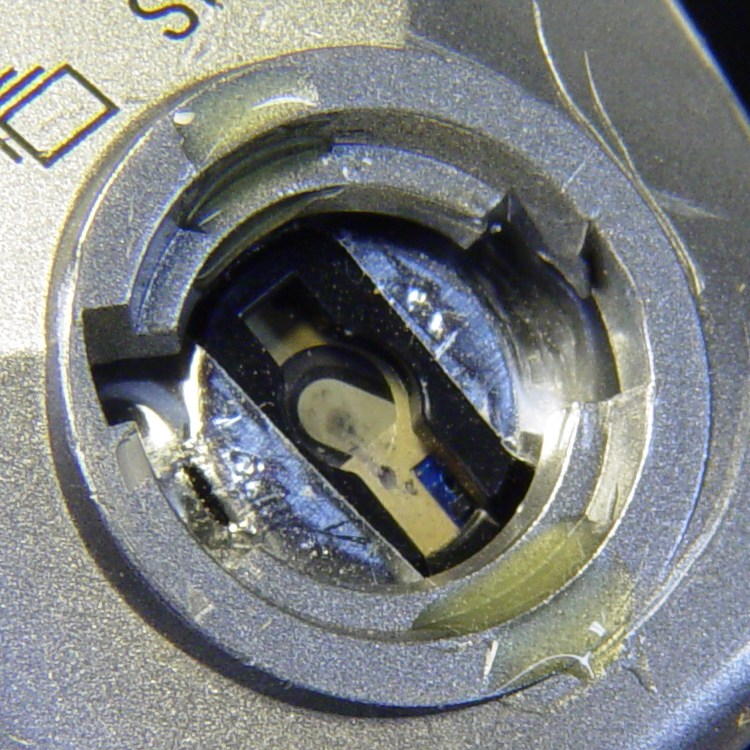
The fall bent the bezel tabs so they no longer latch firmly in the camera body. I put two dabs of urethane adhesive on the socket in the body. The adhesive expands (foams!) as it cures; I hope it will lock the bezel in place while still allowing it to be removed if needed.
I dabbed off most of the adhesive you see in the picture before installing the bezel; it’s not as awful as it looks!
The final result has slightly less travel than the (undamaged, original) shutter button in my DSC-H5, but it works perfectly: half-press to focus, full press to trigger the shutter.
Having figured out what to do, I started with the button, which is chromed plastic, nothing too fancy, and not at all hard to machine.
Laser Aligning to the Button Stem
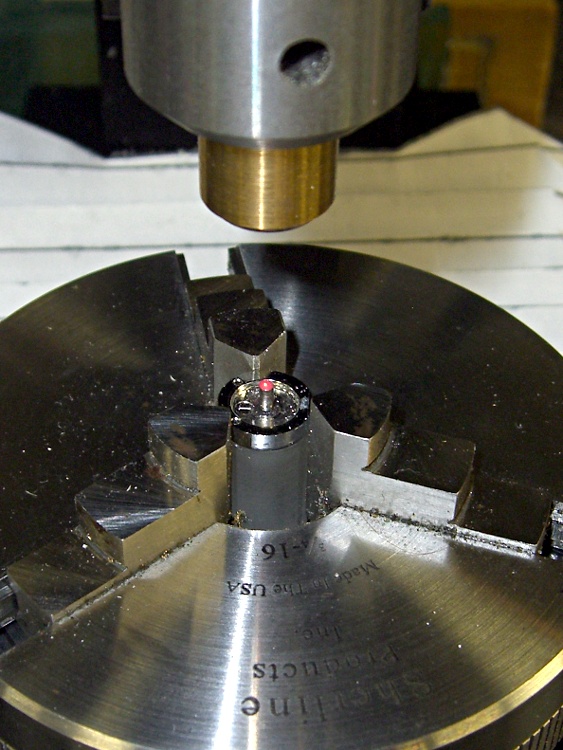
A small post turned from an acrylic rod (the gray cylinder) supports the button in the Sherline 3-jaw chuck attached to the mill table; that was the only way to keep it reasonably level. Laser alignment got eyeballometrically close to the middle; it looks a bit off to the right, but the end result was OK.
Removing the Broken Stem
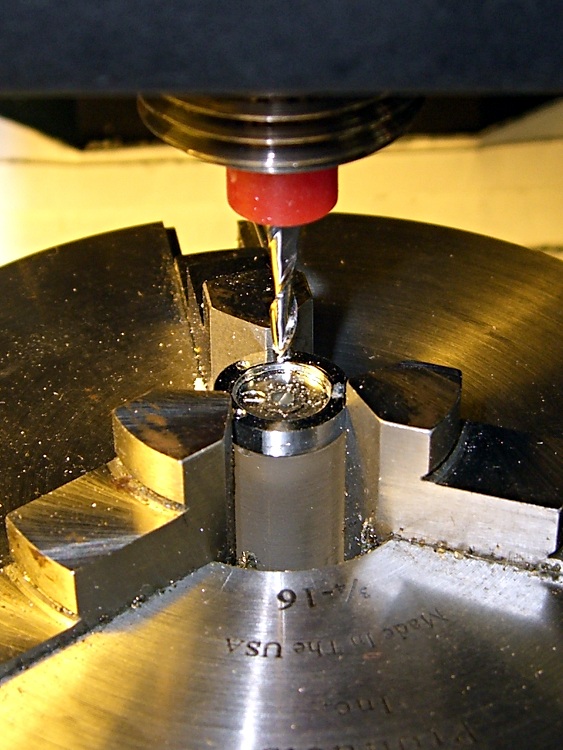
A 2 mm end-cutting bit chewed off the stem in short order; I set the jog speed to about 100 mm/min and just jogged down until the cutter was flush with the button. Spindle at 4000 rpm, for lack of anything smarter.
I decided to go with a 1-72 brass machine screw, which is slightly larger (1.75 mm) than the original 1.5 mm button stem. That means I must drill out the bezel hole, as well, but the 1.5 mm diameter of the next-smaller 0-80 screws in my assortment was a sloppy fit.
A touch of manual CNC for the drilling, #53 with the spindle at 3000 rpm, Z touched off at the button’s surface:
G81 Z-4 R3 F150
The spindle was slow enough and the feed fast enough to keep from melting the button without applying any coolant.
I tapped the hole 1-72 by simply screwing the tap in with my fingers…
Chuck-in-chuck For Head Shaping
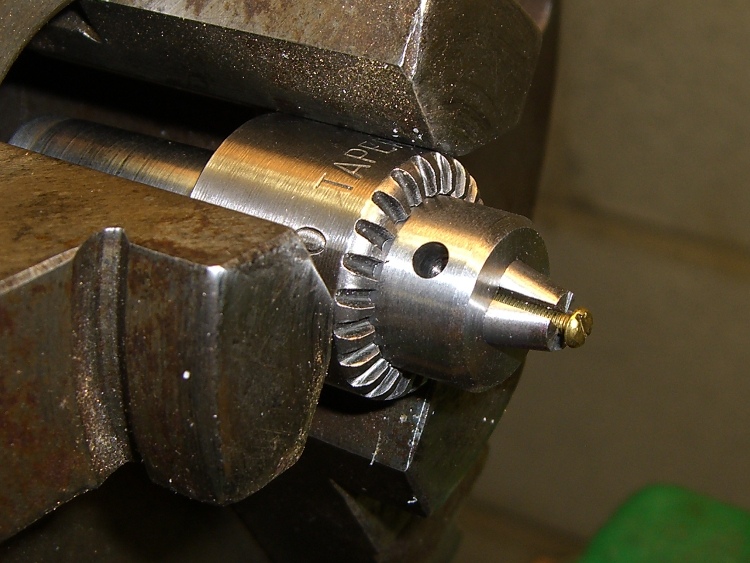
The 3-jaw lathe chuck doesn’t grip a 1-72 screw (no surprise there), so I grabbed the screw in the Sherline’s smallest drill chuck and poked that in the lathe. This doesn’t make for great concentricity, but it was close enough. The right way, as my buddy Eks reminds me, is to slit a nested bunch of brass tubing and use them as collets, but … next time, fer shure.
Button With Reshaped Screw Head
Anyhow, here’s what the button & screw look like so far. The backside of the screw head looks like it needs some cleanup; there’s nothing like taking a picture to reveal that sort of thing.
The pencil lead is 0.5 mm and the grid in the background has 1 mm squares, just to give you an idea of the scale.










 The Smell of Molten Projects in the Morning