Ed Nisley's Blog: Shop notes, electronics, firmware, machinery, 3D printing, laser cuttery, and curiosities. Contents: 100% human thinking, 0% AI slop.
Our travels took us past a mall, in which I discovered another generation of waterless urinals. The general notion is that the cartridge contains a light oil that allows urine through to the drain, while blocking sewer gases just like an ordinary pipe trap.
IIRC, the Hynes restroom retrofit installed waterless drain cartridges in a standard urinal. Unfortunately, with no flush water to rinse the bowl, the urine simply dried in place with exactly the olfactory effect you’d expect.
This urinal is obviously a custom-designed hunk of ceramic technology and, according to their copious literature, whizz just slides right off and runs through the Sloan cartridges on its way to the drain. I’m not sure how all that works, but things have certainly improved… or, perhaps, the mall does maintenance much more frequently than Hynes.
Waterless urinal target
Anyhow, that small dot a few inches above the cartridge seems like an aiming target. Speaking strictly as an amateur apiarist, the notion of “pee on the bee” isn’t all that attractive, but I suppose they needed some way to direct the stream away from the inlets …
With the planetary reducer off, I could remove all the bits and pieces holding the Z-axis slide to the rest of the positioner.
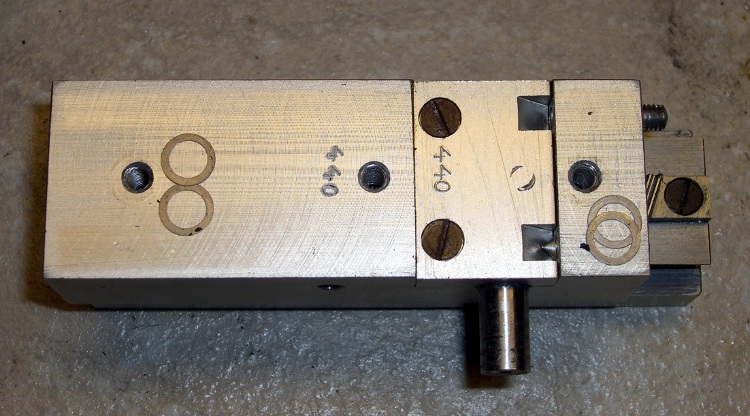
Rack drive casing
Note carefully the three spacing washers near each mounting screw. They hold the slide off the casting body by a very precise amount: they’re each 4 mils thick and prone to vanish in a light breeze. I discovered that each screw had three washers when I flicked one off the workbench and discovered two on the floor.
The metal plate holding the pinion in place has two flat-head screws to the left and two ramps to the right. The conical points of the two long setscrews on the right bear on the ramps, providing a convenient, if obscure from the outside, way to adjust the slide friction by clamping the pinion shaft. One of the setscrews was partially removed, so a previous owner had evidently tried to reduce the overwhelming stickiness.
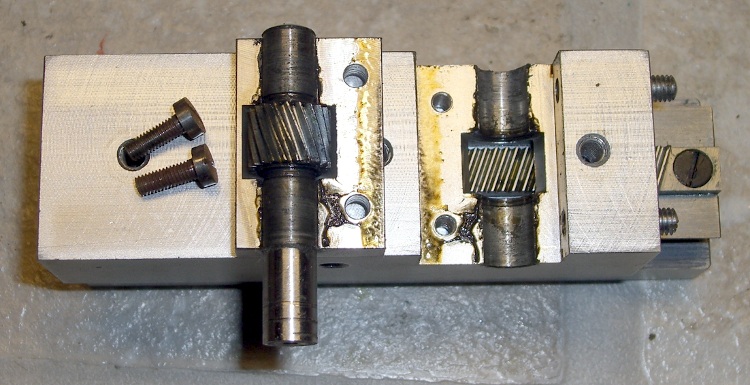
With the washers in a safe place, the pinion cover comes off with only slight encouragement.
Pinion parts
Plenty of congealed lubricating oil to be found.
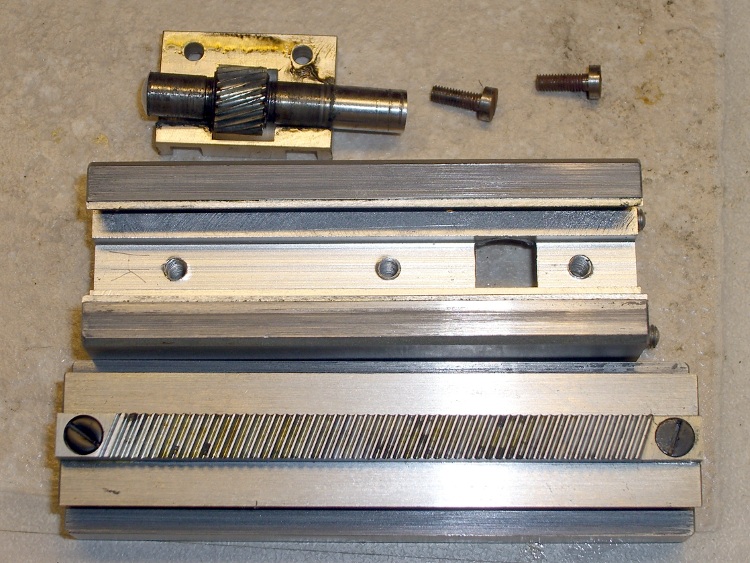
Even without the pinion gear, it was exceedingly difficult to urge the two parts of the slide apart: more congealed oil. Much to my surprise, the slide does not have adjustable gibs: it’s one of those precision-ground gadgets that Just Works. This picture shows all the parts in their gunky glory. Note the random dirt in the rack teeth, along with the goo on the pinion shaft.
Rack and pinion – disassembled
With everything apart, removing the gunk was a simple matter of toxic solvents and mechanical poking with wood picks and splints
I filed off the burrs on the shafts, thought briefly about grinding some flats for the setscrews, and decided to leave well enough alone.
A few dabs of clock oil here & there, reassemble everything in reverse order, and the Z-axis moves gracefully with minimal knob torque. It’s very sensitive to the clamping force of those pointed setscrews, though.
It’s now easy to discover that the planetary reducer has a 5:1 ratio and the Z-axis moves about 6 mm per turn. Because the reducer uses balls, it slips when the slide jams against something, rather than strip its gears.
I should clean the other two slides, but a dot of clock oil on each cheered them up enough to let me punt that for a while…
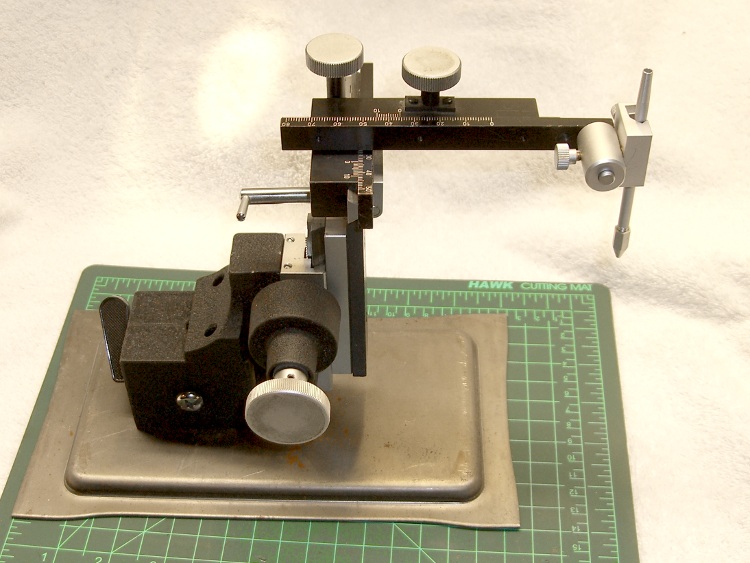
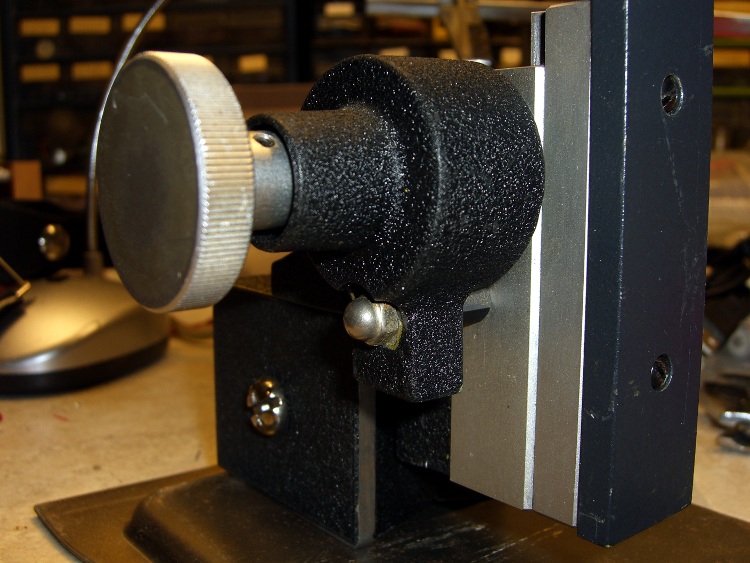
An old 3-axis micropositioner recently found itself on my electronics workbench, where it should come in handy for SMD soldering, microscopic examination, and similar projects requiring the ability to move something in tiny, precise increments. This picture gives you the general idea; it’s mounted on a magnetic base stuck to a random chunk of sheet steel.
The knob on the front drives the vertical (Z) axis, with the other two controlling the front-to-back (Y) and left-to-right (X) axes. A rotary joint between the X and Y axes, plus another at the tip of the arm, mean you’re not restricted to orthogonal axes; that may be either a blessing or a curse, depending on what you’re trying to accomplish.
Unfortunately, the Z axis was essentially immovable: that big knurled knob took a remarkable amount of force to drive the slide. Some Quality Shop Time was in order.
Planetary reducer – cover
The thing is a chunk of old-school German engineering: nary a gratuitous plastic part to be seen. The planetary reducer has a cast metal cover secured to the torque arm with an acorn nut, which had obviously been removed several times before, as the cover was somewhat chewed beneath the nut.
I loosened the two setscrews holding the knob in place, gave it a pull, and … nothing. After a protracted struggle and considerable sub-vocal muttering, the knob came off to reveal a thoroughly scarred shaft. Contrary to what I expected, the shaft did not have flats below the setscrews, so the inevitable screw burrs locked the shaft to the knob.
Planetary reducer – torque arm
The picture to the left shows the planetary drive and torque arm after I filed off the burrs. Two plastic washers (the top one sits on the spring; it’s not shown here) provide smooth bearing surfaces that hold the knob under firm spring pressure, which prevents the Z axis from descending unless you turn the knob manually.
Planetary drive output shaft screws
Two more setscrews secure the planetary drive’s output bushing to the Z axis pinion shaft. The picture to the right shows that they’re pretty much inaccessible; one was directly behind a tab holding the drive together, the other was aimed at the shoulder of the casting holding the Z axis slide.
And, of course, even with the knob in place, I can’t turn the mumble shaft, which is why I’m doing this in the first place. The planetary drive uses balls, rather than gears, and the lubricating oil had long since turned into gummy varnish. I slobbered enough light oil into the drive to loosen the gunk enough to make the drive turn-able, albeit with considerable effort. I urged the input shaft barely enough this-a-way and that-a-way to get access to both of the screws.
Pinion shaft
As you’d expect, removing the drive required even more muttering and the application of dangerous tools. The pinion shaft was badly scarred in several places, so this poor thing has been dismantled several times before.
That was entirely enough for one day. Tomorrow, disassembling the Z-axis slide and cleaning things up…
I suppose this shouldn’t be surprising, but the nature of groundwave propagation pretty much requires vertical polarization: the E-field is perpendicular to the ground.
Perforce, that means the H-field is parallel to the ground, which means that ferrite bar antennas must be horizontal in order to work properly.
A simple experiment with the Alpha-Geek Clock conclusively demonstrates this. Turning it vertically is just as bad as aiming a bar end directly at Colorado: the signal drops right into the noise.
Horizontal and broadside to Colorado, it’s fine.
Alas, I’d been hoping to tuck the bar antenna inside the Totally Featureless Clock I’ve been building. The ideal location, mounted vertically behind the right-hand digit at the end of the circuit board, as far from the Arduino Pro as possible, just isn’t going to work. Good location, wrong orientation!
I want to avoid an external antenna or a tall case. Drat!
Two recent postings were mentioned on blogs with much higher readership than mine, which provides an opportunity to measure the impulse response of the blog to an external simulus.
Views Per Day – Dec 2009
The first peak comes from the Make magazine blog: they liked the trick of holding screws in slit nuts for trimming and finishing.
It looks like an external blog mention is good for 50 to 60 hours of fame. After that, the search engines take over again.
You can tell nearly everybody arrives here from search engines, because the monthly view increases slightly more than linearly with the number of posts.
Monthly Views – 2009
I’d love to believe that’s the start of exponential growth, but that’s just not going to happen!
Speaking of search engines, here are the top terms…
Search Terms
All Time
Search
Views
arduino pwm frequency
235
milling
223
arduino pwm
212
transformer model
99
bellows
94
staghorn beetle
87
triple alert redemption
83
chain catcher
81
sherline
79
arduino command line
79
arduino fast pwm
66
cold solder joint
66
sherline mill
56
hd44780 arduino
50
cold solder
50
cold solder joints
47
sherline projects
46
magnetizer
44
avid rollamajig
43
triple alert
43
Obviously, Arduino, electronics, and machine-shop topics are hot.
Who would have imagined, however, that so many people search the Internet to find pix of staghorn beetles? As of right now, though, Google gives my post two of the four image results and puts it on the first page. Evidently I give good writeup. Now, if only I were selling something, huh?
The most-viewed pages…
Top Posts
All Time
Title
Views
Alpha-Geek Clock
1836
Changing the Arduino PWM Frequency
1324
Arduino Command Line Programming: Avrdud
931
Sherline Mill Counterweight Gantry
928
Finding Transformer Pi Model Parameters
851
Arduino Hardware-assisted SPI: Synchrono
850
Arduino Fast PWM: Faster
740
Dell GX270 Auto-On Power Setting
659
Arduino LiquidCrystal Library vs Old HD4
623
Cold & Fractured Solder Joints
493
Kubuntu Remote Desktop via SSH Tunnel
473
Sunglasses Repair: Half a Hinge Is Bette
420
Sherline Bellows Covers The Cheap Way
380
Laser Alignment for the Sherline Mill
364
Recumbent Bicycle Amateur Radio Antenna
341
Arduino Push-Pull PWM
336
Tektronix 492 Spectrum Analyzer Backplan
335
Experian Triple-Alert Signup: FAIL
312
Holding Machine Screws for Trimming
309
Silver-soldered Bandsaw Blade Joint
307
The Alpha-Geek Clock isn’t representative, due to the sudden peak that slapped it to the top of the list. It’s nice to know that folks are finding (and, presumably, using) the tech info that I put together.
A tip o’ the engineer’s cap to the two dozen of you who keep track of goings-on through the RSS feed. These posts are mostly for my own amusement and record-keeping, but I trust you find something useful every now and again.
A Happy New Year to one & all… and keep on building stuff in your shop!
The script (writeups there and there) I use to convert the HPGL screen dumps from my HP54602 into PNG images produced a transparent background. I put the files into an OpenOffice mockup of my Circuit Cellar columns and the background turns white, so I figured it worked OK.
Turns out that the workflow at Circuit Cellar Galactic HQ turns the background black. A bit of digging showed that the ImageMagick convert program produced an alpha channel that selected only the traces and left everything else unselected. Why that produces white here and black there is a mystery, but there’s no point in putting up with such nonsense.
Another wrestling match produced this revision (the two changed lines are highlighted), which has no alpha channel and a white background. That ought to simplify things: an image shouldn’t depend on where it’s dropped to look right.
#!/usr/bin/kermit +
# Fetches screen shot from HP54602B oscilloscope
# Presumes it's set up for plotter output...
# Converts HPGL to PNG image

set modem none
set line /dev/ttyUSB0
set speed 19200
set flow rts/cts
set carrier-watch off

# Make sure we have a param
if not defined \%1 ask \%1 {File name? }

set input echo off
set input buffer-length 200000

# Wait for PRINT button to send the plot
echo Set HP54602B for HP Plotter, FACTORS ON, 19200, DTR
echo Press PRINT SCREEN button on HP54602B...

log session "\%1.hgl"

# Factors On
input 480 \x03

close session
close

echo Converting HPGL in
echo --\%1.hgl
echo to PNG in
echo --\%1.png

# Factors Off
#run hp2xx -q -m png -a 1.762 -h 91 -c 14 "\%1.hgl"
#run mogrify -density 300 -resize 200% "\%1.png"

# Factors On
run sed '/lb/!d' "\%1.hgl" > "\%1-1.hgl"
run hp2xx -q -m eps -r 270 -a 0.447 -c 14 -f "\%1.eps" "\%1-1.hgl"
run rm "\%1-1.hgl"
run convert "\%1.eps" -alpha off -resize 675x452 "\%1.png"

echo Finished!

exit 0








 The Smell of Molten Projects in the Morning