Ed Nisley's Blog: Shop notes, electronics, firmware, machinery, 3D printing, laser cuttery, and curiosities. Contents: 100% human thinking, 0% AI slop.
I just figured out how to use the WordPress “sourcecode” formatting and applied it to my software-related posts. It produces much nicer results than the manual formatting I was using, mostly by preventing long lines from jamming into the right column.
The catch: WordPress imposes a round trip from my original text to the screen encoding and back, which sometimes randomly mangles special symbols. Angle brackets and double-quotes, in particular, take serious damage.
If you happen to remember a favorite chunk of code in a previous post, please take a look at it and see if I missed any of the obvious text-replacement errors. Trawling through the Software category should turn up most of the posts.
As is always the case with program listings, the errors will be really obvious to everyone except me.
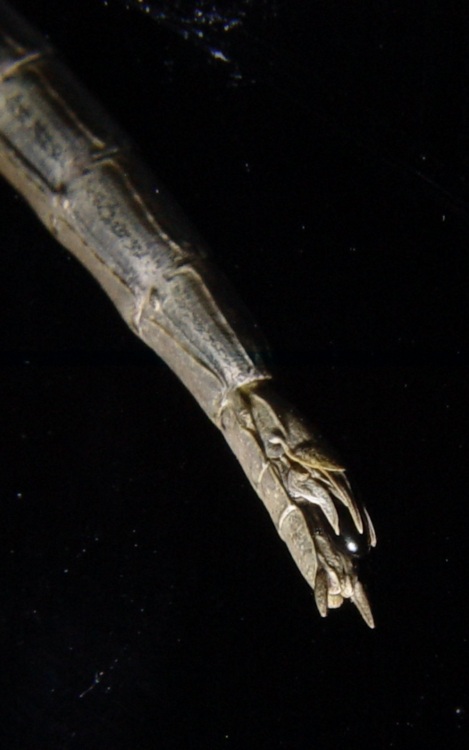
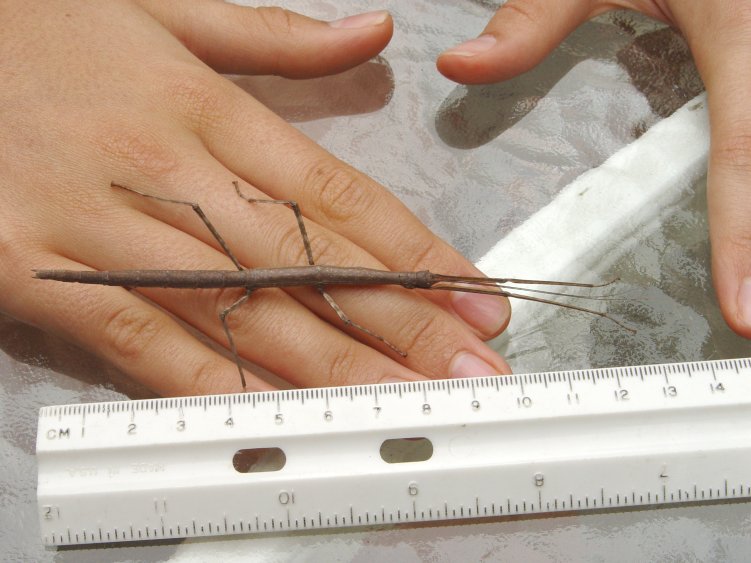
Stick insects just drop their eggs onto the forest floor with a stereotyped abdominal shake. This critter was in an aquarium standing on end, so every egg made a little tick when it hit the bottom pane. They do this mostly at night, hence the black background of our living room.
I caught this egg just before release, aiming through the glass wall with an LED flashlight for illumination, through close-up adapters on a DSC-F717 on a tripod. A bit of fiddly image editing got rid of most of the “stars” caused by dirt on the glass, but the insect and egg aren’t edited.
Although stick insects can live for up to three years, we cannot find food for them during the winter months. They’re rather fussy eaters, specializing in oak leaves in these parts, and simply don’t accept substitute meals.
A high-res version serves as the background on my right-hand portrait monitor.
Another picture from the Arlington Marching Band competition at The Dome in Syracuse.
Silhouetted Flags
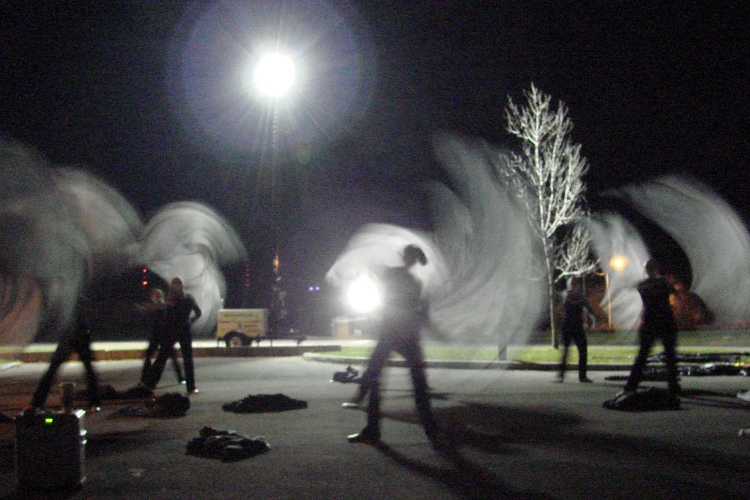
These are flag twirls against portable mercury-vapor floodlights. The glare off that bare tree make the scene look just about as cold as it really was, even if it wasn’t icy.
The camera picked 1/5 second for this exposure, although the translucent flags don’t show the same strobing as the bright-white rifles. I think the lower floodlight is the same one in the single-rifle picture.
Took these pix while chaperoning the Arlington High School Marching Band trip to The Dome at Syracuse University. They’re warming up, if that’s the proper word for standing around in skintight uniforms on a 45-degree evening at Skytop, in preparation for their show.
Many Strobed Rifle Tosses
The ISO 1000 setting on a Sony DSC-H5 produces absolutely terrible color noise, but sometimes it just doesn’t matter. These were taken under low-pressure sodium-vapor parking lot lights, with some mercury-vapor lighting in the background, so they’re basically monochromatic anyway.
Single Strobed Rifle Toss
The shutter is 1/8 second and the lights flicker at 120 Hz, so the rifles reflect 120/8 = 15 blinks as they spin. The similar included angles show that all the rifles spin at nearly the same rate: the Color Guard does very nicely synchronized tosses. They’re good!
Now, for one of my top-ten favorite pictures…
I moved around to put the mercury-vapor light behind her, which prevented flareout & added a crisp edge. The camera managed to get nearly the right exposure, even under considerable duress. This is a crop from a larger image.
She’s absolutely stationary with only her hands moving, exactly the way it’s supposed to be done.
Despite the slow shutter speeds, they’re both hand-held pictures. You simply don’t get to see my botches…
Oh, and by the way. The “rifles” are wooden dummies, carved out in a general rifle-stock shape, but without any metal parts or even a barrel. Frankly, I think the Color Guard should be trained up in marksmanship and carry actual rifles. Perhaps those would work well?
Linear Technology’s LTSpice generic capacitor model has all the parts you need to synthesize a crystal, which is pointed out in the help file and various spots around the web. What’s missing is the relation between all the parts and the values you have in hand for an arbitrary crystal.
SPICE Capacitor Model
The crystal capacitor model looks like this…
Cpar (usually C0) along the right edge is the inter-electrode capacitance, on the order of a few pF.
Rpar (usually R0) along the left edge is the parasitic resistance across the case, on the order of hundreds of MΩ.
The RCL string in the middle is the “motional” part of the crystal model, generally found with a subscript “m” in the specs.
Rser (Rm or ESR) is on the order of 100 Ω
Capacitance (Cm) is the motional capacitance, on the order of fF (that’s femtofarad: 10-15)
Lser (Lm) is tens to thousands of mH
RLshunt is something I haven’t seen in any other model and, in fact, it doesn’t appear in the properties panel.
Crystal Properties
Now, the part I screwed up is that the capacitor’s value (the number appearing on the schematic) is Capacitance (in the angle brackets that royally screw up WordPress HTML), not Cpar. So the crystal capacitor properties panel looks like this…
That models a 10 MHz crystal, taken directly from a sidebar in Refinements in Crystal Ladder Filter Design by the legendary Wes Hayward W7ZOI, in the June 1995 issue of QEX.
Guess what? Plug it into a model of his crystal-measuring circuit and it works exactly like he says it should. No surprise there…
SPICE has a bit of trouble simulating high-Q oscillators; they tend to not start up properly. If nothing seems to be happening, wait for a few tens-to-hundreds of milliseconds before despairing. Try chopping Rser down by a factor of two or four to see if that improves its disposition.
You could try injecting a few (hundred thousand) cycles of a kickstart signal, but that’s fraught with peril: you’re simulating something even further from reality than usual.
Memo to Self: You can rename the cap from C2 (or whatever) to X1 (or whatever) and everything still works fine.
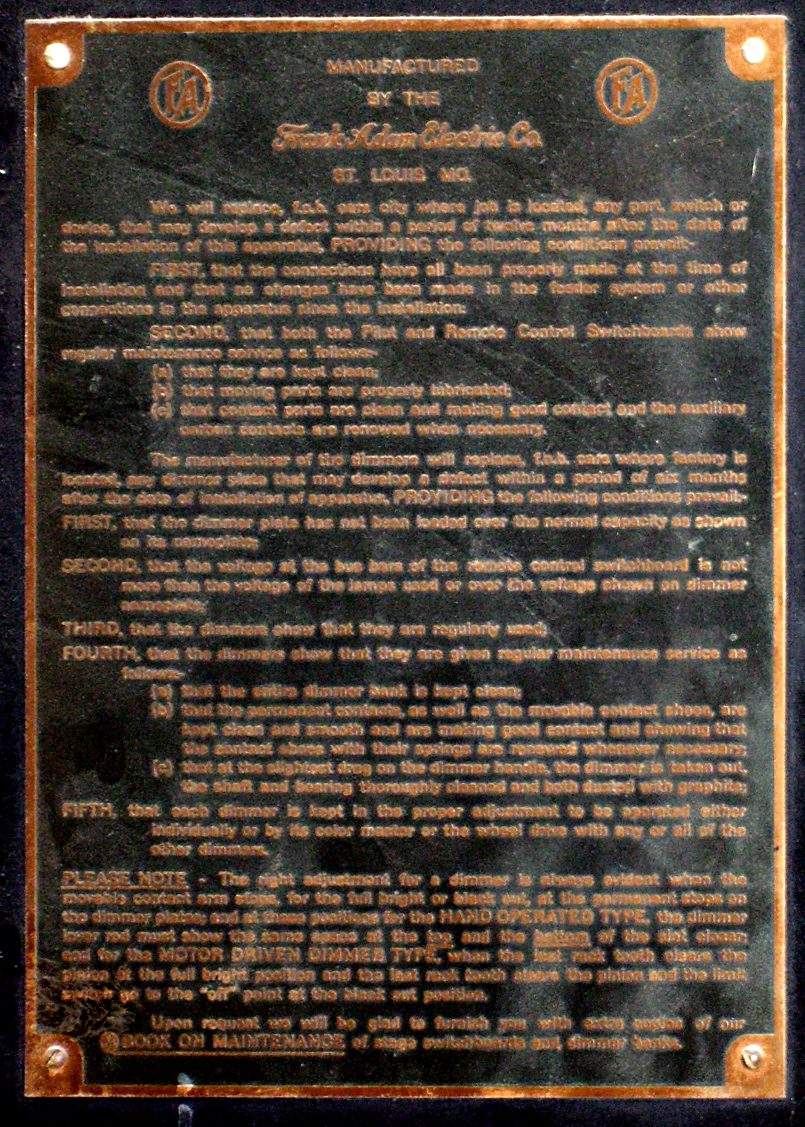
Found this on the long-disused stage of the former Martha Lawrence School, now the St Francis Hospital Daycare Center, hosting the polling place where I was serving as an Election Inspector. It’s a bit hard to read, even in the larger version, but I thought a one-year warranty etched into a brass plate was interesting; it’s screwed right to the side of the dimmer panel.
Lighting Switchboard Warranty Placard
The warranty provisions require that the dimmer panel be properly maintained, regularly used, and kept clean. As you can easily see, it’s been a long while since anyone has put on a stage production.
I think the warranty ran out right around the time I was born, but I could be off by a decade or two either way.
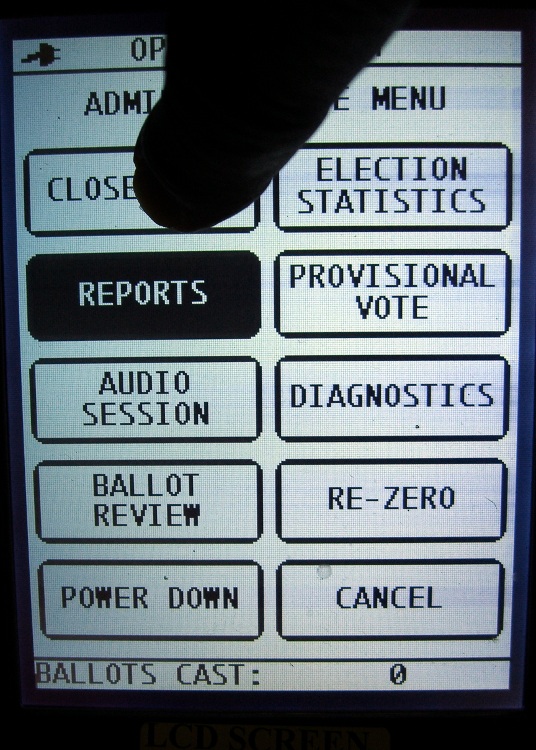
This is on the “control panel” side of the Sequoia ImageCast Ballot Marking Device voting machines used in Dutchess County. I put my finger in the middle of the CLOSE POLL button and the panel misread a press on the REPORTS button.
That’s one of several misreadings of the day. Earlier, while setting up the machine for the day, it misread horizontally and gave me a STATUS report instead of a ZERO report.
Last year the same sort of thing happened. It’s always explained as “being out of calibration”, which makes me wonder just exactly when the panels are calibrated and what the criteria for success might be.
One of the few good things to come out of having a totally dysfunctional State Legislature is that New York has managed to delay and stall and fumble around until other states demonstrated the utter stupidity of direct-recording, no-paper-trail electronic voting machines. The ImageCast machines are a spectacular boondoggle, but far less catastrophic than what we’ve seen in Florida, Ohio, California, and …
Oh, and after a 16-hour shift as a BMD Election Inspector, exactly zero handicapped voters (actually, any voters) took advantage of the machine to cast their vote. A report from someone who’s in a position to know says that in the last election, the bottom line was $250 per vote on the ImageCast machines. I think that’s probably low.



 The Smell of Molten Projects in the Morning