The Smell of Molten Projects in the Morning

Ed Nisley's Blog: Shop notes, electronics, firmware, machinery, 3D printing, laser cuttery, and curiosities. Contents: 100% human thinking, 0% AI slop.

Author: Ed

  • Blog Impulse Response and Summary

    Two recent postings were mentioned on blogs with much higher readership than mine, which provides an opportunity to measure the impulse response of the blog to an external simulus.

    Views Per Day - Dec 2009
    Views Per Day – Dec 2009

    The first peak comes from the Make magazine blog: they liked the trick of holding screws in slit nuts for trimming and finishing.

    The second is from hackaday.com: they loved the Alpha-Geek Clock, although they linked to the inside circuitry.

    It looks like an external blog mention is good for 50 to 60 hours of fame. After that, the search engines take over again.

    You can tell nearly everybody arrives here from search engines, because the monthly view increases slightly more than linearly with the number of posts.

    Monthly Views - 2009
    Monthly Views – 2009

    I’d love to believe that’s the start of exponential growth, but that’s just not going to happen!

    Speaking of search engines, here are the top terms…

    Search Terms
    All Time
    Search Views
    arduino pwm frequency 235
    milling 223
    arduino pwm 212
    transformer model 99
    bellows 94
    staghorn beetle 87
    triple alert redemption 83
    chain catcher 81
    sherline 79
    arduino command line 79
    arduino fast pwm 66
    cold solder joint 66
    sherline mill 56
    hd44780 arduino 50
    cold solder 50
    cold solder joints 47
    sherline projects 46
    magnetizer 44
    avid rollamajig 43
    triple alert 43

    Obviously, Arduino, electronics, and machine-shop topics are hot.

    Who would have imagined, however, that so many people search the Internet to find pix of staghorn beetles? As of right now, though, Google gives my post two of the four image results and puts it on the first page. Evidently I give good writeup. Now, if only I were selling something, huh?

    The most-viewed pages…

    Top Posts
    All Time
    Title Views
    Alpha-Geek Clock 1836
    Changing the Arduino PWM Frequency 1324
    Arduino Command Line Programming: Avrdud 931
    Sherline Mill Counterweight Gantry 928
    Finding Transformer Pi Model Parameters 851
    Arduino Hardware-assisted SPI: Synchrono 850
    Arduino Fast PWM: Faster 740
    Dell GX270 Auto-On Power Setting 659
    Arduino LiquidCrystal Library vs Old HD4 623
    Cold & Fractured Solder Joints 493
    Kubuntu Remote Desktop via SSH Tunnel 473
    Sunglasses Repair: Half a Hinge Is Bette 420
    Sherline Bellows Covers The Cheap Way 380
    Laser Alignment for the Sherline Mill 364
    Recumbent Bicycle Amateur Radio Antenna 341
    Arduino Push-Pull PWM 336
    Tektronix 492 Spectrum Analyzer Backplan 335
    Experian Triple-Alert Signup: FAIL 312
    Holding Machine Screws for Trimming 309
    Silver-soldered Bandsaw Blade Joint 307

    The Alpha-Geek Clock isn’t representative, due to the sudden peak that slapped it to the top of the list. It’s nice to know that folks are finding (and, presumably, using) the tech info that I put together.

    A tip o’ the engineer’s cap to the two dozen of you who keep track of goings-on through the RSS feed. These posts are mostly for my own amusement and record-keeping, but I trust you find something useful every now and again.

    A Happy New Year to one & all… and keep on building stuff in your shop!

  • HP54602 Oscilloscope Trace Conversion Tweakage

    The script (writeups there and there) I use to convert the HPGL screen dumps from my HP54602 into PNG images produced a transparent background. I put the files into an OpenOffice mockup of my Circuit Cellar columns and the background turns white, so I figured it worked OK.

    Turns out that the workflow at Circuit Cellar Galactic HQ turns the background black. A bit of digging showed that the ImageMagick convert program produced an alpha channel that selected only the traces and left everything else unselected. Why that produces white here and black there is a mystery, but there’s no point in putting up with such nonsense.

    Another wrestling match produced this revision (the two changed lines are highlighted), which has no alpha channel and a white background. That ought to simplify things: an image shouldn’t depend on where it’s dropped to look right.

    #!/usr/bin/kermit +
    # Fetches screen shot from HP54602B oscilloscope
    # Presumes it's set up for plotter output...
    # Converts HPGL to PNG image
    
    set modem none
    set line /dev/ttyUSB0
    set speed 19200
    set flow rts/cts
    set carrier-watch off
    
    # Make sure we have a param
    if not defined \%1 ask \%1 {File name? }
    
    set input echo off
    set input buffer-length 200000
    
    # Wait for PRINT button to send the plot
    echo Set HP54602B for HP Plotter, FACTORS ON, 19200, DTR
    echo Press PRINT SCREEN button on HP54602B...
    
    log session "\%1.hgl"
    
    # Factors On
    input 480 \x03
    
    close session
    close
    
    echo Converting HPGL in
    echo --\%1.hgl
    echo to PNG in
    echo --\%1.png
    
    # Factors Off
    #run hp2xx -q -m png -a 1.762 -h 91 -c 14 "\%1.hgl"
    #run mogrify -density 300 -resize 200% "\%1.png"
    
    # Factors On
    run sed '/lb/!d' "\%1.hgl" > "\%1-1.hgl"
    run hp2xx -q -m eps -r 270 -a 0.447 -c 14 -f "\%1.eps" "\%1-1.hgl"
    run rm "\%1-1.hgl"
    run convert "\%1.eps" -alpha off -resize 675x452 "\%1.png"
    
    echo Finished!
    
    exit 0
    
  • Icicle Formations at Red Oaks Mill Dam

    The dam at Red Oaks mill has accumulated several large trees over the past year that often serve as perches for birds surveying the pool.

    Waterfall icicles
    Waterfall icicles

    We spotted these ice formations on a recent walk.

    Tree trunk icicle toothbrush
    Tree trunk icicle toothbrush

    The bottom edge of the toothbrush is just inches over the roiling water.

  • Tchotchke Repair

    Tchotchke epoxy
    Tchotchke epoxy

    Sometimes I get to do an easy one. This dust collector came with the house and sits on the fireplace; one of the little guys fell off when Mary went on a cleaning frenzy. As nearly as I can tell, he had a bad butt weld (using the exact term) with marginal penetration.

    A dot of JB Weld, an uncomfortable overnight stay on the workbench, and he’s as almost good as new. I briefly thought about resistance-soldering him together, but came to my senses: epoxy to the rescue!

    The balance point is sufficiently delicate that the additional weight of the epoxy pulls his side down a bit. I’ll call it art and leave it at that, although I should build a little circuit with a proximity sensor and an electromagnet to keep the thing in motion.

    See-saw tchotche repaired
    See-saw tchotchke repaired

    Yeah, that’s my Tau Beta Pi Bent in the background… along with the little glass bead I made in the Corning Museum of Glass a few summers ago.

  • Bicycle Tire Liner Abrasion

    The front tire (a Primo Comet blackwall) on Mary’s Tour Easy was flat when we rolled out of the garage a few days ago. While a flat isn’t pleasant at any time, it’s much nicer to find one at home, before the ride, rather than out on the road!

    I figured the tire ate something sharp that managed to work its way through the tire liner and into the tube; that’s rare, but it sometimes happens. These two pix of the tread show why we use tire liners: sidewall-to-sidewall nicks, cuts, gouges, and gashes, despite the fact that the herringbone tread has plenty of life left in it. Click the pix to enlarge, if you dare…

    Tire cuts 1
    Tire cuts 1

    And another section; it’s like this all the way around the tire. I think this one is the better part of a year old, so it has maybe 2000 miles on it. It handled 200+ miles along the Pine Creek Gorge rail-trail this past summer, which was sharp crushed gravel, but most of the cuts came from roadside debris on our ordinary utility rides around home.

    Tire cuts 2
    Tire cuts 2

    As it turned out, the tire liner had prevented all those punctures from reaching the tube, while killing the tube all by itself. The sharp edge where the the two ends of the liner overlap had worried its way through the tube.

    Abrasion from tire liner
    Abrasion from tire liner

    The tire liner wasn’t a genuine fluorescent green Slime strip, but some translucent brown thing. The difference: Slime liners are thinner and don’t have nearly this much abrasive power.

    Alas, I didn’t have a Slime liner in my stash (remedied with the most recent bike parts order), so I put the brown liner back in with a few layers of genuine Scotch electrical tape to build the end up a bit. There’s really no good way to feather the end without making it into a ragged knife edge.

    New tire and tube, of course. I’m not that crazy!

    With any luck, the liner and tape will behave for another few years, until the tire wears out, and then I’ll replace everything. Other than this event, flats aren’t a big part of our riding experience.

  • Failed Switch

    Switch Innards
    Switch Innards

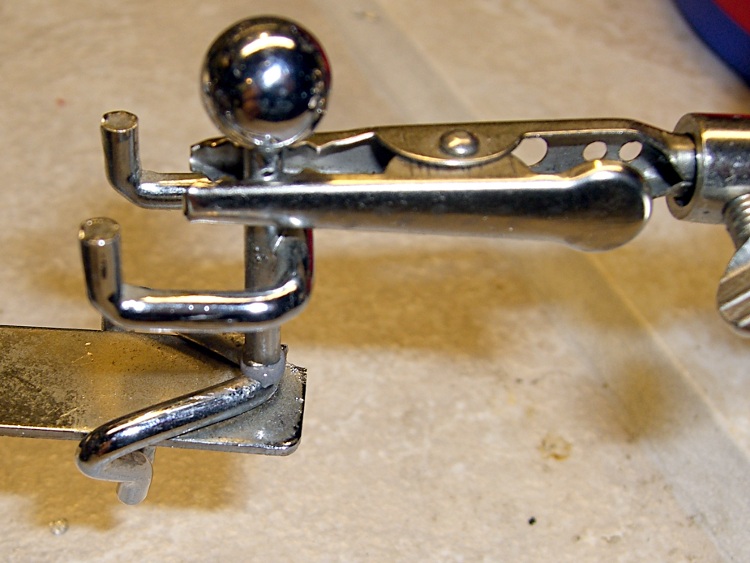
    When I flipped this switch on, it started fizzing and emitting ozone-scented smoke while the lights it controlled flickered. This is not a nominal outcome. I toggled the switch a few times, but it continued to misbehave, so I installed a replacement switch and laid the old one out on the desk for an autopsy.

    It’s an old-school mechanism, as suits the 1930-vintage structure it came from. The lyre-shaped arch with the spring swings back and forth on its tabs, which rest in the small recesses near the middle of the switch body. The peg on the toggle handle engages the spring, thus providing the over-center snap action.

    The switch action takes place at the bottom of the arch, where those two very small tabs stick out. They wipe on the grubby-looking bottom tabs of the oddly shaped flat-brass doodads, the U-shaped ends of which surround the screws that clamp the copper wire to the switch.

    I expected to find a scorched contact or perhaps an insect in the mechanism, but nothing seemed out of the ordinary. Apart, that is, from the layer of congealed grease covering everything inside. I suspect the grease was applied in the factory to help prevent contact corrosion, but the volatiles are long gone.

    Switch Contacts
    Switch Contacts

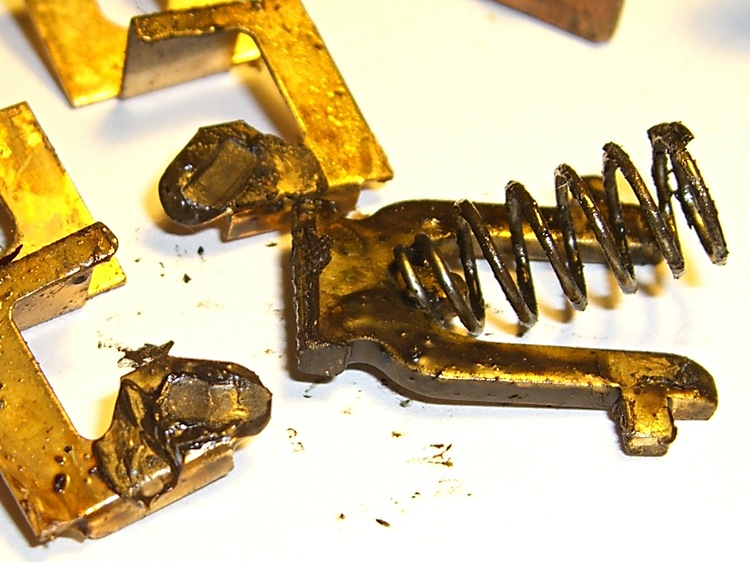
    A closeup of the switch contacts shows (what I think is) the problem.

    All the contact points are covered in grease, but the lyre-shaped gizmo looks like it’s been painted: its contact points were black and resisted cleaning by fingernail scraping.

    As nearly as I can tell, all the current passed through a very few high spots that were wiped somewhat clean as the contacts closed. As those spots heated up, the grease melted and flowed over them, increasing the resistance and the heat.

    The switch had been working for many decades, as the BX armored cable in the box had fabric-covered rubber (stiff rubber) insulation. I managed to install the replacement switch without breaking the insulation, but it was ugly in there.

  • What’s Inside This Box?

    Digital Media Player box
    Digital Media Player box

    Got a package from halfway around the world that, I thought, corresponded to a recent eBay order. Opened the envelope and pulled out a box containing … a Digital Media Player?

    That’s odd. I don’t recall ordering one of those.

    At this point, anybody who’s read Frank Herbert’s The White Plague should get the chills. Do you or don’t you open a mysterious package from far away that seems to offer something interesting?

    Pandora might have something to say, too.

    Digital Media Player box - contents
    Digital Media Player box – contents

    Well, open it I did, and found exactly what I’d ordered: a stash of female headers pins. Of course, one can’t tell what else might have come in the package, but so it goes.

    Now I can hand Eks half a lifetime supply of the strips to replace the ones I mooched.

    One other mildly surprising part of the package: it seems we’ve gotten to the point where magnetic closures are cheap enough to replace everything else, including intricate origami tucks. There’s a small steel plate pasted under the flap. Who knew?

    Digital Media Player box - magnetic closure
    Digital Media Player box – magnetic closure