Ed Nisley's Blog: Shop notes, electronics, firmware, machinery, 3D printing, laser cuttery, and curiosities. Contents: 100% human thinking, 0% AI slop.
The idea behind unit pricing was to simplify comparisons between packages with different quantities: each package would have a price-per-unit value.
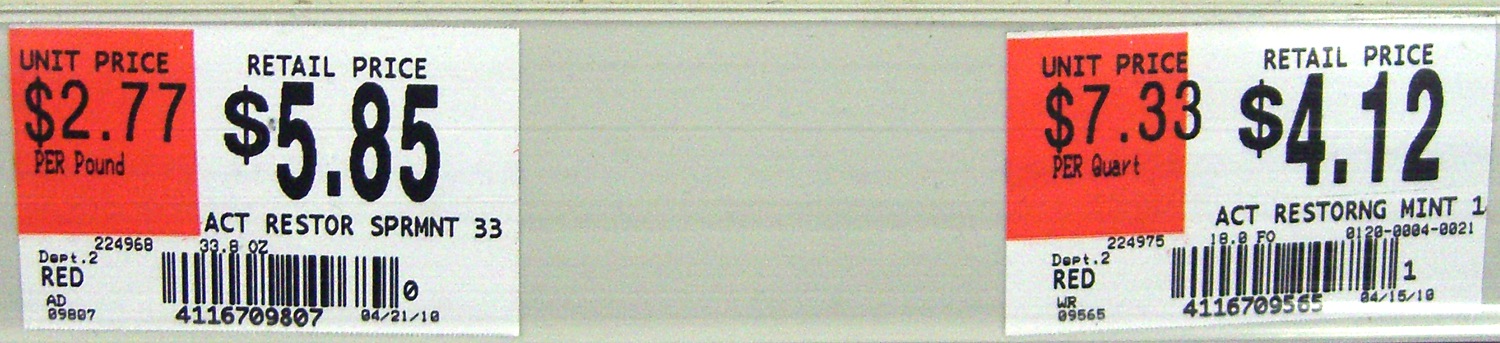
Here are the two shelf labels for two sizes of the lah-dee-dah fluoridating remineralizing mouthwash that our young lady must use for the next few years. The unit price is in the orange block, with some fine print underneath giving the unit. Click for a bigger image; you’ll probably need it.
Unit Pricing Obfuscation
Need a bit more help? Here’s the one on the left:
Price Per Pound
And the one on the right:
Price Per Quart
For those of you in the rest of the world with volumes in liters and weights (uh, masses) in kilograms:
1 pint = 0.5 quart = 1 pound of water
What’s most interesting is that this only occurs when the package with the larger quantity has a higher per-unit price, as with these bottles.
This is a perfect example of something that’s technically legal, but definitely not in keeping with the spirit of the law.
Another interesting situation: if a shelf pricing sticker is missing for one of several similar items, you can be absolutely certain that package is more expensive. A missing shelf price sticker is technically illegal, but I doubt anybody ever gets prosecuted… it’s a simple mistake that could happen to anyone, right?
Because nothing in a Walmart store is left to happenstance, this is obviously planned and approved at the highest levels.
It happens elsewhere, too, but we just happened to be in Walmart this morning. Check it out where you shop…
This story begins years ago, as mentioned there. I’d retrieved the offending outlet expander / extension cord from my mother’s apartment and tossed it in my big box of Extension Cords.
I recently plugged it in and was rewarded with a flash-bang inside the box. Taking it apart reveals two more blackened outlet compartments (in the lower right), but no more missing contact blades.
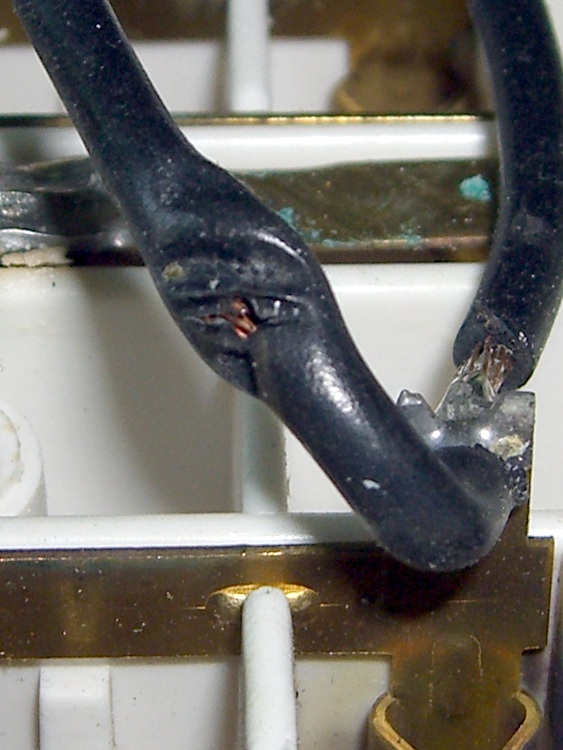
It turns out that the black (hot) wire got caught between a stiffening rib on the back plate and the edge of the box supporting the brass plate connecting the white (neutral) wire to the contacts. Here’s reconstructed view after I cut off the extension cord.
Crushed wire
Flipping the wire over shows the spot where the copper conductor eventually poked through the insulation.
Exposed conductor
It touched the sharp corner of the brass strip just to the left of the divider in this view. The notch in the divider channeled the jet of burning debris across the far wall of the right-hand compartment. The left-hand compartment is completely smudged.
Short-circuit point and debris jets
Looks like I get credit for this one… but even seeing how I did it, I’m not sure there’s any way to know none of the wires got crushed while reassembling the box.
It’s safely in the trash and the cord is in my big box of Random Power Cords.
Memo to Self: Make sure the box fits together smoothly?
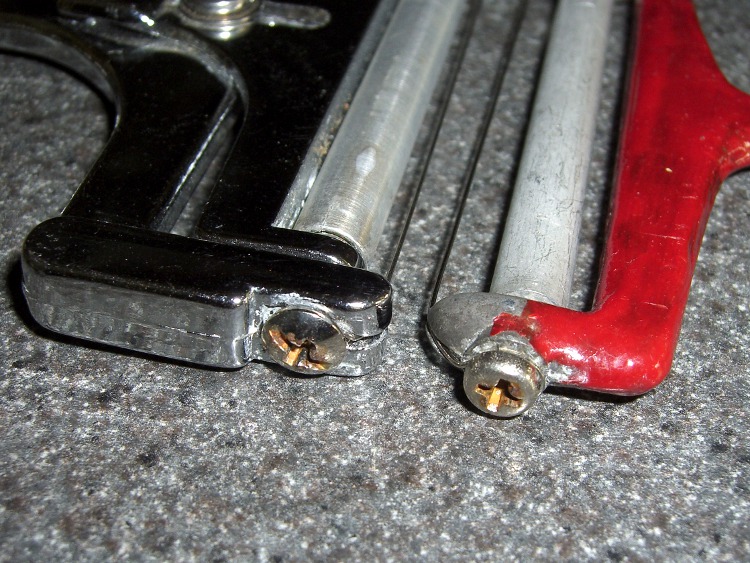
My ladies favor hard cheeses that are murder on cheese slicers. I just replaced the wires on a pair of favorite slicers, using 0.020 inch stainless wire. That’s thicker than the 14-mil wire they came with, so I’m hoping it’ll last longer.
Being thicker, it’s also harder to push through the cheese, so it’s subject to more force and might break sooner. Ah, tradeoffs…
What I really want are monomolecular wires that can cut through anything…
I’ve suggested using a knife on the Romano and Gruyere, reserving the slicers for Cheddar and other sissy cheeses…
Oh, the red stuff on the right-hand slicer is Liquid Electrical Tape. The handle is raw aluminum and leaves smudges all over the place. I’m assuming the layer doesn’t have much lead content, but who knows?
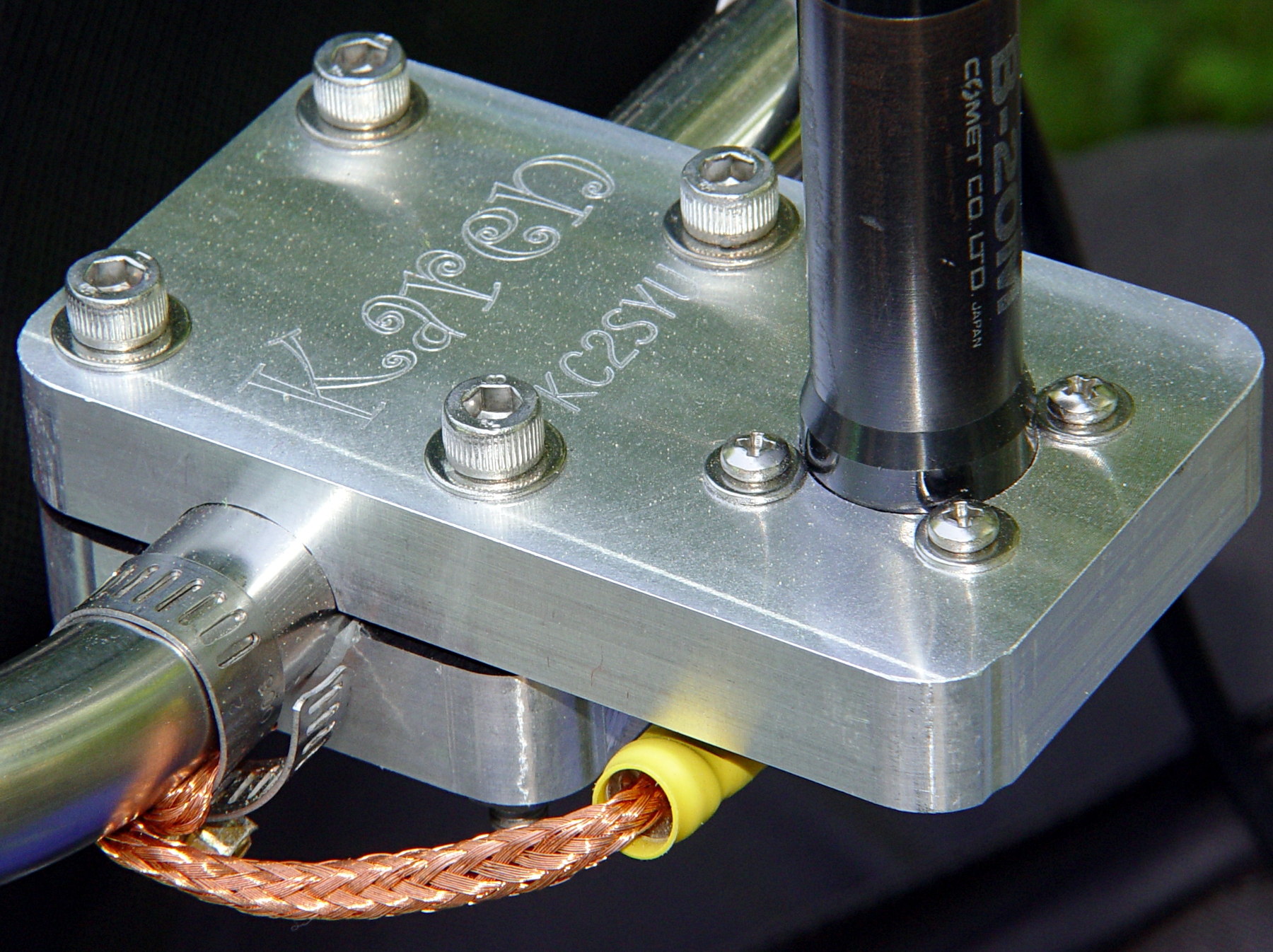
Quite a while ago, I built this slab mount to hold an amateur radio antenna on our daughter’s Tour Easy. It worked fine until the bike blew over and whacked the antenna whip against something solid, at which point the mast cracked.
The antenna screws into an ordinary panel-mount UHF connector secured to the bottom of the slab, with a hole through the slab just large enough to accept the antenna mast. That put all the mechanical stress on the slab, not the connector.
Modified antenna mounting plate
Alas, the new antenna had a slightly different mast outside diameter, so I machined a new adapter to clamp the connector atop the slab. The antenna screws down into the adapter against a brass washer, again keeping the strain on the fitting.
I recently found the commercial mobile antenna cable that I’d been meaning to use on her bike, which required Yet Another Modification to that slab. It turns out that the UHF connector on the cable expects to be secured to sheet metal found in a car body, rather than a half-inch aluminum plate: the threads aren’t long enough!
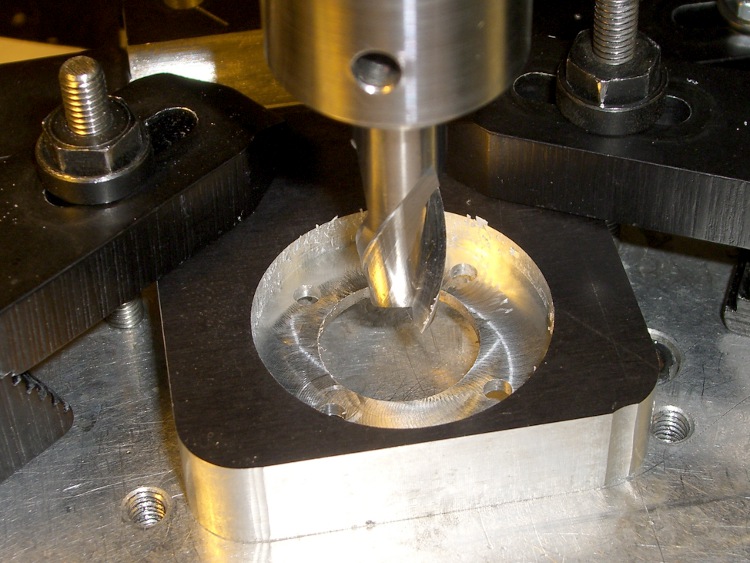
So I machined circular recesses on the top and bottom to hold the mounting nut and washer, respectively, with 2 mm of aluminum remaining in the middle of the slab.
Milling top recess
The recesses are just fractionally larger than the nut & washer, so most of the stress gets transmitted directly to the slab. Even in the high-vibration bicycle environment, I think there’s enough meat in there to prevent fatigue fractures.
Milling bottom recess
I recycled a G-Code routine I’d written to chew out circular recesses. It does a bit of gratuitous (for this application, anyway) spiraling in toward the center, but got the job done without my having to think too much.
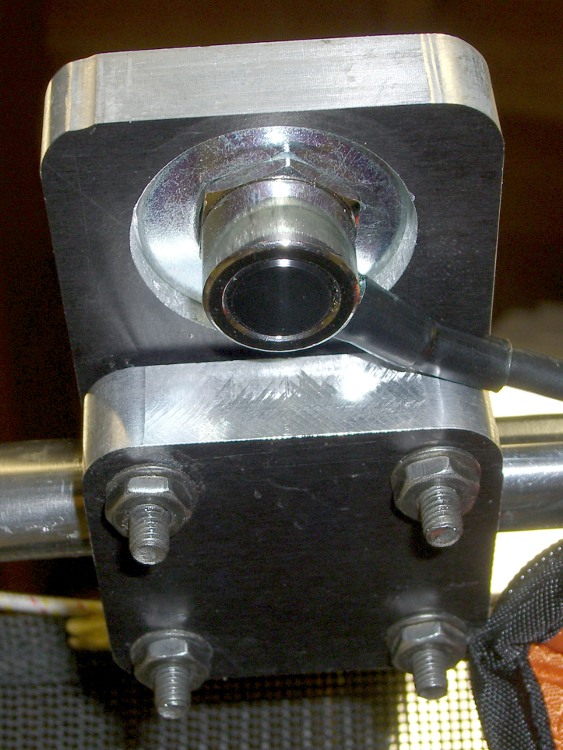
The bottom view shows the washer in action. The recess is deep enough that the cable just barely clears the slab.
Modified mounting plate – bottom
The top view shows the recessed mounting nut. The nut has an O-ring around the connector threads, but the water will probably drain out through the four through-holes left over from the old panel-mount connector.
Modified mounting plate
I turned the top nut down as far as I could with a wrench & (ugh) needle-nose pliers, then tightened the bottom nut about 1/3 turns with a wrench.
You’re not supposed to notice the crispy edges on the PVC bushing holding the reflector to the antenna mast. The high setting on that heat gun is a real toaster…
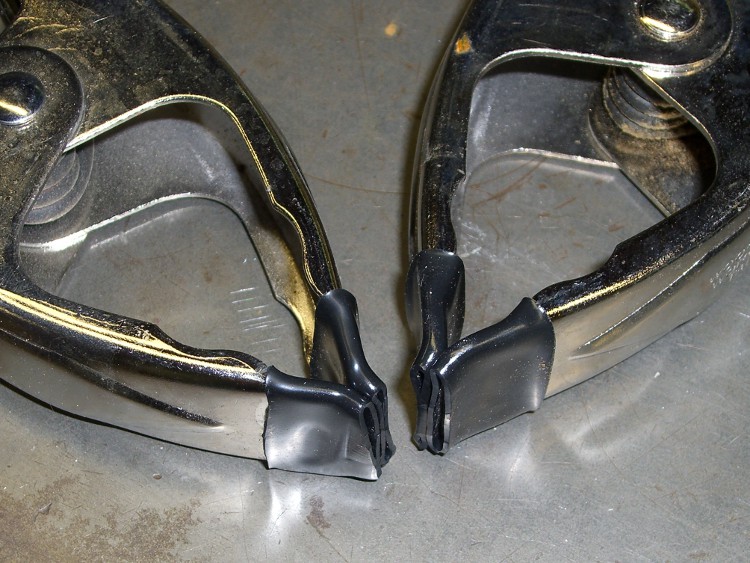
The OEM padding on the ends of my spring clamps wore off long ago; it was some sort of entirely-too-soft dipped plastic.
Some large-diameter heatshrink tubing seems like it ought to be a good replacement… the tips are a bit floppy, but maybe that’s not entirely a Bad Thing.
Here’s the status of the AA NiMH packs I’ve been using with the radios on our bikes, plus three packs I made up last year and have been keeping on the desk to measure their long-term storage characteristics. Click for more detail.
Bike Radio Pack Status – 2010-03
The “Tenergy 09 x” packs are new & unused with, frankly, disappointing capacity of about half their 2.6 Ah rating. That’s not much better than the used Tenergy packs (T9x and RTU x), which is either a Good Thing (they have good long-term stability) or a Bad Thing (they’re grossly over-rated to begin with).
The two Duracell packs are far better than any of the Tenergy packs.
The three 6-cell packs along the bottom are fading fast.
The previous test runs are there, albeit with a 1 A discharge.
This season I’ll use some Li-Ion packs that weigh twice as much with three times the capacity… plus a built-in charge gauge, pessimistic though it may be.
A comment on yesterday’s post about quartz crystal measurements prompted me to destroy a crystal in the name of science…
The question is, what effect does exposing a crystal to the air have on its performance? I would have sworn it would never work right again, because it’s normally running in an inert atmosphere and maybe a partial vacuum. One measurement being worth a kilo-opinion, here’s what happened.
I picked random crystal from the bottom of the crystal box, based on it having a solder seal that I could dismantle without deploying an abrasive cutoff wheel or writing some G-Code to slice the can off with a slitting saw. The crystal was labeled HCI-1800 18.000 MHz and probably older than most of the folks who will eventually read this… younger than some of us, though.
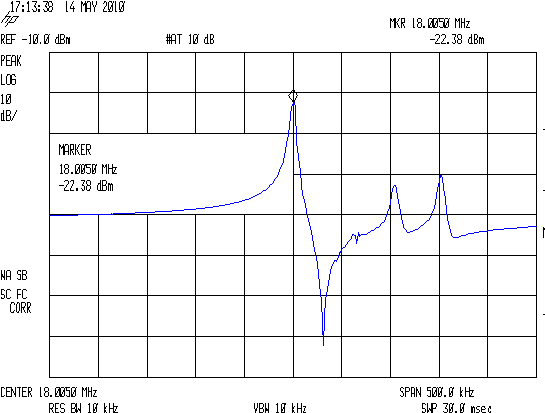
The center frequency is 18.0050 MHz (at this rather broad span) and it has some ugly spurs out there to the right.
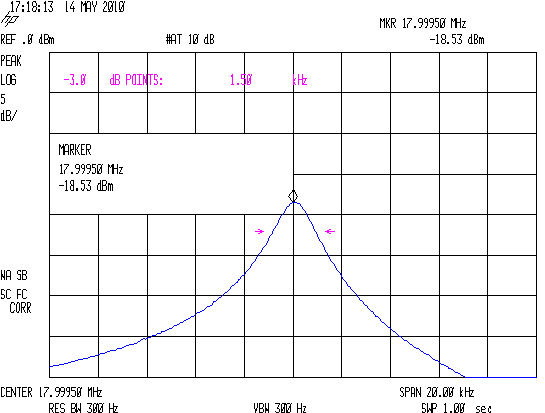
A closeup of the series-resonant peak:
HCI-1800 18 MHz – Baseline BW
The bandwidth is 1.50 kHz at 17.99950 MHz at this span.
Naked HCI-1800 18.0 MHz Crystal
Then I applied a soldering iron around the seal and yanked the case off. I think that didn’t involve whacking the crystal with the case en passant, but I can’t be sure. In any event, it looks undamaged and seems to operate properly.
A pair of spring clips attach to the electrodes and hold the quartz disk in position. They’re just the cutest little things and quite unlike the other holders I’ve seen. I think the solder blobs fasten the spring ends together and don’t bond to the electrodes, but what do I know?
HCI-1800 Crystal Overview
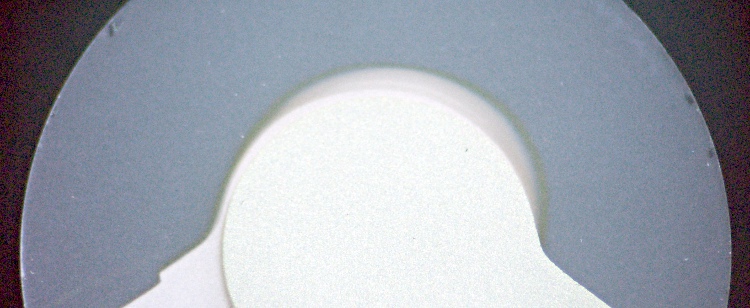
The quartz disk has a few small chips near the edge:
HCI-1800 Crystal Edge Chips
I think those are Inherent Vice… simply because:
They’re not in a position where I could have whacked the disk and
I doubt I could whack it that delicately
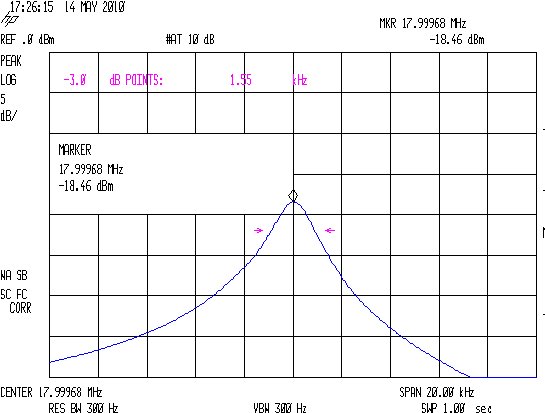
Anyhow, with the can off, here’s what the series resonant peak looks like:
HCI-1800 18 MHz – Opened BW
The resonant frequency is now 17.99968, 180 Hz higher, which may be due to instability in the HP8591 spectrum analyzer’s not-stabilized-for-ten-hours ovenized oscillator. The bandwidth is 1.55 kHz, 50 Hz wider, although I think that’s one resolution quantum of difference.
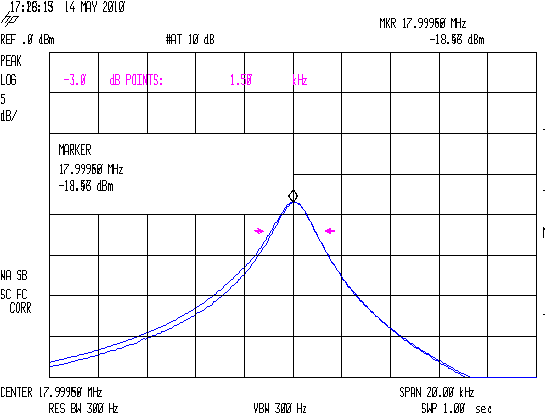
Here are the two bandwidth traces overlaid.
HCI-1800 18 MHz – Overlaid BW
The peak has been centered in both, so you can’t tell they’re slightly different. The interesting point is the difference in the slope to the low-frequency side of the peak, which is slightly higher for the open-case condition. Seeing as how the missing case completely changes the usual stray capacitance situation, I’m not surprised.
Anyhow, I admit to being surprised: there’s not that much difference after opening the case. I’ll put the naked crystal in a small container in a nominally safe place for a while, then retest it to see what’s happening.
Memo to Self: A “safe place” is nowhere near the Electronics Workbench!
Here are some other naked crystals:
Naked Crystals
Notice the tarnished (presumably) silver electrodes on the crystal in the lower left. That one’s been sitting on my monitor and in other hazardous locations for a few years. I can’t find these anywhere right now, but if they turn up I’ll test them, too.










 The Smell of Molten Projects in the Morning