One of our regular walks takes us up the hill on Old Sivermine Place and, being that type of guy, I tend to look at the infrastructure. The LED streetlights along the road sit atop wood poles and are obviously retrofits. Placards on some poles announce “277 V”, which means they’re fed from one leg of a three-phase 480 V wye service, making their casual mid-air wire-nut spliced connections seem … inappropriate.
Anyhow, they’re supposed to look like this:

In reality, having multiple emitters comes in handy:

Typical 12 V systems have parallel strings of three LEDs in series, so you (well, I) often see automobiles with three adjacent dead LEDs. That turned out to be true with the 15 V (-ish) LEDs in the HQ Sixteen machine I’ve been refurbishing.
These streetlights apparently have individual LED drivers, allowing single LEDs to go dark without affecting the rest. This one has five deaders, so the rot is spreading:
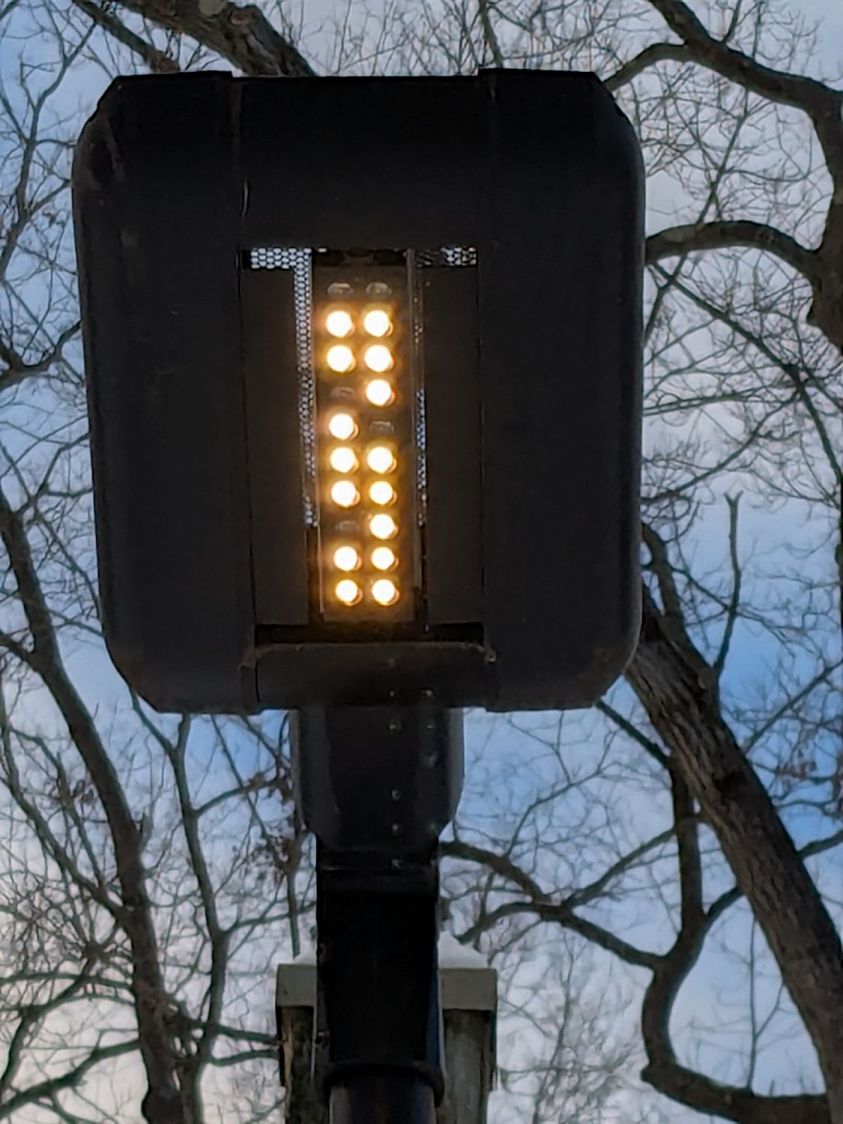
There seems no pattern to the failures:

Those fixtures are in order from the top of the hill downward.
Each light has its own photosensor to decide when to turn on. We don’t go walking after dusk, but at least one light will always be glowing brightly in middday; the sensors aren’t doing well, either.
 The Smell of Molten Projects in the Morning
Comments
4 responses to “Old Silvermine Place: LED Streetlights”
The promise of long-life LEDs is unevenly fulfilled.
I have examples that amaze me. The Aukee “H7 LED Headlight Bulb, Aukee 110W High Power 18,000LM Extremely Bright 6000K” retina burners in the high beams (low beams are factory halogens, I’m not a jerk — at least not in that way) of our van put out more light from a smaller device than seems theoretically possible. The ~100x 8″ long super bright, super white SAD busting tubes that light up the shop, with only one failure while approaching a decade of 10 hours / day operation..
Others dismay: of the 24x 4′ tubes that light the low-duty cycle barn, something like 2/3 failed after only a couple years.
Heat is the killer – closely linked to derating and the driving method. I suppose moisture intrusion in the street lights might be an issue,
I overbought the LED tubes for the basement in the expectation they’d start failing in a few years and I could just pop in replacements. So far, so good: no failures in the first year.
tangentially related, do you know of this?
https://www.scientificamerican.com/article/streetlights-are-mysteriously-turning-purple-heres-why/
I want to believe this, like the capacitor plague, are reflections of industrial espionage. Definitely the dystopian cyberpunk future I was promised growing up.
oh, this is the link I meant to use:
https://yieldpro.com/2023/08/the-great-purpling/