Starting with a box of cheap LEDs from halfway around the planet:

Measuring the forward voltages didn’t take much effort:

The top array fed the LEDs from a bench power supply through a 470 Ω resistor, with the voltage adjusted to make the current come out right. The bottom array came from the Siglent SDM3045 multimeter’s diode test function, which goes up to 4 V while applying about 400 µA to the diode (the 20 µA header is wrong).
These numbers come into play when blinking an LED from a battery, because a battery voltage much below the Vf value won’t produce much light. It’s a happy coincidence that a single lithium cell can light a white or blue LED …
For comparison, the forward voltages from another batch of LEDs:
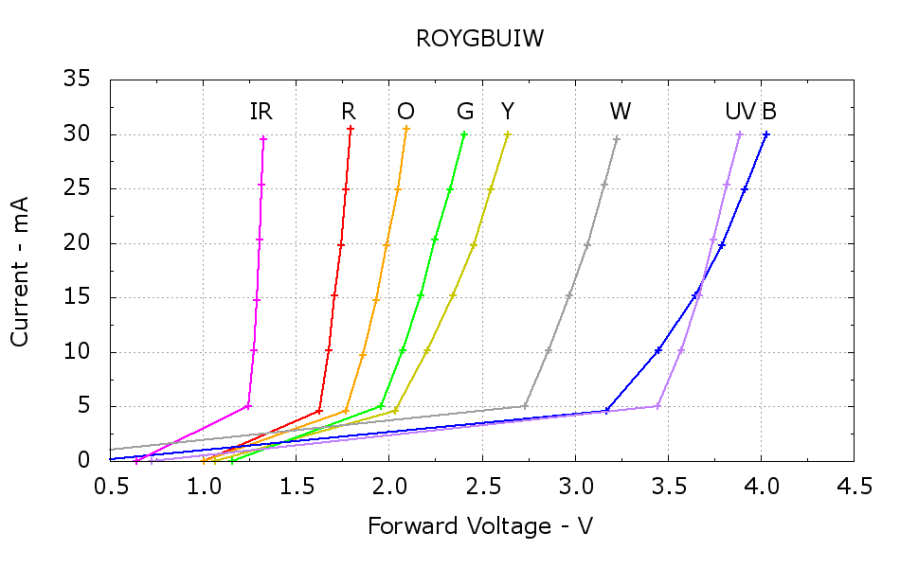
Those all look a bit higher at 20 mA, but everything about the measurements is different, so who knows?
 The Smell of Molten Projects in the Morning
Comments
8 responses to “Cheap LED Assortment: Forward Voltage”
I was disturbed to see the Vfd in the first tables so constant. I did that experiment myself once and thought I saw spreads more like the ones you showed in the graph. I seemed to be able do break that out as diode_drop + resistive_drop + electron_volts_per_quantum. What’s going on with LEDs these days?
My clue stash emptied right out when I saw a set of variously colored LEDs with identical forward voltages. Apparently, they had blue (UV?) LEDs driving phosphor (or whatever) layers, not “real” LEDs with bandgap-based colors. Not what I expected, at all!
So, blue-white LEDs behind (effectively) coloured gels? That’s one way of doing it.
Someone who might have a good answer is pcboard.ca: John’s good people, and designs and imports all manner of LEDs and drivers. He definitely knows which way the magic smoke blows when it comes to Vf.
I thought they were directly stimulated phosphors, but you’re probably right: transmigrating blue → white-ish → whatever would account for weird colors like “pink” and “emerald” outside the usual spectrum.
Maybe what we see in the tables is the result of hordes of electrons passing through the device without producing any light at all, and not paying the ev/q toll. Call them low-efficiency LEDs?
[…] been using not-dead-yet lithium batteries to power astable multivibrators blinking LEDs on the red-to-yellow end of the spectrum, because the over-discharge protection circuitry in the batteries shuts down at 2.5 V, while not […]
[…] the supply in order to put 2.0 V across the LED, which accounts for the relatively low current; the green LED has a forward drop of about 2.2 V at 20 mA and 1.9 V at µA-level […]
[…] blue LED has a forward drop of 2.97 V at 20 mA, so I’m surprised the voltage across it hits 3.1 V at 25 […]