Topics for today’s Squidwrench Electronics Workshop: Session 5 in a continuing series.
Having discussed transistors as current-controlled current sources, we can now select one as a victim use one as a switch, then add capacitors to learn about exponential charging, and introduce the oscilloscope as a vital tool.

So, we proceed:
Transistors as switches
Review graphical parameters
- saturation voltage for high Ic
- cutoff voltage for near-zero Ic
- resistive load line: VR = Vcc – Vc
- power dissipation hyperbola (at all Vc)
- secondary breakdown limit (at higher Vc)
Something like this, only drawn much larger and with actual numbers:

Reminder of linear vs. log scales converting hyperbolas into straight lines.
NPN transistor as “to ground” switch
- where to measure device voltages?
- passing mention of flyback diodes
- IB needed for saturation?
- Darlington transistors: beta multiplier, VBE adder
For example:
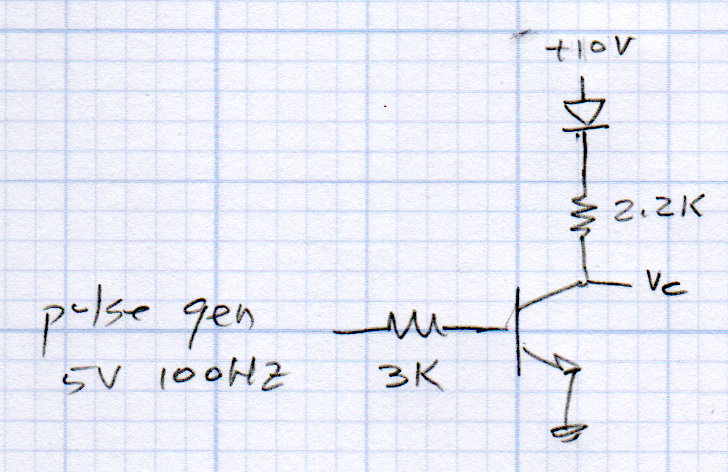
Without the LED, you get nice square waves:

An ancient green LED reduces Vc by a little over a volt:

Discuss PNP transistor as “from supply” switch
- why VCC must not exceed controller VDD
- kill microcontroller and logic gates
Wire up pulse gen to transistor
- function generator for base drive voltage
- collector resistor (then LED) as output
- how do you know what it’s doing?
- add oscilloscope to show voltages
- explanation of scope functions!
Capacitor as charge-storage devices
Useful ideas and equations
- C = Q/V
- so C = ΔQ/ΔV
- therefore i = C * Δv/Δt
- energy = 1/2 * C * V²
Charging capacitor from a voltage source through a resistor
- Exponential waveform: e^t/τ
- time constant τ=RC
- show 3τ = 5%
- and 5τ < 1%
Add cap to transistor switch with R to soften discharge path
- charge vs discharge paths
- calculate time constants
- wire it up
- verify with oscilloscope
The circuit will look like this:
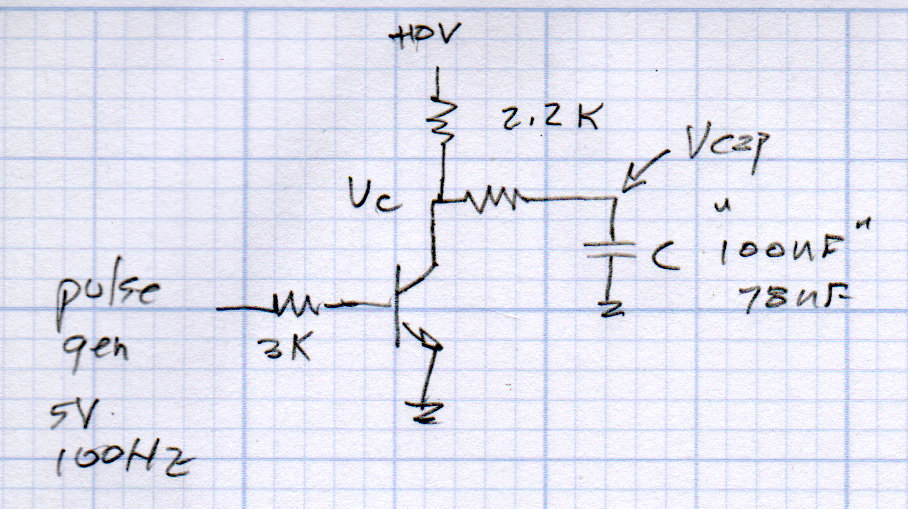
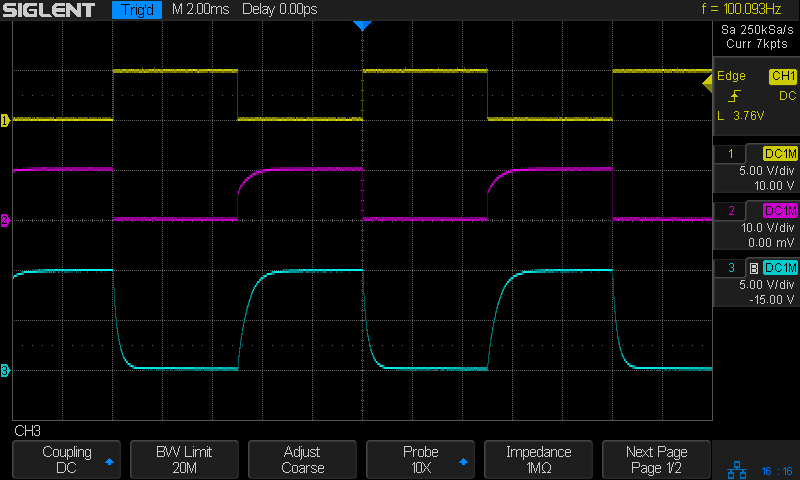
Discussion of parts tolerance: 100 nF caps are really 78 nF
With one cap:
Add another cap for twice the time constant:
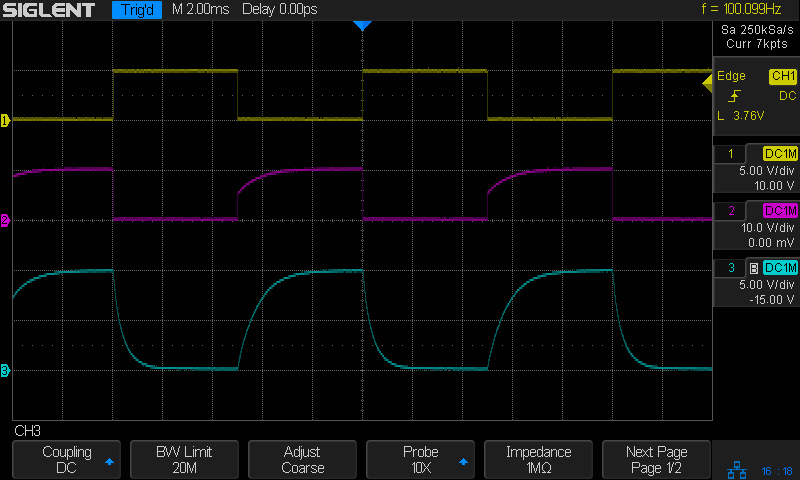
Let the scope calculate 10-90% rise time:
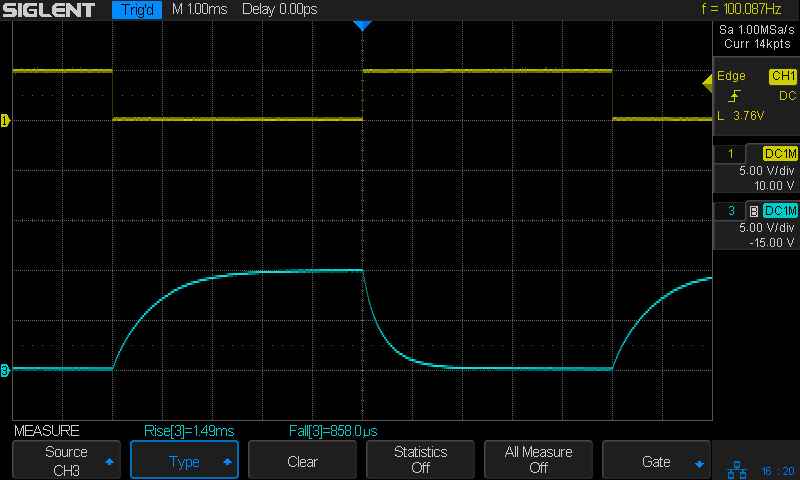
Useful relations:
- rise time = 2.2 τ (compare with calculations!)
- rise time = 0.34/BW
Do it on hard mode with the old Tek scope for pedagogic purposes.
That should soak up the better part of four hours!
 The Smell of Molten Projects in the Morning
Comments
2 responses to “Squidwrench Electronics Workshop: Session 5”
Another nice lesson, Ed.
Your NPN demo circuit reminds me of something similar I ran across in real life just yesterday. This was in the app note for a fluid flow sensor. That sensor has an open-collector pulse train output. Their app note suggests pulling up through 4.7K ohms, and connecting a 100 nF capacitor to ground for “noise reduction”. But they neglected to add a discharge current limiting resistor in series with the capacitor. Methinks that when the cap charges to, say, 5 volts and then is shorted to ground, Big Current Will Flow. This will happen a couple of hundred times per second. Can’t be good for the reliability of the output device, IMHO.
So your students can thank you for teaching them some very useful information that has real-world applicability.
My plan was way off; we didn’t finish the transistor “lab” until just before quitting time and doing the capacitor show-n-tell ran into overtime. So I’ll hack the caps off and run ’em as the next session, along with a better oscilloscope intro.
Thanks for the good words!