The Sandisk Extreme Pro 64 GB MicroSDXC (whew) card in the Sony HDR-AS30V had been working fine, but recently the camera crashed in mid-ride after spitting out an unreadable video file. I reformatting the card, which seemed to restore its good humor, and preemptively dropped $36 on a fancy Sandisk High Endurance Video Monitoring Card from a Nominally Reputable Amazon seller:
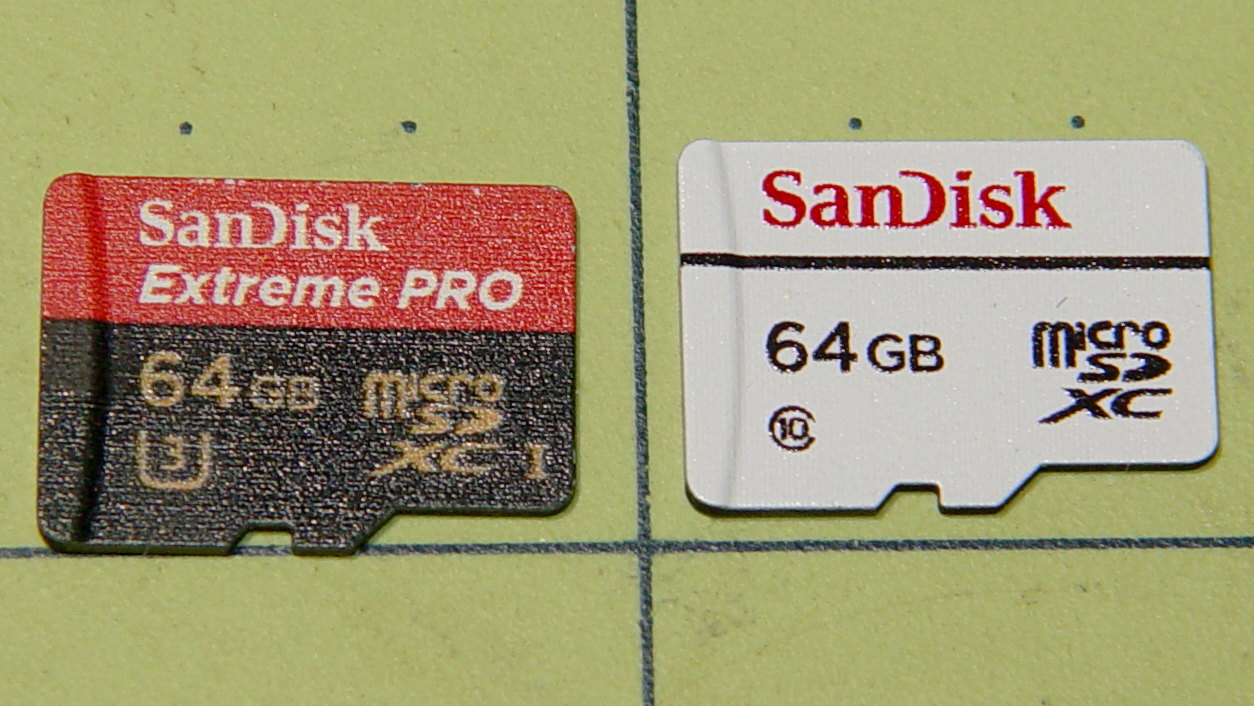
The package & card production values seem high enough to make me think it’s genuine, despite the white-label thing SanDisk has goin’ on; it matches their website pix closely enough.
Popping it into a USB 3.0 adapter, plugging that into the new-to-me Dell Optiplex 9010’s front-panel USB 3.0 port, and unleashing f3probe produced encouraging results:
sudo f3probe -t /dev/sde
[sudo] password for ed:
F3 probe 6.0
Copyright (C) 2010 Digirati Internet LTDA.
This is free software; see the source for copying conditions.

WARNING: Probing normally takes from a few seconds to 15 minutes, but
         it can take longer. Please be patient.

Probe finished, recovering blocks... Done

Good news: The device `/dev/sde' is the real thing

Device geometry:
	         *Usable* size: 59.48 GB (124735488 blocks)
	        Announced size: 59.48 GB (124735488 blocks)
	                Module: 64.00 GB (2^36 Bytes)
	Approximate cache size: 0.00 Byte (0 blocks), need-reset=no
	   Physical block size: 512.00 Byte (2^9 Bytes)

Probe time: 4'26"
 Operation: total time / count = avg time
      Read: 2'42" / 4197135 = 38us
     Write: 1'41" / 4192321 = 24us
     Reset: 1.00s / 1 = 1.00s
Just for completeness, I unleashed f3write to fill it with pseudorandom data:
time f3write /mnt/part
Free space: 59.46 GB
Creating file 1.h2w ... OK!
Creating file 2.h2w ... OK!
… snippage …
Creating file 59.h2w ... OK!
Creating file 60.h2w ... 99.99% -- 5.40 MB/s -- 1sf3write: Write to file /mnt/part/60.h2w failed: Input/output error

real	180m36.861s
user	0m40.520s
sys	6m44.024s
Dividing 64 GB by 180 minutes says the write speed works out to 5.9 MB/s, about a third of the “up to 20 MB/s” in the card’s specs. Huh.
Reading & comparing the data goes faster:
time f3read /mnt/part
                  SECTORS      ok/corrupted/changed/overwritten
Validating file 1.h2w ... 2097152/        0/      0/      0
Validating file 2.h2w ... 2097152/        0/      0/      0
… snippage …
Validating file 59.h2w ... 2097152/        0/      0/      0
Validating file 60.h2w ...  965376/        0/      0/      0

  Data OK: 59.46 GB (124697344 sectors)
Data LOST: 0.00 Byte (0 sectors)
	       Corrupted: 0.00 Byte (0 sectors)
	Slightly changed: 0.00 Byte (0 sectors)
	     Overwritten: 0.00 Byte (0 sectors)
Average reading speed: 23.87 MB/s

real	42m31.288s
user	0m47.444s
sys	0m30.232s
So it reads lickety-split, but writes much more slowly. Fortunately, the HDR-AS30 camera pops out a 4 GB file every 22.75 minute = 2.9 MB/s, so the card has a smidge of headroom while writing.
The specs claim “up to 10,000 hours” of Full HD recording. If so, I’m looking at a card good for “up to 40 years“ of riding at 1 hour/ride and 250 ride/year. For 36 bucks, how can ya go wrong?
I’ll take it for a few rides to see what happens …
The packaging includes a link to a Windows / Mac data recovery program, plus the serial number required to activate the download. I’ll continue to eke out a miserable existence with ordinary Linux disk / file maintenance tools, as I’m no longer enthused about “free” programs requiring secret handshakes for activation on a single computer with an OS I no longer use, particularly a program that auto-pumpkinates after a year:
Please fill in the data accurately as this information will be needed to reactivate the software if you ever need to move the software to a different computer.
Your expectations & preconceptions may vary.
 The Smell of Molten Projects in the Morning
Comments
5 responses to “Sandisk 64 GB High Endurance Video Monitoring Card: Verification”
I am not surprised that the write speed came in low. Meeting the speed class rating requires specific conditions including writing in RU (Recording Unit) sized chunks. While the table of RU size is missing from copy of the Simplified SD Specification that I have, it is 512KB for SDHC cards. I recommend reading the specification which added a lot of information on speed class last year.
That makes perfect sense, although it’s unlikely I can ram big chunks through the stack of software between (say)
ddin a terminal window and the far side of the USB adapter: there’s nothing like software as an experimental science![…] Sandisk Extreme Pro 64 GB MicroSD card in the Sony HDR-AS30V died on the road once more, got reformatted, worked OK for a while, then kicked out catastrophic I/O errors after being […]
[…] set the Sony HDR-AS30V atop a tripod, told it to take photos at 5 second intervals, then stitched the images into a […]
[…] the card using f3probe produced the same results as with the earlier 64 GB card and copying the existing files from the Fly6 card (on the left) went […]