Ed Nisley's Blog: Shop notes, electronics, firmware, machinery, 3D printing, laser cuttery, and curiosities. Contents: 100% human thinking, 0% AI slop.
So: jouncing over the larg(er) potholes / pavement discontinuities / debris on the roads around here wobbulates the front fender enough to pull the stays out of those tidy 18 mm = 6 diameter deep sockets on the fender clip.
Waving a heat gun around a 3D printed part seems fraught with peril, even with PETG’s glass transition temperature around 80 °C = 175 °F, as ordinary polyolefin tubing shrinks at 140-ish °C. Aiming the hot air stream more-or-less away from the clip (and the tire!) carried the day. PLA would surely have gotten bendy.
The proper solution surely involves screw clamps and suchlike. I really dislike fiddly hardware: I hope this hack survives.
The small garage door opener I tote around in the Tour Easy’s underseat bag failed after many years of exposure to the elements, so I paid a few bucks more for a cheap replacement in order to get fast delivery from a (US!) eBay supplier:
Garage door opener remote controls
For whatever it’s worth, before buying the replacement I tried:
Cleaning the battery contacts
Installing a new CR2032 battery
Programming the hitherto-unused buttons to open the door
The remote control would occasionally work, but none of the “repairs” made much difference; I suspect corrosion hidden under the components or cracked solder joints.
The eBay item description clearly, if inarticulately, specifies the compatibility requirement:
key chain remote control
compatible for purple learn button
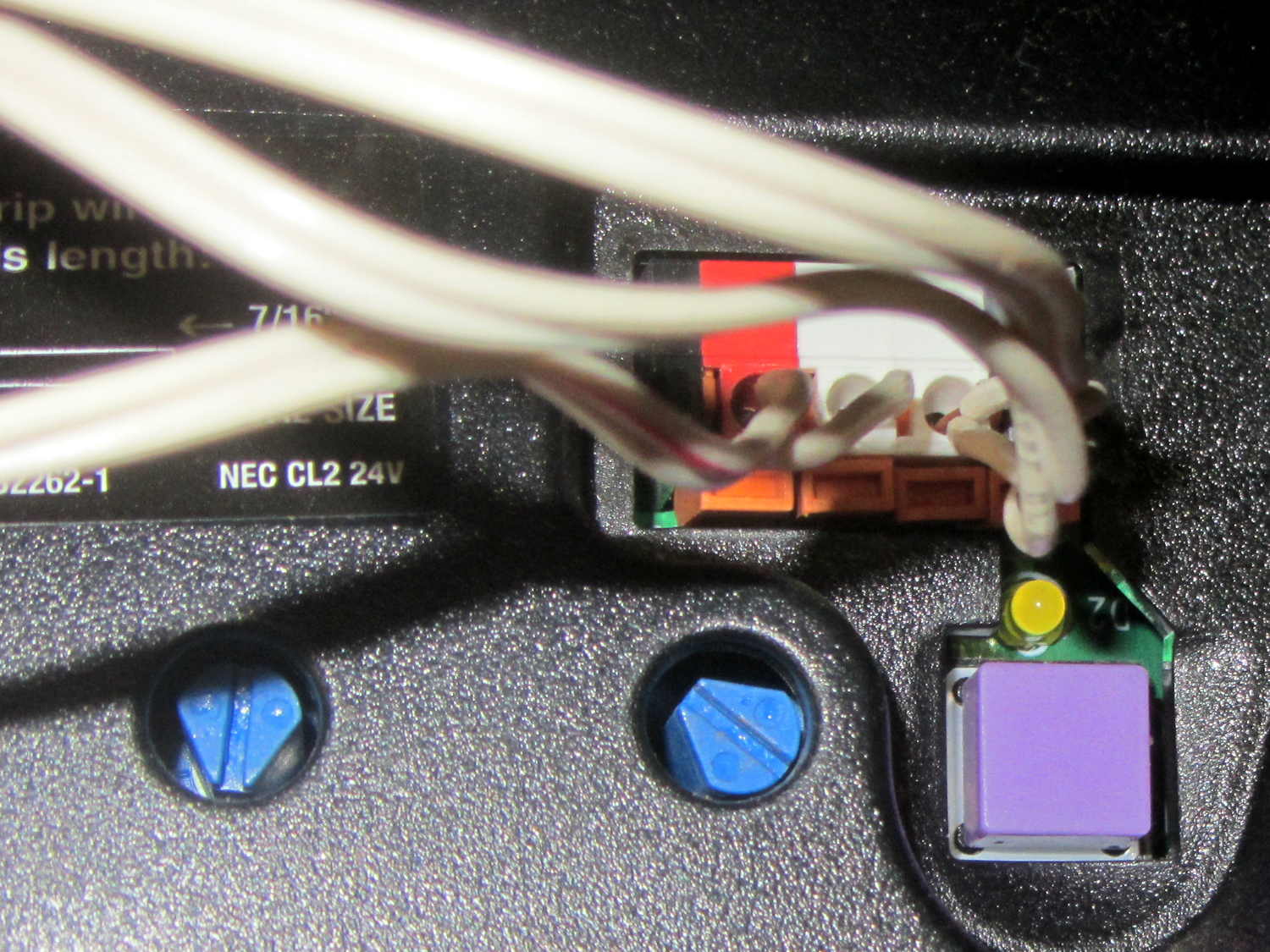
So I trotted out to the garage and inspected the button:
Sears Garage Door Opener – purple button
Looks purple to me, but, being that type of guy, I also read the adjacent instruction sticker:
Sears Garage Door Opener – instructions
Nobody, nobody, maintains the documentation. [sigh]
I figured if they went to all the trouble of ordering a bazillion switches with purple caps, then the PCB surely holds the corresponding RF filters & firmware & whatever else that button signifies.
Seeing as how we have exactly one garage door opener and no lights or other doodads, I told the opener to obey both the 1 and 2 buttons, thereby dramatically reducing the dexterity required to open the door while pedaling up the driveway. The opener can remember an unspecified number of transmitters, so I didn’t go for all four buttons.
Those wearable LEDs spent the last five months sitting on the kitchen window sash, quietly discharging their CR2032 lithium cells:
Wearable LED with CR2023 cell
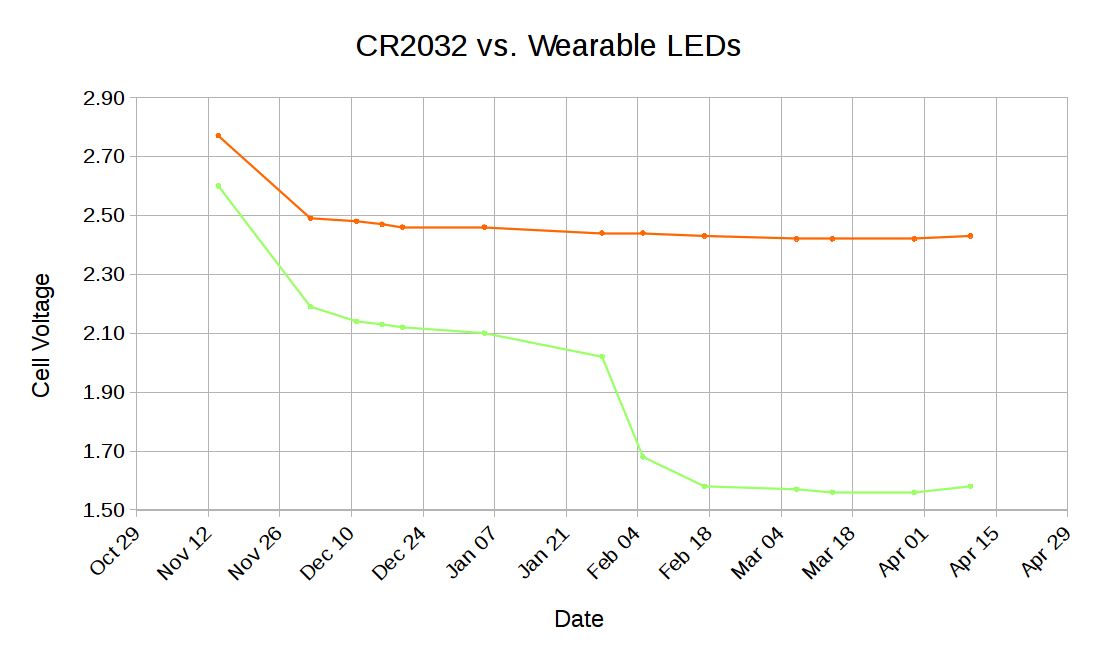
Occasional voltage measurements produced an interesting graph:
CR2032 vs Wearable LEDs
CR2023 primary lithium cells start out around 3.3 V, so these were pretty much dead (from their previous lives in dataloggers) when I slipped them into their holders. The LEDs seem to be blue LEDs, with threshold voltages around 3.6 V, with colored phosphors / filters, so they started out dim and got dimmer. The green(-ish) LED obviously fell over a cliff and went dark in late January; I have no way to measure long-term microamp currents, alas.
The reddish LED is still going, mmm, strong.
If you need a rather dim light for a surprisingly long time, these things will do the trick.





 The Smell of Molten Projects in the Morning